

From AI "Disabling" to "Enabling": An Empirical Study on Digital-Intelligent Learning among Students Majoring in Smart Agriculture


Article Information
Abstract
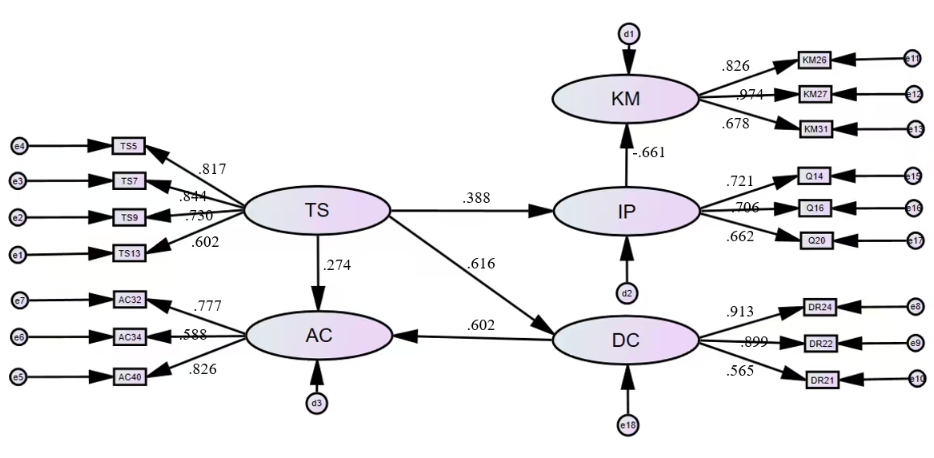
Against the backdrop of deep AI-agriculture integration, smart agriculture has become a key direction for agricultural modernization, demanding higher digital-intelligent learning competence from university students. As a core competency for leveraging AI to engage in agricultural information technology learning and solve practical problems, the mechanisms underlying its formation remain underexplored. This study targets undergraduate and graduate students in smart agriculture-related majors, constructing a theoretical model based on the dual dimensions of external technological characteristics and internal learning processes. It systematically investigates how key factors—including the technological suitability of large language models (LLMs), users' information-processing capability, and their capacity to regulate LLM dependence—influence the formation of digital-intelligent learning competence. Based on 166 valid questionnaire responses, reliability and validity tests and factor analysis were conducted in SPSS, and Structural Equation Modeling (SEM) was performed in Amos. Results indicate that LLM technological suitability and learners' information-processing capability exert significant positive effects on digital-intelligent learning competence, while dependence-regulation capability serves as an important mediating variable. Further analysis reveals that LLMs do not directly enhance learning competence merely by improving efficiency; their enabling effect depends on learners' rational regulation of model usage and deep information processing. These findings uncover the critical pathways underlying the formation of digital-intelligent learning competence, providing theoretical foundations and practical guidance for universities to optimize talent cultivation models and enhance students' digital-intelligent learning competence.
Graphical Abstract
Keywords
Data Availability Statement
Funding
Conflicts of Interest
AI Use Statement
Ethical Approval and Consent to Participate
References
- Kasneci, E., Seßler, K., Küchemann, S., Bannert, M., Dementieva, D., Fischer, F., ... & Kasneci, G. (2023). ChatGPT for good? On opportunities and challenges of large language models for education. Learning and individual differences, 103, 102274.
[CrossRef] [Google Scholar] - Zhai, C., Wibowo, S., & Li, L. D. (2024). The effects of over-reliance on AI dialogue systems on students' cognitive abilities: a systematic review. Smart learning environments, 11(1), 28.
[CrossRef] [Google Scholar] - Gerlich, M. (2025). AI tools in society: Impacts on cognitive offloading and the future of critical thinking. Societies, 15(1), 6.
[CrossRef] [Google Scholar] - Lan, M., & Zhou, X. (2025). A qualitative systematic review on AI empowered self-regulated learning in higher education. npj Science of Learning, 10(1), 21.
[CrossRef] [Google Scholar] - Ji, Z., Lee, N., Frieske, R., Yu, T., Su, D., Xu, Y., Ishii, E., Bang, Y. J., Madotto, A., & Fung, P. (2023). Survey of Hallucination in Natural Language Generation. ACM Computing Surveys, 55(12), 1–38.
[CrossRef] [Google Scholar] - Ouyang, F., & Jiao, P. (2021). Artificial intelligence in education: The three paradigms. Computers and Education: Artificial Intelligence, 2, 100020.
[CrossRef] [Google Scholar] - Holmes, W., & Miao, F. (2023). Guidance for generative AI in education and research. UNESCO Publishing. https://discovery.ucl.ac.uk/id/eprint/10176438/
[Google Scholar] - Zawacki-Richter, O., Marín, V. I., Bond, M., & Gouverneur, F. (2019). Systematic review of research on artificial intelligence applications in higher education–where are the educators?. International journal of educational technology in higher education, 16(1), 39.
[CrossRef] [Google Scholar] - Holmes, W., Bialik, M., & Fadel, C. (2019). Artificial intelligence in education: Promises and implications for teaching and learning. Center for Curriculum Redesign. https://discovery.ucl.ac.uk/id/eprint/10139722/
[Google Scholar] - Ward, A. F., Duke, K., Gneezy, A., & Bos, M. W. (2017). Brain drain: The mere presence of one's own smartphone reduces available cognitive capacity. Journal of the association for consumer research, 2(2), 140-154.
[CrossRef] [Google Scholar] - Bastani, H., Bastani, O., Sungu, A., Ge, H., Kabakcı, Ö., & Mariman, R. (2024). Generative AI can harm learning. The Wharton School Research Paper. https://dx.doi.org/10.1073/pnas.2422633122
[Google Scholar] - Panadero, E. (2017). A review of self-regulated learning: Six models and four directions for research. Frontiers in psychology, 8, 422.
[CrossRef] [Google Scholar] - Mehmood, A., Kausar, R., Mubarak, S., & Ullah, A. (2026). Artificial Intelligence, Self-Regulated Learning, and Academic Achievement: A Structural Equation Modeling Approach in Higher Education. Research Consortium Archive, 4(2), 2969-2981.
[CrossRef] [Google Scholar] - Meng, N., Dhimolea, T. K., & Ali, Z. (2022). AI-enhanced education: Teaching and learning reimagined. In Bridging human intelligence and artificial intelligence (pp. 107-124). Cham: Springer International Publishing.
[CrossRef] [Google Scholar] - Davis, F. D. (1989). Perceived usefulness, perceived ease of use, and user acceptance of information technology. MIS quarterly, 13(3), 319-340.
[CrossRef] [Google Scholar] - Goodhue, D. L., & Thompson, R. L. (1995). Task-technology fit and individual performance. MIS quarterly, 19(2), 213-236.
[CrossRef] [Google Scholar] - Sweller, J. (1988). Cognitive load during problem solving: Effects on learning. Cognitive science, 12(2), 257-285.
[CrossRef] [Google Scholar] - Risko, E. F., & Gilbert, S. J. (2016). Cognitive offloading. Trends in cognitive sciences, 20(9), 676-688.
[CrossRef] [Google Scholar] - Zimmerman, B. J. (2002). Becoming a self-regulated learner: An overview. Theory into practice, 41(2), 64-70.
[CrossRef] [Google Scholar] - Winters, F. I., Greene, J. A., & Costich, C. M. (2008). Self-regulation of learning within computer-based learning environments: A critical analysis. Educational psychology review, 20(4), 429-444.
[CrossRef] [Google Scholar] - Al-Emran, M., Al-Sharafi, M. A., Foroughi, B., Al-Qaysi, N., Mansoor, D., Beheshti, A., & Ali, N. A. (2025). Evaluating the influence of generative AI on students' academic performance through the lenses of TPB and TTF using a hybrid SEM-ANN approach. Education and Information Technologies, 30(12), 17557-17587.
[CrossRef] [Google Scholar] - Bawa, R., Jain, K., & Goel, P. (2026). Generative AI adoption in universities: how TAM–TTF and neuroticism influence sustained usage. Interactive Technology and Smart Education, 23(2), 266-297.
[CrossRef] [Google Scholar] - Bećirović, S., Polz, E., & Tinkel, I. (2025). Exploring students' AI literacy and its effects on their AI output quality, self-efficacy, and academic performance. Smart Learning Environments, 12(1), 29.
[CrossRef] [Google Scholar] - Wu, X. Y. (2024). Exploring the effects of digital technology on deep learning: a meta-analysis. Education and Information Technologies, 29(1), 425-458.
[CrossRef] [Google Scholar] - Grinschgl, S., Papenmeier, F., & Meyerhoff, H. S. (2021). Consequences of cognitive offloading: Boosting performance but diminishing memory. Quarterly Journal of Experimental Psychology, 74(9), 1477-1496.
[CrossRef] [Google Scholar] - Bearman, M., Tai, J., Dawson, P., Boud, D., & Ajjawi, R. (2024). Developing evaluative judgement for a time of generative artificial intelligence. Assessment & Evaluation in Higher Education, 49(6), 893-905.
[CrossRef] [Google Scholar] - Braithwaite, D. W., & Sprague, L. (2021). Conceptual knowledge, procedural knowledge, and metacognition in routine and nonroutine problem solving. Cognitive Science, 45(10), e13048.
[CrossRef] [Google Scholar] - Achuthan, K. (2025, December). Artificial intelligence and learner autonomy: a meta-analysis of self-regulated and self-directed learning. In Frontiers in Education (Vol. 10, p. 1738751). Frontiers Media SA.
[CrossRef] [Google Scholar] - Hair, J. F., Black, W. C., Babin, B. J., & Anderson, R. E. (2019). Multivariate data analysis (8th ed.). Cengage Learning. https://openlibrary.telkomuniversity.ac.id/home/catalog/id/165894/slug/multivariate-data-analysis-8-e.html
[Google Scholar] - Fornell, C., & Larcker, D. F. (1981). Evaluating structural equation models with unobservable variables and measurement error. Journal of marketing research, 18(1), 39-50.
[CrossRef] [Google Scholar]
Cite This Article
TY  - JOUR
AU  - He, Chen
AU  - Yi, Wenlong
AU  - Yin, Hua
AU  - Zhao, Wei
PY  - 2026
DA  - 2026/07/24
TI  - From AI "Disabling" to "Enabling": An Empirical Study on Digital-Intelligent Learning among Students Majoring in Smart Agriculture
JO  - Journal of Digital Intelligence in Education
T2  - Journal of Digital Intelligence in Education
JF  - Journal of Digital Intelligence in Education
VL  - 1
IS  - 1
SP  - 17
EP  - 30
DO  - 10.62762/JDIE.2026.651948
UR  - https://www.icck.org/article/abs/JDIE.2026.651948
KW  - smart agriculture
KW  - digital-intelligent learning
KW  - large language models
KW  - structural equation modeling
AB  - Against the backdrop of deep AI-agriculture integration, smart agriculture has become a key direction for agricultural modernization, demanding higher digital-intelligent learning competence from university students. As a core competency for leveraging AI to engage in agricultural information technology learning and solve practical problems, the mechanisms underlying its formation remain underexplored. This study targets undergraduate and graduate students in smart agriculture-related majors, constructing a theoretical model based on the dual dimensions of external technological characteristics and internal learning processes. It systematically investigates how key factors—including the technological suitability of large language models (LLMs), users' information-processing capability, and their capacity to regulate LLM dependence—influence the formation of digital-intelligent learning competence. Based on 166 valid questionnaire responses, reliability and validity tests and factor analysis were conducted in SPSS, and Structural Equation Modeling (SEM) was performed in Amos. Results indicate that LLM technological suitability and learners' information-processing capability exert significant positive effects on digital-intelligent learning competence, while dependence-regulation capability serves as an important mediating variable. Further analysis reveals that LLMs do not directly enhance learning competence merely by improving efficiency; their enabling effect depends on learners' rational regulation of model usage and deep information processing. These findings uncover the critical pathways underlying the formation of digital-intelligent learning competence, providing theoretical foundations and practical guidance for universities to optimize talent cultivation models and enhance students' digital-intelligent learning competence.
SN  - pending
PB  - Institute of Central Computation and Knowledge
LA  - English
ER  -
@article{He2026From,
  author = {Chen He and Wenlong Yi and Hua Yin and Wei Zhao},
  title = {From AI "Disabling" to "Enabling": An Empirical Study on Digital-Intelligent Learning among Students Majoring in Smart Agriculture},
  journal = {Journal of Digital Intelligence in Education},
  year = {2026},
  volume = {1},
  number = {1},
  pages = {17-30},
  doi = {10.62762/JDIE.2026.651948},
  url = {https://www.icck.org/article/abs/JDIE.2026.651948},
  abstract = {Against the backdrop of deep AI-agriculture integration, smart agriculture has become a key direction for agricultural modernization, demanding higher digital-intelligent learning competence from university students. As a core competency for leveraging AI to engage in agricultural information technology learning and solve practical problems, the mechanisms underlying its formation remain underexplored. This study targets undergraduate and graduate students in smart agriculture-related majors, constructing a theoretical model based on the dual dimensions of external technological characteristics and internal learning processes. It systematically investigates how key factors—including the technological suitability of large language models (LLMs), users' information-processing capability, and their capacity to regulate LLM dependence—influence the formation of digital-intelligent learning competence. Based on 166 valid questionnaire responses, reliability and validity tests and factor analysis were conducted in SPSS, and Structural Equation Modeling (SEM) was performed in Amos. Results indicate that LLM technological suitability and learners' information-processing capability exert significant positive effects on digital-intelligent learning competence, while dependence-regulation capability serves as an important mediating variable. Further analysis reveals that LLMs do not directly enhance learning competence merely by improving efficiency; their enabling effect depends on learners' rational regulation of model usage and deep information processing. These findings uncover the critical pathways underlying the formation of digital-intelligent learning competence, providing theoretical foundations and practical guidance for universities to optimize talent cultivation models and enhance students' digital-intelligent learning competence.},
  keywords = {smart agriculture, digital-intelligent learning, large language models, structural equation modeling},
  issn = {pending},
  publisher = {Institute of Central Computation and Knowledge}
}
Article Metrics
Publisher's Note
ICCK stays neutral with regard to jurisdictional claims in published maps and institutional affiliations.
Rights and Permissions
 Copyright © 2026 by the Author(s). Published by Institute of Central Computation and Knowledge. This article is an open access article distributed under the terms and conditions of the Creative Commons Attribution (CC BY) license (https://creativecommons.org/licenses/by/4.0/), which permits use, sharing, adaptation, distribution and reproduction in any medium or format, as long as you give appropriate credit to the original author(s) and the source, provide a link to the Creative Commons licence, and indicate if changes were made.


Portico
