
Design and Analysis of a GEO-to-GEO Microwave Inter-Satellite Link (ISL) for the Next-Generation Data Relay Satellite Constellation (NG-DRSC)




Article Information
Abstract
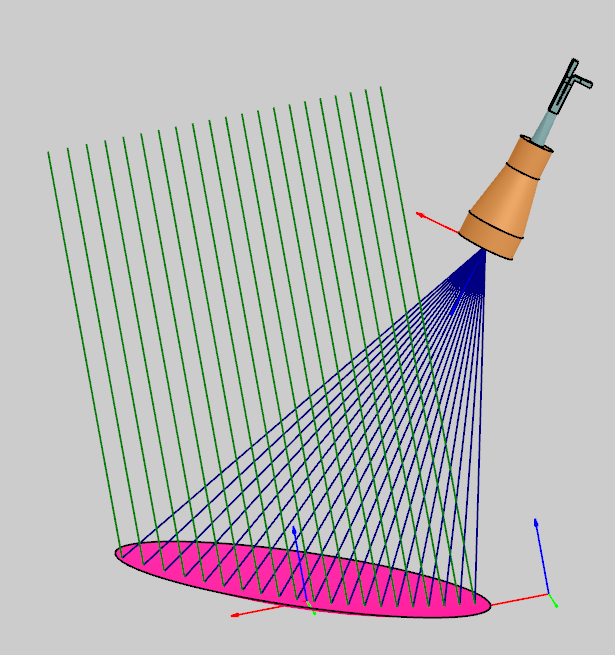
In this paper, the design and analysis of a GEO-to-GEO microwave inter-satellite link (ISL) for the next-generation data relay satellite constellation (NG-DRSC) are described. Closed-form relations are derived to determine the satellite antenna tilt and the spacecraft coordinate system for the ISL. A 300 mm diameter offset reflector antenna (antenna-2) on GEO satellite-2 (at 242.5$^\circ$E) transmits at Ka-band, and the signal is received by an identical 300 mm diameter offset reflector antenna (antenna-1) on GEO satellite-1 (at 42.5$^\circ$E). In this way, satellite-2 sends data over the ISL to satellite-1, which relays it to the hub station. A new method is used to compute the power received by antenna-1 on satellite-1 due to transmitting antenna-2 on satellite-2. The received power is better than $-110$~dBm within an angular beam cone of approximately $\pm1.5^\circ$. It is shown that the ISL is almost insensitive to satellite platform instability.
Graphical Abstract
Keywords
Data Availability Statement
Funding
Conflicts of Interest
AI Use Statement
Ethical Approval and Consent to Participate
References
- Roddy, D. (2001). Satellite Communications (3rd ed.). New York: McGraw-Hill. https://dokumen.pub/satellite-communications-3ed.html
[Google Scholar] - International Telecommunication Union. (2002). Handbook on Satellite Communications (3rd ed.). Geneva: ITU; New York: John Wiley & Sons. https://archive.org/details/handbookonsatell0000unse
[Google Scholar] - Ji, B., Han, J., Kim, D., Yun, J., & Joo, C. (2026). Inter-satellite link technologies and applications in Low Earth Orbit satellite networks. ICT Express, 12(3), 576-592.
[CrossRef] [Google Scholar] - Furqan, M., Ye, L., & Feng, Y. (2026). Geometric characterization of LEO-GEO inter-satellite links for bidirectional communications. International Journal of Satellite Communications and Networking. Advance online publication.
[CrossRef] [Google Scholar] - Amozegay, F., Kosari, A., & Labibian, A. (2025). Inter-satellite link optimization of two collocated geostationary satellites. IEEE Access, 13, 206825-206843.
[CrossRef] [Google Scholar] - Shatnawi, A. A., & Warip, M. N. M. (2016). Challenges to inter-satellite communication system: A review. International Journal of Computer Applications, 148(6), 22-25.
[CrossRef] [Google Scholar] - Teles, J., Samii, M. V., & Doll, C. E. (1995). Overview of TDRSS. Advances in Space Research, 16(12), 67-76.
[CrossRef] [Google Scholar] - Alimenti, F., Mezzanotte, P., Simoncini, G., Palazzi, V., Salvati, R., Cicioni, G., Roselli, L., Dogo, F., Pauletto, S., Fragiacomo, M., & Gregorio, A. (2020). A Ka-band receiver front-end with noise injection calibration circuit for CubeSats inter-satellite links. IEEE Access, 8, 106785-106798. https://dx.doi.org/10.1109/access.2020.3000675
[Google Scholar] - ITU-R. (2017). Frequency bands and transmission directions for data relay satellite networks/systems. Recommendation ITU-R SA.1019-1. Geneva: International Telecommunication Union. https://www.herculesebooks.com/index/ITU-R.PDF
[Google Scholar] - TICRA. (2026). TICRA Tools 26.0 user's manual. Copenhagen, Denmark. https://www.ticra.com/ticra-tools-26-0-is-released/
[Google Scholar]
Cite This Article
TY  - JOUR
AU  - Gupta, Ramesh Chandra
AU  - Singh, Vijay Kumar
AU  - Kulshreshtha, Sanjeev
PY  - 2026
DA  - 2026/11/22
TI  - Design and Analysis of a GEO-to-GEO Microwave Inter-Satellite Link (ISL) for the Next-Generation Data Relay Satellite Constellation (NG-DRSC)
JO  - ICCK Journal of Microwave and Antenna Engineering
T2  - ICCK Journal of Microwave and Antenna Engineering
JF  - ICCK Journal of Microwave and Antenna Engineering
VL  - 1
IS  - 1
SP  - 14
EP  - 20
DO  - 10.62762/JMAE.2026.155302
UR  - https://www.icck.org/article/abs/jmae.2026.155302
KW  - GEO-to-GEO communication link
KW  - inter-satellite link
KW  - data relay satellite
KW  - ISL reflector antenna
KW  - antenna coupling
AB  - In this paper, the design and analysis of a GEO-to-GEO microwave inter-satellite link (ISL) for the next-generation data relay satellite constellation (NG-DRSC) are described. Closed-form relations are derived to determine the satellite antenna tilt and the spacecraft coordinate system for the ISL. A 300 mm diameter offset reflector antenna (antenna-2) on GEO satellite-2 (at 242.5$^\circ$E) transmits at Ka-band, and the signal is received by an identical 300 mm diameter offset reflector antenna (antenna-1) on GEO satellite-1 (at 42.5$^\circ$E). In this way, satellite-2 sends data over the ISL to satellite-1, which relays it to the hub station. A new method is used to compute the power received by antenna-1 on satellite-1 due to transmitting antenna-2 on satellite-2. The received power is better than $-110$~dBm within an angular beam cone of approximately $\pm1.5^\circ$. It is shown that the ISL is almost insensitive to satellite platform instability.
SN  - request pending
PB  - Institute of Central Computation and Knowledge
LA  - English
ER  -
@article{Gupta2026Design,
  author = {Ramesh Chandra Gupta and Vijay Kumar Singh and Sanjeev Kulshreshtha},
  title = {Design and Analysis of a GEO-to-GEO Microwave Inter-Satellite Link (ISL) for the Next-Generation Data Relay Satellite Constellation (NG-DRSC)},
  journal = {ICCK Journal of Microwave and Antenna Engineering},
  year = {2026},
  volume = {1},
  number = {1},
  pages = {14-20},
  doi = {10.62762/JMAE.2026.155302},
  url = {https://www.icck.org/article/abs/jmae.2026.155302},
  abstract = {In this paper, the design and analysis of a GEO-to-GEO microwave inter-satellite link (ISL) for the next-generation data relay satellite constellation (NG-DRSC) are described. Closed-form relations are derived to determine the satellite antenna tilt and the spacecraft coordinate system for the ISL. A 300 mm diameter offset reflector antenna (antenna-2) on GEO satellite-2 (at 242.5\$^\circ\$E) transmits at Ka-band, and the signal is received by an identical 300 mm diameter offset reflector antenna (antenna-1) on GEO satellite-1 (at 42.5\$^\circ\$E). In this way, satellite-2 sends data over the ISL to satellite-1, which relays it to the hub station. A new method is used to compute the power received by antenna-1 on satellite-1 due to transmitting antenna-2 on satellite-2. The received power is better than \$-110\$~dBm within an angular beam cone of approximately \$\pm1.5^\circ\$. It is shown that the ISL is almost insensitive to satellite platform instability.},
  keywords = {GEO-to-GEO communication link, inter-satellite link, data relay satellite, ISL reflector antenna, antenna coupling},
  issn = {request pending},
  publisher = {Institute of Central Computation and Knowledge}
}
Article Metrics
Publisher's Note
ICCK stays neutral with regard to jurisdictional claims in published maps and institutional affiliations.
Rights and Permissions
 Copyright © 2026 by the Author(s). Published by Institute of Central Computation and Knowledge. This article is an open access article distributed under the terms and conditions of the Creative Commons Attribution (CC BY) license (https://creativecommons.org/licenses/by/4.0/), which permits use, sharing, adaptation, distribution and reproduction in any medium or format, as long as you give appropriate credit to the original author(s) and the source, provide a link to the Creative Commons licence, and indicate if changes were made.


Portico
