
Compact Meander Patch Antenna at 915 MHz for Medical Implant Application





Article Information
Abstract
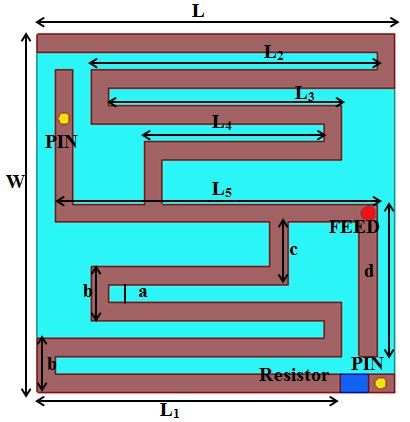
The present study introduces a small and efficient antenna designed specifically for medical implants. With the increasing demand for wireless and minimally invasive medical devices, there is a need for antennas that can reliably transmit and receive data within the human body. The antenna presented in this study functions within the Industrial, Scientific, and Medical (ISM) frequency band, meeting all necessary regulations with a size of 10×10×1.6 mm$^3$. FEM-based HFSS software has been used for simulation and using Roger 3010 substrate with relative permittivity of 10.2. We carefully selected materials and used optimization techniques to create a compact design without sacrificing performance. To overcome challenges from the body's dispersion and losses, we thoroughly evaluated the antenna's electromagnetic properties through simulations and tests. The results show outstanding performance in gain, radiation pattern, and impedance matching, making it ideal for various medical implant applications. Moreover, our design proves to be robust against detuning effects caused by tissue interactions, ensuring dependable communication within the target frequency range. By addressing the size and efficiency constraints of medical implant antennas, our work advances wireless biomedical devices, leading to improved healthcare monitoring and therapeutic solutions with enhanced patient comfort.
Graphical Abstract
Keywords
Data Availability Statement
Funding
Conflicts of Interest
Ethical Approval and Consent to Participate
References
- Nguyen, D., & Seo, C. (2021). An ultra-miniaturized antenna using loading circuit method for medical implant applications. IEEE Access, 9, 111890-111898.
[CrossRef] [Google Scholar] - Li, R., Guo, Y. X., Zhang, B., & Du, G. (2017). A miniaturized circularly polarized implantable annular-ring antenna. IEEE Antennas and Wireless Propagation Letters, 16, 2566-2569.
[CrossRef] [Google Scholar] - Xu, L. J., Guo, Y. X., & Wu, W. (2012). Dual-band implantable antenna with open-end slots on ground. IEEE Antennas and Wireless Propagation Letters, 11, 1564-1567.
[CrossRef] [Google Scholar] - Li, H., Guo, Y. X., & Xiao, S. Q. (2016). Broadband circularly polarised implantable antenna for biomedical applications. Electronics Letters, 52(7), 504-506.
[CrossRef] [Google Scholar] - Xu, L. J., Guo, Y. X., & Wu, W. (2015). Miniaturized circularly polarized loop antenna for biomedical applications. IEEE Transactions on Antennas and Propagation, 63(3), 922-930.
[CrossRef] [Google Scholar] - Balanis, C. A. (2016). Antenna theory: analysis and design. John wiley & sons.
[Google Scholar] - Handbook, M. A. D. (2001). Microstrip Antenna Design Handbook. R. Garg, P. Bhartia, I. Bahi, and A. Ittpiboon.
[Google Scholar] - Khan, A., Dubey, S. K., & Singh, A. K. (2024). Corner T-slot antenna at 2.45 GHz for hyperthermia application. Journal of Electromagnetic Waves and Applications, 38(4), 508-521.
[CrossRef] [Google Scholar] - Khan, A., Dubey, S. K., & Singh, A. K. (2025). Designed and development of 2.45 GHz cross-slot microstrip patch antenna for empowering hyperthermia treatments. Discover Electronics, 2(1), 45.
[CrossRef] [Google Scholar] - Khan, A., Dubey, S. K., & Singh, A. K. (2023). An elliptical‐shaped rectangular slot antenna at 2.48 GHz for hyperthermia application. Microwave and Optical Technology Letters, 65(8), 2425-2430.
[CrossRef] [Google Scholar] - IEEE Standards Coordinating Committee, 2. (1992). IEEE standard for safety levels with respect to human exposure to radio frequency electromagnetic fields, 3kHz to 300GHz. IEEE C95. 1-1991.
[Google Scholar]
Cite This Article
TY  - JOUR
AU  - Khan, Azharuddin
AU  - Singh, Amit Kumar
AU  - Mishra, Abhinav
AU  - Dubey, Rahul
PY  - 2026
DA  - 2026/01/15
TI  - Compact Meander Patch Antenna at 915 MHz for Medical Implant Application
JO  - ICCK Journal of Microwave and Antenna Engineering
T2  - ICCK Journal of Microwave and Antenna Engineering
JF  - ICCK Journal of Microwave and Antenna Engineering
VL  - 1
IS  - 1
SP  - 8
EP  - 13
DO  - 10.62762/JMAE.2025.367865
UR  - https://www.icck.org/article/abs/jmae.2025.367865
KW  - human body model
KW  - medical implant
KW  - specific absorption rate (SAR)
KW  - compact antenna
AB  - The present study introduces a small and efficient antenna designed specifically for medical implants. With the increasing demand for wireless and minimally invasive medical devices, there is a need for antennas that can reliably transmit and receive data within the human body. The antenna presented in this study functions within the Industrial, Scientific, and Medical (ISM) frequency band, meeting all necessary regulations with a size of 10×10×1.6 mm$^3$. FEM-based HFSS software has been used for simulation and using Roger 3010 substrate with relative permittivity of 10.2. We carefully selected materials and used optimization techniques to create a compact design without sacrificing performance. To overcome challenges from the body's dispersion and losses, we thoroughly evaluated the antenna's electromagnetic properties through simulations and tests. The results show outstanding performance in gain, radiation pattern, and impedance matching, making it ideal for various medical implant applications. Moreover, our design proves to be robust against detuning effects caused by tissue interactions, ensuring dependable communication within the target frequency range. By addressing the size and efficiency constraints of medical implant antennas, our work advances wireless biomedical devices, leading to improved healthcare monitoring and therapeutic solutions with enhanced patient comfort.
SN  - request pending
PB  - Institute of Central Computation and Knowledge
LA  - English
ER  -
@article{Khan2026Compact,
  author = {Azharuddin Khan and Amit Kumar Singh and Abhinav Mishra and Rahul Dubey},
  title = {Compact Meander Patch Antenna at 915 MHz for Medical Implant Application},
  journal = {ICCK Journal of Microwave and Antenna Engineering},
  year = {2026},
  volume = {1},
  number = {1},
  pages = {8-13},
  doi = {10.62762/JMAE.2025.367865},
  url = {https://www.icck.org/article/abs/jmae.2025.367865},
  abstract = {The present study introduces a small and efficient antenna designed specifically for medical implants. With the increasing demand for wireless and minimally invasive medical devices, there is a need for antennas that can reliably transmit and receive data within the human body. The antenna presented in this study functions within the Industrial, Scientific, and Medical (ISM) frequency band, meeting all necessary regulations with a size of 10×10×1.6 mm\$^3\$. FEM-based HFSS software has been used for simulation and using Roger 3010 substrate with relative permittivity of 10.2. We carefully selected materials and used optimization techniques to create a compact design without sacrificing performance. To overcome challenges from the body's dispersion and losses, we thoroughly evaluated the antenna's electromagnetic properties through simulations and tests. The results show outstanding performance in gain, radiation pattern, and impedance matching, making it ideal for various medical implant applications. Moreover, our design proves to be robust against detuning effects caused by tissue interactions, ensuring dependable communication within the target frequency range. By addressing the size and efficiency constraints of medical implant antennas, our work advances wireless biomedical devices, leading to improved healthcare monitoring and therapeutic solutions with enhanced patient comfort.},
  keywords = {human body model, medical implant, specific absorption rate (SAR), compact antenna},
  issn = {request pending},
  publisher = {Institute of Central Computation and Knowledge}
}
Article Metrics
Publisher's Note
ICCK stays neutral with regard to jurisdictional claims in published maps and institutional affiliations.
Rights and Permissions
 Copyright © 2026 by the Author(s). Published by Institute of Central Computation and Knowledge. This article is an open access article distributed under the terms and conditions of the Creative Commons Attribution (CC BY) license (https://creativecommons.org/licenses/by/4.0/), which permits use, sharing, adaptation, distribution and reproduction in any medium or format, as long as you give appropriate credit to the original author(s) and the source, provide a link to the Creative Commons licence, and indicate if changes were made.


Portico
