


From CO$_2$ Sequestration to Hydrogen Storage: Further Utilization of Depleted Gas Reservoirs




Article Information
Abstract
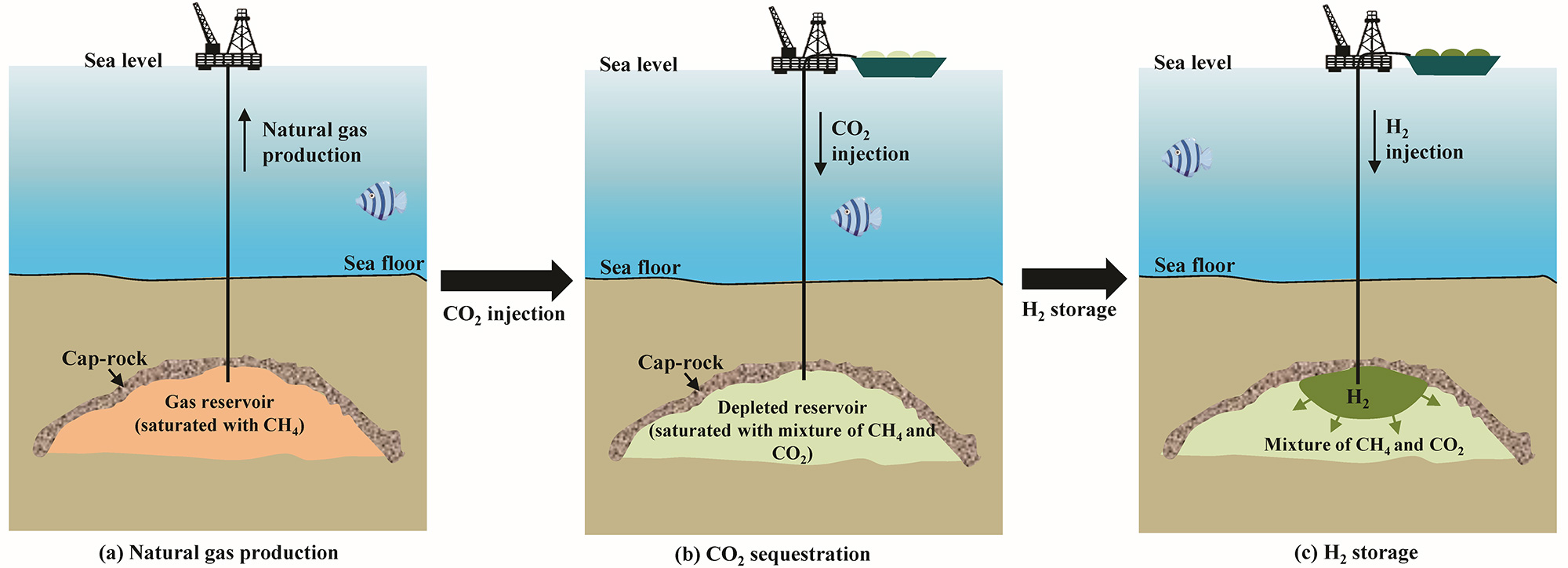
The depleted gas reservoirs can serve not only as sites for CO$_2$ sequestration but also as potential spaces for hydrogen storage. However, this process remains insufficiently understood, limiting the availability of reliable technical guidance for injection operations. In this study, a mathematical model for simulating hydrogen storage in depleted gas reservoirs was developed and numerically solved. Meanwhile, the applicability was then verified through comparison with results from previous studies. Based on this model, a detailed analysis was performed to investigate the evolution of key parameters under specific injection conditions. Finally, the effects of various factors on parameters such as hydrogen distribution and maximum pore pressure during the hydrogen injection process were thoroughly discussed. It was found that hydrogen gradually drives the CH$_4$ and CO$_2$ outward from the near-wellbore region, leading to increases in both bottom-hole pressure and pore pressure during hydrogen injection. Furthermore, as the injection progresses, the spatial extent of hydrogen distribution expands nonlinearly, and the buffering effects of CH$_4$ and CO$_2$ become prominent. Sensitivity analysis further reveals that, although low permeability-induced high pore pressure poses sealing challenges, limited hydrogen storage space within reservoir is beneficial for further hydrogen recovery. Meanwhile, a moderate increase in the injection rate can enhance storage efficiency without compromising reservoir sealing integrity. In contrast, extending the length of wellbore section used for hydrogen injection does not lead to a significant improvement in storage performance.
Graphical Abstract
Keywords
Data Availability Statement
Funding
Conflicts of Interest
Ethical Approval and Consent to Participate
References
- Kovač, A., Paranos, M., & Marciuš, D. (2021). Hydrogen in energy transition: A review. International Journal of Hydrogen Energy, 46(16), 10016-10035.
[CrossRef] [Google Scholar] - Yue, M., Lambert, H., Pahon, E., Roche, R., Jemei, S., & Hissel, D. (2021). Hydrogen energy systems: A critical review of technologies, applications, trends and challenges. Renewable and Sustainable Energy Reviews, 146, 111180.
[CrossRef] [Google Scholar] - Gabrielli, P., Poluzzi, A., Kramer, G. J., Spiers, C., Mazzotti, M., & Gazzani, M. (2020). Seasonal energy storage for zero-emissions multi-energy systems via underground hydrogen storage. Renewable and Sustainable Energy Reviews, 121, 109629.
[CrossRef] [Google Scholar] - Epelle, E. I., Obande, W., Udourioh, G. A., Afolabi, I. C., Desongu, K. S., Orivri, U., ... & Okolie, J. A. (2022). Perspectives and prospects of underground hydrogen storage and natural hydrogen. Sustainable Energy & Fuels, 6(14), 3324-3343.
[CrossRef] [Google Scholar] - Caglayan, D. G., Weber, N., Heinrichs, H. U., Linßen, J., Robinius, M., Kukla, P. A., & Stolten, D. (2020). Technical potential of salt caverns for hydrogen storage in Europe. International Journal of Hydrogen Energy, 45(11), 6793-6805.
[CrossRef] [Google Scholar] - Tarkowski, R. (2019). Underground hydrogen storage: Characteristics and prospects. Renewable and Sustainable Energy Reviews, 105, 86-94.
[CrossRef] [Google Scholar] - Michael, K., Golab, A., Shulakova, V., Ennis-King, J., Allinson, G., Sharma, S., & Aiken, T. (2010). Geological storage of CO2 in saline aquifers—A review of the experience from existing storage operations. International journal of greenhouse gas control, 4(4), 659-667.
[CrossRef] [Google Scholar] - Bachu, S. (2015). Review of CO2 storage efficiency in deep saline aquifers. International Journal of Greenhouse Gas Control, 40, 188-202.
[CrossRef] [Google Scholar] - Wei, B., Wang, B., Li, X., Aishan, M., & Ju, Y. (2023). CO2 storage in depleted oil and gas reservoirs: A review. Advances in Geo-Energy Research, 9(2), 76–93.
[CrossRef] [Google Scholar] - Askarova, A., Mukhametdinova, A., Markovic, S., Khayrullina, G., Afanasev, P., Popov, E., & Mukhina, E. (2023). An overview of geological CO2 sequestration in oil and gas reservoirs. Energies, 16(6), 2821.
[CrossRef] [Google Scholar] - Tyne, R. L., Barry, P. H., Lawson, M., Byrne, D. J., Warr, O., Xie, H., Hillegonds, D. J., Formolo, M., Summers, Z. M., Skinner, B., Eiler, J. M., & Ballentine, C. J. (2021). Rapid microbial methanogenesis during CO2 storage in hydrocarbon reservoirs. Nature, 600(7890), 670–674.
[CrossRef] [Google Scholar] - Deng, P., Ma, H., Song, J., Peng, X., Zhu, S., Xue, D., Jiang, L., & Chen, Z. (2025). Carbon dioxide as cushion gas for large-scale underground hydrogen storage: Mechanisms and implications. Applied Energy, 388, 125622.
[CrossRef] [Google Scholar] - Saeed, M., Jadhawar, P., & Bagala, S. (2023). Geochemical effects on storage gases and reservoir rock during underground hydrogen storage: a depleted North Sea oil reservoir case study. Hydrogen, 4(2), 323–337.
[CrossRef] [Google Scholar] - Amid, A., Mignard, D., & Wilkinson, M. (2016). Seasonal storage of hydrogen in a depleted natural gas reservoir. International journal of hydrogen energy, 41(12), 5549-5558.
[CrossRef] [Google Scholar] - Dehghani, M. R., Ghazi, S. F., & Kazemzadeh, Y. (2024). Interfacial tension and wettability alteration during hydrogen and carbon dioxide storage in depleted gas reservoirs. Scientific Reports, 14(1), 11594.
[CrossRef] [Google Scholar] - Liu, K., Zhu, W., & Pan, B. (2024). Feasibility of hydrogen storage in depleted shale gas reservoir: A numerical investigation. Fuel, 357, 129703.
[CrossRef] [Google Scholar] - Muhammed, N. S., Haq, B., Al Shehri, D., & ... (2023). Role of methane as a cushion gas for hydrogen storage in depleted gas reservoirs. International Journal of Hydrogen Energy, 48(76), 29663–29681.
[CrossRef] [Google Scholar] - Kanaani, M., Sedaee, B., & Asadian-Pakfar, M. (2022). Role of cushion gas on underground hydrogen storage in depleted oil reservoirs. Journal of Energy Storage, 45, 103783.
[CrossRef] [Google Scholar] - He, Y., Xie, Y., Qiao, Y., Qin, J., & Tang, Y. (2024). Estimation of underground hydrogen storage capacity in depleted gas reservoirs using CO2 as cushion gas. Applied Energy, 375, 124093.
[CrossRef] [Google Scholar] - Zeng, L., Sarmadivaleh, M., Saeedi, A., Chen, Y., Zhong, Z., & Xie, Q. (2023). Storage integrity during underground hydrogen storage in depleted gas reservoirs. Earth-Science Reviews, 247, 104625.
[CrossRef] [Google Scholar] - Muhammed, N. S., Haq, B., Al Shehri, D., Al-Ahmed, A., Rahman, M. M., & Zaman, E. (2022). A review on underground hydrogen storage: Insight into geological sites, influencing factors and future outlook. Energy Reports, 8, 461-499.
[CrossRef] [Google Scholar] - Perera, M. S. A. (2023). A review of underground hydrogen storage in depleted gas reservoirs: Insights into various rock-fluid interaction mechanisms and their impact on the process integrity. Fuel, 334, 126677.
[CrossRef] [Google Scholar] - Zivar, D., Kumar, S., & Foroozesh, J. (2021). Underground hydrogen storage: A comprehensive review. International journal of hydrogen energy, 46(45), 23436-23462.
[CrossRef] [Google Scholar] - Mirhasan Hosseini, S. I., Fahimpour, J., Ali, M., & Keshavarz, A. (2022). Capillary Sealing Efficiency Analysis of Caprocks: Implication for Hydrogen Geological Storage. Energy & Fuels, 36(7), 4065–4075.
[CrossRef] [Google Scholar] - Chabab, S., Théveneau, P., Coquelet, C., Corvisier, J., & Paricaud, P. (2020). Measurements and predictive models of high-pressure H2 solubility in brine (H2O+ NaCl) for underground hydrogen storage application. International Journal of Hydrogen Energy, 45(56), 32206-32220.
[CrossRef] [Google Scholar] - Hashemi, L., Glerum, W., Farajzadeh, R., & Hajibeygi, H. (2021). Contact angle measurement for hydrogen/brine/sandstone system using captive-bubble method relevant for underground hydrogen storage. Advances in Water Resources, 154, 103964.
[CrossRef] [Google Scholar] - Lysyy, M., Fernø, M., & Ersland, G. (2021). Seasonal hydrogen storage in a depleted oil and gas field. International Journal of Hydrogen Energy, 46(49), 25160-25174.
[CrossRef] [Google Scholar] - Lu, J., Muhammed, N. S., Okolie, J. A., & Epelle, E. I. (2025). A sensitivity study of hydrogen mixing with cushion gases for effective storage in porous media. Sustainable Energy & Fuels, 9(5), 1353–1370.
[CrossRef] [Google Scholar] - Flesch, S., Pudlo, D., Albrecht, D., Jacob, A., & Enzmann, F. (2018). Hydrogen underground storage—Petrographic and petrophysical variations in reservoir sandstones from laboratory experiments under simulated reservoir conditions. International Journal of Hydrogen Energy, 43(45), 20822-20835.
[CrossRef] [Google Scholar] - Zamehrian, M., & Sedaee, B. (2022). Underground hydrogen storage in a naturally fractured gas reservoir: The role of fracture. International Journal of Hydrogen Energy, 47(93), 39606–39618.
[CrossRef] [Google Scholar] - Zeng, L., Sander, R., Chen, Y., & Xie, Q. (2024). Hydrogen storage performance during underground hydrogen storage in depleted gas reservoirs: a review. Engineering, 40, 211–225.
[CrossRef] [Google Scholar] - Heinemann, N., Alcalde, J., Miocic, J. M., Hangx, S. J., Kallmeyer, J., Ostertag-Henning, C., ... & Rudloff, A. (2021). Enabling large-scale hydrogen storage in porous media–the scientific challenges. Energy & Environmental Science, 14(2), 853-864.
[CrossRef] [Google Scholar] - Okere, C. J., Sheng, J. J., & Ejike, C. (2024). Evaluating reservoir suitability for large-scale hydrogen storage: a preliminary assessment considering reservoir properties. Energy Geoscience, 5(4), 100318.
[CrossRef] [Google Scholar]
Cited By (82)
-
Bao Jia, Zhongwei Huang. Thermophysical, multiphase-flow, geochemical, and microbial controls on combined H2–CO2 storage in depleted gas reservoirs and saline aquifers.
Fuel, 2027 , 429 .
[CrossRef] -
Thenkaraimuthu Mariprasath, Kaliappan Esakkiappan, Shaik M Ali, Muraly Natarajan, Basem A Zneid, Oleksandr Rubanenko. A system-level critical assessment of electric mobility integrating electric vehicle powertrains, advanced battery technologies, grid impacts, artificial intelligence, and sustainability.
Energy Exploration & Exploitation, 2026 , 44 (4).
[CrossRef] -
Yunjun Zhang, Hao Zhang, Li Zhang, Jianlin Li, Yaohui Yan. Pore-micro fracture structure, porosity and gas- bearing property of deep shale under lithofacies-formation pressure coupling.
Scientific Reports, 2026 , 16 (1).
[CrossRef] -
Fuling Wang, Hongqi Cao, Chenyi Tang, Chengzhe Lu, Yixin Zhang, Rui Deng, Yandong Yang. Factor Analysis and Mechanism Revelation of Reservoir Conditions and Driving Fluids Affecting Geothermal Energy Extraction.
Eng, 2026 , 7 (5).
[CrossRef] -
Marialuna Loffredo, Cristina Serazio, Nicolò Santi Vasile, Eloisa Salina Borello, Matteo Scapolo, Donatella Barbieri, Andrea Mantegazzi, Fabrizio Candido Pirri, Francesca Verga, Christian Coti, Dario Viberti. A Rock-on-a-Chip Approach to Investigate Flow Behavior for Underground Gas Storage Applications.
Energies, 2026 , 19 (2).
[CrossRef] -
Uliya Mitra, Anoop Arya, Sushma Gupta. DC microgrid integration of an optimized proton exchange membrane fuel cell utilizing a cost-effective clamping boost converter.
Journal of the Indian Chemical Society, 2026 , 103 (2).
[CrossRef] -
Qiuyue Zhang, Renyi Cao, Xinyi Zheng, Linsong Cheng, Gaofei Yan. Hydrogen adsorption and diffusion in caprock mineral slits: A molecular dynamics study for underground storage.
Physics of Fluids, 2026 , 38 (6).
[CrossRef] -
Lili Wang, Yanming Zhang, Zhanguo Ma, Changjing Zhou, Fei Feng, Yonghong Gu, Xinjia Liu, Xiaobo Lin, Yuhang Xie, Fuling Wang. Analysis of Hydraulic Fracture Propagation Behavior Using a Thermo-Hydro-Mechanical Coupled Model.
Processes, 2026 , 14 (18).
[CrossRef] -
Zhenglian Yuan, Xianglu Tang, Zhenxue Jiang, Shu Jiang, Ze Li, Shitan Ning, Xiaolong Yan, Caihua Lin. Controlling Effect of Seepage Channels in Tight Reservoirs on Fluid Flow Capacity Based on Pore–Throat Network Numerical Simulation and Fluid Injection Experiments.
Energies, 2026 , 19 (3).
[CrossRef] -
Nader Naifar. Tail-Risk Spillovers in Strategic Commodity and Carbon Markets: Evidence for Natural Resource Risk Management.
Resources, 2026 , 15 (4).
[CrossRef] -
Ao Feng, Yufa He, Kexin Zhang, Chuanliang Yan. Research on Sensitivity Factors of Wellbore Stability During Directional Well Construction in Deepwater Shallow Soft Hydrate Reservoirs.
Processes, 2026 , 14 (15).
[CrossRef] -
Xing Wang, Yongjiang Luo, Sicheng Wang, Yu Meng, Guoqing Yin, Qi He. Hydraulic fracture propagation characteristics in coal mines hard roof rocks with PAM fracturing fluid.
Results in Engineering, 2026 , 29 .
[CrossRef] -
Jingjuan Wu, Qiang Li, Qingchao Li, Fuling Wang, Yuanfang Cheng, Chuanliang Yan. Design and Optimization of Bottom-Hole Temperature–Pressure Combinations in Gas Production from Gas Hydrates via Carbon Dioxide Replacement Strategy.
Energies, 2026 , 19 (15).
[CrossRef] -
Yifeng Ma, Jianwei Gu, Feng Xu, Fan Cheng, Yuxia Shi, Xiaojian Su, Siyuan Zhang, Caili Dai. Experimental Study on Reservoir Damage Mechanisms of Depleted Gas Reservoirs Considering Variable Pressure Depletion Rates During Multi-Cycle Injection and Production.
Processes, 2026 , 14 (10).
[CrossRef] -
Juhi Jannat Mim, Abdullah Al Momen, Md. Rubayet Alam, Md Arif Hasan, Golam Azam, Md. Aminul Islam, Nayem Hossain, Li Qingchao. 3D Printing With Cementitious Composites: Innovations, Challenges, and Prospects—A Review.
Advances in Civil Engineering, 2026 , 2026 (1).
[CrossRef] -
Wei-dong Zhao, Li-ping Fang, Zhen-qiang Xie, Xiong Zhou. Prediction of liquid accumulation in a shale gas pipeline.
Scientific Reports, 2026 , 16 (1).
[CrossRef] -
Lei Guo, Ben-sheng Huang, Zhong-feng Liu, Jing Qiu. Eliminating air entrainment in complex siphon drainage systems: a physical modelling approach.
Discover Applied Sciences, 2026 , 8 (4).
[CrossRef] -
Magzhan N. Orynbasar, Vladimir E. Messerle, Alexandr B. Ustimenko, Sestager Kh. Aknazarov. Production of Synthesis Gas by Plasma–Steam Gasification of Solid Fuels with Different Ash and Volatile Matter Contents: An Experiment and Thermodynamic Calculations.
Gases, 2026 , 6 (1).
[CrossRef] -
Xiangjun Ren, Hao Li. Effect of die temperature variation on biomass pelletizing and optimization of built-in heat source.
Energy Reports, 2026 , 15 .
[CrossRef] -
Shruti Malik, Parsa Alimohammadiardakani, Mayur Pal. Comparative Analysis of Flow Behavior and Geochemical Impact of CO2 and Hydrogen in Lithuanian Saline Aquifer: A Simulation and Experimental Study.
Energies, 2026 , 19 (2).
[CrossRef]
Cite This Article
TY  - JOUR
AU  - Wu, Jingjuan
AU  - Ansari, Ubedullah
PY  - 2025
DA  - 2025/09/30
TI  - From CO$_2$ Sequestration to Hydrogen Storage: Further Utilization of Depleted Gas Reservoirs
JO  - Reservoir Science
T2  - Reservoir Science
JF  - Reservoir Science
VL  - 1
IS  - 1
SP  - 19
EP  - 35
DO  - 10.62762/RS.2025.860510
UR  - https://www.icck.org/article/abs/RS.2025.860510
KW  - hydrogen storage
KW  - CO$_2$ sequestration
KW  - depleted gas reservoir
KW  - CCUS
KW  - H$_2$ injection
KW  - clean energy
AB  - The depleted gas reservoirs can serve not only as sites for CO$_2$ sequestration but also as potential spaces for hydrogen storage. However, this process remains insufficiently understood, limiting the availability of reliable technical guidance for injection operations. In this study, a mathematical model for simulating hydrogen storage in depleted gas reservoirs was developed and numerically solved. Meanwhile, the applicability was then verified through comparison with results from previous studies. Based on this model, a detailed analysis was performed to investigate the evolution of key parameters under specific injection conditions. Finally, the effects of various factors on parameters such as hydrogen distribution and maximum pore pressure during the hydrogen injection process were thoroughly discussed. It was found that hydrogen gradually drives the CH$_4$ and CO$_2$ outward from the near-wellbore region, leading to increases in both bottom-hole pressure and pore pressure during hydrogen injection. Furthermore, as the injection progresses, the spatial extent of hydrogen distribution expands nonlinearly, and the buffering effects of CH$_4$ and CO$_2$ become prominent. Sensitivity analysis further reveals that, although low permeability-induced high pore pressure poses sealing challenges, limited hydrogen storage space within reservoir is beneficial for further hydrogen recovery. Meanwhile, a moderate increase in the injection rate can enhance storage efficiency without compromising reservoir sealing integrity. In contrast, extending the length of wellbore section used for hydrogen injection does not lead to a significant improvement in storage performance.
SN  - 3070-2356
PB  - Institute of Central Computation and Knowledge
LA  - English
ER  -
@article{Wu2025From,
  author = {Jingjuan Wu and Ubedullah Ansari},
  title = {From CO\$\_2\$ Sequestration to Hydrogen Storage: Further Utilization of Depleted Gas Reservoirs},
  journal = {Reservoir Science},
  year = {2025},
  volume = {1},
  number = {1},
  pages = {19-35},
  doi = {10.62762/RS.2025.860510},
  url = {https://www.icck.org/article/abs/RS.2025.860510},
  abstract = {The depleted gas reservoirs can serve not only as sites for CO\$\_2\$ sequestration but also as potential spaces for hydrogen storage. However, this process remains insufficiently understood, limiting the availability of reliable technical guidance for injection operations. In this study, a mathematical model for simulating hydrogen storage in depleted gas reservoirs was developed and numerically solved. Meanwhile, the applicability was then verified through comparison with results from previous studies. Based on this model, a detailed analysis was performed to investigate the evolution of key parameters under specific injection conditions. Finally, the effects of various factors on parameters such as hydrogen distribution and maximum pore pressure during the hydrogen injection process were thoroughly discussed. It was found that hydrogen gradually drives the CH\$\_4\$ and CO\$\_2\$ outward from the near-wellbore region, leading to increases in both bottom-hole pressure and pore pressure during hydrogen injection. Furthermore, as the injection progresses, the spatial extent of hydrogen distribution expands nonlinearly, and the buffering effects of CH\$\_4\$ and CO\$\_2\$ become prominent. Sensitivity analysis further reveals that, although low permeability-induced high pore pressure poses sealing challenges, limited hydrogen storage space within reservoir is beneficial for further hydrogen recovery. Meanwhile, a moderate increase in the injection rate can enhance storage efficiency without compromising reservoir sealing integrity. In contrast, extending the length of wellbore section used for hydrogen injection does not lead to a significant improvement in storage performance.},
  keywords = {hydrogen storage, CO\$\_2\$ sequestration, depleted gas reservoir, CCUS, H\$\_2\$ injection, clean energy},
  issn = {3070-2356},
  publisher = {Institute of Central Computation and Knowledge}
}
Publisher's Note
ICCK stays neutral with regard to jurisdictional claims in published maps and institutional affiliations.
Rights and Permissions
 Copyright © 2025 by the Author(s). Published by Institute of Central Computation and Knowledge. This article is an open access article distributed under the terms and conditions of the Creative Commons Attribution (CC BY) license (https://creativecommons.org/licenses/by/4.0/), which permits use, sharing, adaptation, distribution and reproduction in any medium or format, as long as you give appropriate credit to the original author(s) and the source, provide a link to the Creative Commons licence, and indicate if changes were made.

