

Current Status and Development Prospects of Carbon Capture, Utilization, and Storage (CCUS) in China: Technical, Policy, and Market Perspectives




Article Information
Abstract
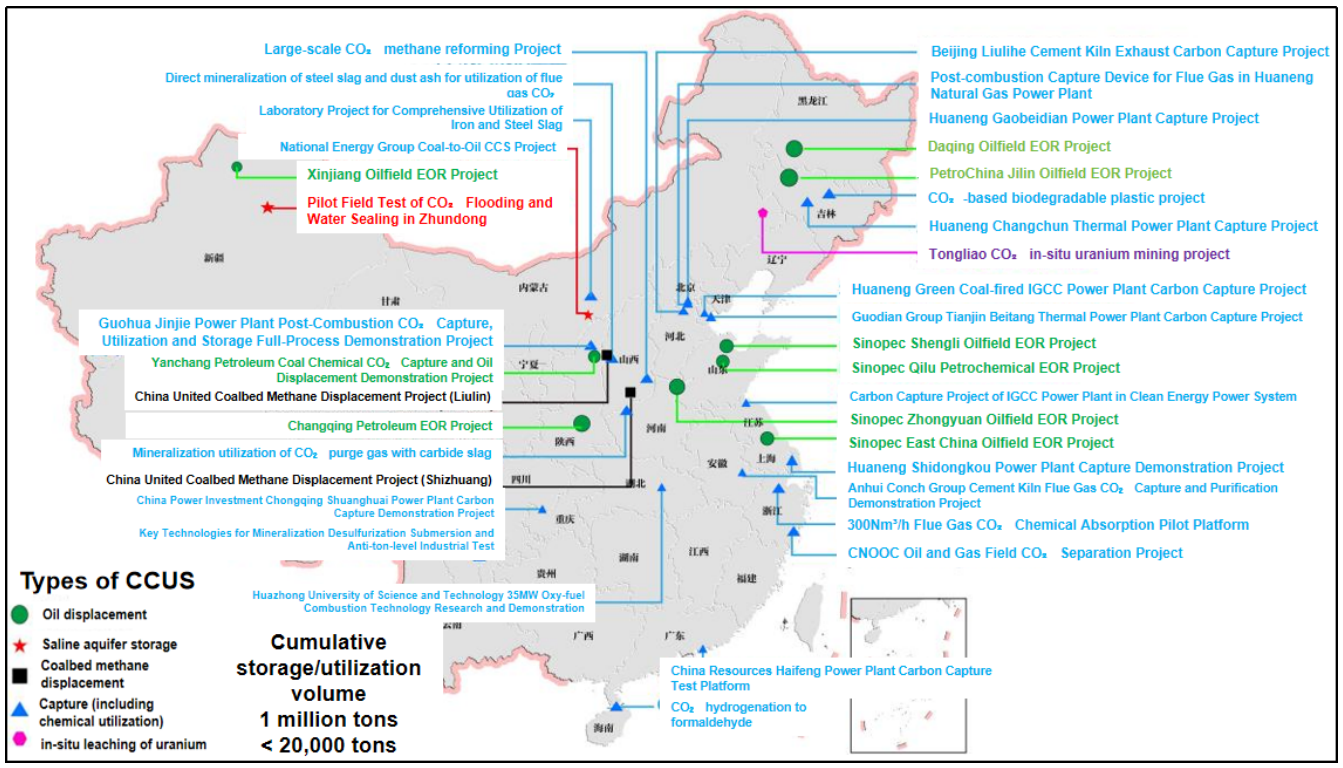
Based on in-depth investigation and analysis of the current situation of CCUS development in China, this paper combs and summarizes the technical status and development trends of the carbon capture, transportation, utilization and storage industry (CCUS) at home and abroad in recent years through comprehensive research, and conducts in-depth discussions on the existing technical problems and risks. The analysis shows that in the short term, China's CCUS will still be dominated by CO2-EOR (Enhanced Oil Recovery) utilization. CO2 mineralization utilization and chemical utilization will gain new development space with technological breakthroughs. Pure carbon dioxide storage is restricted by policies and costs in the short term, making it difficult to develop rapidly, and will be dominated by demonstration projects in the near future. Future development requires improving relevant laws, regulations and incentive policies, formulating scientific and reasonable systems, regulations and standard systems covering the construction, operation, supervision and termination of CCUS. It is also necessary to improve the source-sink matching of CCUS by forming a complete industrial chain that integrates capture, transportation, utilization, and storage. The construction of carbon dioxide transportation and storage hubs can generate economies of scale and commercial synergy, reduce the unit cost of CCUS projects, and improve the economic efficiency of CCUS projects by using CO2 miscible flooding to increase oil recovery and producing hydrogen with low emissions. Under China's ``dual carbon'' strategy, through the implementation of the proposed suggestions, China's CCUS industry can achieve healthy and sustainable development.
Graphical Abstract
Keywords
Data Availability Statement
Funding
Conflicts of Interest
Ethical Approval and Consent to Participate
References
- Jiang, K., Ashworth, P., Zhang, S., Liang, X., Sun, Y., & Angus, D. (2020). China's carbon capture, utilization and storage (CCUS) policy: A critical review. Renewable and Sustainable Energy Reviews, 119, 109601.
[CrossRef] [Google Scholar] - Almeida, B. R. F., Ziglio, C. M., Batello, D. A., Lorenzeti, J. F. C., Musse, A. P. S., Lopreato, L. G. R., & Aimoli, C. G. (2024, April). CCUS Operational Challenges: Lessons Learned from the World's Largest Offshore Carbon-Capture, Utilization and Storage Initiative in the Oil and Gas Industry. In Offshore Technology Conference (p. D011S007R006). OTC.
[CrossRef] [Google Scholar] - Kong, M., Song, L., Liao, H., Zhang, S., Wang, Y., Deng, X., & Feng, W. (2024). A review on development of post-combustion CO2 capture technologies: Performance of carbon-based, zeolites and MOFs adsorbents. Fuel, 371, 132103.
[CrossRef] [Google Scholar] - Davoodi, S., Al-Shargabi, M., Wood, D. A., Mehrad, M., & Rukavishnikov, V. S. (2024). Carbon dioxide sequestration through enhanced oil recovery: A review of storage mechanisms and technological applications. Fuel, 366, 131313.
[CrossRef] [Google Scholar] - Alhalawani, G., Fajri, K., & Onaizi, S. A. (2025). Recent advances in CO2 capture using MgO-based nanomaterials: A comprehensive review. Fuel, 381, 133608.
[CrossRef] [Google Scholar] - Wang, R. (2024). Status and perspectives on CCUS clusters and hubs. Unconventional Resources, 4, 100065.
[CrossRef] [Google Scholar] - de Aquino, T. F., Estevam, S. T., Viola, V. O., Marques, C. R., Zancan, F. L., Vasconcelos, L. B., ... & Cavalcante Jr, C. L. (2020). CO2 adsorption capacity of zeolites synthesized from coal fly ashes. Fuel, 276, 118143.
[CrossRef] [Google Scholar] - Nedoma, M., Netušil, M., & Hrdlička, J. (2023). Integration of adsorption based post-combustion carbon dioxide capture for a natural gas-fired combined heat and power plant. Fuel, 354, 129346.
[CrossRef] [Google Scholar] - Hamza, A., Hussein, I. A., Al-Marri, M. J., Mahmoud, M., Shawabkeh, R., & Aparicio, S. (2021). CO2 enhanced gas recovery and sequestration in depleted gas reservoirs: A review. Journal of Petroleum Science and Engineering, 196, 107685.
[CrossRef] [Google Scholar] - Zhang, C., & Wang, M. (2023). CO2/brine interfacial tension for geological CO2 storage: A systematic review. Journal of Petroleum Science and Engineering, 220, 111154.
[CrossRef] [Google Scholar] - Jian, G., Fernandez, C. A., Puerto, M., Sarathi, R., Bonneville, A., & Biswal, S. L. (2021). Advances and challenges in CO2 foam technologies for enhanced oil recovery in carbonate reservoirs. Journal of Petroleum Science and Engineering, 202, 108447.
[CrossRef] [Google Scholar] - Ozotta, O., Ostadhassan, M., Liu, K., Liu, B., Kolawole, O., & Hadavimoghaddam, F. (2021). Reassessment of CO2 sequestration in tight reservoirs and associated formations. Journal of Petroleum Science and Engineering, 206, 109071.
[CrossRef] [Google Scholar] - Olea, R. A. (2015). CO2 retention values in enhanced oil recovery. Journal of Petroleum Science and Engineering, 129, 23-28.
[CrossRef] [Google Scholar] - Gao, C., Li, X., Guo, L., & Zhao, F. (2013). Heavy oil production by carbon dioxide injection. Greenhouse Gases: Science and Technology, 3(3), 185-195.
[CrossRef] [Google Scholar] - Saraf, S., & Bera, A. (2023). Carbon dioxide injection for enhanced oil recovery and underground storage to reduce greenhouse gas. In Green sustainable process for chemical and environmental engineering and science (pp. 149-176). Elsevier.
[CrossRef] [Google Scholar] - Jiutian, Z., Zhiyong, W., Jia-Ning, K., Xiangjing, S., & Dong, X. (2022). Several key issues for CCUS development in China targeting carbon neutrality. Carbon Neutrality, 1(1), 17.
[CrossRef] [Google Scholar] - Wei, Y. M., Kang, J. N., Liu, L. C., Li, Q., Wang, P. T., Hou, J. J., ... & Yu, B. (2021). A proposed global layout of carbon capture and storage in line with a 2 C climate target. Nature Climate Change, 11(2), 112-118.
[CrossRef] [Google Scholar] - SALEM, S. M., SOLIMAN, M. M., ELNOBY, M. G., & WAHBA, A. M. (2024). The Room for Growth Applications of Carbon Dioxide Recovery Technologies in the Petroleum Industry. Pakistan Journal of Life & Social Sciences, 22(2).
[CrossRef] [Google Scholar] - Li, H. (2023). Advancing “Carbon Peak” and “Carbon Neutrality” in China: A comprehensive review of current global research on carbon capture, utilization, and storage technology and its implications. ACS omega, 8(45), 42086-42101.
[CrossRef] [Google Scholar] - Sharafi, P., Mortazavi, M., Samali, B., & Ronagh, H. (2018). Interlocking system for enhancing the integrity of multi-storey modular buildings. Automation in construction, 85, 263-272.
[CrossRef] [Google Scholar] - Hanson, E., Nwakile, C., & Hammed, V. O. (2025). Carbon capture, utilization, and storage (CCUS) technologies: Evaluating the effectiveness of advanced CCUS solutions for reducing CO2 emissions. Results in Surfaces and Interfaces, 18, 100381.
[CrossRef] [Google Scholar] - Yan, J., & Zhang, Z. (2019). Carbon capture, utilization and storage (CCUS). Applied Energy, 235, 1289-1299.
[CrossRef] [Google Scholar] - Yongle, H. U., Mingqiang, H. A. O., Guoli, C. H. E. N., Ruiyan, S. U. N., & Shi, L. I. (2019). Technologies and practice of CO2 flooding and sequestration in China. Petroleum Exploration and Development, 46(4), 753-766.
[CrossRef] [Google Scholar] - Gaofeng, W., Yongle, H., & Xinmin, S. (2013). New theory of oil production prediction in gas flooding tight reservoirs. Journal of Science Technology and Engineering, 13(30), 8906-8911.
[Google Scholar] - Guangzhi, L. I. A. O., Dongbo, H. E., Gaofeng, W. A. N. G., Liangang, W. A. N. G., Zhengmao, W. A. N. G., Chunmei, S. U., ... & Shengzhou, W. A. N. G. (2022). Discussion on the limit recovery factor of carbon dioxide flooding in a permanent sequestration scenario. Petroleum Exploration and Development, 49(6), 1463-1470.
[CrossRef] [Google Scholar] - Li, Q., Chen, Z. A., Zhang, J. T., Liu, L. C., Li, X. C., & Jia, L. (2016). Positioning and revision of CCUS technology development in China. International Journal of Greenhouse Gas Control, 46, 282-293.
[CrossRef] [Google Scholar] - Zheng, B., Niu, J., & Zhang, K. (2024). Current Status and Outlook of CCUS Industry in China. Annual Report on China’s Petroleum, Gas and New Energy Industry (2022–2023), 289-306.
[CrossRef] [Google Scholar] - Huber, J. (2020). Upstreaming environmental action. In The ecological modernisation reader (pp. 334-355). Routledge.
[Google Scholar] - Zhang, Z., & Huisingh, D. (2017). Carbon dioxide storage schemes: technology, assessment and deployment. Journal of cleaner production, 142, 1055-1064.
[CrossRef] [Google Scholar] - Li, Q., & Liu, G. (2016). Risk assessment of the geological storage of CO2: A review. Geologic carbon sequestration: Understanding reservoir behavior, 249-284.
[CrossRef] [Google Scholar]
Cited By (11)
-
Mohamed Arafat, Shu Jiang, Mohamed Fagelnour, Pengfei Xiong, Khaled Al‐Kahtany, Sherif Farouk. Evaluating CO2 Storage Potential in a Paleozoic Shifah Sandstone Reservoir Using 3D Modeling, Shushan Basin, Western Desert, Egypt.
Journal of Petroleum Geology, 2026 , 49 (4).
[CrossRef] -
Jingpeng Wang, Jun Li, Wei Lian, Zongyu Lu, Yanxian Wu, Tao Wan. Mechanisms and Applications of Casing Running Mechanics in CCUS Extended‐Reach Horizontal Wells.
Energy Science & Engineering, 2026 , 14 (1).
[CrossRef] -
Tianbiao Zhao. A mini review on “from decades to centuries”: temporal gaps in CCUS governance.
Frontiers in Earth Science, 2026 , 14 .
[CrossRef] -
Zhi Gao, Tian Tang, Cheng Yang, Jing Li, Yijia Wu, Ying Wang, Jingru Ruan, Yi Xiao, Hu Li, Kun Zhang. Reservoir Characteristics and Productivity Controlling Factors of the Wufeng–Longmaxi Formations in the Lu203–Yang101 Well Block, Southern Sichuan Basin, China.
Energies, 2026 , 19 (2).
[CrossRef] -
Yinhui Wang, Xiaodan Gao, Hu Li. Generalized spatial two stage least squares analysis of foreign direct investment air pollution and green technology innovation in Chinese cities.
Scientific Reports, 2026 , 16 (1).
[CrossRef] -
Zaheer Hussain Zardari, Dzeti Farhah Mohshim, Muhammad Aslam Md Yusof, Adnan Aftab, Muhammad Ali. Shale Composition and Pore Architecture Effects Governing Underground CO2 Storage.
Energy & Fuels, 2026 , 40 (5).
[CrossRef] -
Qiang Liu, Yuan Li, Chaoyue Huang, Jialong Li, Bing Liang, Weiji Sun, Jiaxu Jin, Jianjun Liu, Hu Li. Research on Migration
and Surface Deformation during
Goaf CO2 Geological Storage─Taking Mindong No.1
Mine in Hulunbuir as an Example.
ACS Omega, 2026 , 11 (35).
[CrossRef] -
Zhongwei Wu, Li Zhong, Xin Cai, Rongtao Li, Haitao Li, Lianting Sun, Chuanzhi Cui. Division of CO2 flooding and storage development stages and optimization of water–alternating–gas injection parameters: A case study of block F in oilfield S.
Geoenergy Science and Engineering, 2026 , 266 .
[CrossRef] -
Tianbiao Zhao. CO2 geological storage in China: a mini review of technical options, trade-offs, and pathways toward carbon neutrality.
Frontiers in Earth Science, 2026 , 14 .
[CrossRef] -
Lixue Cheng, Hongxian Gao, Hu Li. Quantitative characterization and optimization of fracability in continental shale reservoirs.
Scientific Reports, 2025 , 15 (1).
[CrossRef] -
Jiang Lu, Nan Wu, Yanxin Lv, Xiaoyu Fang, Haibo Li, Yi Xin, Weiji Liu. Long distance migration assisted structural trapping during CO2 storage in offshore basin.
Scientific Reports, 2025 , 15 (1).
[CrossRef]
Cite This Article
TY  - JOUR
AU  - Yang, Feiran
AU  - Guo, Chan
AU  - Ma, Chen
AU  - Gong, Xuefeng
AU  - Zhao, Hong
PY  - 2025
DA  - 2025/08/31
TI  - Current Status and Development Prospects of Carbon Capture, Utilization, and Storage (CCUS) in China: Technical, Policy, and Market Perspectives
JO  - Journal of Geo-Energy and Environment
T2  - Journal of Geo-Energy and Environment
JF  - Journal of Geo-Energy and Environment
VL  - 1
IS  - 1
SP  - 23
EP  - 31
DO  - 10.62762/JGEE.2025.885716
UR  - https://www.icck.org/article/abs/JGEE.2025.885716
KW  - shale gas preservation
KW  - Longmaxi formation
KW  - fluid properties
KW  - structural control
KW  - nonhydrocarbon gases
AB  - Based on in-depth investigation and analysis of the current situation of CCUS development in China, this paper combs and summarizes the technical status and development trends of the carbon capture, transportation, utilization and storage industry (CCUS) at home and abroad in recent years through comprehensive research, and conducts in-depth discussions on the existing technical problems and risks. The analysis shows that in the short term, China's CCUS will still be dominated by CO2-EOR (Enhanced Oil Recovery) utilization. CO2 mineralization utilization and chemical utilization will gain new development space with technological breakthroughs. Pure carbon dioxide storage is restricted by policies and costs in the short term, making it difficult to develop rapidly, and will be dominated by demonstration projects in the near future. Future development requires improving relevant laws, regulations and incentive policies, formulating scientific and reasonable systems, regulations and standard systems covering the construction, operation, supervision and termination of CCUS. It is also necessary to improve the source-sink matching of CCUS by forming a complete industrial chain that integrates capture, transportation, utilization, and storage. The construction of carbon dioxide transportation and storage hubs can generate economies of scale and commercial synergy, reduce the unit cost of CCUS projects, and improve the economic efficiency of CCUS projects by using CO2 miscible flooding to increase oil recovery and producing hydrogen with low emissions. Under China's ``dual carbon'' strategy, through the implementation of the proposed suggestions, China's CCUS industry can achieve healthy and sustainable development.
SN  - 3069-3268
PB  - Institute of Central Computation and Knowledge
LA  - English
ER  -
@article{Yang2025Current,
  author = {Feiran Yang and Chan Guo and Chen Ma and Xuefeng Gong and Hong Zhao},
  title = {Current Status and Development Prospects of Carbon Capture, Utilization, and Storage (CCUS) in China: Technical, Policy, and Market Perspectives},
  journal = {Journal of Geo-Energy and Environment},
  year = {2025},
  volume = {1},
  number = {1},
  pages = {23-31},
  doi = {10.62762/JGEE.2025.885716},
  url = {https://www.icck.org/article/abs/JGEE.2025.885716},
  abstract = {Based on in-depth investigation and analysis of the current situation of CCUS development in China, this paper combs and summarizes the technical status and development trends of the carbon capture, transportation, utilization and storage industry (CCUS) at home and abroad in recent years through comprehensive research, and conducts in-depth discussions on the existing technical problems and risks. The analysis shows that in the short term, China's CCUS will still be dominated by CO2-EOR (Enhanced Oil Recovery) utilization. CO2 mineralization utilization and chemical utilization will gain new development space with technological breakthroughs. Pure carbon dioxide storage is restricted by policies and costs in the short term, making it difficult to develop rapidly, and will be dominated by demonstration projects in the near future. Future development requires improving relevant laws, regulations and incentive policies, formulating scientific and reasonable systems, regulations and standard systems covering the construction, operation, supervision and termination of CCUS. It is also necessary to improve the source-sink matching of CCUS by forming a complete industrial chain that integrates capture, transportation, utilization, and storage. The construction of carbon dioxide transportation and storage hubs can generate economies of scale and commercial synergy, reduce the unit cost of CCUS projects, and improve the economic efficiency of CCUS projects by using CO2 miscible flooding to increase oil recovery and producing hydrogen with low emissions. Under China's ``dual carbon'' strategy, through the implementation of the proposed suggestions, China's CCUS industry can achieve healthy and sustainable development.},
  keywords = {shale gas preservation, Longmaxi formation, fluid properties, structural control, nonhydrocarbon gases},
  issn = {3069-3268},
  publisher = {Institute of Central Computation and Knowledge}
}
Publisher's Note
ICCK stays neutral with regard to jurisdictional claims in published maps and institutional affiliations.
Rights and Permissions
 Copyright © 2025 by the Author(s). Published by Institute of Central Computation and Knowledge. This article is an open access article distributed under the terms and conditions of the Creative Commons Attribution (CC BY) license (https://creativecommons.org/licenses/by/4.0/), which permits use, sharing, adaptation, distribution and reproduction in any medium or format, as long as you give appropriate credit to the original author(s) and the source, provide a link to the Creative Commons licence, and indicate if changes were made.


Portico
