


Effects of Crosslinking Agents and Reservoir Conditions on the Propagation of Fractures in Coal Reservoirs During Hydraulic Fracturing










Article Information
Abstract
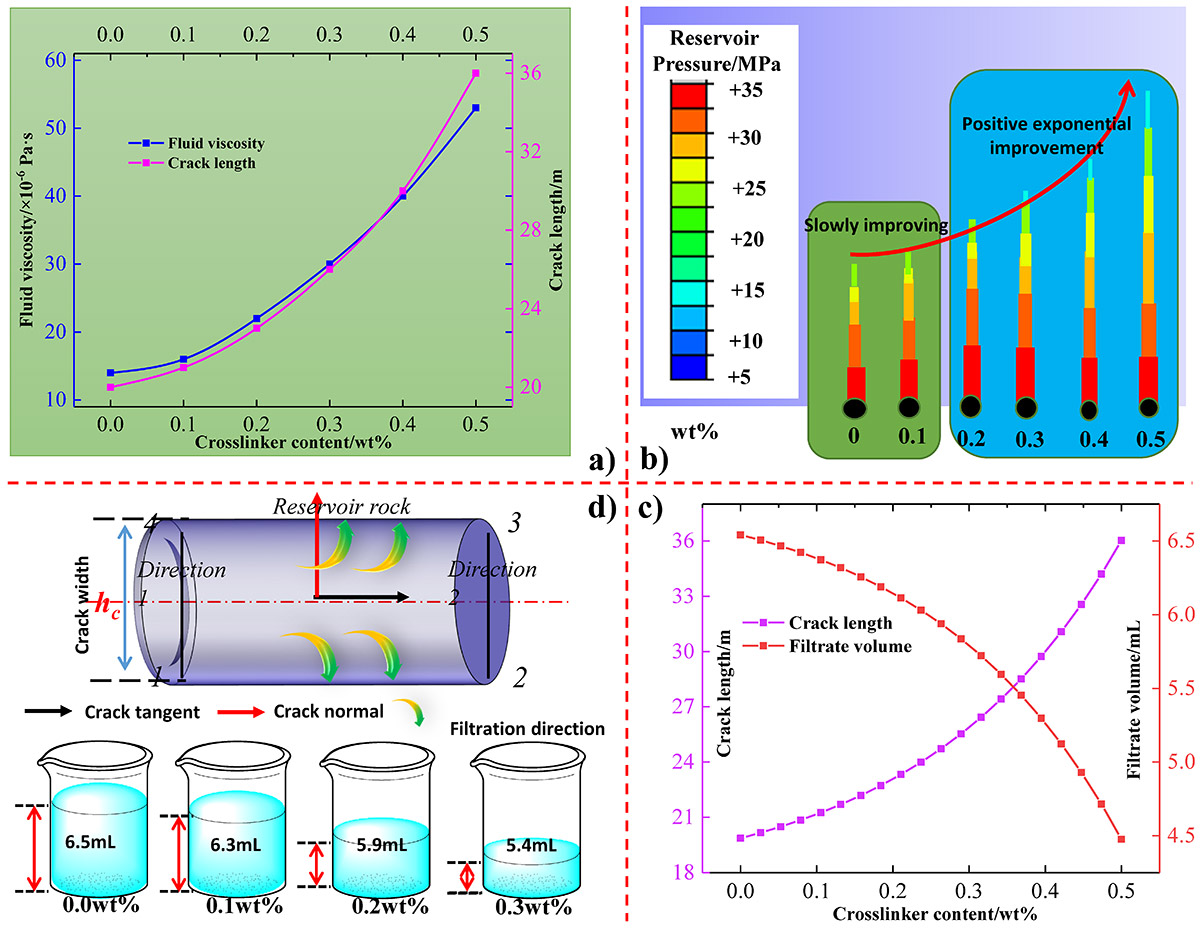
Low fracturing efficiency and high permeability filtration present substantial challenges during the fracturing development of coalbed methane (CBM), significantly hindering its efficient exploitation. In this study, a cross-linker featuring specific polar functional groups on its side chains was synthesized, and a multi-functional coupling evaluation apparatus was developed to systematically investigate the performance characteristics of water-based fracturing fluids. Furthermore, molecular dynamics simulations were employed to elucidate the microscopic mechanisms by which the modified cross-linkers and various external factors influence CBM extraction efficiency. The results indicated that the modified water-based fracturing fluid enhances fracture propagation and reduces fluid filtration into the reservoir. Increasing the concentration of the cross-linker (0wt% to 0.3wt%) improves both gas production efficiency and fracture expansion capacity (20m of crack length to 36m). Conversely, elevated reservoir temperatures (383K to 433K) markedly decrease gas recovery efficiency while significantly increasing fluid seepage (5.8ml to 7.5ml) and expansion capacity (26m of crack length to 42m). In contrast, higher reservoir pressure demonstrates an opposite trend by enhancing extraction efficiency and mitigating fluid filtration. The alteration of chemical bonding interactions between fluid molecules is identified as a key microscopic mechanism influencing CBM development, thereby offering a theoretical foundation for optimizing water-based fracturing strategies in low-permeability coal reservoirs.
Graphical Abstract
Keywords
Data Availability Statement
Funding
Conflicts of Interest
Ethical Approval and Consent to Participate
References
- Palmer, I., & Mansoori, J. (1998). How permeability depends on stress and pore pressure in coalbeds: a new model. SPE reservoir evaluation & engineering, 1(06), 539-544.
[CrossRef] [Google Scholar] - Montgomery, C. T., & Smith, M. B. (2010). Hydraulic fracturing: History of an enduring technology. Journal of Petroleum Technology, 62(12), 26-40.
[CrossRef] [Google Scholar] - Busch, A., & Gensterblum, Y. (2011). CBM and CO2-ECBM related sorption processes in coal: a review. International Journal of Coal Geology, 87(2), 49-71.
[CrossRef] [Google Scholar] - Moore, T. A. (2012). Coalbed methane: A review. International Journal of Coal Geology, 101, 36-81.
[CrossRef] [Google Scholar] - Huang, Q., Liu, S., Wang, G., & Cheng, W. (2021). Evaluating the changes of sorption and diffusion behaviors of Illinois coal with various water-based fracturing fluid treatments. Fuel, 283, 118884.
[CrossRef] [Google Scholar] - Nianyin, L., Yu, J., Daocheng, W., Chao, W., Jia, K., Pingli, L., ... & Ying, X. (2022). Development status of crosslinking agent in high-temperature and pressure fracturing fluid: A review. Journal of Natural Gas Science and Engineering, 107, 104369.
[CrossRef] [Google Scholar] - Liu, B., Suzuki, A., & Ito, T. (2020). Numerical analysis of different fracturing mechanisms between supercritical CO2 and water-based fracturing fluids. International Journal of Rock Mechanics and Mining Sciences, 132, 104385.
[CrossRef] [Google Scholar] - Zhang, S. C., Lei, X., Zhou, Y. S., & Xu, G. Q. (2015). Numerical simulation of hydraulic fracture propagation in tight oil reservoirs by volumetric fracturing. Petroleum Science, 12(4), 674-682.
[CrossRef] [Google Scholar] - Wang, J., Elsworth, D., Wu, Y., Liu, J., Zhu, W., & Liu, Y. (2018). The influence of fracturing fluids on fracturing processes: a comparison between water, oil and SC-CO2. Rock Mechanics and Rock Engineering, 51(1), 299-313.
[CrossRef] [Google Scholar] - Zhang, C. P., Ranjith, P. G., Perera, M. S. A., Li, X., & Zhao, J. (2018). Simulation of flow behaviour through fractured unconventional gas reservoirs considering the formation damage caused by water-based fracturing fluids. Journal of Natural Gas Science and Engineering, 57, 100-121.
[CrossRef] [Google Scholar] - Papavasileiou, K. D., Michalis, V. K., Peristeras, L. D., Vasileiadis, M., Striolo, A., & Economou, I. G. (2018). Molecular dynamics simulation of water-based fracturing fluids in kaolinite slit pores. The Journal of Physical Chemistry C, 122(30), 17170-17183.
[CrossRef] [Google Scholar] - Song, H., & Liu, J. (2024). Effects of Modified Cross-Linkers on the Rheology of Water-Based Fracturing Fluids and Reservoir Water Environment. Processes, 12(12), 2896.
[CrossRef] [Google Scholar] - Fan, M., Lai, X., Tang, M., Li, J., Wang, L., & Gao, J. (2022). Preparation and properties of a clean, low‐damage waterproof locking damage multifunctional integrated water‐based fracturing fluid. Journal of Applied Polymer Science, 139(48), e53207.
[CrossRef] [Google Scholar] - Kesavan, S., & Prud'Homme, R. K. (1992). Rheology of guar and (hydroxypropyl) guar crosslinked by borate. Macromolecules, 25(7), 2026-2032.
[CrossRef] [Google Scholar] - Li, L., Al-Muntasheri, G. A., & Liang, F. (2016). A review of crosslinked fracturing fluids prepared with produced water. Petroleum, 2(4), 313-323.
[CrossRef] [Google Scholar] - Whitsitt, N. F., & Dysart, G. R. (1970). The effect of temperature on stimulation design. Journal of Petroleum Technology, 22(04), 493-502.
[CrossRef] [Google Scholar] - Wu, G., Pan, J., Anwaier, M., Wu, J., Xiao, P., Zheng, L., ... & Zhu, D. (2023). Effect of nano-SiO2 on the flowback-flooding integrated performance of water-based fracturing fluids. Journal of Molecular Liquids, 379, 121686.
[CrossRef] [Google Scholar] - Wang, L., Zheng, A., Lu, W., Shen, T., Wang, W., Wei, L., ... & Li, Q. (2024). Analysis of fracturing expansion law of shale reservoir by supercritical CO2 fracturing and mechanism revealing. Energies, 17(16), 3865.
[CrossRef] [Google Scholar] - Li, S., Zhang, S., Ma, X., Zou, Y., Li, N., Chen, M., ... & Bo, Z. (2019). Hydraulic fractures induced by water-/carbon dioxide-based fluids in tight sandstones. Rock Mechanics and Rock Engineering, 52(9), 3323-3340.
[CrossRef] [Google Scholar] - Zhang, X., Wang, J. G., Gao, F., & Ju, Y. (2017). Impact of water, nitrogen and CO2 fracturing fluids on fracturing initiation pressure and flow pattern in anisotropic shale reservoirs. Journal of Natural Gas Science and Engineering, 45, 291-306.
[CrossRef] [Google Scholar] - Al-Hajri, S., Negash, B. M., Rahman, M. M., Haroun, M., & Al-Shami, T. M. (2022). Perspective Review of polymers as additives in water-based fracturing fluids. ACS omega, 7(9), 7431-7443.
[CrossRef] [Google Scholar] - Xue, S., Huang, Q., Wang, G., Bing, W., & Li, J. (2021). Experimental study of the influence of water-based fracturing fluids on the pore structure of coal. Journal of Natural Gas Science and Engineering, 88, 103863.
[CrossRef] [Google Scholar] - Barati, R., & Liang, J. T. (2014). A review of fracturing fluid systems used for hydraulic fracturing of oil and gas wells. Journal of Applied Polymer Science, 131(16).
[CrossRef] [Google Scholar] - Al-Muntasheri, G. A. (2014). A critical review of hydraulic-fracturing fluids for moderate- to ultralow-permeability formations over the last decade. SPE Production & Operations, 29(04), 243-260.
[CrossRef] [Google Scholar] - Zhang, Q., Mao, J., Qu, X., Liao, Y., Du, A., Zhang, H., ... & Zhang, Y. (2023). Application of fumed silica-enhanced polymeric fracturing fluids in highly mineralized water. Journal of Molecular Liquids, 375, 120835.
[CrossRef] [Google Scholar] - Liu, Y., Pei, X., Yang, F., Zhong, J., Dai, L., Wang, C., ... & Xiao, S. (2025). Molecular Simulation Study of Gas--Water Adsorption Behavior and Mobility Evaluation in Ultra-Deep, High-Pressure Fractured Tight Sandstone Reservoirs. Energies, 18(9), 2175.
[CrossRef] [Google Scholar] - Matovu, S., Al Shafloot, T., Raza, A., Mahmoud, M. A., Hassan, A., Alarifi, S., & Abu-Mahfouz, I. S. (2025). A Novel Approach to Stimulating Tight Reservoirs Using Cyclic Thermochemical Fluids. Energy & Fuels, 39(29), 14158-14172.
[CrossRef] [Google Scholar] - Holtsclaw, J., & Funkhouser, G. P. (2010). A crosslinkable synthetic-polymer system for high-temperature hydraulic-fracturing applications. SPE Drilling & Completion, 25(04), 555-563.
[CrossRef] [Google Scholar] - Liu, J., Liu, P., Du, J., Wang, Q., Chen, X., & Zhao, L. (2023). Review on high-temperature-resistant viscoelastic surfactant fracturing fluids: State-of-the-art and perspectives. Energy & Fuels, 37(14), 9790-9821.
[CrossRef] [Google Scholar] - Tang, H., Tang, H., He, J., Zhao, F., Zhang, L., Liao, J., ... & Yuan, X. (2021). Damage mechanism of water-based fracturing fluid to tight sandstone gas reservoirs: Improvement of The Evaluation Measurement for Properties of Water-based Fracturing Fluid: SY/T 5107-2016. Natural Gas Industry B, 8(2), 163-172.
[CrossRef] [Google Scholar] - Wang, Y., Zhang, C., Xu, N., Lan, J., Jiang, B., & Meng, L. (2021). Synthesis and properties of organoboron functionalized nanocellulose for crosslinking low polymer fracturing fluid system. RSC advances, 11(22), 13466-13474.
[CrossRef] [Google Scholar] - Budiman, O., & Alajmei, S. (2023). Seawater-based fracturing fluid: a review. ACS omega, 8(44), 41022-41038.
[CrossRef] [Google Scholar] - Liu, J., Wang, S., Wang, C., Zhao, F., Lei, S., Yi, H., & Guo, J. (2020). Influence of nanomaterial morphology of guar-gum fracturing fluid, physical and mechanical properties. Carbohydrate Polymers, 234, 115915.
[CrossRef] [Google Scholar] - Pezron, E., Ricard, A., Lafuma, F., & Audebert, R. (1988). Reversible gel formation induced by ion complexation. 1. Borax-galactomannan interactions. Macromolecules, 21(4), 1121-1125.
[CrossRef] [Google Scholar] - Wang, X., Dai, C., Zhao, M., Wang, X., Guo, X., Liu, P., & Qu, Y. (2022). A novel property enhancer of clean fracturing fluids: Deep eutectic solvents. Journal of Molecular Liquids, 366, 120153.
[CrossRef] [Google Scholar] - Wang, T., & Ye, J. (2023). Rheological and fracturing characteristics of a cationic guar gum. International Journal of Biological Macromolecules, 224, 196-206.
[CrossRef] [Google Scholar] - Zhao, M., Yang, Z., Meng, X., Xu, Z., Wu, Y., & Dai, C. (2024). Enhancing temperature resistance of polymer gel fracturing fluids: The role of alcohol. Geoenergy Science and Engineering, 242, 213219.
[CrossRef] [Google Scholar] - Othman, A., Aljawad, M. S., Kalgaonkar, R., & Kamal, M. S. (2025). Application of Polymers in Hydraulic Fracturing Fluids: A Review. Polymers, 17(18), 2562.
[CrossRef] [Google Scholar] - Yang, S., Yu, W., Zhao, M., Ding, F., & Zhang, Y. (2024). A review of weak gel fracturing fluids for deep shale gas reservoirs. Gels, 10(5), 345.
[CrossRef] [Google Scholar] - de Araujo, I. S., & Heidari, Z. (2022). Quantifying Interfacial Interactions Between Minerals and Reservoir/Fracturing Fluids. Petrophysics, 63(06), 658-670.
[CrossRef] [Google Scholar] - Liao, Z., Chen, F., Deng, Y., Wang, K., Von Gunten, K., He, Y., & Zhong, C. (2022). Organic weighting hydraulic fracturing fluid: complex interactions between formate salts, hydroxy carboxylate acid, and guar. SPE Journal, 27(04), 2334-2351.
[CrossRef] [Google Scholar] - Jennings Jr, A. R. (1996). Fracturing fluids-then and now. Journal of petroleum technology, 48(07), 604-610.
[CrossRef] [Google Scholar] - Wang, X., Zhao, M., Wang, X., Liu, P., Fan, M., Yan, X., ... & Dai, C. (2023). Synergistic effect of dual hydrogen-donor deep eutectic solvent for performance improvement of fracturing-oil expulsion fluids. Chemical Engineering Journal, 468, 143728.
[CrossRef] [Google Scholar] - Hou, P., Gao, F., Ju, Y., Yang, Y., Gao, Y., & Liu, J. (2017). Effect of water and nitrogen fracturing fluids on initiation and extension of fracture in hydraulic fracturing of porous rock. Journal of Natural Gas Science and Engineering, 45, 38-52.
[CrossRef] [Google Scholar] - Hu, J., Fu, M., Li, M., Zheng, Y., Li, G., & Hou, B. (2023). Preparation and Performance Evaluation of a Self-Crosslinking Emulsion-Type Fracturing Fluid for Quasi-Dry CO2 Fracturing. Gels, 9(2), 156.
[CrossRef] [Google Scholar] - Almubarak, T., Rafie, M., Alotaibi, F., & Alabdrabalnabi, M. I. (2025). Advancing Hydraulic Fracturing Fluids with Ascorbic Acid: A Green and Multifunctional Approach. ACS omega, 10(32), 36252-36266.
[CrossRef] [Google Scholar] - Zhang, C., Wang, Y., Yin, Z., Yan, Y., Wang, Z., & Wang, H. (2024). Quantitative characterization of the crosslinking degree of hydroxypropyl guar gum fracturing fluid by low-field NMR. International Journal of Biological Macromolecules, 277, 134445.
[CrossRef] [Google Scholar] - Shan, H., Sun, Y., Li, B., Shen, Y., Qi, Y., & Zhang, G. (2024). Low-temperature gel breaking fracturing fluid for marine hydrate reservoir fracturing and its effect on phase equilibrium of methane hydrates. Geoenergy Science and Engineering, 233, 212583.
[CrossRef] [Google Scholar] - Bishop, M., Shahid, N., Yang, J., & Barron, A. R. (2004). Determination of the mode and efficacy of the cross-linking of guar by borate using MAS $^{11$B NMR of borate cross-linked guar in the presence of increasing amounts of boric acid. Dalton Transactions, (17), 2621-2634.
[CrossRef] [Google Scholar]
Cited By (57)
-
Marialuna Loffredo, Cristina Serazio, Nicolò Santi Vasile, Eloisa Salina Borello, Matteo Scapolo, Donatella Barbieri, Andrea Mantegazzi, Fabrizio Candido Pirri, Francesca Verga, Christian Coti, Dario Viberti. A Rock-on-a-Chip Approach to Investigate Flow Behavior for Underground Gas Storage Applications.
Energies, 2026 , 19 (2).
[CrossRef] -
Jiang He, Hang Li, Lei Luo, Lin Qiao, Juzheng Li, Xiaolin Ma, Yuhan Zhang, Jian Yao, Sisi Jiang, Yaping Wang. Controlling Mechanisms of Burial Karstification in Gypsum Moldic Vug Reservoirs of the 4-1 Sub-Member, Member 5 of the Majiagou Formation, Central Ordos Basin.
Processes, 2026 , 14 (2).
[CrossRef] -
Ahmed M. Al-Mahbashi, Abdullah Shaker, Abdullah Almajed. Using Biopolymers to Control Hydraulic Degradation of Natural Expansive-Clay Liners Due to Fines Migration: Long-Term Performance.
Polymers, 2026 , 18 (2).
[CrossRef] -
Ying Han, Feifan Shan, Feiyan Zhang, Chen Niu, Qingchao Li. Precise Definition and Quantitative Assessment of Ineffective Boreholes in Coalbed Methane Drainage.
Energies, 2026 , 19 (11).
[CrossRef] -
Yunjun Zhang, Hao Zhang, Li Zhang, Jianlin Li, Yaohui Yan. Pore-micro fracture structure, porosity and gas- bearing property of deep shale under lithofacies-formation pressure coupling.
Scientific Reports, 2026 , 16 (1).
[CrossRef] -
Tianlong Zhao, Xiong Hu, Changjing Fu, Gangyong Song, Liucheng Su, Yuanyang Chu. Modeling Landslide Dam Breach Due to Overtopping and Seepage: Development and Model Evaluation.
Sustainability, 2026 , 18 (2).
[CrossRef] -
Vladimir V. Bukhtoyarov, Alexey A. Gorodov, Natalia A. Shepeta, Ivan S. Nekrasov, Oleg A. Kolenchukov, Svetlana S. Kositsyna, Artem Y. Mikhaylov. A Physics-Informed Combinatorial Digital Twin for Value-Optimized Production of Petroleum Coke.
Energies, 2026 , 19 (2).
[CrossRef] -
Daocheng Wang, Liuyi Tang, Qiang Liu, Xin Ye, Huan He, Di Tang, Jingxiang Yang, Jiachen Zhao. Rainfall-induced instability of mountainous photovoltaic slopes under spatially non-uniform infiltration.
Frontiers in Earth Science, 2026 , 13 .
[CrossRef] -
Jin-Zhi Zhu, Hong-Jun Liang, Cheng-Li Li, Guo-Chuan Qin, Shao-Jun Zhang, Dong-Dong Song, Zong-Tan Zhang, Dan Bao. Research on the Evaluation of 10,000-Meter Ultra-Deep Well Lost Circulation Material Properties Resistant to 240 °C High Temperatures.
Processes, 2026 , 14 (3).
[CrossRef] -
Lei Guo, Ben-sheng Huang, Zhong-feng Liu, Jing Qiu. Eliminating air entrainment in complex siphon drainage systems: a physical modelling approach.
Discover Applied Sciences, 2026 , 8 (4).
[CrossRef] -
Juhi Jannat Mim, Abdullah Al Momen, Md. Rubayet Alam, Md Arif Hasan, Golam Azam, Md. Aminul Islam, Nayem Hossain, Li Qingchao. 3D Printing With Cementitious Composites: Innovations, Challenges, and Prospects—A Review.
Advances in Civil Engineering, 2026 , 2026 (1).
[CrossRef] -
Gizem Yildirim, Margrethe Faaberg Hotter. Child-Well Stimulation Intensity in Unconventional Reservoirs: Impacts on Well Performance, Economics, and Environmental Considerations.
Fuels, 2026 , 7 (3).
[CrossRef] -
Xing Wang, Yongjiang Luo, Sicheng Wang, Yu Meng, Guoqing Yin, Qi He. Hydraulic fracture propagation characteristics in coal mines hard roof rocks with PAM fracturing fluid.
Results in Engineering, 2026 , 29 .
[CrossRef] -
Mingjing Lu, Xuelin Zheng, Dongying Wang, Kang Wang, Feng Yang, Zilin Zhang. Fracture Propagation Laws in Lamina-Developed Shale Based on the Discrete Element Method.
Processes, 2026 , 14 (8).
[CrossRef] -
Andrés Peralta, Vinicius Botechia, Antonio Santos, Denis Schiozer, Arne Skauge, Tormod Skauge. Model-Based Decision Analysis of Production Strategy for Heavy-Oil Field Development and Management Under Uncertainty: Waterflooding, Polymer Flooding, and Intelligent Wells.
Energies, 2026 , 19 (5).
[CrossRef] -
Uliya Mitra, Anoop Arya, Sushma Gupta. DC microgrid integration of an optimized proton exchange membrane fuel cell utilizing a cost-effective clamping boost converter.
Journal of the Indian Chemical Society, 2026 , 103 (2).
[CrossRef] -
Jesse Oloimutie Pereso, Erastus Karoki Kabando, Peter Kavita Nzimbi, Li Qingchao. Experimental Study on Influence of Sporosarcina ureae Bacteria on Mechanical and Fresh Properties of Self‐Healing Concrete With Focus on Elemental/Microstructural Analysis.
Advances in Civil Engineering, 2026 , 2026 (1).
[CrossRef] -
Xue-Feng Yang, Hai-Peng Liang, Yue Chen, Shan Huang, Dong-Chen Liu, Yuan-Han He, Xue-Lun Zhang, Chong-Jiu Qu, Lie-Yan Cao, Kai-Xiang Di. Nonlinear Stress Sensitivity of Multiple Continua in Shale and Its Impact on Production: An Experimental Study on Longmaxi Formation, Southern Sichuan Basin, China.
Processes, 2026 , 14 (2).
[CrossRef] -
Wei-dong Zhao, Li-ping Fang, Zhen-qiang Xie, Xiong Zhou. Prediction of liquid accumulation in a shale gas pipeline.
Scientific Reports, 2026 , 16 (1).
[CrossRef] -
Qiang Gao, Yun Bai, Shuaizhi Ji, Junying Zhang, Shitian Wan, Hongxia He, Feng Huang, Junling Lou, Qiang Li. Wellbore Stability Analysis of Shale Formation Considering Sealing Effect of Mud Cake on Drilling Fluid Seepage.
Processes, 2026 , 14 (6).
[CrossRef]
Cite This Article
TY  - JOUR
AU  - Cao, Lili
AU  - Lv, Man
AU  - Li, Chaoying
AU  - Sun, Quan
AU  - Wu, Maoquan
AU  - Xu, Chenxi
AU  - Dou, Jingwen
PY  - 2025
DA  - 2025/10/28
TI  - Effects of Crosslinking Agents and Reservoir Conditions on the Propagation of Fractures in Coal Reservoirs During Hydraulic Fracturing
JO  - Reservoir Science
T2  - Reservoir Science
JF  - Reservoir Science
VL  - 1
IS  - 1
SP  - 36
EP  - 51
DO  - 10.62762/RS.2025.494074
UR  - https://www.icck.org/article/abs/RS.2025.494074
KW  - coalbed methane
KW  - reservoir transformation
KW  - coalbed methane mining
KW  - water-based fracturing
KW  - low permeability reservoir
AB  - Low fracturing efficiency and high permeability filtration present substantial challenges during the fracturing development of coalbed methane (CBM), significantly hindering its efficient exploitation. In this study, a cross-linker featuring specific polar functional groups on its side chains was synthesized, and a multi-functional coupling evaluation apparatus was developed to systematically investigate the performance characteristics of water-based fracturing fluids. Furthermore, molecular dynamics simulations were employed to elucidate the microscopic mechanisms by which the modified cross-linkers and various external factors influence CBM extraction efficiency. The results indicated that the modified water-based fracturing fluid enhances fracture propagation and reduces fluid filtration into the reservoir. Increasing the concentration of the cross-linker (0wt% to 0.3wt%) improves both gas production efficiency and fracture expansion capacity (20m of crack length to 36m). Conversely, elevated reservoir temperatures (383K to 433K) markedly decrease gas recovery efficiency while significantly increasing fluid seepage (5.8ml to 7.5ml) and expansion capacity (26m of crack length to 42m). In contrast, higher reservoir pressure demonstrates an opposite trend by enhancing extraction efficiency and mitigating fluid filtration. The alteration of chemical bonding interactions between fluid molecules is identified as a key microscopic mechanism influencing CBM development, thereby offering a theoretical foundation for optimizing water-based fracturing strategies in low-permeability coal reservoirs.
SN  - 3070-2356
PB  - Institute of Central Computation and Knowledge
LA  - English
ER  -
@article{Cao2025Effects,
  author = {Lili Cao and Man Lv and Chaoying Li and Quan Sun and Maoquan Wu and Chenxi Xu and Jingwen Dou},
  title = {Effects of Crosslinking Agents and Reservoir Conditions on the Propagation of Fractures in Coal Reservoirs During Hydraulic Fracturing},
  journal = {Reservoir Science},
  year = {2025},
  volume = {1},
  number = {1},
  pages = {36-51},
  doi = {10.62762/RS.2025.494074},
  url = {https://www.icck.org/article/abs/RS.2025.494074},
  abstract = {Low fracturing efficiency and high permeability filtration present substantial challenges during the fracturing development of coalbed methane (CBM), significantly hindering its efficient exploitation. In this study, a cross-linker featuring specific polar functional groups on its side chains was synthesized, and a multi-functional coupling evaluation apparatus was developed to systematically investigate the performance characteristics of water-based fracturing fluids. Furthermore, molecular dynamics simulations were employed to elucidate the microscopic mechanisms by which the modified cross-linkers and various external factors influence CBM extraction efficiency. The results indicated that the modified water-based fracturing fluid enhances fracture propagation and reduces fluid filtration into the reservoir. Increasing the concentration of the cross-linker (0wt\% to 0.3wt\%) improves both gas production efficiency and fracture expansion capacity (20m of crack length to 36m). Conversely, elevated reservoir temperatures (383K to 433K) markedly decrease gas recovery efficiency while significantly increasing fluid seepage (5.8ml to 7.5ml) and expansion capacity (26m of crack length to 42m). In contrast, higher reservoir pressure demonstrates an opposite trend by enhancing extraction efficiency and mitigating fluid filtration. The alteration of chemical bonding interactions between fluid molecules is identified as a key microscopic mechanism influencing CBM development, thereby offering a theoretical foundation for optimizing water-based fracturing strategies in low-permeability coal reservoirs.},
  keywords = {coalbed methane, reservoir transformation, coalbed methane mining, water-based fracturing, low permeability reservoir},
  issn = {3070-2356},
  publisher = {Institute of Central Computation and Knowledge}
}
Publisher's Note
ICCK stays neutral with regard to jurisdictional claims in published maps and institutional affiliations.
Rights and Permissions
 Copyright © 2025 by the Author(s). Published by Institute of Central Computation and Knowledge. This article is an open access article distributed under the terms and conditions of the Creative Commons Attribution (CC BY) license (https://creativecommons.org/licenses/by/4.0/), which permits use, sharing, adaptation, distribution and reproduction in any medium or format, as long as you give appropriate credit to the original author(s) and the source, provide a link to the Creative Commons licence, and indicate if changes were made.

