


The Influence of Geological Factors and Transmission Fluids on the Exploitation of Reservoir Geothermal Resources: Factor Discussion and Mechanism Analysis





Article Information
Abstract
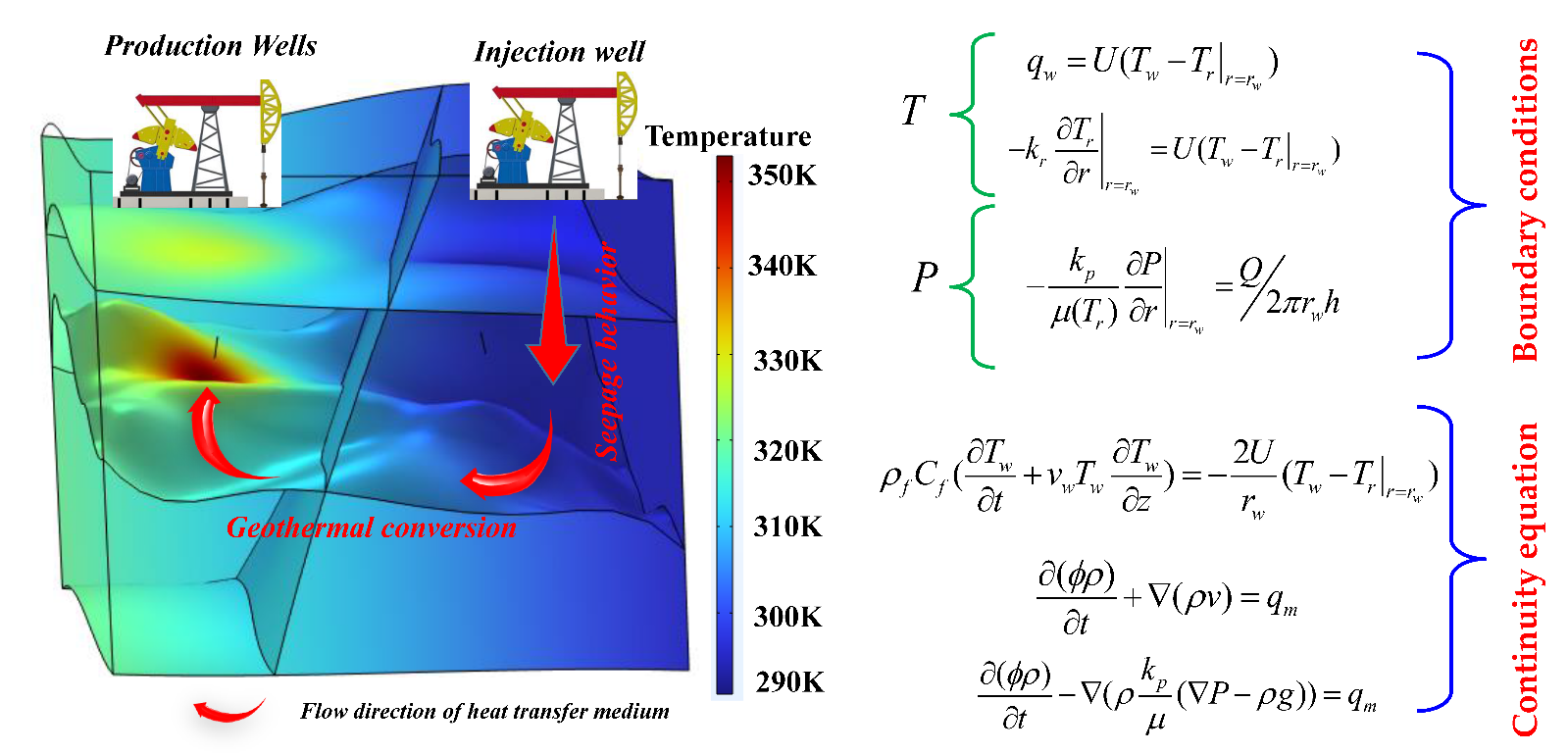
The geothermal resources present within the reservoir post-oil production in the oil field have hitherto been overlooked and underdeveloped, constituting a novel energy supplement for the maintenance of energy security. The present study constructed a geothermal transmission and exploitation model for oil reservoirs based on the geological environment and the characteristics of geothermal transmission media. This model can be used to analyse the impact of different factors on the efficiency of reservoir geothermal resources. Concurrently, a molecular dynamics model was constructed to reveal the geothermal transmission mechanism at a microscopic perspective, which will facilitate the optimisation of geothermal mining technology. The findings indicate that fluid viscosity hinders geothermal transmission, and the transmission medium of 40~mPa$\cdot$s increases the effective thermal influence radius by 9~m compared with the medium of 30~mPa$\cdot$s. Furthermore, the deflection angle of reservoir fractures is also not conducive to reservoir geothermal transmission. It has been demonstrated that an increase in the deflection angle results in a reduction of the transmission capacity, owing to substantial fluid filtration. The utilisation of reservoir geothermal resources provides fundamental data support for the rational application of energy and the assurance of energy security.
Graphical Abstract
Keywords
Data Availability Statement
Funding
Conflicts of Interest
Ethical Approval and Consent to Participate
References
- Hall, A., Scott, J. A., & Shang, H. (2011). Geothermal energy recovery from underground mines. Renewable and Sustainable Energy Reviews, 15(2), 916–924.
[CrossRef] [Google Scholar] - Loredo, C., Roqueñí, N., & Ordóñez, A. (2016). Modelling flow and heat transfer in flooded mines for geothermal energy use: A review. International Journal of Coal Geology, 164, 115–122.
[CrossRef] [Google Scholar] - Tester, J. W., Herzog, H. J., Chen, Z., Potter, R. M., & Frank, M. G. (1994). Prospects for universal geothermal energy from heat mining. Science & Global Security, 5(1), 99–121.
[CrossRef] [Google Scholar] - Aliyu, M. D., & Chen, H. P. (2017). Sensitivity analysis of deep geothermal reservoir: Effect of reservoir parameters on production temperature. Energy, 129, 101-113.
[CrossRef] [Google Scholar] - Gan, Q., & Elsworth, D. (2016). Production optimization in fractured geothermal reservoirs by coupled discrete fracture network modeling. Geothermics, 62, 131-142.
[CrossRef] [Google Scholar] - Breede, K., Dzebisashvili, K., Liu, X., & Falcone, G. (2013). A systematic review of enhanced (or engineered) geothermal systems: past, present and future. Geothermal Energy, 1(1), 4.
[CrossRef] [Google Scholar] - Zeng, Y. C., Su, Z., & Wu, N. Y. (2013). Numerical simulation of heat production potential from hot dry rock by water circulating through two horizontal wells at Desert Peak geothermal field. Energy, 56, 92-107.
[CrossRef] [Google Scholar] - Huang, Y., Kong, Y., Cheng, Y., Zhu, C., Zhang, J., & Wang, J. (2023). Evaluating the long-term sustainability of geothermal energy utilization from deep coal mines. Geothermics, 107, 102584.
[CrossRef] [Google Scholar] - Zhao, Y., Feng, Z., Zhao, Y., & Wan, Z. (2017). Experimental investigation on thermal cracking, permeability under HTHP and application for geothermal mining of HDR. Energy, 132, 305–314.
[CrossRef] [Google Scholar] - Qu, Z. Q., Zhang, W., & Guo, T. K. (2017). Influence of different fracture morphology on heat mining performance of enhanced geothermal systems based on COMSOL. International Journal of Hydrogen Energy, 42(29), 18263–18278.
[CrossRef] [Google Scholar] - Zhang, L., Ezekiel, J., Li, D., Pei, J., & Ren, S. (2014). Potential assessment of CO2 injection for heat mining and geological storage in geothermal reservoirs of China. Applied Energy, 122, 237–246.
[CrossRef] [Google Scholar] - Lund, J. W., & Toth, A. N. (2021). Direct utilization of geothermal energy 2020 worldwide review. Geothermics, 90, 101915.
[CrossRef] [Google Scholar] - Limberger, J., Boxem, T., Pluymaekers, M., Bruhn, D., Manzella, A., Calcagno, P., ... & van Wees, J. D. (2018). Geothermal energy in deep aquifers: A global assessment of the resource base for direct heat utilization. Renewable and Sustainable Energy Reviews, 82, 961-975.
[CrossRef] [Google Scholar] - Zhang, W., Qu, Z., Guo, T., & Wang, Z. (2019). Study of the enhanced geothermal system (EGS) heat mining from variably fractured hot dry rock under thermal stress. Renewable Energy, 143, 855–871.
[CrossRef] [Google Scholar] - Bongole, K., Sun, Z., & Yao, J. (2021). Potential for geothermal heat mining by analysis of the numerical simulation parameters in proposing enhanced geothermal system at Bongor Basin, Chad. Simulation Modelling Practice and Theory, 107, 102218.
[CrossRef] [Google Scholar] - Li, C., Hu, Y., Meng, T., Jin, P., Zhao, Z., & Zhang, C. (2020). Experimental study of the influence of temperature and cooling method on mechanical properties of granite: Implication for geothermal mining. Energy Science & Engineering, 8(5), 1716–1728.
[CrossRef] [Google Scholar] - Cui, G., Ren, S., Rui, Z., Ezekiel, J., Zhang, L., & Wang, H. (2018). The influence of complicated fluid-rock interactions on the geothermal exploitation in the CO2 plume geothermal system. Applied Energy, 227, 49–63.
[CrossRef] [Google Scholar] - Guo, P., Zheng, L., Sun, X., He, M., Wang, Y., & Shang, J. (2018). Sustainability evaluation model of geothermal resources in abandoned coal mine. Applied Thermal Engineering, 144, 804–811.
[CrossRef] [Google Scholar] - Lu, X., Tong, X., Du, X., Xiao, Y., & Deng, J. (2023). Effect of wellbore layout and varying flow rate on fluid flow and heat transfer of deep geothermal mining system. Thermal Science and Engineering Progress, 42, 101870.
[CrossRef] [Google Scholar] - Ramey Jr, H. J. (1962). Wellbore heat transmission. Journal of petroleum Technology, 14(04), 427-435.
[CrossRef] [Google Scholar] - O'Sullivan, M. J., Pruess, K., & Lippmann, M. J. (2001). State of the art of geothermal reservoir simulation. Geothermics, 30(4), 395–429.
[CrossRef] [Google Scholar] - Battistelli, A., Calore, C., & Pruess, K. (1997). The simulator TOUGH2/EWASG for modelling geothermal reservoirs with brines and non-condensible gas. Geothermics, 26(4), 437–464.
[CrossRef] [Google Scholar] - Wang, Z., Sun, B., & Sun, X. (2016). Calculation of temperature in fracture for carbon dioxide fracturing. SPE Journal, 21(5), 1491–1500.
[CrossRef] [Google Scholar] - Shi, Y., Bai, Z., Feng, G., Tian, H., & Bai, H. (2021). Performance analysis of medium-depth coaxial heat exchanger geothermal system using CO2 as a circulating fluid for building heating. Arabian Journal of Geosciences, 14(14), 1308.
[CrossRef] [Google Scholar] - Sun, Z. X., Zhang, X., Xu, Y., Yao, J., Wang, H. X., Lv, S., ... & Huang, X. (2017). Numerical simulation of the heat extraction in EGS with thermal-hydraulic-mechanical coupling method based on discrete fractures model. Energy, 120, 20-33.
[CrossRef] [Google Scholar] - Barbier, E. (2002). Geothermal energy technology and current status: an overview. Renewable and sustainable energy reviews, 6(1-2), 3-65.
[CrossRef] [Google Scholar] - Mao, S., & Duan, Z. (2009). The viscosity of aqueous alkali-chloride solutions up to 623 K, 1,000 bar, and high ionic strength. International Journal of Thermophysics, 30(5), 1510-1523.
[CrossRef] [Google Scholar] - Shaik, A. R., Rahman, S. S., Tran, N. H., & Tran, T. (2011). Numerical simulation of fluid-rock coupling heat transfer in naturally fractured geothermal system. Applied thermal engineering, 31(10), 1600-1606.
[CrossRef] [Google Scholar] - Fan, H., Zhang, L., Wang, R., Song, H., Xie, H., Du, L., & Sun, P. (2020). Investigation on geothermal water reservoir development and utilization with variable temperature regulation: a case study of China. Applied energy, 275, 115370.
[CrossRef] [Google Scholar] - Pandey, S. N., Chaudhuri, A., & Kelkar, S. (2017). A coupled thermo-hydro-mechanical modeling of fracture aperture alteration and reservoir deformation during heat extraction from a geothermal reservoir. Geothermics, 65, 17-31.
[CrossRef] [Google Scholar]
Cited By (42)
-
Xiao Luo, Zheng Sun. Thermodynamic Controls on Nanoscale Methane Transport: Reassessing Non-Ideal Fluid Dynamics in Tight Formation.
Processes, 2026 , 14 (14).
[CrossRef] -
E-chuan Wang, Hualin Liao, He-en Zhang. Experimental study and evaluation analysis on the plugging mechanism of sand control screen in argillaceous Fine-Silt gas hydrate reservoirs.
Scientific Reports, 2026 , 16 (1).
[CrossRef] -
Evar Umeozor. Application of Machine Learning Models to Oil Refinery Programming.
Processes, 2026 , 14 (7).
[CrossRef] -
Kepeng Hou, Yong Yang, Jing Zhang, Huafen Sun, Hai Liu, Li Qingchao. Mechanical Model and Mechanical Characteristic Analysis of Isolated Roof in Double‐Layer Goafs.
Advances in Civil Engineering, 2026 , 2026 (1).
[CrossRef] -
Bintao Zheng, Liaoyuan Zhang, Jiaqi Zhao, Yuan Li, Xianjie Xue, Wenhui Song. A permeability evolution model of high-pressure waterflooding with dual-fractal characteristics of mechanical properties and fracture structures.
Frontiers in Earth Science, 2026 , 13 .
[CrossRef] -
Jiang He, Hang Li, Lei Luo, Lin Qiao, Juzheng Li, Xiaolin Ma, Yuhan Zhang, Jian Yao, Sisi Jiang, Yaping Wang. Controlling Mechanisms of Burial Karstification in Gypsum Moldic Vug Reservoirs of the 4-1 Sub-Member, Member 5 of the Majiagou Formation, Central Ordos Basin.
Processes, 2026 , 14 (2).
[CrossRef] -
Jin Guo, Hu Meng. A High-Temperature-Resistant Nanogel for Profile Control and Water Shutoff in Deep Low-Permeability Reservoirs: Performance and Mechanism Study.
ACS Omega, 2026 , 11 (26).
[CrossRef] -
Edson de Andrade Araújo, Mateus Palharini Schwalbert, Rafael Japiassú Leitão, Lorena Cardoso Batista Aum, Pedro Tupã Pandava Aum. Influence of Skin Factor on Oil Recovery and Economic Performance in Synthetic Layered Carbonate Models Based on Pre-Salt Well Profiles.
Energies, 2026 , 19 (4).
[CrossRef] -
Xiangjun Ren, Hao Li. Effect of die temperature variation on biomass pelletizing and optimization of built-in heat source.
Energy Reports, 2026 , 15 .
[CrossRef] -
Shuhui Huang, Zhuyu Zhao, Zhiyou Chen, Qin Yong, Bo Sun, Wenna Jiang, Xiaomeng Han, Jun Lin. Research on the interfacial penetration mechanism in gas-assisted co-injection molding of polymers with different cross-sectional cavities.
Iranian Polymer Journal, 2026 .
[CrossRef] -
Tianlong Zhao, Xiong Hu, Changjing Fu, Gangyong Song, Liucheng Su, Yuanyang Chu. Modeling Landslide Dam Breach Due to Overtopping and Seepage: Development and Model Evaluation.
Sustainability, 2026 , 18 (2).
[CrossRef] -
Maoyuan Ma, Liangjie Mao, Xueyin Han, Jian Zhou, Denghuang Fu, Linping Zhang. Research on transient temperature field in hot dry rock drilling based on multi medium coupled heat transfer.
International Journal of Thermal Sciences, 2026 , 223 .
[CrossRef] -
Xinze Li, Dezhong Wang, Yixun Shi, Jiaojiao Jia, Zixu Wang. Research on the Evaluation Model for Natural Gas Pipeline Capacity Allocation Under Fair and Open Access Mode.
Energies, 2025 , 18 (20).
[CrossRef] -
Xing Guo, Xiao Sun, Ji-Ren Tang, Feng Shen, Zhao-Long Ge, Cai-Yun Xiao, Qi Cheng, Jing-Fu Mu, Kun Tian, Pan Luo. An Experimental Study on the Influence of CO2 Real-Time Contact on the Mechanical Properties of Shale.
Processes, 2025 , 13 (11).
[CrossRef] -
Yi Song, Xinjie Yang, Yongzhi Huang, Wenquan Deng, Xiaojin Zhou, Wenjing Song, Yurou Du, Xiaodong Hu. Log-Log Pressure Curve–Based Analysis and Evaluation of Shale Gas Stimulation: A Case Study from Block X, Sichuan Basin.
Energies, 2025 , 18 (23).
[CrossRef] -
Sushil Acharya, Karl Fabian, Anis Yazidi, Kjetil Westeng. Deep Hierarchical Graph Correlation: A Two-Stage Approach to Well-Log Alignment Using CNNs and Dynamic Programming.
Journal of Marine Science and Engineering, 2025 , 14 (1).
[CrossRef] -
Liandong Tang, Yongbin Zhang, Xueni Chen, Qihui Zhang, Mingjun Chen, Xuehao Pei, Yili Kang, Yiguo Zhang, Xingyu Tang, Bihui Zhou, Jun Li, Pandong Tian, Di Wu. Multiscale Gas Flow Mechanisms in Ultra-Deep Fractured Tight Sandstone Reservoirs with Water Invasion.
Processes, 2025 , 13 (11).
[CrossRef] -
Jianchi Hao, Shuangming Wang, Hu Wen, Zegong Liu, Lifeng Ren. Effect of Carbon Dioxide’s Injection Concentration on the Diffusion Coefficient of Methane.
ACS Omega, 2025 , 10 (50).
[CrossRef] -
Wenlan Wei, Yuqiang Li, Jiarui Cheng, Xinyang Guo, Xueer Fan, Pengju Bai, Kaixing Zhang. Study on Time-Dependent Load Characteristics of CO2 Fracturing Tubing Considering Multi-Field Coupling Effects.
Processes, 2025 , 14 (1).
[CrossRef] -
Jiguo Liu, Xialin Liu, Longhai Wei, Wenbo Peng, Shaobing Hu. A Multi-Stage Data-Driven Process for Magnetic Azimuth Error Compensation in Horizontal Wells Under Complex Magnetic Environments.
Processes, 2025 , 13 (11).
[CrossRef]
Cite This Article
TY  - JOUR
AU  - Wang, Fuling
AU  - Kobina, Forson
PY  - 2025
DA  - 2025/09/29
TI  - The Influence of Geological Factors and Transmission Fluids on the Exploitation of Reservoir Geothermal Resources: Factor Discussion and Mechanism Analysis
JO  - Reservoir Science
T2  - Reservoir Science
JF  - Reservoir Science
VL  - 1
IS  - 1
SP  - 3
EP  - 18
DO  - 10.62762/RS.2025.637298
UR  - https://www.icck.org/article/abs/RS.2025.637298
KW  - geothermal transmission
KW  - reservoir energy extraction
KW  - fluid heat transfer
KW  - energy engineering
KW  - petroleum reservoir
AB  - The geothermal resources present within the reservoir post-oil production in the oil field have hitherto been overlooked and underdeveloped, constituting a novel energy supplement for the maintenance of energy security. The present study constructed a geothermal transmission and exploitation model for oil reservoirs based on the geological environment and the characteristics of geothermal transmission media. This model can be used to analyse the impact of different factors on the efficiency of reservoir geothermal resources. Concurrently, a molecular dynamics model was constructed to reveal the geothermal transmission mechanism at a microscopic perspective, which will facilitate the optimisation of geothermal mining technology. The findings indicate that fluid viscosity hinders geothermal transmission, and the transmission medium of 40~mPa$\cdot$s increases the effective thermal influence radius by 9~m compared with the medium of 30~mPa$\cdot$s. Furthermore, the deflection angle of reservoir fractures is also not conducive to reservoir geothermal transmission. It has been demonstrated that an increase in the deflection angle results in a reduction of the transmission capacity, owing to substantial fluid filtration. The utilisation of reservoir geothermal resources provides fundamental data support for the rational application of energy and the assurance of energy security.
SN  - 3070-2356
PB  - Institute of Central Computation and Knowledge
LA  - English
ER  -
@article{Wang2025The,
  author = {Fuling Wang and Forson Kobina},
  title = {The Influence of Geological Factors and Transmission Fluids on the Exploitation of Reservoir Geothermal Resources: Factor Discussion and Mechanism Analysis},
  journal = {Reservoir Science},
  year = {2025},
  volume = {1},
  number = {1},
  pages = {3-18},
  doi = {10.62762/RS.2025.637298},
  url = {https://www.icck.org/article/abs/RS.2025.637298},
  abstract = {The geothermal resources present within the reservoir post-oil production in the oil field have hitherto been overlooked and underdeveloped, constituting a novel energy supplement for the maintenance of energy security. The present study constructed a geothermal transmission and exploitation model for oil reservoirs based on the geological environment and the characteristics of geothermal transmission media. This model can be used to analyse the impact of different factors on the efficiency of reservoir geothermal resources. Concurrently, a molecular dynamics model was constructed to reveal the geothermal transmission mechanism at a microscopic perspective, which will facilitate the optimisation of geothermal mining technology. The findings indicate that fluid viscosity hinders geothermal transmission, and the transmission medium of 40~mPa\$\cdot\$s increases the effective thermal influence radius by 9~m compared with the medium of 30~mPa\$\cdot\$s. Furthermore, the deflection angle of reservoir fractures is also not conducive to reservoir geothermal transmission. It has been demonstrated that an increase in the deflection angle results in a reduction of the transmission capacity, owing to substantial fluid filtration. The utilisation of reservoir geothermal resources provides fundamental data support for the rational application of energy and the assurance of energy security.},
  keywords = {geothermal transmission, reservoir energy extraction, fluid heat transfer, energy engineering, petroleum reservoir},
  issn = {3070-2356},
  publisher = {Institute of Central Computation and Knowledge}
}
Publisher's Note
ICCK stays neutral with regard to jurisdictional claims in published maps and institutional affiliations.
Rights and Permissions
 Copyright © 2025 by the Author(s). Published by Institute of Central Computation and Knowledge. This article is an open access article distributed under the terms and conditions of the Creative Commons Attribution (CC BY) license (https://creativecommons.org/licenses/by/4.0/), which permits use, sharing, adaptation, distribution and reproduction in any medium or format, as long as you give appropriate credit to the original author(s) and the source, provide a link to the Creative Commons licence, and indicate if changes were made.

