

Mechanistic Insights and Engineering Strategies for Wellbore Integrity Control in Polar Permafrost Reservoirs





Article Information
Abstract
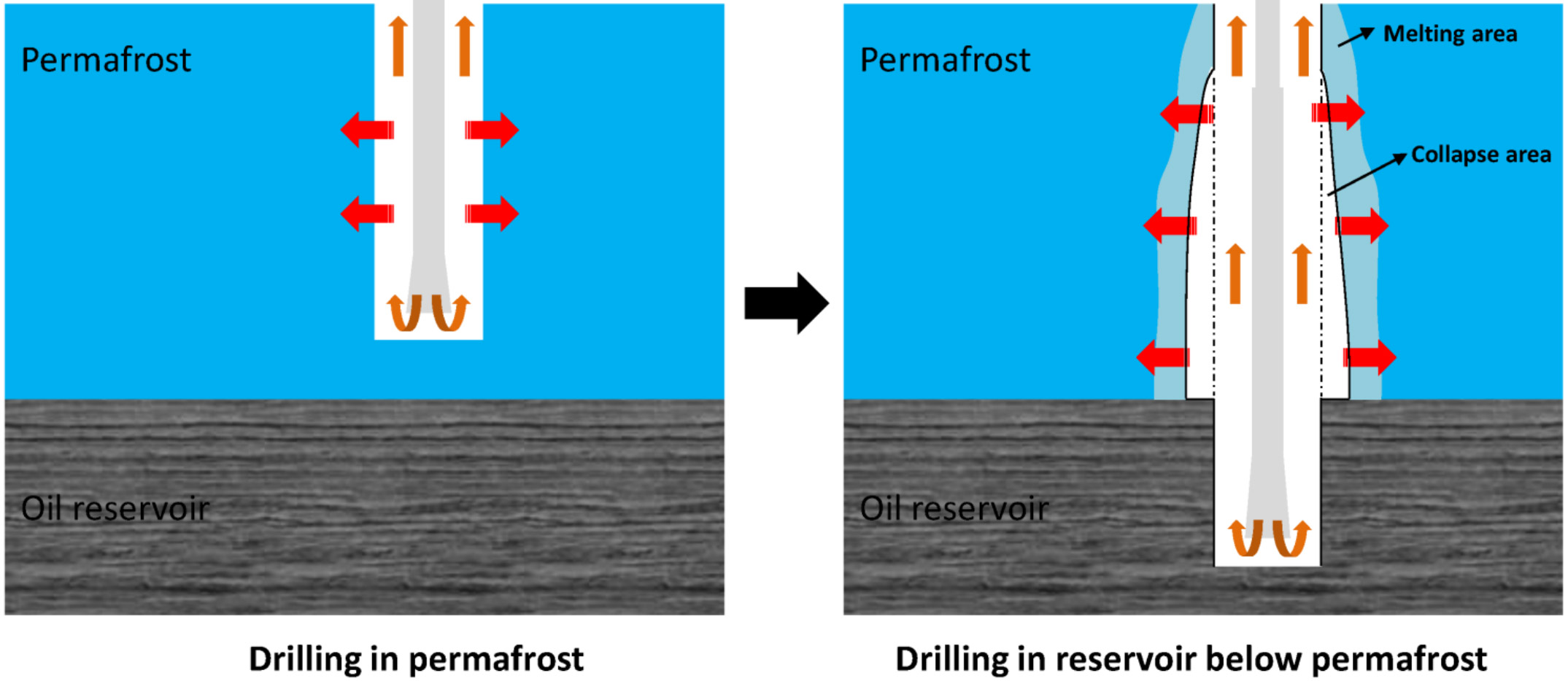
Permafrost is typical temperature-sensitive sediment, and geo-mechanical issues such as wellbore collapse and sand production are prone to occur during the oil and gas development. Therefore, it is crucial to elucidate the patterns and mechanisms of wellbore instability throughout the drilling process and to develop/propose effective control strategies. In this study, based on sensitivity analysis of wellbore stability, a method for determining the safe windows of drilling fluid temperature, density, and salinity was proposed, along with corresponding measures for preventing wellbore collapse. The investigation results indicate that the collapse of sediments around the wellbore was primarily distributed within an elliptical region oriented along the direction of the minimum horizontal principal stress. Furthermore, the worsening of wellbore collapse gradually slows as drilling operation progresses, and the final borehole enlargement rate corresponding to the default investigation case reaches 89.84\%. Sensitivity analysis showed that higher drilling fluid temperature, lower density, and elevated salinity all negatively affect wellbore stability. However, wellbore stability is easier to maintain when the permafrost has high initial ice saturation, low stress difference, and shallow burial depth. Ultimately, the safe mud temperature, density, and salinity windows derived from the wellbore stability simulations are beneficial for accurately controlling wellbore stability within the required range.
Graphical Abstract
Keywords
Data Availability Statement
Funding
Conflicts of Interest
AI Use Statement
Ethical Approval and Consent to Participate
References
- Zhou, X., Su, Y., Cheng, Y., & Li, Q. (2024). Evaluation of Thermal Insulation of Vacuum-Insulated Casing to Prevent Uncontrollable Melting of Ice and Borehole Instability in Permafrost. Processes, 12(7), 1389.
[CrossRef] [Google Scholar] - Li, Y., Shi, J., Cui, Q., & Song, L. (2025). Influence of Drilling Fluid Temperature, Density, and Salinity on Borehole Stability in Permafrost Strata. Processes, 13(2), 297.
[CrossRef] [Google Scholar] - Yakushev, V. (2023). Environmental and technological problems for natural gas production in permafrost regions. Energies, 16(11), 4522.
[CrossRef] [Google Scholar] - Wu, Z., Xu, L., Li, B., Wang, H., Sun, Y., & Ke, K. (2024). Hydrothermal coupling model between wellbore and permafrost for drilling in arctic cold regions. International Journal of Heat and Mass Transfer, 235, 126236.
[CrossRef] [Google Scholar] - Zhigarev, V. A. (2025). Study of the Influence of Gas-Liquid Systems on the Rate of Permafrost Thawing During Drilling. Journal of Siberian Federal University. Engineering & Technologies, 18(5), 574-585.
[Google Scholar] - Zhang, Y., Msangi, S., Edmonds, J., & Waldhoff, S. (2024). Limited increases in Arctic offshore oil and gas production with climate change and the implications for energy markets. Scientific Reports, 14(1), 6699.
[CrossRef] [Google Scholar] - Hu, X., Zhang, Y., Du Hongxing, H. Z., Wu, X., & Wang, H. (2025). Characteristic analysis of liquid CO2 jet flow field for gas hydrate well drilling. Acta Petrolei Sinica, 46(2), 426.
[CrossRef] [Google Scholar] - Wang, K. (2015). Simulation and analysis of wellbore stability in permafrost formation with FLAC (Master’s project). University of Alaska Fairbanks. http://hdl.handle.net/11122/8866
[Google Scholar] - Taylor, A. E. (1979). Thermal regime modelled for drilling and producing in permafrost. Journal of Canadian Petroleum Technology, 18(02).
[CrossRef] [Google Scholar] - Pui, N. K., & Kljucec, N. M. (1978). Temperature simulation while drilling permafrost. Journal of Canadian Petroleum Technology, 17(02).
[CrossRef] [Google Scholar] - Dong, L., Wu, N., Leonenko, Y., Wan, Y., Liao, H., Hu, G., & Li, Y. (2023). A coupled thermal-hydraulic-mechanical model for drilling fluid invasion into hydrate-bearing sediments. Energy, 278, 127785.
[CrossRef] [Google Scholar] - Zhou, X., Su, Y., Cheng, Y., & Li, Q. (2024). Preliminary insight into ice melting, surface subsidence, and wellhead instability during oil and gas extraction in permafrost region. Energies, 17(6), 1292.
[CrossRef] [Google Scholar] - Lau, H. C., Zhang, M., Wang, J., & Pan, L. (2020). Some technical considerations of gas-hydrate development from chinese permafrost regions. SPE Reservoir Evaluation & Engineering, 23(01), 369-387.
[CrossRef] [Google Scholar] - Shi, J., Li, Y., Yan, C., & Xue, M. (2024). Stability Analysis of Borehole Walls When Drilling with Normal-Temperature Drilling Fluids in Permafrost Strata. Processes, 12(9), 1819.
[CrossRef] [Google Scholar] - Wang, J., Liu, L., Zhao, K., Gao, T., Liu, J., Lv, K., ... & Sun, J. (2024). Numerical simulation study on the action law of low temperature drilling fluid intrusion into rock formation in polar drilling. Thermal Science, 28(2 Part A), 1007-1011.
[CrossRef] [Google Scholar] - Kustyshev, A. V., & Leontyev, D. S. (2016). Development and research of peat drilling mud for drilling in argillaceous rocks (Russian). Oil Industry Journal, 2016(01), 36-38. https://onepetro.org/OIJ/article-abstract/2016/01/36/15548/
[Google Scholar] - Talalay, P., Hu, Z., Xu, H., Yu, D., Han, L., Han, J., & Wang, L. (2014). Environmental considerations of low-temperature drilling fluids. Annals of Glaciology, 55(65), 31-40.
[CrossRef] [Google Scholar] - Chen, F., Gao, J., Feng, Y., Lin, H., Zhang, B., Bian, G., Yang, W., & Ouyang, H. (2024). Optimizing the wellbore trajectory of directional wells considering wellbore stability Subjected to the non-independence and uncertainty of geomechanical parameters. Geoenergy Science and Engineering, 241, 213085.
[CrossRef] [Google Scholar] - Talalay, P. G. (2022). Geotechnical and exploration drilling in the polar regions. Springer.
[CrossRef] [Google Scholar] - Zhang, Y., Qiu, Z., Zhao, X., Zhong, H., Huang, W., & Mu, J. (2021). Experimental study on ultra-low temperature drilling fluid in Arctic permafrost. Polar Science, 28, 100645.
[CrossRef] [Google Scholar] - Yu, F., Guo, P., & Na, S. (2022). A framework for constructing elasto‐plastic constitutive models for frozen and unfrozen soils. International Journal for Numerical and Analytical Methods in Geomechanics, 46(2), 436-466.
[CrossRef] [Google Scholar] - Allawi, R. H., & Al-Jawad, M. S. (2021). Wellbore instability management using geomechanical modeling and wellbore stability analysis for Zubair shale formation in Southern Iraq. Journal of Petroleum Exploration and Production Technology, 11(11), 4047-4062.
[CrossRef] [Google Scholar] - Jamshidi, E., Kianoush, P., Hosseini, N., & Adib, A. (2024). Scaling-up dynamic elastic logs to pseudo-static elastic moduli of rocks using a wellbore stability analysis approach in the Marun oilfield, SW Iran. Scientific Reports, 14(1), 19094.
[CrossRef] [Google Scholar] - Radwan, A. E. (2022). Drilling in complex pore pressure regimes: analysis of wellbore stability applying the depth of failure approach. Energies, 15(21), 7872.
[CrossRef] [Google Scholar] - Chen, G., Chenevert, M. E., Sharma, M. M., & Yu, M. (2003). A study of wellbore stability in shales including poroelastic, chemical, and thermal effects. Journal of Petroleum Science and Engineering, 38(3-4), 167-176.
[CrossRef] [Google Scholar] - Liao, Y., Wang, Z., Chao, M., Sun, X., Wang, J., Zhou, B., & Sun, B. (2021). Coupled wellbore–reservoir heat and mass transfer model for horizontal drilling through hydrate reservoir and application in wellbore stability analysis. Journal of Natural Gas Science and Engineering, 95, 104216.
[CrossRef] [Google Scholar] - Motahari, M., Hashemi, A., & Molaghab, A. (2022). Successful mechanical earth model construction and wellbore stability analysis using elastic and plasticity solutions, a case study. Geomechanics for Energy and the Environment, 32, 100357.
[CrossRef] [Google Scholar] - Ma, T., Liu, J., Fu, J., Qiu, Y., Fan, X., & Martyushev, D. A. (2025). Fully coupled thermo-hydro-mechanical model for wellbore stability analysis in deep gas-bearing unsaturated formations based on thermodynamics. Rock Mechanics and Rock Engineering, 58(1), 33-64.
[CrossRef] [Google Scholar] - Ajmera, B., & Emami Ahari, H. (2024). Review of the impact of permafrost thawing on the strength of soils. J. Cold Reg. Eng., 38(2), 03124001.
[CrossRef] [Google Scholar] - Mahetaji, M., & Brahma, J. (2024). Prediction of minimum mud weight for prevention of breakout using new 3D failure criterion to maintain wellbore stability. Rock Mechanics and Rock Engineering, 57(3), 2231-2252.
[CrossRef] [Google Scholar] - Gao, C., Miska, S., Yu, M., Dokhani, V., Ozbayoglu, E., & Takach, N. (2021). Experimental and numerical analysis of effective enhancement of wellbore stability in shales with nanoparticles. Journal of Natural Gas Science and Engineering, 95, 104197.
[CrossRef] [Google Scholar] - Hoseinpour, M., & Riahi, M. A. (2022). Determination of the mud weight window, optimum drilling trajectory, and wellbore stability using geomechanical parameters in one of the Iranian hydrocarbon reservoirs. Journal of Petroleum Exploration and Production Technology, 12(1), 63-82.
[CrossRef] [Google Scholar] - Eladj, S., Doghmane, M. Z., Lounissi, T. K., Djeddi, M., Tee, K. F., & Djezzar, S. (2022). 3D geomechanical model construction for wellbore stability analysis in Algerian Southeastern petroleum field. Energies, 15(20), 7455.
[CrossRef] [Google Scholar] - Wang, T., Yu, Y., Liu, J., Sun, Y., & Wang, Z. (2025). Risk assessment of wellbore instability during drilling in hydrate reservoirs based on thermo-hydro-mechanical coupling. Ocean Engineering, 341, 122689.
[CrossRef] [Google Scholar] - Li, H., Sun, J., Lv, K., Huang, X., Zhang, P., & Zhang, Z. (2022). Wettability alteration to maintain wellbore stability of shale formation using hydrophobic nanoparticles. Colloids and Surfaces A: Physicochemical and Engineering Aspects, 635, 128015.
[CrossRef] [Google Scholar] - Jain, G., & Singh, A. (2024). An elastoplastic semi-analytical solution for enhanced geothermal wellbore stability considering temperature-sensitive failure criterion. Geothermics, 121, 103046.
[CrossRef] [Google Scholar] - Shad, S., Kolahkaj, P., & Zivar, D. (2023). Geomechanical analysis of an oil field: Numerical study of wellbore stability and reservoir subsidence. Petroleum Research, 8(3), 350-359.
[CrossRef] [Google Scholar] - Heydari, M., Aghakhani Emamqeysi, M. R., & Sanei, M. (2022). Finite element analysis of wellbore stability and optimum drilling direction and applying NYZA method for a safe mud weight window. Journal of Analytical and Numerical Methods in Mining Engineering, 11(29), 67-76.
[Google Scholar] - Gao, L., Shi, X., Liu, J., & Chen, X. (2022). Simulation-based three-dimensional model of wellbore stability in fractured formation using discrete element method based on formation microscanner image: A case study of Tarim Basin, China. Journal of Natural Gas Science and Engineering, 97, 104341.
[CrossRef] [Google Scholar] - Lv, K., Liu, J., Jin, J., Sun, J., Huang, X., Liu, J., Guo, X., Hou, Q., Zhao, J., Liu, K., Wang, J., & Bai, Y. (2022). Synthesis of a novel cationic hydrophobic shale inhibitor with preferable wellbore stability. Colloids and Surfaces A: Physicochemical and Engineering Aspects, 637, 128274.
[CrossRef] [Google Scholar] - Li, J., Ma, Y., Liu, Y., & Liu, Q. (2024). Numerical simulation for the effect of mud cake time-dependent properties on wellbore stability. Rock Mechanics and Rock Engineering, 57(1), 581-596.
[CrossRef] [Google Scholar] - Freij-Ayoub, R., Tan, C., Clennell, B., Tohidi, B., & Yang, J. (2007). A wellbore stability model for hydrate bearing sediments. Journal of petroleum science and engineering, 57(1-2), 209-220.
[CrossRef] [Google Scholar] - Montes, A. C., Callerio, S., Turhan, Ç., Safarov, A., Ashok, P., & van Oort, E. (2024). Automatic Determination of Cuttings and Cavings Properties for Hole Cleaning and Wellbore Stability Assessment Using a Laser-Based Sensor. SPE Journal, 29(10), 5238-5257.
[CrossRef] [Google Scholar] - Liu, H., Cui, S., Meng, Y., Chen, Z., & Sun, H. (2023). Study on mechanical properties and wellbore stability of deep sandstone rock based on variable parameter MC criterion. Geoenergy Science and Engineering, 224, 211609.
[CrossRef] [Google Scholar] - Abu Dayyeh, H., Wang, X., Chen, S. L., Han, Y., & Abousleiman, Y. (2025). Graphical Analysis–Based Elastoplastic Solution for Wellbore Stability Problem in Hoek–Brown Rock under Moderate Nonhydrostatic Far-Field Stress and Undrained Conditions. Journal of Engineering Mechanics, 151(10), 04025055.
[CrossRef] [Google Scholar] - Peng, H., Yue, Y., Luo, X., Gao, J., He, M., Wen, J., Yin, H., & Chen, Y. (2023). Double-porosity poromechanical models for wellbore stability of inclined borehole drilled through the naturally fractured porous rocks. Geoenergy Science and Engineering, 228, 211756.
[CrossRef] [Google Scholar] - Li, Y., Cheng, Y., Yan, C., Xue, M., Niu, C., Gao, Y., & Wang, T. (2020). Simulating the effect of frozen soil thaw on wellhead stability during oil and gas drilling operations in arctic waters. Journal of Cold Regions Engineering, 34(4), 04020026.
[CrossRef] [Google Scholar]
Cited By (10)
-
Zhenfeng Zhang, Chong Jiang, Aiyun Song, Yixin Wang, Yangling Chen, Shiqiao Ruan, Ying Zhao. Quantifying the Cross-Regional Spillover Effects of Offshore Wind Power on National Carbon Footprint: Insights from China’s Two Largest Installed Capacity Provinces.
Sustainability, 2026 , 18 (12).
[CrossRef] -
Ze Li, Bo Zeng, Xiaojin Zhou, Huan Peng, Yongjun Xiao, Juntao Yan, Wang Liu, Jun Su. Optimization of pump rate for hydraulic fracturing of shale in the Qiongzhusi Formation.
Frontiers in Earth Science, 2026 , 14 .
[CrossRef] -
Wenlong Xia, Zhaoyu Wang, Xiaodong Dai, Changlei Tan, Chenlong Duan, Fankun Meng. Ensemble Feature Engineering and Crayfish Optimization Algorithm-Optimized Random Forest for Productivity Prediction in High-Water-Cut Offshore Reservoirs.
Processes, 2026 , 14 (11).
[CrossRef] -
Shunzuo Qiu, Zhaoliang Zhu, Yan Yang, Qin Liu, Yan Jiang, Caixia Xian. Effect of Structural Parameters on Performance of Dissolvable Metal Ball Seat Sealing Rings in Frac Plug.
Technologies, 2026 , 14 (6).
[CrossRef] -
Ying Han, Feifan Shan, Feiyan Zhang, Chen Niu, Qingchao Li. Precise Definition and Quantitative Assessment of Ineffective Boreholes in Coalbed Methane Drainage.
Energies, 2026 , 19 (11).
[CrossRef] -
Lili Wang, Yanming Zhang, Zhanguo Ma, Changjing Zhou, Fei Feng, Yonghong Gu, Xinjia Liu, Xiaobo Lin, Yuhang Xie, Fuling Wang. Analysis of Hydraulic Fracture Propagation Behavior Using a Thermo-Hydro-Mechanical Coupled Model.
Processes, 2026 , 14 (18).
[CrossRef] -
Peng Su, Shouzhi Hu, Honghan Chen, Simeng Cui, Yangfan Guo. Effects of Carnian Pluvial Episode on the Yanchang Formation Depositional Environment and Hydrocarbon Accumulation, Ordos Basin, China.
Geosciences, 2026 , 16 (6).
[CrossRef] -
Qiang Li, Fuling Wang, Jingjuan Wu, Qingchao Li, Gan Zhang. Multivariate Coupling Model and Reservoir Characteristics of Enhanced Geothermal Reservoirs.
Energies, 2026 , 19 (13).
[CrossRef] -
Qingchao Li, Qiang Li. Editorial for the Special Issue “Environmentally Friendly Production of Energy from Natural Gas Hydrates”.
Processes, 2026 , 14 (12).
[CrossRef] -
Xiang Ruan, Kai Sun, Xuewen Ma, Xianglu Wang, Hangyu Chen, Limin Huang, Li Qingchao. Numerical Investigation of the Hydrodynamic Characteristics of Typical Bridge Pier Structures.
Advances in Civil Engineering, 2026 , 2026 (1).
[CrossRef]
Cite This Article
TY  - JOUR
AU  - Zhou, Xiaohui
AU  - Yang, Feiran
AU  - Chen, Zhen
AU  - Su, Yinao
PY  - 2026
DA  - 2026/04/29
TI  - Mechanistic Insights and Engineering Strategies for Wellbore Integrity Control in Polar Permafrost Reservoirs
JO  - Reservoir Science
T2  - Reservoir Science
JF  - Reservoir Science
VL  - 2
IS  - 2
SP  - 126
EP  - 150
DO  - 10.62762/RS.2025.816374
UR  - https://www.icck.org/article/abs/RS.2025.816374
KW  - wellbore integrity
KW  - numerical simulation
KW  - permafrost
KW  - wellbore collapse
KW  - engineering optimization
AB  - Permafrost is typical temperature-sensitive sediment, and geo-mechanical issues such as wellbore collapse and sand production are prone to occur during the oil and gas development. Therefore, it is crucial to elucidate the patterns and mechanisms of wellbore instability throughout the drilling process and to develop/propose effective control strategies. In this study, based on sensitivity analysis of wellbore stability, a method for determining the safe windows of drilling fluid temperature, density, and salinity was proposed, along with corresponding measures for preventing wellbore collapse. The investigation results indicate that the collapse of sediments around the wellbore was primarily distributed within an elliptical region oriented along the direction of the minimum horizontal principal stress. Furthermore, the worsening of wellbore collapse gradually slows as drilling operation progresses, and the final borehole enlargement rate corresponding to the default investigation case reaches 89.84\%. Sensitivity analysis showed that higher drilling fluid temperature, lower density, and elevated salinity all negatively affect wellbore stability. However, wellbore stability is easier to maintain when the permafrost has high initial ice saturation, low stress difference, and shallow burial depth. Ultimately, the safe mud temperature, density, and salinity windows derived from the wellbore stability simulations are beneficial for accurately controlling wellbore stability within the required range.
SN  - 3070-2356
PB  - Institute of Central Computation and Knowledge
LA  - English
ER  -
@article{Zhou2026Mechanisti,
  author = {Xiaohui Zhou and Feiran Yang and Zhen Chen and Yinao Su},
  title = {Mechanistic Insights and Engineering Strategies for Wellbore Integrity Control in Polar Permafrost Reservoirs},
  journal = {Reservoir Science},
  year = {2026},
  volume = {2},
  number = {2},
  pages = {126-150},
  doi = {10.62762/RS.2025.816374},
  url = {https://www.icck.org/article/abs/RS.2025.816374},
  abstract = {Permafrost is typical temperature-sensitive sediment, and geo-mechanical issues such as wellbore collapse and sand production are prone to occur during the oil and gas development. Therefore, it is crucial to elucidate the patterns and mechanisms of wellbore instability throughout the drilling process and to develop/propose effective control strategies. In this study, based on sensitivity analysis of wellbore stability, a method for determining the safe windows of drilling fluid temperature, density, and salinity was proposed, along with corresponding measures for preventing wellbore collapse. The investigation results indicate that the collapse of sediments around the wellbore was primarily distributed within an elliptical region oriented along the direction of the minimum horizontal principal stress. Furthermore, the worsening of wellbore collapse gradually slows as drilling operation progresses, and the final borehole enlargement rate corresponding to the default investigation case reaches 89.84\\%. Sensitivity analysis showed that higher drilling fluid temperature, lower density, and elevated salinity all negatively affect wellbore stability. However, wellbore stability is easier to maintain when the permafrost has high initial ice saturation, low stress difference, and shallow burial depth. Ultimately, the safe mud temperature, density, and salinity windows derived from the wellbore stability simulations are beneficial for accurately controlling wellbore stability within the required range.},
  keywords = {wellbore integrity, numerical simulation, permafrost, wellbore collapse, engineering optimization},
  issn = {3070-2356},
  publisher = {Institute of Central Computation and Knowledge}
}
Publisher's Note
ICCK stays neutral with regard to jurisdictional claims in published maps and institutional affiliations.
Rights and Permissions
 Copyright © 2026 by the Author(s). Published by Institute of Central Computation and Knowledge. This article is an open access article distributed under the terms and conditions of the Creative Commons Attribution (CC BY) license (https://creativecommons.org/licenses/by/4.0/), which permits use, sharing, adaptation, distribution and reproduction in any medium or format, as long as you give appropriate credit to the original author(s) and the source, provide a link to the Creative Commons licence, and indicate if changes were made.