


Methane Interface Desorption Mechanism in Geological Reservoirs After Natural Gas Hydrate Decomposition



Article Information
Abstract
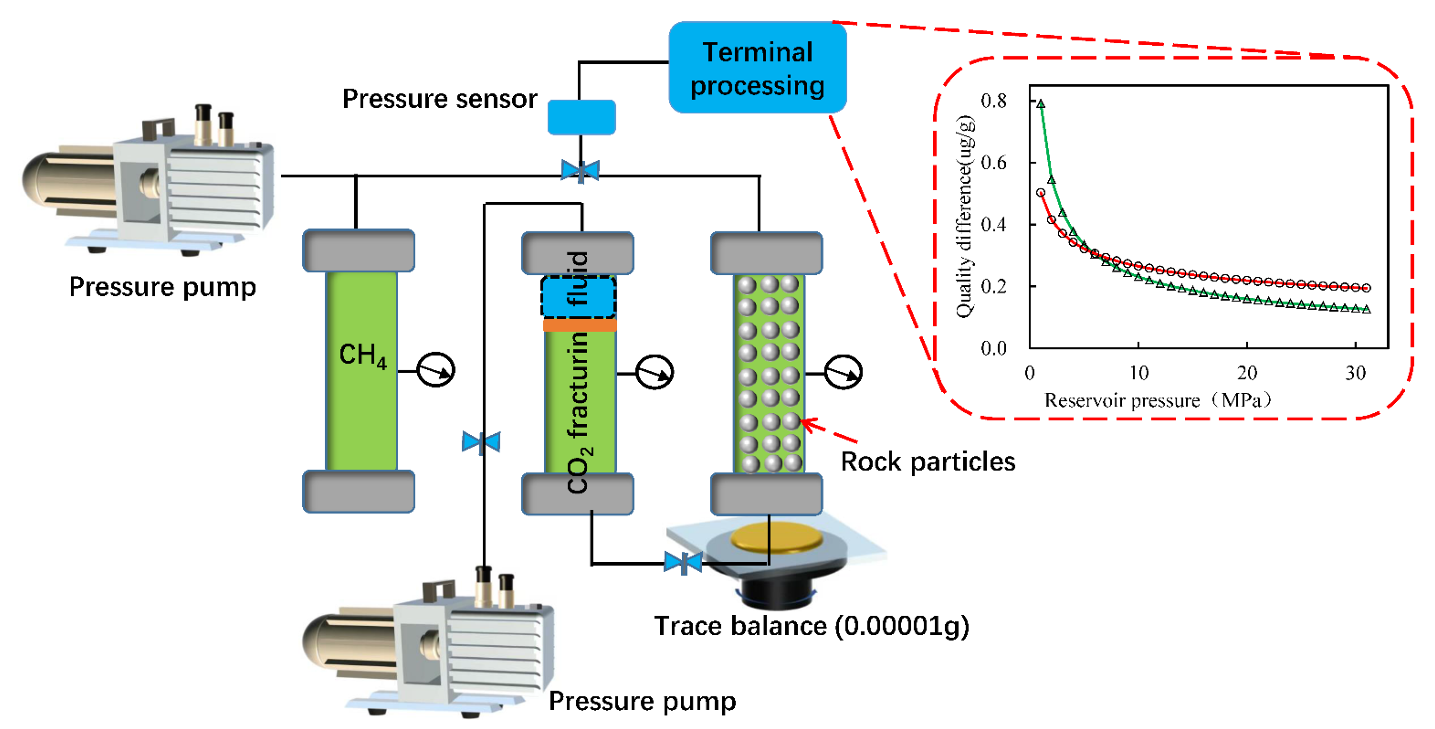
The morphological transformation of methane hydrates during re-exploitation, caused by depressurization and changes in reservoir environment, significantly impacts hydrate extraction. The present study explores the adsorption and desorption behaviour of methane under different environmental factors by constructing a rock adsorption and desorption device, which can contribute to the efficient extraction of methane during the decomposition of methane hydrates. The findings demonstrate that reservoir temperature strongly promotes methane desorption. Desorption capacity increased markedly above $100^{\circ}\mathrm{C}$, reaching $9.4~\mu\mathrm{g/g}$ at $120^{\circ}\mathrm{C}$, consistent with reduced adsorption enthalpy ($\Delta H_{\text{ads}}$ from $-4.2$ to $-5.2\times10^{-3}$ kJ/mol) and increased Gibbs free energy favoring desorption. In contrast, higher reservoir pressure enhanced the drag force of the driving fluid, with methane desorption showing a sharp increase at pressures around $25$ MPa, although low pressures yielded only marginal improvements. In addition, methane desorption rose from $5.3~\mu\mathrm{g/g}$ in low-CO$_2$ formulations to $8.2~\mu\mathrm{g/g}$ at $90%$ CO$_2$ content, driven by increased drag force (from $2.5\times10^{-3}$ N to $4.3\times10^{-3}$ N) and reduced adsorption energy (from $6.2\times10^{-4}$ N to $4.8\times10^{-4}$ N). Among reservoir minerals, montmorillonite showed the highest methane desorption capacity due to its lowest adsorption enthalpy and strong electrostatic repulsion, followed by illite, while kaolinite exhibited the weakest desorption performance. In conclusion, the present study provides fundamental data for the desorption and efficient extraction of methane leaked into geological reservoirs after the decomposition of methane hydrates.
Graphical Abstract
Keywords
Data Availability Statement
Funding
Conflicts of Interest
AI Use Statement
Ethical Approval and Consent to Participate
References
- Song, Y., Yang, L., Zhao, J., Liu, W., Yang, M., Li, Y., ... & Li, Q. (2014). The status of natural gas hydrate research in China: A review. Renewable and Sustainable Energy Reviews, 31, 778-791.
[CrossRef] [Google Scholar] - Koh, C. A. (2002). Towards a fundamental understanding of natural gas hydrates. Chemical Society Reviews, 31(3), 157-167.
[CrossRef] [Google Scholar] - Makogon, Y. F. (2010). Natural gas hydrates–A promising source of energy. Journal of natural gas science and engineering, 2(1), 49-59.
[CrossRef] [Google Scholar] - Li, X. S., Xu, C. G., Zhang, Y., Ruan, X. K., Li, G., & Wang, Y. (2016). Investigation into gas production from natural gas hydrate: A review. Applied energy, 172, 286-322.
[CrossRef] [Google Scholar] - Yu, Y. S., Zhang, X., Liu, J. W., Lee, Y., & Li, X. S. (2021). Natural gas hydrate resources and hydrate technologies: a review and analysis of the associated energy and global warming challenges. Energy & Environmental Science, 14(11), 5611-5668.
[CrossRef] [Google Scholar] - Yang, M., Zhao, J., Zheng, J. N., & Song, Y. (2019). Hydrate reformation characteristics in natural gas hydrate dissociation process: A review. Applied Energy, 256, 113878.
[CrossRef] [Google Scholar] - Pang, X. Q., Chen, Z. H., Jia, C. Z., Wang, E. Z., Shi, H. S., Wu, Z. Y., ... & Wang, T. (2021). Evaluation and re-understanding of the global natural gas hydrate resources. Petroleum Science, 18(2), 323-338.
[CrossRef] [Google Scholar] - Ye, J. L., Qin, X. W., Xie, W. W., Lu, H. L., Ma, B. J., Qiu, H. J., ... & Bian, H. (2020). The second natural gas hydrate production test in the South China Sea. China Geology, 3(2), 197-209.
[CrossRef] [Google Scholar] - Qin, X. W., Lu, J. A., Lu, H. L., Qiu, H. J., Liang, J. Q., Kang, D. J., ... & Kuang, Z. G. (2020). Coexistence of natural gas hydrate, free gas and water in the gas hydrate system in the Shenhu Area, South China Sea. China Geology, 3(2), 210-220.
[CrossRef] [Google Scholar] - Wu, N., Li, Y., Wan, Y., Sun, J., Huang, L. & Mao, P. (2021). Prospect of marine natural gas hydrate stimulation theory and technology system. Natural Gas Industry B, 8(2), 173-187.
[CrossRef] [Google Scholar] - Boswell, R., Yoneda, J., & Waite, W. F. (2019). India National Gas Hydrate Program Expedition 02 summary of scientific results: Evaluation of natural gas-hydrate-bearing pressure cores. Marine and Petroleum Geology, 108, 143-153.
[CrossRef] [Google Scholar] - Sahu, C., Kumar, R., & Sangwai, J. S. (2020). Comprehensive review on exploration and drilling techniques for natural gas hydrate reservoirs. Energy & Fuels, 34(10), 11813-11839.
[CrossRef] [Google Scholar] - Chong, Z. R., Yang, S. H. B., Babu, P., Linga, P., & Li, X. S. (2016). Review of natural gas hydrates as an energy resource: Prospects and challenges. Applied energy, 162, 1633-1652.
[CrossRef] [Google Scholar] - Wei, N., Pei, J., Li, H., Zhou, S., Zhao, J., Kvamme, B., ... & Xue, J. (2024). Classification of natural gas hydrate resources: Review, application and prospect. Gas Science and Engineering, 124, 205269.
[CrossRef] [Google Scholar] - Gajanan, K., Ranjith, P. G., Yang, S. Q., & Xu, T. (2024). Advances in research and developments on natural gas hydrate extraction with gas exchange. Renewable and Sustainable Energy Reviews, 190, 114045.
[CrossRef] [Google Scholar] - Liu, T., Wu, P., Chen, Z., & Li, Y. (2022). Review on carbon dioxide replacement of natural gas hydrate: research progress and perspectives. Energy & Fuels, 36(14), 7321-7336.
[CrossRef] [Google Scholar] - Yan, C., Ren, X., Cheng, Y., Song, B., Li, Y., & Tian, W. (2020). Geomechanical issues in the exploitation of natural gas hydrate. Gondwana Research, 81, 403-422.
[CrossRef] [Google Scholar] - Yamamoto, K., Boswell, R., Collett, T. S., Dallimore, S. R., & Lu, H. (2022). Review of past gas production attempts from subsurface gas hydrate deposits and necessity of long-term production testing. Energy & Fuels, 36(10), 5047-5062.
[CrossRef] [Google Scholar] - Zhao, D., Li, X., Feng, Z., Pu, Y., Chang, H., & Jia, Y. (2022). Study on the behavior and mechanism of methane desorption-diffusion for multi-scale coal samples under multi-temperature conditions. Fuel, 328, 125332.
[CrossRef] [Google Scholar] - Xu, H., Qin, Y., Yang, D., Wang, G., Huang, Q., & Zhang, F. (2024). Experimental investigation of gas diffusion kinetics and pore-structure characteristics during coalbed methane desorption within a coal seam. Gas Science and Engineering, 121, 205173.
[CrossRef] [Google Scholar] - Zou, Y., Liu, X., Nie, B., Luo, B., Liu, P., & Zhao, X. (2023). Quantitative evaluation of the influence of injected water on methane desorption behaviors of coal in the ordos basin. Energy & Fuels, 37(22), 17227-17237.
[CrossRef] [Google Scholar] - Li, Y., Wang, L., Xie, Y., Wu, P., Liu, T., Huang, L., ... & Song, Y. (2023). Deformation characteristics of methane hydrate-bearing clayey and sandy sediments during depressurization dissociation. Energy, 275, 127527.
[CrossRef] [Google Scholar] - Wang, T., Deng, Z., Hu, H., Ding, R., Tian, F., Zhang, T., ... & Wang, D. (2024). Pore structure of deep coal of different ranks and its effect on coalbed methane adsorption. International Journal of Hydrogen Energy, 59, 144-158.
[CrossRef] [Google Scholar] - Ye, J., Tao, S., Zhao, S., Li, S., Chen, S., & Cui, Y. (2022). Characteristics of methane adsorption/desorption heat and energy with respect to coal rank. Journal of Natural Gas Science and Engineering, 99, 104445.
[CrossRef] [Google Scholar] - Xie, W., Wang, M., Chen, S., Vandeginste, V., Yu, Z., & Wang, H. (2022). Effects of gas components, reservoir property and pore structure of shale gas reservoir on the competitive adsorption behavior of CO2 and CH4. Energy, 254, 124242.
[CrossRef] [Google Scholar] - Li, Y., Wang, Z., Tang, S., & Elsworth, D. (2022). Re-evaluating adsorbed and free methane content in coal and its ad-and desorption processes analysis. Chemical Engineering Journal, 428, 131946.
[CrossRef] [Google Scholar] - Zhang, L., Deng, C., Guo, X., Zhang, Y., Song, L., Shi, T., ... & Li, G. (2025). Ultrasonic cavitation response mechanism of coalbed methane desorption-seepage and coal pores damage. Process Safety and Environmental Protection, 201, 107552.
[CrossRef] [Google Scholar] - Kang, J., Zhu, J., Wang, Y., Zhou, F., & Liu, Y. (2022). Dynamical modeling of coupled heat and mass transfer process of coalbed methane desorption in porous coal matrix. International Journal of Heat and Mass Transfer, 183, 122212.
[CrossRef] [Google Scholar] - Shi, P., Wang, S., Gao, Y., Yuwen, X., Ma, F., Haidong, W., & Mei, Y. (2025). Insight into the effect of fracturing thickener adsorption on coalbed methane desorption: Experiments and mechanisms. Colloids and Surfaces A: Physicochemical and Engineering Aspects, 137734.
[CrossRef] [Google Scholar] - Ren, W. (2025). Modeling hysteretic adsorption and desorption of methane on shale. Energy & Fuels, 39(34), 16214-16222.
[CrossRef] [Google Scholar] - Ming-yi, C., Zi-ting, P., Shi-bo, H., Wei-wei, S., Fu-chao, T., & Xue-jie, Z. (2025). Investigation of microstructural characteristics and methane desorption in coal using surfactant treatment. Fuel, 401, 135826.
[CrossRef] [Google Scholar] - Li, Z., Ren, T., Cheng, Y., He, X., Qiao, M., Black, D., ... & Nemcik, J. (2024). Study of methane and carbon dioxide adsorption-desorption hysteresis in coals from Sydney Basin: A theoretical and experimental approach. International Journal of Mining Science and Technology, 34(10), 1453-1463.
[CrossRef] [Google Scholar] - Huang, S., Jiang, G., Chang, Z., Wang, Q., Dong, T., He, Y., ... & Jin, Z. (2025). The effect of viscoelastic surfactant fracturing fluid on methane adsorption/desorption characteristics in Shale: Experimental and mechanistic study. Chemical Engineering Journal, 510, 161901.
[CrossRef] [Google Scholar] - Wang, Z., Deng, Z., Fu, X., Li, G., Pan, J., Hao, M., & Zhou, H. (2021). Effects of Methane Saturation and Nitrogen Pressure on N2–Enhanced Coalbed Methane Desorption Strain Characteristics of Medium-Rank Coal. Natural Resources Research, 30(2), 1527-1545.
[CrossRef] [Google Scholar] - Zhang, X., Sun, J., Liu, C., & Sun, Q. (2025). Synthesis comparative evaluation of hydrophobic polymer/surfactant fracturing fluids on methane adsorption–desorption and pore structure modifications in coal. International Journal of Coal Science & Technology, 12(1), 86.
[CrossRef] [Google Scholar] - Li, X., Si, X., Li, X., Zhang, S., Yang, T., Hu, L., ... & Li, Z. (2025). Methane release and energy evolution in coal and its implication for gas outburst. Physics of Fluids, 37(2).
[CrossRef] [Google Scholar] - Ren, J., Niu, Q., Wang, Z., Wang, W., Yuan, W., Weng, H., ... & Du, Z. (2022). CO2 adsorption/desorption, induced deformation behavior, and permeability characteristics of different rank coals: Application for CO2-enhanced coalbed methane recovery. Energy & Fuels, 36(11), 5709-5722.
[CrossRef] [Google Scholar] - Chen, X., Shi, B., Cao, Y., Long, P., Qi, Y., & Li, L. (2024). Study on the wettability and methane desorption characteristics of coal under high pressure with different surfactants. ACS omega, 9(18), 20012-20020.
[CrossRef] [Google Scholar] - Hu, X., Deng, H., Lu, C., Tian, Y., & Jin, Z. (2019). Characterization of CO2/CH4 competitive adsorption in various clay minerals in relation to shale gas recovery from molecular simulation. Energy & Fuels, 33(9), 8202-8214.
[CrossRef] [Google Scholar] - Heller, R., & Zoback, M. (2014). Adsorption of methane and carbon dioxide on gas shale and pure mineral samples. Journal of unconventional oil and gas resources, 8, 14-24.
[CrossRef] [Google Scholar] - Liang, L., Xiong, J., Liu, X., & Luo, D. (2016). An investigation into the thermodynamic characteristics of methane adsorption on different clay minerals. Journal of Natural Gas Science and Engineering, 33, 1046-1055.
[CrossRef] [Google Scholar] - Liu, D., Yuan, P., Liu, H., Li, T., Tan, D., Yuan, W., & He, H. (2013). High-pressure adsorption of methane on montmorillonite, kaolinite and illite. Applied Clay Science, 85, 25-30.
[CrossRef] [Google Scholar] - Du, X., Guang, W., Cheng, Y., Hou, Z., Liu, Z., Yin, H., ... & Shu, C. (2020). Thermodynamics analysis of the adsorption of CH4 and CO2 on montmorillonite. Applied Clay Science, 192, 105631.
[CrossRef] [Google Scholar] - Du, X., Pang, D., Zhao, Y., Hou, Z., Wang, H., & Cheng, Y. (2022). Investigation into the adsorption of CO2, N2 and CH4 on kaolinite clay. Arabian Journal of Chemistry, 15(3), 103665.
[CrossRef] [Google Scholar] - Liu, F., Ellett, K., Xiao, Y., & Rupp, J. A. (2013). Assessing the feasibility of CO2 storage in the New Albany Shale (Devonian–Mississippian) with potential enhanced gas recovery using reservoir simulation. International Journal of Greenhouse Gas Control, 17, 111-126.
[CrossRef] [Google Scholar] - Jin, Z., & Firoozabadi, A. (2014). Effect of water on methane and carbon dioxide sorption in clay minerals by Monte Carlo simulations. Fluid Phase Equilibria, 382, 10-20.
[CrossRef] [Google Scholar] - Gu, M., Xian, X., Duan, S., & Du, X. (2017). Influences of the composition and pore structure of a shale on its selective adsorption of CO2 over CH4. Journal of Natural Gas Science and Engineering, 46, 296-306.
[CrossRef] [Google Scholar] - Pei, P., Ling, K., He, J., & Liu, Z. (2015). Shale gas reservoir treatment by a CO2-based technology. Journal of Natural Gas Science and Engineering, 26, 1595-1606.
[CrossRef] [Google Scholar] - Yang, K., Zhou, J., Xian, X., Zhang, C., Tian, S., Dong, Z., ... & Cai, J. (2021). Adsorption characteristics and thermodynamic analysis of CH4 and CO2 on continental and marine shale. Transport in Porous Media, 140(3), 763-788.
[CrossRef] [Google Scholar]
Cited By (10)
-
Qiang Li, Fuling Wang, Jingjuan Wu, Qingchao Li, Gan Zhang. Multivariate Coupling Model and Reservoir Characteristics of Enhanced Geothermal Reservoirs.
Energies, 2026 , 19 (13).
[CrossRef] -
Xiang Ruan, Kai Sun, Xuewen Ma, Xianglu Wang, Hangyu Chen, Limin Huang, Li Qingchao. Numerical Investigation of the Hydrodynamic Characteristics of Typical Bridge Pier Structures.
Advances in Civil Engineering, 2026 , 2026 (1).
[CrossRef] -
Vladislav Filatov, Irina Rastvorova, Fedor Chmilenko. Enhancing the Information Content of IR Spectroscopy of High-Viscosity Oil in the Field Using Ultrasonic Sample Preparation.
Energies, 2026 , 19 (13).
[CrossRef] -
Azizollah Khormali, Soroush Ahmadi. Hybrid nano-chemical enhanced oil recovery processes in oil reservoirs: A critical review.
Results in Engineering, 2026 , 32 .
[CrossRef] -
Wenlong Xia, Zhaoyu Wang, Xiaodong Dai, Changlei Tan, Chenlong Duan, Fankun Meng. Ensemble Feature Engineering and Crayfish Optimization Algorithm-Optimized Random Forest for Productivity Prediction in High-Water-Cut Offshore Reservoirs.
Processes, 2026 , 14 (11).
[CrossRef] -
Ying Han, Feifan Shan, Feiyan Zhang, Chen Niu, Qingchao Li. Precise Definition and Quantitative Assessment of Ineffective Boreholes in Coalbed Methane Drainage.
Energies, 2026 , 19 (11).
[CrossRef] -
Ze Li, Bo Zeng, Xiaojin Zhou, Huan Peng, Yongjun Xiao, Juntao Yan, Wang Liu, Jun Su. Optimization of pump rate for hydraulic fracturing of shale in the Qiongzhusi Formation.
Frontiers in Earth Science, 2026 , 14 .
[CrossRef] -
Jingjuan Wu, Qiang Li, Qingchao Li, Fuling Wang, Yuanfang Cheng, Chuanliang Yan. Design and Optimization of Bottom-Hole Temperature–Pressure Combinations in Gas Production from Gas Hydrates via Carbon Dioxide Replacement Strategy.
Energies, 2026 , 19 (15).
[CrossRef] -
Lili Wang, Yanming Zhang, Zhanguo Ma, Changjing Zhou, Fei Feng, Yonghong Gu, Xinjia Liu, Xiaobo Lin, Yuhang Xie, Fuling Wang. Analysis of Hydraulic Fracture Propagation Behavior Using a Thermo-Hydro-Mechanical Coupled Model.
Processes, 2026 , 14 (18).
[CrossRef] -
Zhenfeng Zhang, Chong Jiang, Aiyun Song, Yixin Wang, Yangling Chen, Shiqiao Ruan, Ying Zhao. Quantifying the Cross-Regional Spillover Effects of Offshore Wind Power on National Carbon Footprint: Insights from China’s Two Largest Installed Capacity Provinces.
Sustainability, 2026 , 18 (12).
[CrossRef]
Cite This Article
TY  - JOUR
AU  - Tang, Longhao
AU  - Wang, Tingyi
AU  - Liu, Yunlei
AU  - Zhou, Haigang
PY  - 2026
DA  - 2026/05/06
TI  - Methane Interface Desorption Mechanism in Geological Reservoirs After Natural Gas Hydrate Decomposition
JO  - Reservoir Science
T2  - Reservoir Science
JF  - Reservoir Science
VL  - 2
IS  - 3
SP  - 172
EP  - 188
DO  - 10.62762/RS.2025.633924
UR  - https://www.icck.org/article/abs/RS.2025.633924
KW  - hydrate decomposition
KW  - reservoir energy
KW  - reservoir transformation
KW  - methane desorption
KW  - energy resource exploitation
AB  - The morphological transformation of methane hydrates during re-exploitation, caused by depressurization and changes in reservoir environment, significantly impacts hydrate extraction. The present study explores the adsorption and desorption behaviour of methane under different environmental factors by constructing a rock adsorption and desorption device, which can contribute to the efficient extraction of methane during the decomposition of methane hydrates. The findings demonstrate that reservoir temperature strongly promotes methane desorption. Desorption capacity increased markedly above $100^{\circ}\mathrm{C}$, reaching $9.4~\mu\mathrm{g/g}$ at $120^{\circ}\mathrm{C}$, consistent with reduced adsorption enthalpy ($\Delta H_{\text{ads}}$ from $-4.2$ to $-5.2\times10^{-3}$ kJ/mol) and increased Gibbs free energy favoring desorption. In contrast, higher reservoir pressure enhanced the drag force of the driving fluid, with methane desorption showing a sharp increase at pressures around $25$ MPa, although low pressures yielded only marginal improvements. In addition, methane desorption rose from $5.3~\mu\mathrm{g/g}$ in low-CO$_2$ formulations to $8.2~\mu\mathrm{g/g}$ at $90%$ CO$_2$ content, driven by increased drag force (from $2.5\times10^{-3}$ N to $4.3\times10^{-3}$ N) and reduced adsorption energy (from $6.2\times10^{-4}$ N to $4.8\times10^{-4}$ N). Among reservoir minerals, montmorillonite showed the highest methane desorption capacity due to its lowest adsorption enthalpy and strong electrostatic repulsion, followed by illite, while kaolinite exhibited the weakest desorption performance. In conclusion, the present study provides fundamental data for the desorption and efficient extraction of methane leaked into geological reservoirs after the decomposition of methane hydrates.
SN  - 3070-2356
PB  - Institute of Central Computation and Knowledge
LA  - English
ER  -
@article{Tang2026Methane,
  author = {Longhao Tang and Tingyi Wang and Yunlei Liu and Haigang Zhou},
  title = {Methane Interface Desorption Mechanism in Geological Reservoirs After Natural Gas Hydrate Decomposition},
  journal = {Reservoir Science},
  year = {2026},
  volume = {2},
  number = {3},
  pages = {172-188},
  doi = {10.62762/RS.2025.633924},
  url = {https://www.icck.org/article/abs/RS.2025.633924},
  abstract = {The morphological transformation of methane hydrates during re-exploitation, caused by depressurization and changes in reservoir environment, significantly impacts hydrate extraction. The present study explores the adsorption and desorption behaviour of methane under different environmental factors by constructing a rock adsorption and desorption device, which can contribute to the efficient extraction of methane during the decomposition of methane hydrates. The findings demonstrate that reservoir temperature strongly promotes methane desorption. Desorption capacity increased markedly above \$100^{\circ}\mathrm{C}\$, reaching \$9.4~\mu\mathrm{g/g}\$ at \$120^{\circ}\mathrm{C}\$, consistent with reduced adsorption enthalpy (\$\Delta H\_{\text{ads}}\$ from \$-4.2\$ to \$-5.2\times10^{-3}\$ kJ/mol) and increased Gibbs free energy favoring desorption. In contrast, higher reservoir pressure enhanced the drag force of the driving fluid, with methane desorption showing a sharp increase at pressures around \$25\$ MPa, although low pressures yielded only marginal improvements. In addition, methane desorption rose from \$5.3~\mu\mathrm{g/g}\$ in low-CO\$\_2\$ formulations to \$8.2~\mu\mathrm{g/g}\$ at \$90\%\$ CO\$\_2\$ content, driven by increased drag force (from \$2.5\times10^{-3}\$ N to \$4.3\times10^{-3}\$ N) and reduced adsorption energy (from \$6.2\times10^{-4}\$ N to \$4.8\times10^{-4}\$ N). Among reservoir minerals, montmorillonite showed the highest methane desorption capacity due to its lowest adsorption enthalpy and strong electrostatic repulsion, followed by illite, while kaolinite exhibited the weakest desorption performance. In conclusion, the present study provides fundamental data for the desorption and efficient extraction of methane leaked into geological reservoirs after the decomposition of methane hydrates.},
  keywords = {hydrate decomposition, reservoir energy, reservoir transformation, methane desorption, energy resource exploitation},
  issn = {3070-2356},
  publisher = {Institute of Central Computation and Knowledge}
}
Publisher's Note
ICCK stays neutral with regard to jurisdictional claims in published maps and institutional affiliations.
Rights and Permissions
 Copyright © 2026 by the Author(s). Published by Institute of Central Computation and Knowledge. This article is an open access article distributed under the terms and conditions of the Creative Commons Attribution (CC BY) license (https://creativecommons.org/licenses/by/4.0/), which permits use, sharing, adaptation, distribution and reproduction in any medium or format, as long as you give appropriate credit to the original author(s) and the source, provide a link to the Creative Commons licence, and indicate if changes were made.

