


Preliminary Investigation of Fracture Behavior during Carbon Dioxide Fracturing of Natural Hydrogen Reservoir with Hard-Core Imperfections




Article Information
Abstract
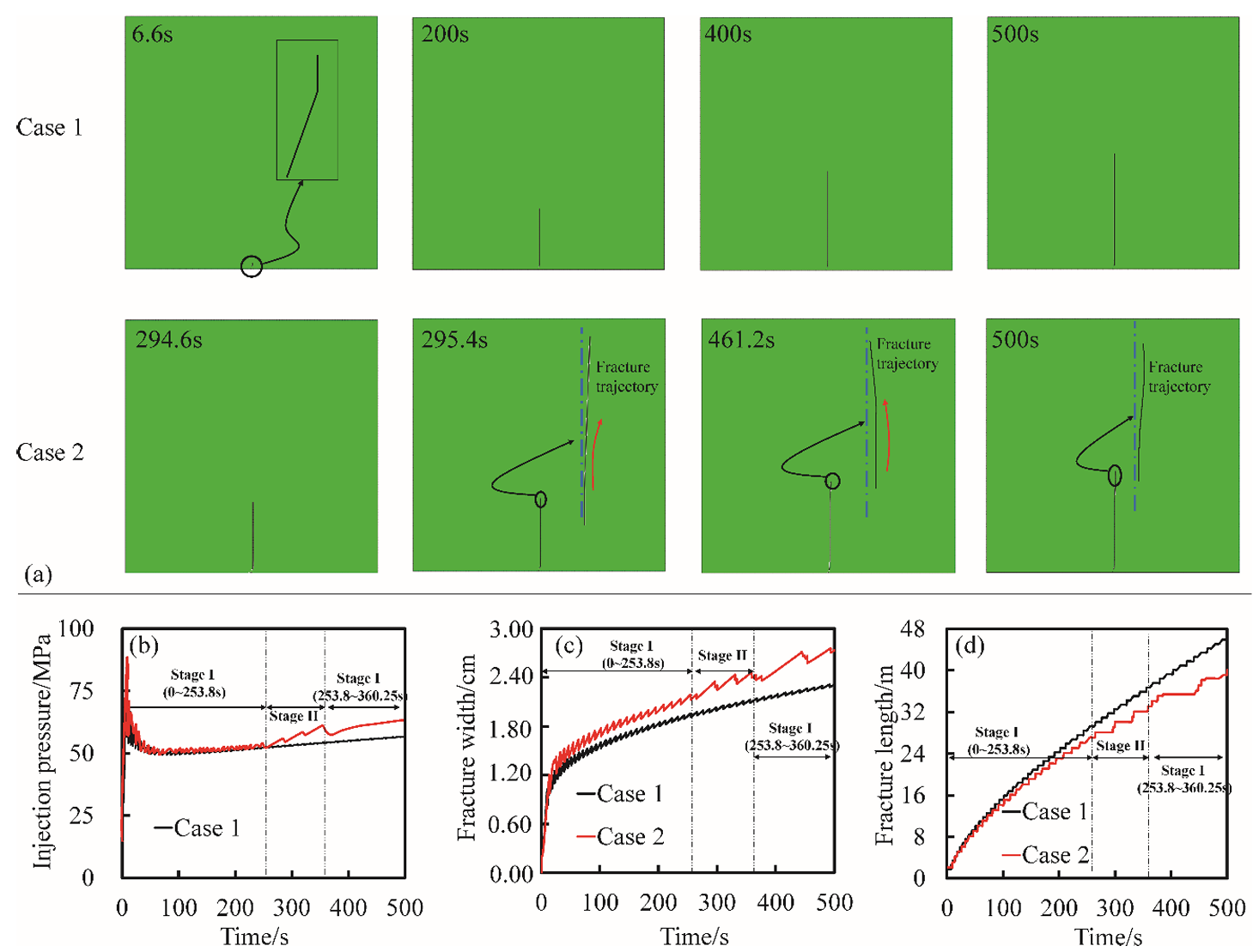
The low concentration and poor reservoir properties of natural hydrogen suggest that reservoir stimulation measures such as fracturing are required for its efficient development. Nevertheless, the presence of reservoir imperfections, including hard and soft cores, can significantly affect fracture behavior during the fracturing operations. Moreover, there is currently a lack of relevant simulation and experimental studies addressing these effects. In the present work, the effects and mechanisms of hard cores on fracture propagation in natural hydrogen reservoirs in the Songliao basin were numerically simulated. In addition, various factors affecting propagation behavior of fracture were also analyzed. The investigation results indicate that the presence of hard cores induces the fracture propagation mode from “straight-line dominated” to “path optimization” (obstacle-avoidance) pattern, which consequently decreases propagation efficiency. The final fracture length exhibits a reduction of 12.63% compared with that in the homogeneous reservoir case, accompanied by an increase of 18.49% in the final fracture width. Furthermore, higher hard core strength and leakage coefficients significantly decrease fracture propagation efficiency, promoting the development of wide, short fractures. This research offers a preliminary theoretical framework to support the stimulation and efficient development of imperfection-bearing natural hydrogen reservoirs.
Graphical Abstract
Keywords
Data Availability Statement
Funding
Conflicts of Interest
AI Use Statement
Ethical Approval and Consent to Participate
References
- Zgonnik, V. (2020). The occurrence and geoscience of natural hydrogen: A comprehensive review. Earth-Science Reviews, 203, 103140.
[CrossRef] [Google Scholar] - Dawood, F., Anda, M., & Shafiullah, G. M. (2020). Hydrogen production for energy: An overview. International journal of hydrogen energy, 45(7), 3847-3869.
[CrossRef] [Google Scholar] - Blay-Roger, R., Bach, W., Bobadilla, L. F., Reina, T. R., Odriozola, J. A., Amils, R., & Blay, V. (2024). Natural hydrogen in the energy transition: Fundamentals, promise, and enigmas. Renewable and Sustainable Energy Reviews, 189, 113888.
[CrossRef] [Google Scholar] - Gaucher, E. C. (2020). New perspectives in the industrial exploration for native hydrogen. Elements: An International Magazine of Mineralogy, Geochemistry, and Petrology, 16(1), 8-9.
[CrossRef] [Google Scholar] - Prinzhofer, A., Cissé, C. S. T., & Diallo, A. B. (2018). Discovery of a large accumulation of natural hydrogen in Bourakebougou (Mali). International Journal of Hydrogen Energy, 43(42), 19315-19326.
[CrossRef] [Google Scholar] - Milkov, A. V. (2022). Molecular hydrogen in surface and subsurface natural gases: Abundance, origins and ideas for deliberate exploration. Earth-Science Reviews, 230, 104063.
[CrossRef] [Google Scholar] - Maiga, O., Deville, E., Laval, J., Prinzhofer, A., & Diallo, A. B. (2023). Characterization of the spontaneously recharging natural hydrogen reservoirs of Bourakebougou in Mali. Scientific reports, 13(1), 11876.
[CrossRef] [Google Scholar] - Hassanpouryouzband, A., Armitage, T., Cowen, T., Thaysen, E. M., McMahon, S., Hajibeygi, H., ... & Haszeldine, R. S. (2025). The search for natural hydrogen: a hidden energy giant or an elusive dream?. ACS Energy Letters, 10(8), 3887-3891.
[CrossRef] [Google Scholar] - Arrouvel, C., & Prinzhofer, A. (2021). Genesis of natural hydrogen: New insights from thermodynamic simulations. International Journal of Hydrogen Energy, 46(36), 18780–18794.
[CrossRef] [Google Scholar] - Prinzhofer, A., Moretti, I., Françolin, J., Pacheco, C., d'Agostino, A., Werly, J., & Rupin, F. (2019). Natural hydrogen continuous emission from sedimentary basins: The example of a Brazilian H2-emitting structure. International Journal of Hydrogen Energy, 44(12), 5676-5685.
[CrossRef] [Google Scholar] - AlTammar, M. J., Agrawal, S., & Sharma, M. M. (2019). Effect of geological layer properties on hydraulic-fracture initiation and propagation: an experimental study. SPE Journal, 24(02), 757-794.
[CrossRef] [Google Scholar] - Dahi-Taleghani, A., & Olson, J. E. (2011). Numerical modeling of multistranded-hydraulic-fracture propagation: accounting for the interaction between induced and natural fractures. SPE journal, 16(03), 575-581.
[CrossRef] [Google Scholar] - Zhang, X., & Jeffrey, R. G. (2006). The role of friction and secondary flaws on deflection and re-initiation of hydraulic fractures at orthogonal pre-existing fractures. Geophysical Journal International, 166(3), 1454-1465.
[CrossRef] [Google Scholar] - Ellis, G. S., & Gelman, S. E. (2024). Model predictions of global geologic hydrogen resources. Science Advances, 10(50), eado0955.
[CrossRef] [Google Scholar] - Boreham, C. J., Edwards, D. S., Czado, K., Rollet, N., Wang, L., van der Wielen, S., ... & Henson, P. A. (2021). Hydrogen in Australian natural gas: occurrences, sources and resources. The APPEA Journal, 61(1), 163-191.
[CrossRef] [Google Scholar] - Lefeuvre, N., Truche, L., Donzé, F. V., Ducoux, M., Barré, G., Fakoury, R. A., ... & Gaucher, E. C. (2021). Native H2 exploration in the western Pyrenean foothills. Geochemistry, Geophysics, Geosystems, 22(8), e2021GC009917.
[CrossRef] [Google Scholar] - Moretti, I., Brouilly, E., Loiseau, K., Prinzhofer, A., & Deville, E. (2021). Hydrogen emanations in intracratonic areas: new guide lines for early exploration basin screening. Geosciences, 11(3), 145.
[CrossRef] [Google Scholar] - Guo, T., Wang, X., Li, Z., Gong, F., Lin, Q., Qu, Z., Lv, W., Tian, Q., & Xie, Z. (2019). Numerical simulation study on fracture propagation of zipper and synchronous fracturing in hydrogen energy development. International Journal of Hydrogen Energy, 44(11), 5270–5285.
[CrossRef] [Google Scholar] - Liang, X., Zhou, F., Liang, T., Wang, C., Wang, J., & Yuan, S. (2020). Impacts of low harm fracturing fluid on fossil hydrogen energy production in tight reservoirs. International Journal of Hydrogen Energy, 45(41), 21195–21204.
[CrossRef] [Google Scholar] - Liu, X., Qu, Z., Guo, T., Tian, Q., Lv, W., Xie, Z., & Chu, C. (2019). An innovative technology of directional propagation of hydraulic fracture guided by radial holes in fossil hydrogen energy development. International Journal of Hydrogen Energy, 44(11), 5286–5302.
[CrossRef] [Google Scholar] - Lu, Y., Li, H., Lu, C., Wu, K., Chen, Z., Wang, K., Luo, H., & Shan, J. (2019). The effect of completion strategy on fracture propagation from multiple cluster perforations in fossil hydrogen energy development. International Journal of Hydrogen Energy, 44(14), 7168–7180.
[CrossRef] [Google Scholar] - Horsfield, B., Mahlstedt, N., Weniger, P., Misch, D., Vranjes-Wessely, S., Han, S., & Wang, C. (2022). Molecular hydrogen from organic sources in the deep Songliao Basin, PR China. International Journal of Hydrogen Energy, 47(38), 16750-16774.
[CrossRef] [Google Scholar] - Ming-Yuan, H., & Hutchinson, J. W. (1989). Crack deflection at an interface between dissimilar elastic materials. International journal of solids and structures, 25(9), 1053-1067.
[CrossRef] [Google Scholar] - Gu, H., Weng, X., Lund, J., Mack, M., Ganguly, U., & Suarez-Rivera, R. (2012). Hydraulic fracture crossing natural fracture at nonorthogonal angles: a criterion and its validation. SPE Production & Operations, 27(01), 20-26.
[CrossRef] [Google Scholar] - Wang, L., Jin, Z., Liu, Q., Liu, K., Meng, Q., Huang, X., Su, Y., & Zhang, Q. (2024). The occurrence pattern of natural hydrogen in the Songliao Basin, PR China: Insights on natural hydrogen exploration. International Journal of Hydrogen Energy, 50(Part A), 261–275.
[CrossRef] [Google Scholar] - Frery, E., Langhi, L., Maison, M., & Moretti, I. (2021). Natural hydrogen seeps identified in the North Perth basin, Western Australia. International Journal of Hydrogen Energy, 46(61), 31158-31173.
[CrossRef] [Google Scholar] - Carrier, B., & Granet, S. (2012). Numerical modeling of hydraulic fracture problem in permeable medium using cohesive zone model. Engineering fracture mechanics, 79, 312-328.
[CrossRef] [Google Scholar] - Li, Q., Li, Y., Cheng, Y., Li, Q., Wang, F., Wei, J., Liu, Y., Zhang, C., Song, B., Yan, C., & Ansari, U. (2018). Numerical simulation of fracture reorientation during hydraulic fracturing in perforated horizontal well in shale reservoirs. Energy Sources, Part A: Recovery, Utilization, and Environmental Effects, 40(15), 1807–1813.
[CrossRef] [Google Scholar] - Chen, Z., Bunger, A. P., Zhang, X., & Jeffrey, R. G. (2009). Cohesive zone finite element-based modeling of hydraulic fractures. Acta Mechanica Solida Sinica, 22(5), 443-452.
[CrossRef] [Google Scholar] - Wang, H. (2015). Numerical modeling of non-planar hydraulic fracture propagation in brittle and ductile rocks using XFEM with cohesive zone method. Journal of Petroleum Science and Engineering, 135, 127-140.
[CrossRef] [Google Scholar] - Ismail, A., & Azadbakht, S. (2024). A comprehensive review of numerical simulation methods for hydraulic fracturing. International Journal for Numerical and Analytical Methods in Geomechanics, 48(5), 1433–1459.
[CrossRef] [Google Scholar] - Ao, F., Qingchao, L., Qiang, L., Jingjuan, W., Fuling, W., & Chuanliang, Y. (2025). Numerical Simulation Investigation of Fracture Propagation Behavior Patterns and Sensitivity Factors of Oil Shale Reservoirs in the Xunyi Region Considering the Influence of Natural Fracture. Geofluids, 2025(1), 2762142.
[CrossRef] [Google Scholar] - Li, L. C., Tang, C. A., Li, G., Wang, S. Y., Liang, Z. Z., & Zhang, Y. B. (2012). Numerical simulation of 3D hydraulic fracturing based on an improved flow-stress-damage model and a parallel FEM technique. Rock Mechanics and Rock Engineering, 45(5), 801–818.
[CrossRef] [Google Scholar] - Hossain, M. M., & Rahman, M. K. (2008). Numerical simulation of complex fracture growth during tight reservoir stimulation by hydraulic fracturing. Journal of Petroleum Science and Engineering, 60(2), 86–104.
[CrossRef] [Google Scholar] - Li, D. Q., Zhang, S. C., & Zhang, S. A. (2014). Experimental and numerical simulation study on fracturing through interlayer to coal seam. Journal of Natural Gas Science and Engineering, 21, 386–396.
[CrossRef] [Google Scholar] - Zhao, Q., Lisjak, A., Mahabadi, O., Liu, Q., & Grasselli, G. (2014). Numerical simulation of hydraulic fracturing and associated microseismicity using finite-discrete element method. Journal of Rock Mechanics and Geotechnical Engineering, 6(6), 574–581.
[CrossRef] [Google Scholar] - Wang, T., Guo, Z., Li, G., Ma, Z., Yong, Y., & Tian, S. (2023). Numerical simulation of three-dimensional fracturing fracture propagation in radial wells. Petroleum Exploration and Development, 50(3), 699–711.
[CrossRef] [Google Scholar] - Guo, C., Xu, J., Wei, M., & Jiang, R. (2015). Experimental study and numerical simulation of hydraulic fracturing tight sandstone reservoirs. Fuel, 159, 334–344.
[CrossRef] [Google Scholar] - Xu, B., Liu, Y., Wang, Y., Yang, G., Yu, Q., & Wang, F. (2018). A new method and application of full 3D numerical simulation for hydraulic fracturing horizontal fracture. Energies, 12(1), 48.
[CrossRef] [Google Scholar] - Huang, L., Liao, X., Fan, M., Wu, S., Tan, P., & Yang, L. (2024). Experimental and numerical simulation technique for hydraulic fracturing of shale formations. Advances in Geo-Energy Research, 13(2), 83–88.
[CrossRef] [Google Scholar] - Sun, J., & Schechter, D. (2015). Investigating the effect of improved fracture conductivity on production performance of hydraulically fractured wells: Field-case studies and numerical simulations. Journal of Canadian Petroleum Technology, 54(06), 442–449.
[CrossRef] [Google Scholar] - Ren, Q., Li, L., Wang, J., Jiang, R., Li, M., & Feng, J. (2024). Dynamic evolution mechanism of the fracturing fracture system—Enlightenments from hydraulic fracturing physical experiments and finite element numerical simulation. Petroleum Science, 21(6), 3839–3866.
[CrossRef] [Google Scholar] - Li, Y., Deng, J., Liu, W., Yan, W., Feng, Y., Cao, W., Wang, P., & Hou, Y. (2017). Numerical simulation of limited-entry multi-cluster fracturing in horizontal well. Journal of Petroleum Science and Engineering, 152, 443–455.
[CrossRef] [Google Scholar] - Zeng, Q., & Yao, J. (2016). Numerical simulation of fracture network generation in naturally fractured reservoirs. Journal of Natural Gas Science and Engineering, 30, 430–443.
[CrossRef] [Google Scholar] - Zhao, J., Wang, Z., Lin, R., Ren, L., Wu, J., & Wu, J. (2023). Numerical simulation of diverting fracturing for staged fracturing horizontal well in shale gas reservoir. Journal of Energy Resources Technology, 145(5), 053202.
[CrossRef] [Google Scholar] - Liu, X., Qu, Z., Guo, T., Sun, Y., Wang, Z., & Bakhshi, E. (2019). Numerical simulation of non-planar fracture propagation in multi-cluster fracturing with natural fractures based on Lattice methods. Engineering Fracture Mechanics, 220, 106625.
[CrossRef] [Google Scholar] - Lu, C., Ma, L., Li, Z., Huang, F., Huang, C., Yuan, H., & Guo, J. (2020). A novel hydraulic fracturing method based on the coupled CFD-DEM numerical simulation study. Applied Sciences, 10(9), 3027.
[CrossRef] [Google Scholar] - Sanchez, E. C. M., Cordero, J. A. R., & Roehl, D. (2020). Numerical simulation of three-dimensional fracture interaction. Computers and Geotechnics, 122, 103528.
[CrossRef] [Google Scholar]
Cited By (41)
-
Dejen Teklu Asfha, Abdul Halim Abdul Latiff, Hassan Soleimani, Abdul Rahim Md Arshad, Alidu Rashid, Ida Bagus Suananda Yogi, Daniel Asante Otchere, Ahmed Mousa, Rifqi Roid Dhiaulhaq. Real-Time Sand Transport Detection in an Offshore Hydrocarbon Well Using Distributed Acoustic Sensing-Based VSP Technology: Field Data Analysis and Operational Insights.
Technologies, 2026 , 14 (3).
[CrossRef] -
Nihal D. Salman, György Pillinger, Muammel M. Hanon. Mechanical Characterization of Shallow Soils with Varying Clay Content Under Confined Compression.
Eng, 2026 , 7 (4).
[CrossRef] -
Gizem Yildirim, Margrethe Faaberg Hotter. Child-Well Stimulation Intensity in Unconventional Reservoirs: Impacts on Well Performance, Economics, and Environmental Considerations.
Fuels, 2026 , 7 (3).
[CrossRef] -
Ana Caroline V. Rubin, Gustavo R. Bitencourt, Erico M. M. Flores, Paola A. Mello. Screening of Phenolic Compounds in Aqueous Extracts of Pyrolysis Oils by High-Resolution Mass Spectrometry.
Processes, 2026 , 14 (7).
[CrossRef] -
Jiacheng Zhang, Yunliang Yu, Hongchen Cai, Mengyu Li, Yingchun Liu. Multiscale characterization of micro fracture connectivity and gas migration in volcanic reservoirs using µCT and hybrid learning segmentation.
Scientific Reports, 2026 , 16 (1).
[CrossRef] -
Bao Zhang, Junhui Wei, Xiaofei Bai, Rongjun Ye, Jianxin Shen, Shicai Huang, Changyin Dong, Fansheng Huang. Fracture-Controlled Mechanisms of Sand Production in Deep Tight Sandstone: Insights from Coupled FDEM Modeling.
Processes, 2026 , 14 (5).
[CrossRef] -
Elham Kariri. Interpretable modeling to forecast CO2 solid phase boundaries in cryogenic methane rich systems.
Scientific Reports, 2026 , 16 (1).
[CrossRef] -
Qiang Li, Yunbo Li, Dangyu Song, Rongqi Wang, Jienan Pan, Zhenzhi Wang, Chengtao Wang. THMD Coupling Modelling and Crack Propagation Analysis of Coal Rock Under In Situ Liquid Nitrogen Fracturing.
Fractal and Fractional, 2026 , 10 (4).
[CrossRef] -
Jie Yuan, Liangchen Lv, Wen Cheng, Lin Sun, Yulin Zhu, Qian Huang, Hang Yang, Xueyuan Long. Study on the Influence of Crude Oil Emulsion Types on Hydrate Formation.
Processes, 2026 , 14 (5).
[CrossRef] -
Xingming Wang, Yuanyuan Yang, Le He, Qiaozhu Wang, Bin He. Automatic calibration of wellbore pressure wave velocity using perforation-induced shock waves.
Scientific Reports, 2026 , 16 (1).
[CrossRef] -
Eleni Kriemadi, Venetia D. Nikita, Nikos Krigas, Pepy Bareka. Experiencing Biodiversity in Upper Secondary Education and Botanical Gardens Through a Novel Karyotype-Based Educational Approach Using the Genus Tulipa L. as a Model.
Journal of Zoological and Botanical Gardens, 2026 , 7 (1).
[CrossRef] -
Magzhan N. Orynbasar, Vladimir E. Messerle, Alexandr B. Ustimenko, Sestager Kh. Aknazarov. Production of Synthesis Gas by Plasma–Steam Gasification of Solid Fuels with Different Ash and Volatile Matter Contents: An Experiment and Thermodynamic Calculations.
Gases, 2026 , 6 (1).
[CrossRef] -
Bojia Xi, Pengfei Shan, Biao Jiao, Huicong Xu, Zheng Meng, Ke Yang, Zhongming Yan, Long Zhang. The Development and Performance Validation of a Real-Time Stress Extraction Device for Deep Mining-Induced Stress.
Sensors, 2026 , 26 (3).
[CrossRef] -
Zhengzheng Xue, Xiaokai Xu, Lin Tian, Kuo Jian, Shuo Zhang, Liangwei Xu, Jian Li, Zehua Zhang, Yue Xin, Yixuan Yao. Potential evaluation and favorable zone optimization of CO2 geological sequestration in deep coal reservoirs.
Scientific Reports, 2026 , 16 (1).
[CrossRef] -
Xuhui Zhao, Guangtai Shi, Zonghui Cui, Yanping Zhang. Study of sand particle motion characteristics and distribution patterns in a helical-blade multiphase pump.
Scientific Reports, 2026 , 16 (1).
[CrossRef] -
Shunsuke Nakaya, Jun Matsushima. Oil Production, Net Energy, and Capital Dynamics: A System-Coupled Lotka–Volterra Approach.
Energies, 2026 , 19 (7).
[CrossRef] -
Eleni Strantzali, Nikolaos Vasilikos, Georgios A. Livanos, Dimitrios Nikolaos Pagonis. Techno-Economic and Regulatory Assessment of Onboard Carbon Capture Systems in LNG Carriers Toward the 2050 Decarbonization Horizon.
Energies, 2026 , 19 (7).
[CrossRef] -
Khaled A. Fattah, Salem S. Basaloom, Musaed N. J. AlAwad, Faisal S. Altawati, Mohammed A. Almobarky. Impact of Barite Nanoparticles on Barite Sag in Water-Based Drilling Fluids.
Eng, 2026 , 7 (3).
[CrossRef] -
Anxu Ding, Cui Xiao, Li Jia, Liang Wang, Shoujian Peng. Dynamic Evolution of Reservoir Pressure, Temperature, and Deformation During Multi-Coalbed Methane Commingled Production.
Processes, 2026 , 14 (6).
[CrossRef] -
Beatrice Wanjiru Mwangi, Genson Murithi, Reginah Ngari, Jackson Muthengia, Nancy Mweni Paul, Li Qingchao. Microbial Deterioration Potential and Mitigation Strategies in Blended Cement Structures: A Review.
Advances in Civil Engineering, 2026 , 2026 (1).
[CrossRef]
Cite This Article
TY  - JOUR
AU  - Tahir, Muhammad Usman
AU  - Guo, Shenglan
PY  - 2026
DA  - 2026/01/18
TI  - Preliminary Investigation of Fracture Behavior during Carbon Dioxide Fracturing of Natural Hydrogen Reservoir with Hard-Core Imperfections
JO  - Reservoir Science
T2  - Reservoir Science
JF  - Reservoir Science
VL  - 2
IS  - 1
SP  - 34
EP  - 51
DO  - 10.62762/RS.2025.759326
UR  - https://www.icck.org/article/abs/RS.2025.759326
KW  - natural hydrogen
KW  - carbon dioxide-based fracturing
KW  - reservoir imperfection
KW  - fracture initiation
KW  - fracture propagation
AB  - The low concentration and poor reservoir properties of natural hydrogen suggest that reservoir stimulation measures such as fracturing are required for its efficient development. Nevertheless, the presence of reservoir imperfections, including hard and soft cores, can significantly affect fracture behavior during the fracturing operations. Moreover, there is currently a lack of relevant simulation and experimental studies addressing these effects. In the present work, the effects and mechanisms of hard cores on fracture propagation in natural hydrogen reservoirs in the Songliao basin were numerically simulated. In addition, various factors affecting propagation behavior of fracture were also analyzed. The investigation results indicate that the presence of hard cores induces the fracture propagation mode from “straight-line dominated” to “path optimization” (obstacle-avoidance) pattern, which consequently decreases propagation efficiency. The final fracture length exhibits a reduction of 12.63% compared with that in the homogeneous reservoir case, accompanied by an increase of 18.49% in the final fracture width. Furthermore, higher hard core strength and leakage coefficients significantly decrease fracture propagation efficiency, promoting the development of wide, short fractures. This research offers a preliminary theoretical framework to support the stimulation and efficient development of imperfection-bearing natural hydrogen reservoirs.
SN  - 3070-2356
PB  - Institute of Central Computation and Knowledge
LA  - English
ER  -
@article{Tahir2026Preliminar,
  author = {Muhammad Usman Tahir and Shenglan Guo},
  title = {Preliminary Investigation of Fracture Behavior during Carbon Dioxide Fracturing of Natural Hydrogen Reservoir with Hard-Core Imperfections},
  journal = {Reservoir Science},
  year = {2026},
  volume = {2},
  number = {1},
  pages = {34-51},
  doi = {10.62762/RS.2025.759326},
  url = {https://www.icck.org/article/abs/RS.2025.759326},
  abstract = {The low concentration and poor reservoir properties of natural hydrogen suggest that reservoir stimulation measures such as fracturing are required for its efficient development. Nevertheless, the presence of reservoir imperfections, including hard and soft cores, can significantly affect fracture behavior during the fracturing operations. Moreover, there is currently a lack of relevant simulation and experimental studies addressing these effects. In the present work, the effects and mechanisms of hard cores on fracture propagation in natural hydrogen reservoirs in the Songliao basin were numerically simulated. In addition, various factors affecting propagation behavior of fracture were also analyzed. The investigation results indicate that the presence of hard cores induces the fracture propagation mode from “straight-line dominated” to “path optimization” (obstacle-avoidance) pattern, which consequently decreases propagation efficiency. The final fracture length exhibits a reduction of 12.63\% compared with that in the homogeneous reservoir case, accompanied by an increase of 18.49\% in the final fracture width. Furthermore, higher hard core strength and leakage coefficients significantly decrease fracture propagation efficiency, promoting the development of wide, short fractures. This research offers a preliminary theoretical framework to support the stimulation and efficient development of imperfection-bearing natural hydrogen reservoirs.},
  keywords = {natural hydrogen, carbon dioxide-based fracturing, reservoir imperfection, fracture initiation, fracture propagation},
  issn = {3070-2356},
  publisher = {Institute of Central Computation and Knowledge}
}
Publisher's Note
ICCK stays neutral with regard to jurisdictional claims in published maps and institutional affiliations.
Rights and Permissions
 Copyright © 2026 by the Author(s). Published by Institute of Central Computation and Knowledge. This article is an open access article distributed under the terms and conditions of the Creative Commons Attribution (CC BY) license (https://creativecommons.org/licenses/by/4.0/), which permits use, sharing, adaptation, distribution and reproduction in any medium or format, as long as you give appropriate credit to the original author(s) and the source, provide a link to the Creative Commons licence, and indicate if changes were made.

