


Microscopic Analysis of Flow Resistance of Oil Displacement Fluid in Reservoir Fractures




Article Information
Abstract
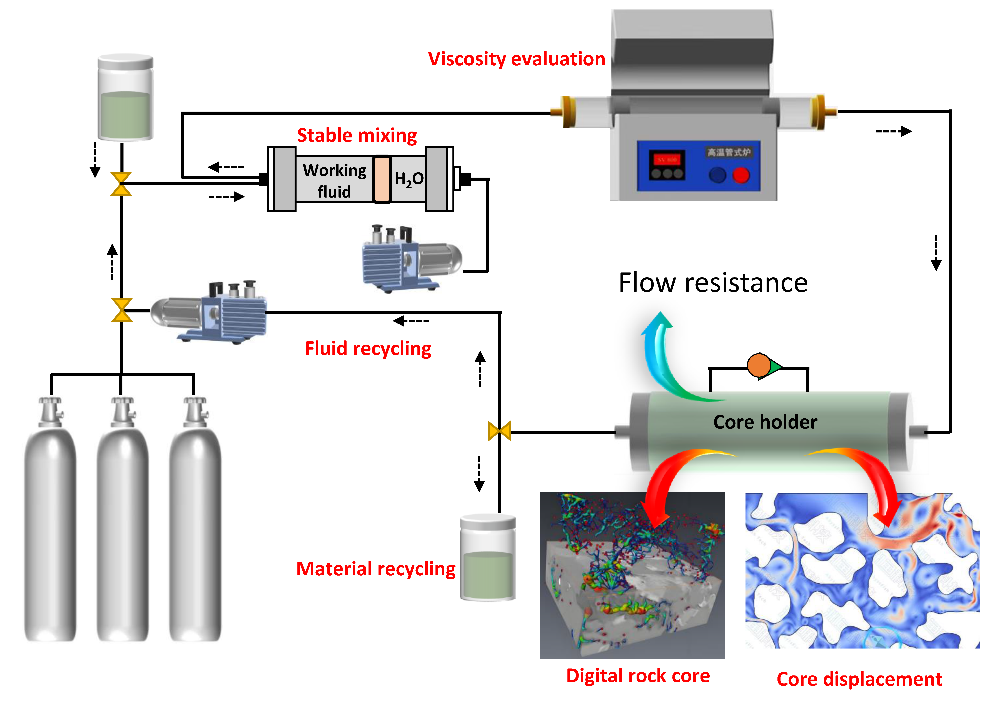
The flow resistance of displacement fluids within reservoir fractures directly influences oil recovery efficiency and sweep efficiency, thereby exerting a substantial impact on reservoir recovery and overall oilfield production. To address the significant flow resistance of contemporary displacement fluids, this study developed a multi-performance evaluation apparatus capable of simultaneously measuring fluid viscosity, flow resistance, and displacement efficiency. The effects of various reservoir parameters and fluid compositions on flow resistance and sweep area were systematically analyzed. Elevated reservoir temperatures clearly reduce fluid flow resistance within fractures, allowing displacement fluids to penetrate more deeply into the reservoir. In contrast, an inverse relationship between reservoir pressure and flow resistance was observed, which poses a significant barrier to reducing flow resistance and achieving rapid fluid penetration. Moreover, through a micromolecular perspective and adsorption theory, this study identifies strategies to modify flow resistance, thereby substantially enhancing displacement efficiency and sweep area by lowering flow resistance. This study provides foundational data and a theoretical framework for mitigating fluid flow resistance within reservoir fractures during oil recovery, thereby facilitating enhanced oil recovery over a larger reservoir area.
Graphical Abstract
Keywords
Data Availability Statement
Funding
Conflicts of Interest
Ethical Approval and Consent to Participate
References
- Wang, Y., Han, X., Li, J., Liu, R., Wang, Q., Huang, C., ... & Lin, R. (2023). Review on oil displacement technologies of enhanced oil recovery: state-of-the-art and outlook. Energy & Fuels, 37(4), 2539-2568.
[CrossRef] [Google Scholar] - Wei, B., Romero-Zerón, L., & Rodrigue, D. (2014). Oil displacement mechanisms of viscoelastic polymers in enhanced oil recovery (EOR): a review. Journal of Petroleum Exploration and Production Technology, 4(2), 113-121.
[CrossRef] [Google Scholar] - Basu, S., Nandakumar, K., & Masliyah, J. H. (1996). A study of oil displacement on model surfaces. Journal of colloid and interface science, 182(1), 82-94.
[CrossRef] [Google Scholar] - Cao, W., Xie, K., Lu, X., Liu, Y., & Zhang, Y. (2019). Effect of profile-control oil-displacement agent on increasing oil recovery and its mechanism. Fuel, 237, 1151-1160.
[CrossRef] [Google Scholar] - Shuhong, J., Changbing, T., Chengfang, S. H. I., Jigen, Y. E., & Xiujuan, F. U. (2012). New understanding on water-oil displacement efficiency in a high water-cut stage. Petroleum Exploration and Development, 39(3), 362-370.
[CrossRef] [Google Scholar] - Conn, C. A., Ma, K., Hirasaki, G. J., & Biswal, S. L. (2014). Visualizing oil displacement with foam in a microfluidic device with permeability contrast. Lab on a Chip, 14(20), 3968-3977.
[CrossRef] [Google Scholar] - Tan, F., Jiang, R., Ma, C., Jing, Y., Chen, K., & Lu, Y. (2025). CO2 oil displacement and geological storage status and prospects. Energy Science & Engineering, 13(2), 475–511.
[CrossRef] [Google Scholar] - Yikun, L. I. U., Fengjiao, W. A. N. G., Yumei, W. A. N. G., Binhui, L. I., Guang, Y. A. N. G., Jiqiang, Z. H. I., ... & He, X. U. (2022). The mechanism of hydraulic fracturing assisted oil displacement to enhance oil recovery in low and medium permeability reservoirs. Petroleum Exploration and Development, 49(4), 864-873.
[CrossRef] [Google Scholar] - Chen, L., Zhang, G., Ge, J., Jiang, P., Tang, J., & Liu, Y. (2013). Research of the heavy oil displacement mechanism by using alkaline/surfactant flooding system. Colloids and Surfaces A: Physicochemical and Engineering Aspects, 434, 63–71.
[CrossRef] [Google Scholar] - Hua, Z., Lin, M., Dong, Z., Li, M., Zhang, G., & Yang, J. (2014). Study of deep profile control and oil displacement technologies with nanoscale polymer microspheres. Journal of colloid and interface science, 424, 67-74.
[CrossRef] [Google Scholar] - Lai, N., Zhao, J., Zhu, Y., Wen, Y., Huang, Y., & Han, J. (2021). Influence of different oil types on the stability and oil displacement performance of gel foams. Colloids and Surfaces A: Physicochemical and Engineering Aspects, 630, 127674.
[CrossRef] [Google Scholar] - Comiti, F., Cadol, D., & Wohl, E. (2009). Flow regimes, bed morphology, and flow resistance in self‐formed step‐pool channels. Water Resources Research, 45(4), W04424.
[CrossRef] [Google Scholar] - Xu, Y., Sheng, G., Zhao, H., Hui, Y., Zhou, Y., Ma, J., Rao, X., Zhong, X., & Gong, J. (2021). A new approach for gas–water flow simulation in multi-fractured horizontal wells of shale gas reservoirs. Journal of Petroleum Science and Engineering, 199, 108292.
[CrossRef] [Google Scholar] - Cornelissen, P., & Jansen, J. D. (2023). Steady-state flow through a subsurface reservoir with a displaced fault and its poro-elastic effects on fault stresses. Transport in Porous Media, 150(3), 709–734.
[CrossRef] [Google Scholar] - Deng, X., Li, S., Guan, B., Li, J., Meng, X., Wei, H., & Wang, Z. (2025). Study on the influence of reservoir wettability on shale oil flow characteristics by molecular dynamics simulation. Arabian Journal for Science and Engineering, 50(7), 4643-4660.
[CrossRef] [Google Scholar] - Wang, Q., Zhou, F., Su, H., Zhang, S., Dong, R., Yang, D., ... & Li, J. (2024). Experimental evaluations of nano high-viscosity friction reducers to improve acid fracturing efficiency in low-permeability carbonate reservoirs. Chemical Engineering Journal, 483, 149358.
[CrossRef] [Google Scholar] - Palmer, T. L., Espås, T. A., & Skartlien, R. (2019). Effects of polymer adsorption on the effective viscosity in microchannel flows: phenomenological slip layer model from molecular simulations. Journal of Dispersion Science and Technology, 40(2), 264-275.
[CrossRef] [Google Scholar] - Song, H., Lao, J., Zhang, L., Xie, C., & Wang, Y. (2023). Underground hydrogen storage in reservoirs: pore-scale mechanisms and optimization of storage capacity and efficiency. Applied energy, 337, 120901.
[CrossRef] [Google Scholar] - Zhu, W., Liu, Y., Li, Z., Yue, M., & Kong, D. (2021). Study on pressure propagation in tight oil reservoirs with stimulated reservoir volume development. ACS omega, 6(4), 2589-2600.
[CrossRef] [Google Scholar] - Lei, M., Huang, W. A., Li, N., Jia, J. H., Li, J. X., Wang, Y. W., & Li, J. Y. (2017). The damage mechanism of oil-based drilling fluid for tight sandstone gas reservoir and its optimization. Journal of Petroleum Science and Engineering, 158, 616-625.
[CrossRef] [Google Scholar] - Chen, F., Wang, Z., Fu, S., Li, A., & Zhong, J. (2023). Research on transformation of connate water to movable water in water-bearing tight gas reservoirs. Energies, 16(19), 6961.
[CrossRef] [Google Scholar] - Yang, S., Sheng, Q., Zou, M., & Zheng, Q. (2025). Fractal study on spontaneous imbibition characteristics of the non-Newtonian fracturing fluids in porous media with rough surfaces. Chinese Journal of Physics, 95, 1155-1166.
[CrossRef] [Google Scholar] - Dang, C., Liu, S., Chen, Q., Sun, W., Zhong, H., Hu, J., ... & Ni, J. (2021). Response of microbial nitrogen transformation processes to antibiotic stress in a drinking water reservoir. Science of The Total Environment, 797, 149119.
[CrossRef] [Google Scholar] - Yoon, W. W., Han, W. S., Hwang, J., Kim, J. W., Chang, K. W., & Suk, H. (2024). Effect of fracture characteristics on groundwater flow adjacent to high-level radioactive waste repository. Journal of Hydrology, 629, 130593.
[CrossRef] [Google Scholar] - Xu, J., Qin, H., & Li, H. (2022). The Laplace-transform embedded discrete fracture model for flow simulation of stimulated reservoir volume. Journal of Petroleum Exploration and Production Technology, 12(8), 2303-2328.
[CrossRef] [Google Scholar] - Deng, J., Zhu, W., & Ma, Q. (2014). A new seepage model for shale gas reservoir and productivity analysis of fractured well. Fuel, 124, 232-240.
[CrossRef] [Google Scholar] - Wu, Z., Cui, C., Jia, P., Wang, Z., & Sui, Y. (2022). Advances and challenges in hydraulic fracturing of tight reservoirs: A critical review. Energy Geoscience, 3(4), 427-435.
[CrossRef] [Google Scholar] - Zhao, L., Chen, X., Zou, H., Liu, P., Liang, C., Zhang, N., ... & Du, J. (2020). A review of diverting agents for reservoir stimulation. Journal of Petroleum Science and Engineering, 187, 106734.
[CrossRef] [Google Scholar] - Kostic, S., & Parker, G. (2003). Progradational sand-mud deltas in lakes and reservoirs. Part 1. Theory and numerical modeling. Journal of Hydraulic Research, 41(2), 127-140.
[CrossRef] [Google Scholar] - Wang, T., Zhang, Y., Li, L., Yang, Z., Liu, Y., Fang, J., ... & You, Q. (2018). Experimental study on pressure-decreasing performance and mechanism of nanoparticles in low permeability reservoir. Journal of Petroleum Science and Engineering, 166, 693-703.
[CrossRef] [Google Scholar] - Xie, Y., Liao, J., Zhao, P., Xia, K., & Li, C. (2024). Effects of fracture evolution and non-Darcy flow on the thermal performance of enhanced geothermal system in 3D complex fractured rock. International Journal of Mining Science and Technology, 34(4), 443-459.
[CrossRef] [Google Scholar] - Hu, A., Su, L., Cao, G., Luo, Z., Yan, C., & Chen, Q. (2025). Experimental Study on the Effect of Fractures on the Irreducible and Movable Water in Water-Bearing Tight Sandstone Gas Reservoirs. Processes, 13(6), 1685.
[CrossRef] [Google Scholar] - Zhang, Q., Liu, H., Kang, X., Liu, Y., Dong, X., Wang, Y., Liu, S., & Li, G. (2021). An investigation of production performance by cyclic steam stimulation using horizontal well in heavy oil reservoirs. Energy, 218, 119500.
[CrossRef] [Google Scholar] - Li, B., Su, Y., & Wang, W. (2017). Temporal scale-based production analysis of fractured horizontal wells with stimulated reservoir volume. Journal of Natural Gas Science and Engineering, 48, 46–64.
[CrossRef] [Google Scholar] - Cao, H., Xia, Y., Wang, J., Ji, H., Hong, H., Xu, K., ... & Xu, Z. (2025). Shearing metal-organic framework lattice defects create low-resistance reservoir channels for high-performance aqueous organic flow battery. Journal of Membrane Science, 717, 123607.
[CrossRef] [Google Scholar] - Zhao, Y. L., Zhang, L. H., Liu, Y. H., Hu, S. Y., & Liu, Q. G. (2015). Transient pressure analysis of fractured well in bi-zonal gas reservoirs. Journal of Hydrology, 524, 89–99.
[CrossRef] [Google Scholar] - Wang, P., Hu, Y. H., Zhang, L. Y., Meng, Y., Ma, Z. F., Wang, T. R., ... & Zhang, Y. (2024). Experimental study of the influencing factors and mechanisms of the pressure-reduction and augmented injection effect by nanoparticles in ultra-low permeability reservoirs. Petroleum Science, 21(3), 1915-1927.
[CrossRef] [Google Scholar] - Jia, P., Wu, D., Yin, H., Li, Z., Cheng, L., & Ke, X. (2021). A practical solution model for transient pressure behavior of multistage fractured horizontal wells with finite conductivity in tight oil reservoirs. Geofluids, 2021(1), 9948505.
[CrossRef] [Google Scholar] - Xin, Y., Li, B., Li, Z., Li, Z., Wang, B., Wang, X., ... & Li, W. (2025). Gas channeling control with CO2-responsive gel system in fractured low-permeability reservoirs: Enhancing oil recovery during CO2 flooding. Separation and Purification Technology, 353, 128475.
[CrossRef] [Google Scholar] - Cui, Q., Zhao, Y., Bu, C., Zheng, J., Hu, H., & Zhang, L. (2023). A hybrid numerical/analytical model of transient seepage for vertical fractured well in tight gas reservoir by use of fractal theory and conformal mapping method. Fractals, 31(08), 2340180.
[CrossRef] [Google Scholar] - Guo, J., Cao, W., Wang, Y., & Jiang, F. (2019). A novel flow-resistor network model for characterizing enhanced geothermal system heat reservoir. Frontiers in energy, 13(1), 99-106.
[CrossRef] [Google Scholar] - Huang, T., Liu, T., Zhai, C., Sun, Y., Xu, J., Li, Y., & Xu, H. (2025). Nonlinear flow and permeability characteristics in fracture induced by shale self-supporting particles. Energy & Fuels, 39(10), 4746-4760.
[CrossRef] [Google Scholar] - Lv, J. X., & Hou, B. (2024). Fractures interaction and propagation mechanism of multi-cluster fracturing on laminated shale oil reservoir. Petroleum Science, 21(4), 2600-2613.
[CrossRef] [Google Scholar] - Dai, Z., Zhang, A., Wang, S., Fu, X., Yang, L., Jiang, X., & Wang, H. (2023). The development characteristics and mechanisms of the Xigou debris flow in the Three Gorges Reservoir Region. Frontiers in Earth Science, 11, 1122562.
[CrossRef] [Google Scholar] - Zhang, X., Li, L., Da, Q. A., Su, Y., Ma, S., & Zhu, Z. (2022). Microfluidic investigation on multiphase interaction and flow behavior of immiscible/miscible gases in deep heterogeneous reservoir. Journal of Environmental Chemical Engineering, 10(6), 109036.
[CrossRef] [Google Scholar] - Chen, D., Yang, F., Li, H., Wei, C., Yang, M., Zhao, X., ... & Li, J. (2024). Study on Water Intrusion Flow Model of the Tight Gas Reservoir. Chemistry and Technology of Fuels and Oils, 60(2), 297-308.
[CrossRef] [Google Scholar] - Xu, Z., Zhao, M., Zhang, Y., Wang, P., Wu, Y., Li, L., ... & Dai, C. (2023). Bio-inspired superhydrophobic interface of nano-gaseous film for reducing injection pressure in oil reservoirs. Chemical Engineering Journal, 454, 140393.
[CrossRef] [Google Scholar] - Su, Y., Li, M., Wang, W., & Dong, M. (2021). Fractal-based production analysis for shale reservoir considering vertical cross-flow. Fractals, 29(08), 2150251.
[CrossRef] [Google Scholar] - Zhang, L., Khan, N., & Pu, C. (2019). A new method of plugging the fracture to enhance oil production for fractured oil reservoir using gel particles and the HPAM/Cr3+ system. Polymers, 11(3), 446.
[CrossRef] [Google Scholar] - Liu, Q., Chen, Y., Wang, W., Liu, H., Hu, X., & Xie, Y. (2017). A productivity prediction model for multiple fractured horizontal wells in shale gas reservoirs. Journal of Natural Gas Science and Engineering, 42, 252-261.
[CrossRef] [Google Scholar] - Knauss, W. G. (2015). A review of fracture in viscoelastic materials. International Journal of Fracture, 196(1), 99-146.
[CrossRef] [Google Scholar] - Zhang, L., Gao, J., Hu, S., Guo, J., & Liu, Q. (2016). Five-region flow model for MFHWs in dual porous shale gas reservoirs. Journal of Natural Gas Science and Engineering, 33, 1316-1323.
[CrossRef] [Google Scholar] - Weiyao, Z. H. U., Qian, Q. I., Qian, M. A., Jia, D. E. N. G., Ming, Y. U. E., & Yuzhang, L. I. U. (2016). Unstable seepage modeling and pressure propagation of shale gas reservoirs. Petroleum Exploration and Development, 43(2), 285-292.
[CrossRef] [Google Scholar] - Wei, Y., Jia, A., He, D., & Wang, J. (2016). A new method in predicting productivity of multi-stage fractured horizontal well in tight gas reservoirs. Journal of Natural Gas Geoscience, 1(5), 397-406.
[CrossRef] [Google Scholar] - Belikov, V. V., & Borisova, N. M. (2023). Numerical 2D-Modeling of Rain Runoff Transformation in the Drainage Basin of Gelendzhik City Taking into Account the Mountain Collector and Accumulating Reservoirs. Water Resources, 50(4), 482-490.
[CrossRef] [Google Scholar] - Liu, X., Liu, W., Chen, X., Wang, L., Zhang, Z., & Peng, T. (2024). Estimating fracture characteristics and hydraulic conductivity from slug tests in epikarst of southwest China. Journal of Hydrology: Regional Studies, 53, 101777.
[CrossRef] [Google Scholar] - Gao, X., Guo, K., Chen, P., Yang, H., & Zhu, G. (2023). A productivity prediction method for multi-fractured horizontal wells in tight oil reservoirs considering fracture closure. Journal of Petroleum Exploration and Production Technology, 13(3), 865-876.
[CrossRef] [Google Scholar]
Cited By (28)
-
Abdulmajeed Murad, Arne Skauge, Tormod Skauge. Polymer Retention Leading to Non-Darcy Flow in Porous Media—Influence of Molecular Weight, Composition and Mechanical Degradation.
Colloids and Interfaces, 2026 , 10 (2).
[CrossRef] -
Xiaolong Wang, Yuanxiu Sun, Yue Wang, Feng Yang, Haitao Liu, Shuai Xie. Review and Future Perspectives of CO2 Flooding-Storage Synergy in Low-Permeability Reservoirs: Influencing Factors and Optimization Techniques.
Energy & Fuels, 2026 , 40 (17).
[CrossRef] -
Shen Guan, Zhiqiang Hu, Gengchen Li, Xuyue Chen, Minghe Zhang, Yamei Hao. Prediction of Annular Pressure Under Wellhead Uplift Load in Deepwater Subsea Wells.
Processes, 2026 , 14 (11).
[CrossRef] -
Qiang Gao, Yun Bai, Shuaizhi Ji, Junying Zhang, Shitian Wan, Hongxia He, Feng Huang, Junling Lou, Qiang Li. Wellbore Stability Analysis of Shale Formation Considering Sealing Effect of Mud Cake on Drilling Fluid Seepage.
Processes, 2026 , 14 (6).
[CrossRef] -
Tong Zhou, Kunpeng Zhang, Zhiwen Huang, Haibo Wang, Xin Huang, Juncheng Hu, Haochu Ku. A DAS-Based Approach for Predicting Liquid Flow Velocity in Pipelines.
Photonics, 2026 , 13 (3).
[CrossRef] -
Fuling Wang, Hongqi Cao, Chenyi Tang, Chengzhe Lu, Yixin Zhang, Rui Deng, Yandong Yang. Factor Analysis and Mechanism Revelation of Reservoir Conditions and Driving Fluids Affecting Geothermal Energy Extraction.
Eng, 2026 , 7 (5).
[CrossRef] -
Ningbo He, Junzhe Xu, Wenjun Zhong, Li Qingchao. Creep Behavior and Damage Modeling of Red Sandstone Under Cyclic Water Pressure.
Advances in Civil Engineering, 2026 , 2026 (1).
[CrossRef] -
Izabela Jonek-Kowalska. Sustainable Municipal Energy Transition—Evaluating Support and Citizens’ Awareness Levels in the Post-Mining Region in Poland.
Sustainability, 2026 , 18 (6).
[CrossRef] -
Quan Zhang, Jun Wei, Ning Li, Kaifeng Chen, Hui Yan, Liang Wen, Fang Shi, Tonglin Song, Yandong Yang. Study on the Mechanical Behaviors of Conglomerate, Considering Stress State and Gravel Content.
Processes, 2026 , 14 (9).
[CrossRef] -
Khaled A. Fattah, Salem S. Basaloom, Musaed N. J. AlAwad, Faisal S. Altawati, Mohammed A. Almobarky. Impact of Barite Nanoparticles on Barite Sag in Water-Based Drilling Fluids.
Eng, 2026 , 7 (3).
[CrossRef] -
Jinzhi Zhu, Hongjun Liang, Chengli Li, Guochuan Qin, Shaojun Zhang, Aisheng Sun, Dan Bao. Study on the Characteristics and Mechanisms of Drilling Fluid Loss in Kuqa, Tarim Oilfield.
Processes, 2026 , 14 (3).
[CrossRef] -
Shanshan Tang, Chaokun Wei, Wei Zhang, Mohd Danial Ibrahim, Andrew R. H. Rigit. A Review of Dust Movement Laws and Numerical Simulation-Based Dust Suppression Methods in Coal Mines.
Processes, 2026 , 14 (6).
[CrossRef] -
Shayuan Yang, Laibin Zhang, Jingtian Qin, Wei Chen, Yu Song, Lei Li, Kun Jiang, Gengchen Li, Xiaoxiao Zhu. A Multistage Amplification Circuit for Coils with Independent Parallel Feeds for Through-Coupling in Metal Pipelines.
Processes, 2026 , 14 (10).
[CrossRef] -
Zhonghui Zhang, Zihao Pang, Yuanmin Wang, Jiaqi Zhou, Kang Peng, Xu Liu. Study on Conventional Triaxial Mechanical Properties and Energy Evolution Patterns of Red Sandstone Under Brine Erosion.
Water, 2026 , 18 (4).
[CrossRef] -
Xiuming Zhang, Yonggang Duan, Yang Ren, Jian Yang, Qishuang Zhou. Production Prediction for Acid Stimulation in Long Horizontal Wells with Along-Well Property Heterogeneity in Carbonate Gas Reservoirs.
Processes, 2026 , 14 (5).
[CrossRef] -
Zhiguo Cui, Mingyu Cao, Jing Liu, Yong Cao, Xiaofeng Mao, Yue Cen, Jiajie Li. Development and Application of a Novel Prediction Self-Adaptive Control Technology in Ground Source Heat Pump System.
Energies, 2026 , 19 (4).
[CrossRef] -
Zhengzheng Xue, Xiaokai Xu, Lin Tian, Kuo Jian, Shuo Zhang, Liangwei Xu, Jian Li, Zehua Zhang, Yue Xin, Yixuan Yao. Potential evaluation and favorable zone optimization of CO2 geological sequestration in deep coal reservoirs.
Scientific Reports, 2026 , 16 (1).
[CrossRef] -
Bojia Xi, Pengfei Shan, Biao Jiao, Huicong Xu, Zheng Meng, Ke Yang, Zhongming Yan, Long Zhang. The Development and Performance Validation of a Real-Time Stress Extraction Device for Deep Mining-Induced Stress.
Sensors, 2026 , 26 (3).
[CrossRef] -
Na Li, Wu Liu, Man Chen, Shuang Li, Yanli Luo. Numerical Assessment of Interference Caused by Commissioning New Wells in the Shale Gas Gathering System.
Energies, 2026 , 19 (10).
[CrossRef] -
Kang Liu, Haojun Zhang, Haitao Xu, Fei Cao, Guoming Chen, Lei Liu, Duoya Liu. Dynamic Failure Analysis of Suction Anchor Installation Operation in Marine Natural Gas Hydrate Development Using DBN-GO Method.
Sustainability, 2026 , 18 (4).
[CrossRef]
Cite This Article
TY  - JOUR
AU  - Li, Wusheng
AU  - Liao, Junying
PY  - 2026
DA  - 2026/01/15
TI  - Microscopic Analysis of Flow Resistance of Oil Displacement Fluid in Reservoir Fractures
JO  - Reservoir Science
T2  - Reservoir Science
JF  - Reservoir Science
VL  - 2
IS  - 1
SP  - 16
EP  - 33
DO  - 10.62762/RS.2025.837826
UR  - https://www.icck.org/article/abs/RS.2025.837826
KW  - geological exploration
KW  - reservoir flooding
KW  - reservoir transformation
KW  - energy extraction
KW  - petroleum geology
AB  - The flow resistance of displacement fluids within reservoir fractures directly influences oil recovery efficiency and sweep efficiency, thereby exerting a substantial impact on reservoir recovery and overall oilfield production. To address the significant flow resistance of contemporary displacement fluids, this study developed a multi-performance evaluation apparatus capable of simultaneously measuring fluid viscosity, flow resistance, and displacement efficiency. The effects of various reservoir parameters and fluid compositions on flow resistance and sweep area were systematically analyzed. Elevated reservoir temperatures clearly reduce fluid flow resistance within fractures, allowing displacement fluids to penetrate more deeply into the reservoir. In contrast, an inverse relationship between reservoir pressure and flow resistance was observed, which poses a significant barrier to reducing flow resistance and achieving rapid fluid penetration. Moreover, through a micromolecular perspective and adsorption theory, this study identifies strategies to modify flow resistance, thereby substantially enhancing displacement efficiency and sweep area by lowering flow resistance. This study provides foundational data and a theoretical framework for mitigating fluid flow resistance within reservoir fractures during oil recovery, thereby facilitating enhanced oil recovery over a larger reservoir area.
SN  - 3070-2356
PB  - Institute of Central Computation and Knowledge
LA  - English
ER  -
@article{Li2026Microscopi,
  author = {Wusheng Li and Junying Liao},
  title = {Microscopic Analysis of Flow Resistance of Oil Displacement Fluid in Reservoir Fractures},
  journal = {Reservoir Science},
  year = {2026},
  volume = {2},
  number = {1},
  pages = {16-33},
  doi = {10.62762/RS.2025.837826},
  url = {https://www.icck.org/article/abs/RS.2025.837826},
  abstract = {The flow resistance of displacement fluids within reservoir fractures directly influences oil recovery efficiency and sweep efficiency, thereby exerting a substantial impact on reservoir recovery and overall oilfield production. To address the significant flow resistance of contemporary displacement fluids, this study developed a multi-performance evaluation apparatus capable of simultaneously measuring fluid viscosity, flow resistance, and displacement efficiency. The effects of various reservoir parameters and fluid compositions on flow resistance and sweep area were systematically analyzed. Elevated reservoir temperatures clearly reduce fluid flow resistance within fractures, allowing displacement fluids to penetrate more deeply into the reservoir. In contrast, an inverse relationship between reservoir pressure and flow resistance was observed, which poses a significant barrier to reducing flow resistance and achieving rapid fluid penetration. Moreover, through a micromolecular perspective and adsorption theory, this study identifies strategies to modify flow resistance, thereby substantially enhancing displacement efficiency and sweep area by lowering flow resistance. This study provides foundational data and a theoretical framework for mitigating fluid flow resistance within reservoir fractures during oil recovery, thereby facilitating enhanced oil recovery over a larger reservoir area.},
  keywords = {geological exploration, reservoir flooding, reservoir transformation, energy extraction, petroleum geology},
  issn = {3070-2356},
  publisher = {Institute of Central Computation and Knowledge}
}
Publisher's Note
ICCK stays neutral with regard to jurisdictional claims in published maps and institutional affiliations.
Rights and Permissions
 Copyright © 2026 by the Author(s). Published by Institute of Central Computation and Knowledge. This article is an open access article distributed under the terms and conditions of the Creative Commons Attribution (CC BY) license (https://creativecommons.org/licenses/by/4.0/), which permits use, sharing, adaptation, distribution and reproduction in any medium or format, as long as you give appropriate credit to the original author(s) and the source, provide a link to the Creative Commons licence, and indicate if changes were made.

