


Effect of Nanomaterials on Improving the Apparent Viscosity of Heavy Oil and the Environmental Evaluation of Reservoir Environment




Article Information
Abstract
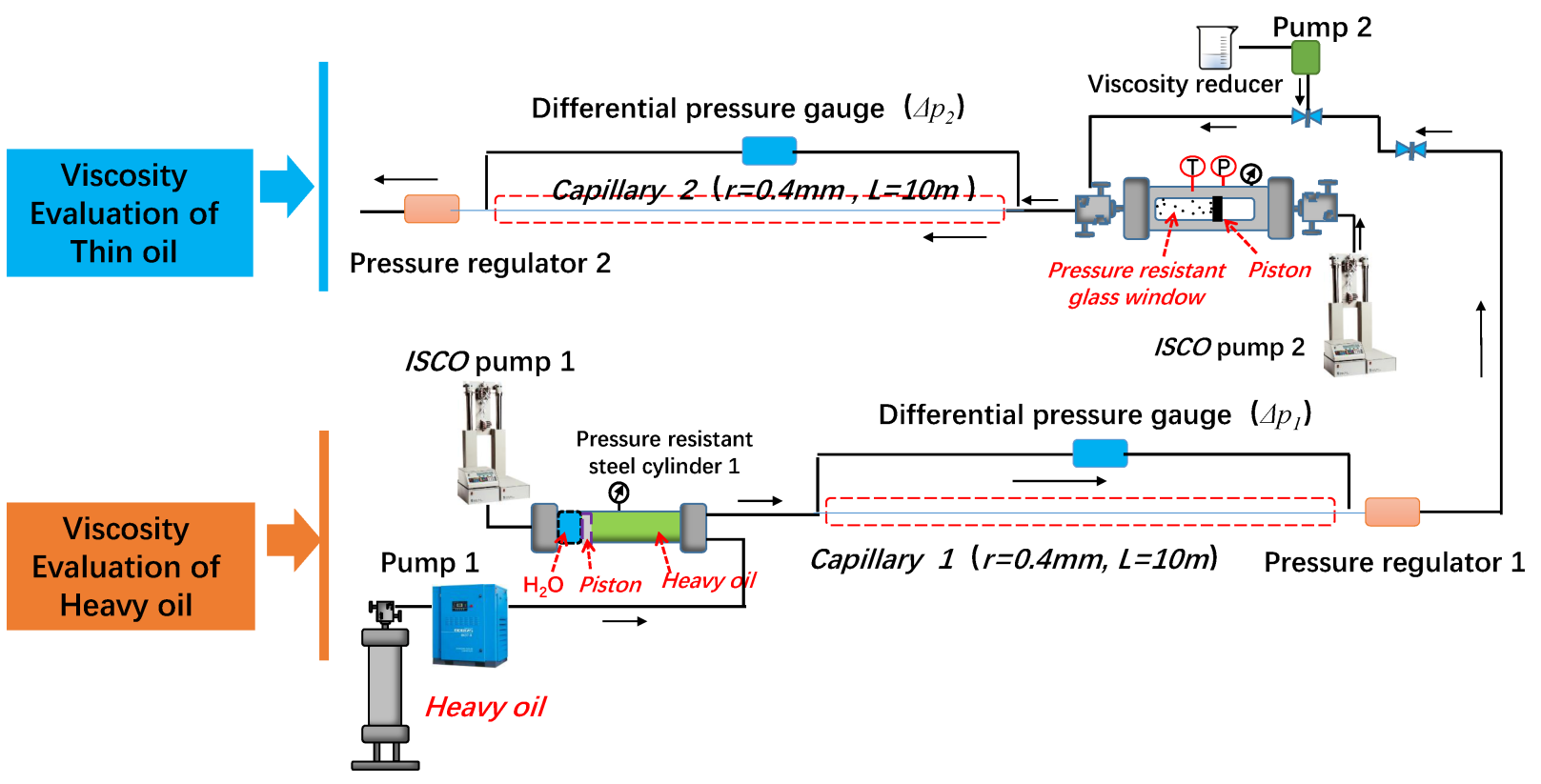
Heavy oil reservoirs represent an important resource for alleviating energy shortages and supporting global economic development. This investigation explores the influence of a nano vanadium acid catalyst (NVR) and reservoir conditions including temperature, pressure, and shear rate on the apparent viscosity and rheological properties of crude oil during the underground extraction process. NVR was synthesized by loading vanadate active groups onto nano-SiO$_2$ particles via hydrothermal reaction. The results indicate that 0.3~wt% NVR achieves a maximum viscosity reduction rate of 60%, significantly outperforming the commercially available viscosity reducer CVR under identical conditions. Among the investigated factors, NVR dosage exhibits the greatest impact on viscosity reduction, while shear rate shows the smallest influence on heavy oil recovery. The viscosity reduction mechanism is attributed to the catalytic cleavage of C--S bonds by vanadate active groups, which reduces molecular chain entanglement and lowers the micro-grid density of the heavy oil system. Furthermore, NVR causes significantly less reservoir damage than CVR owing to its nanoscale structure and strong polar repulsion with reservoir rock surfaces. This investigation provides theoretical support and basic data for improving the flowability and recovery efficiency of heavy oil in deep shale reservoirs.
Graphical Abstract
Keywords
Data Availability Statement
Funding
Conflicts of Interest
AI Use Statement
Ethical Approval and Consent to Participate
References
- Montes, D., Orozco, W., Taborda, E. A., Franco, C. A., & Cortés, F. B. (2019). Development of nanofluids for perdurability in viscosity reduction of extra-heavy oils. Energies, 12(6), 1068.
[CrossRef] [Google Scholar] - Santos, R. G. D., Loh, W., Bannwart, A. C., & Trevisan, O. V. (2014). An overview of heavy oil properties and its recovery and transportation methods. Brazilian Journal of Chemical Engineering, 31(3), 571-590.
[CrossRef] [Google Scholar] - Fan, H., Li, Z., & Liang, T. (2007). Experimental study on using ionic liquids to upgrade heavy oil. Journal of Fuel Chemistry and Technology, 35(1), 32–35.
[CrossRef] [Google Scholar] - Chen, Y., Yang, C., & Wang, Y. (2010). Gemini catalyst for catalytic aquathermolysis of heavy oil. Journal of Analytical and Applied Pyrolysis, 89(2), 159-165.
[CrossRef] [Google Scholar] - Chen, L., Zhang, G., & Ge, J. (2013). Research of the heavy oil displacement mechanism by using alkaline/surfactant flooding system. Colloids and Surfaces A: Physicochemical and Engineering Aspects, 434, 63–71.
[CrossRef] [Google Scholar] - Guo, K., Li, H., & Yu, Z. (2016). In-situ heavy and extra-heavy oil recovery: A review. Fuel, 185, 886-902.
[CrossRef] [Google Scholar] - Hasan, S. W., Ghannam, M. T., & Esmail, N. (2010). Heavy crude oil viscosity reduction and rheology for pipeline transportation. Fuel, 89(5), 1095–1100.
[CrossRef] [Google Scholar] - Mart\'{inez-Palou, R., de Lourdes Mosqueira, M., Zapata-Rend\'{on, B., Mar-Ju\'{arez, E., Bernal-Huicochea, C., de la Cruz Clavel-L\'{opez, J., & Aburto, J. (2011). Transportation of heavy and extra-heavy crude oil by pipeline: A review. Journal of Petroleum Science and Engineering, 75(3-4), 274-282.
[CrossRef] [Google Scholar] - Ke, H., Yuan, M., & Xia, S. (2022). A review of nanomaterials as viscosity reducer for heavy oil. Journal of Dispersion Science and Technology, 43(9), 1271-1282.
[CrossRef] [Google Scholar] - Muraza, O., & Galadima, A. (2015). Aquathermolysis of heavy oil: A review and perspective on catalyst development. Fuel, 157, 219-231.
[CrossRef] [Google Scholar] - Hart, A. (2014). A review of technologies for transporting heavy crude oil and bitumen via pipelines. Journal of Petroleum Exploration and Production Technology, 4(3), 327-336.
[CrossRef] [Google Scholar] - Tang, X., Duan, W., Xu, K., & Zheng, C. (2022). Three-dimensional network gel structure and viscosity reduction mechanism of heavy oil. Colloids and Surfaces A: Physicochemical and Engineering Aspects, 653, 130060.
[CrossRef] [Google Scholar] - Xu, J., Wang, N., Xue, S., Zhang, H., Zhang, J., Xia, S., & Han, Y. (2022). Insights into the mechanism during viscosity reduction process of heavy oil through molecule simulation. Fuel, 310, 122270.
[CrossRef] [Google Scholar] - Li, X., Zhang, F., & Liu, G. (2022, February). Review on new heavy oil viscosity reduction technologies. In IOP Conference Series: Earth and Environmental Science (Vol. 983, No. 1, p. 012059). IOP Publishing.
[CrossRef] [Google Scholar] - Chen, Q., Wang, Y., Lu, Z., & Feng, Y. (2013). Thermoviscosifying polymer used for enhanced oil recovery: rheological behaviors and core flooding test. Polymer bulletin, 70(2), 391-401.
[CrossRef] [Google Scholar] - Jang, H. Y., Zhang, K., Chon, B. H., & Choi, H. (2015). Enhanced oil recovery performance and viscosity characteristics of polysaccharide xanthan gum solution. Journal of Industrial and Engineering Chemistry, 21, 741–745.
[CrossRef] [Google Scholar] - Taborda, E. A., Franco, C. A., Lopera, S. H., Alvarado, V., & Cort\'{es, F. B. (2016). Effect of nanoparticles/nanofluids on the rheology of heavy crude oil and its mobility on porous media at reservoir conditions. Fuel, 184, 222-232.
[CrossRef] [Google Scholar] - Patel, H., Shah, S., Ahmed, R., & Ucan, S. (2018). Effects of nanoparticles and temperature on heavy oil viscosity. Journal of Petroleum Science and Engineering, 167, 819–828.
[CrossRef] [Google Scholar] - Franco, C. A., Nassar, N. N., Ruiz, M. A., Pereira-Almao, P., & Cort\'{es, F. B. (2013). Nanoparticles for inhibition of asphaltenes damage: adsorption study and displacement test on porous media. Energy & Fuels, 27(6), 2899-2907.
[CrossRef] [Google Scholar] - Tan, J., Wang, Z., Chen, S., & Hu, H. (2023). Progress and outlook of supercritical CO2–heavy oil viscosity reduction technology: a minireview. Energy & Fuels, 37(16), 11567-11583.
[CrossRef] [Google Scholar] - Shao, M., Shao, Y., Wang, Y., Fu, L., Liao, K., Zhu, T., & Yang, Z. (2025). A review and perspective on viscosity reduction development technologies for heavy oil. Petroleum Science and Technology.
[CrossRef] [Google Scholar] - Shi, C., Yang, W., Chen, J., Sun, X., Chen, W., An, H., ... & Pei, M. (2017). Application and mechanism of ultrasonic static mixer in heavy oil viscosity reduction. Ultrasonics sonochemistry, 37, 648-653.
[CrossRef] [Google Scholar] - Ilyin, S. O., & Strelets, L. A. (2018). Basic fundamentals of petroleum rheology and their application for the investigation of crude oils of different natures. Energy & Fuels, 32(1), 268-278.
[CrossRef] [Google Scholar] - Luo, P., & Gu, Y. (2007). Effects of asphaltene content on the heavy oil viscosity at different temperatures. Fuel, 86(7-8), 1069-1078.
[CrossRef] [Google Scholar] - Wang, C., Gao, L., Liu, M., Nian, Y., Shu, Q., Xia, S., & Han, Y. (2024). Viscosity reduction mechanism of surface-functionalized Fe3O4 nanoparticles in different types of heavy oil. Fuel, 360, 130535.
[CrossRef] [Google Scholar] - Ghannam, M. T., Hasan, S. W., Abu-Jdayil, B., & Esmail, N. (2012). Rheological properties of heavy & light crude oil mixtures for improving flowability. Journal of petroleum science and engineering, 81, 122-128.
[CrossRef] [Google Scholar] - Xu, Y., Heck, K. N., Ayala-Orozco, C., Arredondo, J. H., Zenor, W., Shammai, M., & Wong, M. S. (2021). Heavy oil viscosity reduction at mild temperatures using palladium acetylacetonate. Fuel, 294, 120546.
[CrossRef] [Google Scholar] - Wang, C., Zhong, L., Cao, Z., Liu, Y., Zou, J., & Wang, Q. (2019). Synergistic collaboration between a viscosity reducer and a surfactant for in situ emulsion formation to enhance heavy-oil recovery. Energy & Fuels, 34(1), 95-102.
[CrossRef] [Google Scholar] - Hashemi, R., Nassar, N. N., & Almao, P. P. (2014). Nanoparticle technology for heavy oil in-situ upgrading and recovery enhancement: Opportunities and challenges. Applied Energy, 133, 374-387.
[CrossRef] [Google Scholar] - Zhang, S., Huo, J., Sun, X., Yang, F., Wang, P., Wu, J., ... & Shi, Q. (2020). Molecular composition reveals unique rheological property of Karamay heavy crude oil. Energy & Fuels, 35(1), 473-478.
[CrossRef] [Google Scholar] - Wang, J., Tang, X., Li, J., Dai, L., & Deng, G. (2023). Synergistic effect and viscosity reduction mechanism of different biomass and extra-heavy oil in aquathermolysis. Fuel, 333, 126528.
[CrossRef] [Google Scholar] - Wang, J., & Dong, M. (2009). Optimum effective viscosity of polymer solution for improving heavy oil recovery. Journal of Petroleum Science and Engineering, 67(3–4), 155–158.
[CrossRef] [Google Scholar] - Zhong, X., Chen, J., An, R., Li, K., & Chen, M. (2021). A state-of-the-art review of nanoparticle applications with a focus on heavy oil viscosity reduction. Journal of Molecular Liquids, 344, 117845.
[CrossRef] [Google Scholar] - Zheng, C., Fu, H., Wang, Y., Zhang, T., & Duan, W. (2021). Preparation and mechanism of hyperbranched heavy oil viscosity reducer. Journal of Petroleum Science and Engineering, 196, 107941.
[CrossRef] [Google Scholar] - Maity, S. K., Ancheyta, J., & Marroquín, G. (2010). Catalytic aquathermolysis used for viscosity reduction of heavy crude oils: A review. Energy & Fuels, 24(5), 2809–2816.
[CrossRef] [Google Scholar] - Guo, J., Wang, H., Chen, C., Chen, Y., & Xie, X. (2010). Synthesis and evaluation of an oil-soluble viscosity reducer for heavy oil. Petroleum Science, 7(4), 536–540.
[CrossRef] [Google Scholar] - Wu, B., & Gao, J. (2010). A viscosity reduction study on Chinese extra heavy oil by the addition of synthesized novel oil-soluble viscosity-reducing agents. Petroleum Science and Technology, 28(18), 1919–1935.
[CrossRef] [Google Scholar] - Hu, J., Yang, J., Wang, P., Gu, X., & Chen, G. (2025). Improvement of the fluidity of heavy oil using a composite viscosity reducer. Processes, 13(11), 3547.
[CrossRef] [Google Scholar] - Liu, Z., Wu, G., & Wei, C. (2020). Physical experiments and numerical simulations of viscosity reducer flooding for ordinary heavy oil. Journal of Petroleum Science and Engineering, 192, 107194.
[CrossRef] [Google Scholar] - Wang, Q., Zhang, W., Wang, C., Han, X., Wang, H., & Zhang, H. (2023). Microstructure of heavy oil components and mechanism of influence on viscosity of heavy oil. ACS Omega, 8(12), 10980–10990.
[CrossRef] [Google Scholar] - Shi, H., Mao, Z., Ran, L., Ru, C., Guo, S., & Dong, H. (2023). Heavy oil viscosity reduction through aquathermolysis catalyzed by Ni20 (NiO) 80 nanocatalyst. Fuel Processing Technology, 250, 107911.
[CrossRef] [Google Scholar]
Cited By (22)
-
Zhenlong Song, Ke Zhang, Yu Zhang, Yaoze Cheng, Wenning Zhou, Jian Ma, Xiaolin Zhou, Maomao Hong. Simulation Study of Influence of Nano-Confinement Effect on Shale Fluid Phase Characteristics: A Case Study of Gulong Shale Oil.
Processes, 2026 , 14 (3).
[CrossRef] -
Jinzhi Zhu, Hongjun Liang, Chengli Li, Guochuan Qin, Shaojun Zhang, Aisheng Sun, Dan Bao. Study on the Characteristics and Mechanisms of Drilling Fluid Loss in Kuqa, Tarim Oilfield.
Processes, 2026 , 14 (3).
[CrossRef] -
Bojia Xi, Pengfei Shan, Biao Jiao, Huicong Xu, Zheng Meng, Ke Yang, Zhongming Yan, Long Zhang. The Development and Performance Validation of a Real-Time Stress Extraction Device for Deep Mining-Induced Stress.
Sensors, 2026 , 26 (3).
[CrossRef] -
Thenkaraimuthu Mariprasath, Kaliappan Esakkiappan, Shaik M Ali, Muraly Natarajan, Basem A Zneid, Oleksandr Rubanenko. A system-level critical assessment of electric mobility integrating electric vehicle powertrains, advanced battery technologies, grid impacts, artificial intelligence, and sustainability.
Energy Exploration & Exploitation, 2026 , 44 (4).
[CrossRef] -
Ningbo He, Junzhe Xu, Wenjun Zhong, Li Qingchao. Creep Behavior and Damage Modeling of Red Sandstone Under Cyclic Water Pressure.
Advances in Civil Engineering, 2026 , 2026 (1).
[CrossRef] -
Shanshan Tang, Chaokun Wei, Wei Zhang, Mohd Danial Ibrahim, Andrew R. H. Rigit. A Review of Dust Movement Laws and Numerical Simulation-Based Dust Suppression Methods in Coal Mines.
Processes, 2026 , 14 (6).
[CrossRef] -
Jiacheng Zhang, Yunliang Yu, Hongchen Cai, Mengyu Li, Yingchun Liu. Multiscale characterization of micro fracture connectivity and gas migration in volcanic reservoirs using µCT and hybrid learning segmentation.
Scientific Reports, 2026 , 16 (1).
[CrossRef] -
Ana Caroline V. Rubin, Gustavo R. Bitencourt, Erico M. M. Flores, Paola A. Mello. Screening of Phenolic Compounds in Aqueous Extracts of Pyrolysis Oils by High-Resolution Mass Spectrometry.
Processes, 2026 , 14 (7).
[CrossRef] -
Qiang Gao, Yun Bai, Shuaizhi Ji, Junying Zhang, Shitian Wan, Hongxia He, Feng Huang, Junling Lou, Qiang Li. Wellbore Stability Analysis of Shale Formation Considering Sealing Effect of Mud Cake on Drilling Fluid Seepage.
Processes, 2026 , 14 (6).
[CrossRef] -
Guzel R. Farrahova, Natalya G. Tanykova, Elizaveta M. Kolosova, Yuliya Yu. Petrova, Ruslan Ya. Bajbulatov, Oleg S. Sutormin. Reducing the Gap Between Chemical and Biological Assessment of Petroleum-Contaminated Soils: An FTIR-Based Method Using Aqueous Dimethyl Sulfoxide Extraction.
Environments, 2026 , 13 (3).
[CrossRef] -
Miłosz Rutkowski, Damian Duda, Ewa Godos, Wojciech Makowski, Emilia Bernaś, Karen Khachatryan, Andrzej Kalisz, Agnieszka Sękara, Gohar Khachatryan. The Effect of Gold Nanoparticles in Sodium Alginate on the Biochemical Characteristics of Garden Cress.
Molecules, 2026 , 31 (8).
[CrossRef] -
Edson de Andrade Araújo, Mateus Palharini Schwalbert, Rafael Japiassú Leitão, Lorena Cardoso Batista Aum, Pedro Tupã Pandava Aum. Influence of Skin Factor on Oil Recovery and Economic Performance in Synthetic Layered Carbonate Models Based on Pre-Salt Well Profiles.
Energies, 2026 , 19 (4).
[CrossRef] -
Xiuming Zhang, Yonggang Duan, Yang Ren, Jian Yang, Qishuang Zhou. Production Prediction for Acid Stimulation in Long Horizontal Wells with Along-Well Property Heterogeneity in Carbonate Gas Reservoirs.
Processes, 2026 , 14 (5).
[CrossRef] -
Khizar Abid, Catalin Teodoriu. A Structured Risk Framework for CCS AoR Wells: Qualitative FEPs to Semi-Quantitative Rankings.
Energies, 2026 , 19 (5).
[CrossRef] -
Zhonghui Zhang, Zihao Pang, Yuanmin Wang, Jiaqi Zhou, Kang Peng, Xu Liu. Study on Conventional Triaxial Mechanical Properties and Energy Evolution Patterns of Red Sandstone Under Brine Erosion.
Water, 2026 , 18 (4).
[CrossRef] -
Zhiguo Cui, Mingyu Cao, Jing Liu, Yong Cao, Xiaofeng Mao, Yue Cen, Jiajie Li. Development and Application of a Novel Prediction Self-Adaptive Control Technology in Ground Source Heat Pump System.
Energies, 2026 , 19 (4).
[CrossRef] -
Xuhui Zhao, Guangtai Shi, Zonghui Cui, Yanping Zhang. Study of sand particle motion characteristics and distribution patterns in a helical-blade multiphase pump.
Scientific Reports, 2026 , 16 (1).
[CrossRef] -
Liang Zhao, Cunyou Zou, Yushan Ma, Baolei Liu, Daigang Wang, Jinde Feng, Jie Han, Donghui Wang. Experimental and Numerical Investigation of Pore-Scale Remaining Oil Mobilization Mechanisms Under Variable-Rate Waterflooding.
Energies, 2026 , 19 (5).
[CrossRef] -
Arturo Alvarez-Cruz, Estela Mayoral-Villa, Alfonso Ramón García-Márquez, Jaime Klapp. Rational Design of High-Performance Viscosifying Polymers in Confined Systems via a Machine-Learning-Accelerated Multiscale Framework for Enhanced Hydrocarbon Recovery.
Fluids, 2026 , 11 (4).
[CrossRef] -
Fuling Wang, Hongqi Cao, Chenyi Tang, Chengzhe Lu, Yixin Zhang, Rui Deng, Yandong Yang. Factor Analysis and Mechanism Revelation of Reservoir Conditions and Driving Fluids Affecting Geothermal Energy Extraction.
Eng, 2026 , 7 (5).
[CrossRef]
Cite This Article
TY  - JOUR
AU  - Xu, Ning
AU  - Wang, Yanling
PY  - 2026
DA  - 2026/01/06
TI  - Effect of Nanomaterials on Improving the Apparent Viscosity of Heavy Oil and the Environmental Evaluation of Reservoir Environment
JO  - Reservoir Science
T2  - Reservoir Science
JF  - Reservoir Science
VL  - 2
IS  - 1
SP  - 1
EP  - 15
DO  - 10.62762/RS.2025.277961
UR  - https://www.icck.org/article/abs/RS.2025.277961
KW  - heavy oil viscosity reduction
KW  - nano catalyst
KW  - rheological properties
KW  - reservoir damage evaluation
KW  - enhanced oil recovery
KW  - nanoparticles
AB  - Heavy oil reservoirs represent an important resource for alleviating energy shortages and supporting global economic development. This investigation explores the influence of a nano vanadium acid catalyst (NVR) and reservoir conditions including temperature, pressure, and shear rate on the apparent viscosity and rheological properties of crude oil during the underground extraction process. NVR was synthesized by loading vanadate active groups onto nano-SiO$_2$ particles via hydrothermal reaction. The results indicate that 0.3~wt% NVR achieves a maximum viscosity reduction rate of 60%, significantly outperforming the commercially available viscosity reducer CVR under identical conditions. Among the investigated factors, NVR dosage exhibits the greatest impact on viscosity reduction, while shear rate shows the smallest influence on heavy oil recovery. The viscosity reduction mechanism is attributed to the catalytic cleavage of C--S bonds by vanadate active groups, which reduces molecular chain entanglement and lowers the micro-grid density of the heavy oil system. Furthermore, NVR causes significantly less reservoir damage than CVR owing to its nanoscale structure and strong polar repulsion with reservoir rock surfaces. This investigation provides theoretical support and basic data for improving the flowability and recovery efficiency of heavy oil in deep shale reservoirs.
SN  - 3070-2356
PB  - Institute of Central Computation and Knowledge
LA  - English
ER  -
@article{Xu2026Effect,
  author = {Ning Xu and Yanling Wang},
  title = {Effect of Nanomaterials on Improving the Apparent Viscosity of Heavy Oil and the Environmental Evaluation of Reservoir Environment},
  journal = {Reservoir Science},
  year = {2026},
  volume = {2},
  number = {1},
  pages = {1-15},
  doi = {10.62762/RS.2025.277961},
  url = {https://www.icck.org/article/abs/RS.2025.277961},
  abstract = {Heavy oil reservoirs represent an important resource for alleviating energy shortages and supporting global economic development. This investigation explores the influence of a nano vanadium acid catalyst (NVR) and reservoir conditions including temperature, pressure, and shear rate on the apparent viscosity and rheological properties of crude oil during the underground extraction process. NVR was synthesized by loading vanadate active groups onto nano-SiO\$\_2\$ particles via hydrothermal reaction. The results indicate that 0.3~wt\% NVR achieves a maximum viscosity reduction rate of 60\%, significantly outperforming the commercially available viscosity reducer CVR under identical conditions. Among the investigated factors, NVR dosage exhibits the greatest impact on viscosity reduction, while shear rate shows the smallest influence on heavy oil recovery. The viscosity reduction mechanism is attributed to the catalytic cleavage of C--S bonds by vanadate active groups, which reduces molecular chain entanglement and lowers the micro-grid density of the heavy oil system. Furthermore, NVR causes significantly less reservoir damage than CVR owing to its nanoscale structure and strong polar repulsion with reservoir rock surfaces. This investigation provides theoretical support and basic data for improving the flowability and recovery efficiency of heavy oil in deep shale reservoirs.},
  keywords = {heavy oil viscosity reduction, nano catalyst, rheological properties, reservoir damage evaluation, enhanced oil recovery, nanoparticles},
  issn = {3070-2356},
  publisher = {Institute of Central Computation and Knowledge}
}
Publisher's Note
ICCK stays neutral with regard to jurisdictional claims in published maps and institutional affiliations.
Rights and Permissions
 Copyright © 2026 by the Author(s). Published by Institute of Central Computation and Knowledge. This article is an open access article distributed under the terms and conditions of the Creative Commons Attribution (CC BY) license (https://creativecommons.org/licenses/by/4.0/), which permits use, sharing, adaptation, distribution and reproduction in any medium or format, as long as you give appropriate credit to the original author(s) and the source, provide a link to the Creative Commons licence, and indicate if changes were made.

