


Reservoir Characterization of Eocene Carbonates and Cambrian Sands in the Eastern Potwar Region, Pakistan





Article Information
Abstract
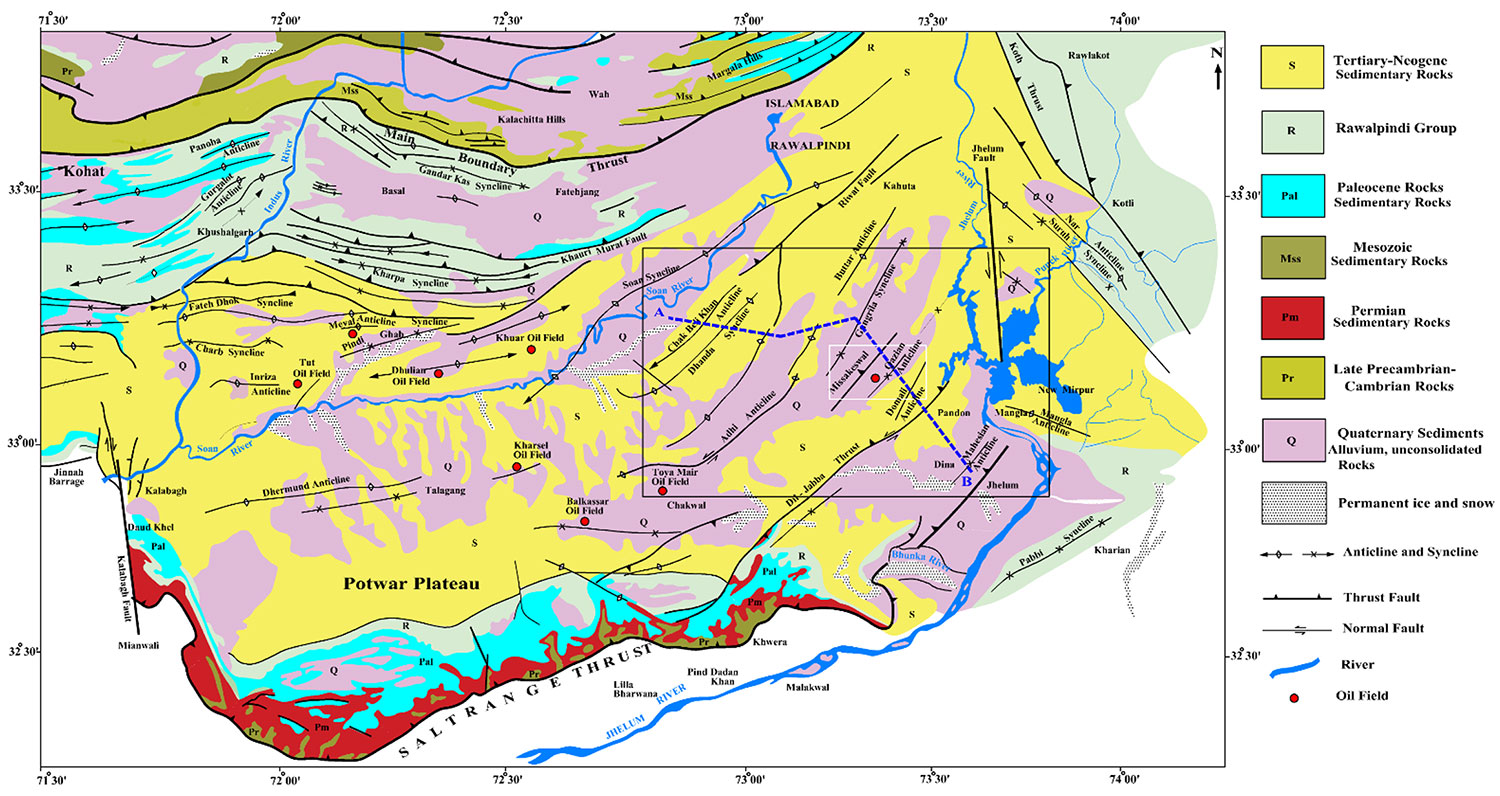
Hydrocarbon prospectivity in fold-and-thrust belts remains inherently uncertain due to the combined effects of structural complexity and heterogeneous reservoir properties. The Eastern Potwar region of Pakistan, characterized by imbricate thrust systems, anticlines, and synclines, represents a typical example where conventional approaches often fail to adequately constrain reservoir quality. This study integrates seismic interpretation with rock physics modeling to evaluate the hydrocarbon potential of the Missakeswal area. Seismic analysis delineates the structural framework controlling trap development, while rock physics modeling of well log data provides quantitative constraints on lithology, porosity, and fluid effects within Eocene carbonates and Cambrian sandstones. The results demonstrate a clear inverse relationship between velocity and porosity in the carbonate units, together with significant deviations from standard empirical models in both carbonate and sandstone intervals. In particular, the Eocene carbonates exhibit significant deviations from the Raymer model for water-saturated limestone, indicating probable hydrocarbon saturation, whereas the Cambrian sands show dispersion consistent with clay-influenced elastic behavior. The integrated interpretation highlights the Missakeswal area as a promising exploration target, and demonstrates that the combined use of seismic and rock physics analysis provides a robust framework for reducing uncertainty and improving reservoir characterization in tectonically complex basins.
Graphical Abstract
Keywords
Data Availability Statement
Funding
Conflicts of Interest
AI Use Statement
Ethical Approval and Consent to Participate
References
- Searle, M. P., & Khan, M. A. (Eds.). (1996). Geological Map of North Pakistan and Adjacent Areas of Northern Ladakh and Western Tibet.(Western Himalaya, Salt Ranges, Kohistan, Karakoram, Hindu Kush), 1: 650 000. Available at: https://searchworks.stanford.edu/view/3782644
[Google Scholar] - Aleardi, M., & Ciabarri, F. (2017). Assessment of different approaches to rock-physics modeling: A case study from offshore Nile Delta. Geophysics, 82(1), MR15-MR25.
[CrossRef] [Google Scholar] - Eberli, G. P., Baechle, G. T., Anselmetti, F. S., & Incze, M. L. (2003). Factors controlling elastic properties in carbonate sediments and rocks. The Leading Edge, 22(7), 654-660.
[CrossRef] [Google Scholar] - Fournier, F., & Borgomano, J. (2009). Critical porosity and elastic properties of microporous mixed carbonate-siliciclastic rocks. Geophysics, 74(2), E93-E109.
[CrossRef] [Google Scholar] - Veeken, P. C. H., & Da Silva, M. (2004). Seismic inversion methods and some of their constraints. First Break, 22(6), 47-70.
[CrossRef] [Google Scholar] - Nur, A. M., Mavko, G., Dvorkin, J., & Gal, D. (1995, October). Critical porosity: The key to relating physical properties to porosity in rocks. In SEG International Exposition and Annual Meeting (pp. SEG-1995). SEG.
[Google Scholar] - Han, D. H., Nur, A., & Morgan, D. (1986). Effects of porosity and clay content on wave velocities in sandstones. Geophysics, 51(11), 2093-2107.
[CrossRef] [Google Scholar] - Tosaya, C., & Nur, A. (1982). Effects of diagenesis and clays on compressional velocities in rocks. Geophysical Research Letters, 9(1), 5-8.
[CrossRef] [Google Scholar] - Mavko, G., Mukerji, T., & Dvorkin, J. (2020). The Rock Physics Handbook (3rd ed.). Cambridge University Press.
[CrossRef] [Google Scholar] - Avseth, P. A., & Odegaard, E. (2004). Well log and seismic data analysis using rock physics templates. First Break, 22(10), 37-43.
[CrossRef] [Google Scholar] - Xu, S., & Payne, M. A. (2009). Modeling elastic properties in carbonate rocks. The Leading Edge, 28(1), 66-74.
[CrossRef] [Google Scholar] - Avseth, P., Mukerji, T., & Mavko, G. (2005). Quantitative Seismic Interpretation: Applying Rock Physics Tools to Reduce Interpretation Risk. Cambridge University Press.
[CrossRef] [Google Scholar] - Anselmetti, F. S., & Eberli, G. P. (1999). The velocity-deviation log: a tool to predict pore type and permeability trends in carbonate drill holes from sonic and porosity or density logs. AAPG bulletin, 83(3), 450-466.
[CrossRef] [Google Scholar] - Avseth, P., Mukerji, T., Mavko, G., & Dvorkin, J. (2010). Rock-physics diagnostics of depositional texture, diagenetic alterations, and reservoir heterogeneity in high-porosity siliciclastic sediments and rocks—A review of selected models and suggested work flows. Geophysics, 75(5), 75A31-75A47.
[CrossRef] [Google Scholar] - Dvorkin, J., & Nur, A. (1996). Elasticity of high-porosity sandstones: Theory for two North Sea data sets. Geophysics, 61(5), 1363-1370.
[CrossRef] [Google Scholar] - Anselmetti, F. S., & Eberli, G. P. (1993). Controls on sonic velocity in carbonates. Pure and Applied geophysics, 141(2), 287-323.
[CrossRef] [Google Scholar] - Asif, M., Fazeelat, T., & Grice, K. (2011). Petroleum geochemistry of the Potwar Basin, Pakistan: 1. Oil-oil correlation using biomarkers, $\delta$13C and $\delta$D. Organic Geochemistry, 42(10), 1226-1240.
[CrossRef] [Google Scholar] - Craig, J., Hakhoo, N., Bhat, G. M., Hafiz, M., Khan, M. R., Misra, R., ... & Khullar, S. (2018). Petroleum systems and hydrocarbon potential of the North-West Himalaya of India and Pakistan. Earth-science reviews, 187, 109-185.
[CrossRef] [Google Scholar] - Durrani, M. Z. A., Rahman, S. A., Talib, M., Subhani, G., & Sarosh, B. (2023). Rock physics modelling‐based characterization of deep and tight mixed sedimentary (clastic and carbonate) reservoirs: A case study from North Potwar Basin of Pakistan. Geophysical Prospecting, 71(2), 263-278.
[CrossRef] [Google Scholar] - Grelaud, S., Sassi, W., de Lamotte, D. F., Jaswal, T., & Roure, F. (2002). Kinematics of eastern Salt Range and South Potwar basin (Pakistan): a new scenario. Marine and Petroleum Geology, 19(9), 1127-1139.
[CrossRef] [Google Scholar] - Khan, M., Nawaz, S., & Radwan, A. E. (2023). New insights into tectonic evolution and deformation mechanism of continental foreland fold-thrust belt. Journal of Asian Earth Sciences, 245, 105556.
[CrossRef] [Google Scholar] - Iqbal, S., Akhter, G., & Bibi, S. (2015). Structural model of the Balkassar area, Potwar Plateau, Pakistan. International Journal of Earth Sciences, 104(8), 2253-2272.
[CrossRef] [Google Scholar] - Ahmad, N., Khan, S., Noor, E. F., Zou, Z., & Al-Shuhail, A. (2021). Seismic data interpretation and identification of hydrocarbon-bearing zones of Rajian area, Pakistan. Minerals, 11(8), 891.
[CrossRef] [Google Scholar] - Safi, I., Rehman, G., Yaseen, M., Wahid, S., Nouman, M., Fida, S., ... & Anjum, M. N. (2021). Effects of transpression on the rocks exposed at the Jhelum Fault Zone in the east of Potwar Basin, Pakistan: implications on the subsurface deformation pattern. Journal of Petroleum Exploration and Production Technology, 11(6), 2407-2424.
[CrossRef] [Google Scholar] - Farah, A., & DeJong, K. A. (Eds.). (1979). Geodynamics of Pakistan. Geological Survey of Pakistan. https://www.nypl.org/research/research-catalog/bib/b10904934
[Google Scholar] - Kazmi, A. H., & Rana, R. A. (1982). Tectonic map of Pakistan 1: 2 000 000: Map showing structural features and tectonic stages in Pakistan. Geological survey of Pakistan.
[Google Scholar] - Pennock, E. S., Lillie, R. J., Zaman, A. S. H., & Yousaf, M. (1989). Structural interpretation of seismic reflection data from eastern Salt Range and Potwar Plateau, Pakistan. AAPG bulletin, 73(7), 841-857.
[CrossRef] [Google Scholar] - Yeats, R. S., & Lawrence, R. D. (1982, November). Tectonics of the Himalayan thrust belt in northern Pakistan. In US-Pakistan Workshop on Marine Sciences in Pakistan. https://ntrs.nasa.gov/citations/19840060813
[Google Scholar] - Jaumé, S. C., & Lillie, R. J. (1988). Mechanics of the Salt Range‐Potwar Plateau, Pakistan: A fold‐and‐thrust belt underlain by evaporites. Tectonics, 7(1), 57-71.
[CrossRef] [Google Scholar] - Baker, D. M., Lillie, R. J., Yeats, R. S., Johnson, G. D., Yousuf, M., & Zamin, A. S. H. (1988). Development of the Himalayan frontal thrust zone: Salt Range, Pakistan. Geology, 16(1), 3-7.
[CrossRef] [Google Scholar] - Aamir, M., & Siddiqui, M. M. (2006). Interpretation and visualization of thrust sheets in a triangle zone in eastern Potwar, Pakistan. The Leading Edge, 25(1), 24-37.
[CrossRef] [Google Scholar] - Banks, C. J., & Warburton, J. (1986). 'Passive-roof' duplex geometry in the frontal structures of the Kirthar and Sulaiman mountain belts, Pakistan. Journal of Structural Geology, 8(3-4), 229-237.
[CrossRef] [Google Scholar] - Jaswal, T. M., Lillie, R. J., & Lawrence, R. D. (1997). Structure and evolution of the northern Potwar deformed zone, Pakistan. AAPG bulletin, 81(2), 308-328.
[CrossRef] [Google Scholar] - Kazmi, A. H., & Abbasi, I. A. (2008). Stratigraphy & historical geology of Pakistan. Department and National Centre of Excellence in Geology, University of Peshawar, Pakistan, 524. http://nceg.uop.edu.pk/forms/stratigraphyandhistoricalgeologyofpakistan.doc
[Google Scholar] - Awais, M., Hanif, M., Khan, M. Y., Jan, I. U., & Ishaq, M. (2019). Relating petrophysical parameters to petrographic interpretations in carbonates of the Chorgali Formation, Potwar Plateau, Pakistan. Carbonates and Evaporites, 34(3), 581-595.
[CrossRef] [Google Scholar] - Leathers, M. R. (1987). Balanced structural cross section of the western Salt Range and Potwar Plateau, Pakistan: deformation near the strike-slip terminus of an overthrust sheet (Master's thesis, Oregon State University, Corvallis, OR, United States). http://hdl.handle.net/1957/13150
[Google Scholar] - Shah, S. B. A., Shah, S. H. A., & Nath, M. (2024). 1-D basin modeling, 3-D reservoir mapping and source rock generative potential of Balkassar oilfield, Potwar basin, Pakistan. Petroleum Science and Technology, 42(20), 2843-2867.
[CrossRef] [Google Scholar] - Pervaiz, M., & Wang, Y. (2024). Seismic reflection data interpretation and petrophysical evaluation of the Meyal area, the Potwar Basin, Pakistan. Interpretation, 12(4), T453-T465.
[CrossRef] [Google Scholar] - Shah, S. B. A., Shah, S. H. A., & Jamshed, K. (2023). An integrated palynofacies, geochemical and petrophysical analysis for characterizing mixed organic-rich carbonate and shale rocks of Dhulian oilfield Potwar Basin, Pakistan: Insights for multiple source and reservoir rocks evaluation. Geoenergy Science and Engineering, 221, 111236.
[CrossRef] [Google Scholar] - Brown, A. R. (2011). Interpretation of three-dimensional seismic data. Society of Exploration Geophysicists and American Association of Petroleum Geologists.
[CrossRef] [Google Scholar] - Sheriff, R. E., & Geldart, L. P. (2015). Exploration Seismology (2nd ed.). Cambridge University Press.
[CrossRef] [Google Scholar] - Mitchum, R. M., Vail, P. R., & Sangree, J. B. (1977). Seismic stratigraphy and global changes of sea level, part 6: stratigraphic interpretation of seismic reflection patterns in depositional sequences. AAPG Memoir, 26, 117–133.
[CrossRef] [Google Scholar] - Suppe, J. (1983). Geometry and kinematics of fault-bend folding. American Journal of Science, 283(7), 684-721.
[CrossRef] [Google Scholar] - Qayyum, A., Poessé, J. W., Kaymakci, N., Langereis, C. G., Gülyüz, E., & Ahsan, N. (2022). Neogene kinematics of the Potwar plateau and the Salt range, NW Himalayan front: A paleostress inversion and AMS study. International Geology Review, 64(9), 1311-1329.
[CrossRef] [Google Scholar] - Gardner, G. H. F., Gardner, L. W., & Gregory, A. (1974). Formation velocity and density; the diagnostic basics for stratigraphic traps. Geophysics, 39(6), 770-780.
[CrossRef] [Google Scholar] - Raymer, L. L., Hunt, E. R., & Gardner, J. S. (1980, July). An improved sonic transit time-to-porosity transform. In SPWLA Annual Logging Symposium (pp. SPWLA-1980). SPWLA. https://onepetro.org/SPWLAALS/proceedings-abstract/SPWLA-1980/All-SPWLA-1980/SPWLA-1980-P/19448
[Google Scholar] - Han, D.-H. (1987). Effects of porosity and clay content on acoustic properties of sandstones and unconsolidated sediments (Doctoral dissertation, Stanford University, Stanford, CA, United States). https://pangea.stanford.edu/research/srb/docs/theses/SRB_28_OCT86_Han.pdf
[Google Scholar] - Castagna, J. P., Batzle, M. L., & Eastwood, R. L. (1985). Relationships between compressional-wave and shear-wave velocities in clastic silicate rocks. Geophysics, 50(4), 571-581.
[CrossRef] [Google Scholar] - Saberi, M. R. (2017). A closer look at rock physics models and their assisted interpretation in seismic exploration. Iranian Journal of Geophysics, 10(5), 71-84. https://www.ijgeophysics.ir/article_46957_en.html
[Google Scholar] - Onita, F. B., Ebeh, C. O., & Iriogbe, H. O. (2023). Advancing quantitative interpretation petrophysics: Integrating seismic petrophysics for enhanced subsurface characterization. Engineering Science & Technology Journal, 4(6), 617-636.
[CrossRef] [Google Scholar]
Cited By (15)
-
Grachik Eremyan, Adel M. Magdeev, Mohammed Al-Shargabi, Ivan V. Matveev, Ivan E. Smirnov, Gleb Y. Shishaev, Shadfar Davoodi. Enhancing Reservoir Simulation History Matching Using SHAP Value for Parameter Range Selection.
Energies, 2026 , 19 (10).
[CrossRef] -
Yufeng Shen, Yu Song, Jian Yi, Wentong He, Xuanlong Shan, Ang Li, Ying Bian, Nan Jiang, Shuyang Wang, Yongbo Zhang. Research Progress in Engineering Technology and Related Fields of Oil Shale In Situ Conversion Triggered by the Topochemical Reaction Method.
Processes, 2026 , 14 (11).
[CrossRef] -
Moataz Barakat, Dhyaa H. Haddad, Nader H. El-Gendy, Abdelmoniem Raef, Ahmed A. Badr, Mohamed Reda. Integrated 3D Reservoir Characterization of the Mesozoic–Cenozoic Succession in the Northern Hinge Zone: Insights from the Abu Gharadig Basin, Western Desert, Egypt.
Energies, 2026 , 19 (9).
[CrossRef] -
Huajun Min, Jinhui Xu, Shuangqing Liang, Chunyan Liu, Limin Zhao. The Origin of Organic Matter Pore Destruction in Post-Mature Shales of the Qiongzhusi Formation, Southwestern Upper Yangtze, China: Evidence from Scanning Electron Microscopy.
Minerals, 2026 , 16 (5).
[CrossRef] -
Marija Pejić, Duje Smirčić, Iva Kolenković Močilac, Anja Vrbaški, Petar Maruna, Dino Benedik, Ana Brcković Gruić, Josipa Kapuralić, Marko Cvetković. Sedimentary Controls on Organic Matter Preservation and Gamma-Ray Response in Marine Middle Miocene Successions: Insights from Surface Gamma-Ray Spectrometry Data.
Applied Sciences, 2026 , 16 (11).
[CrossRef] -
Peng Su, Shouzhi Hu, Honghan Chen, Simeng Cui, Yangfan Guo. Effects of Carnian Pluvial Episode on the Yanchang Formation Depositional Environment and Hydrocarbon Accumulation, Ordos Basin, China.
Geosciences, 2026 , 16 (6).
[CrossRef] -
Qiang Li, Gan Zhang, Hongqi Cao, Qingchao Li, Fuling Wang, Jingjuan Wu, Wuhua Chen, Wanqing Ma. Multiphysics Modeling and Microscopic Analysis of Water-Based Heat Extraction from Hot Dry Rock Reservoirs.
Energies, 2026 , 19 (19).
[CrossRef] -
Peisen Zhang, Kaixuan Zhang, Lei Tu, Shubao Wu, Peng Xiao. Study on Overburden Migration Law During Working Face Mining After Grouting Reconstruction of Unconsolidated Aquifer.
Processes, 2026 , 14 (9).
[CrossRef] -
Kuan Lu, Jiakai Hou, Zhenkai Huang, Guangyou Zhu, Jianyong Liu, Jiangna Fu, Heting Gao. Fracture Development in Alkaline Lacustrine Shales: Insights from Multi-Stage Fluid–Rock Interactions in the Permian Fengcheng Formation, Mahu Sag, Junggar Basin.
Minerals, 2026 , 16 (4).
[CrossRef] -
Sergio Matias-Gutierres, Edgar Israel García-Otamendi, Hugo David Sánchez-Chávez, Roberto Cifuentes-Villafuerte. Three-Dimensional Fractal Modeling and Construction of Flow Capacity (kh) from Well Logs: A Case Study in Southeastern Mexico.
Fractal and Fractional, 2026 , 10 (5).
[CrossRef] -
Fuling Wang, Hongqi Cao, Chenyi Tang, Chengzhe Lu, Yixin Zhang, Rui Deng, Yandong Yang. Factor Analysis and Mechanism Revelation of Reservoir Conditions and Driving Fluids Affecting Geothermal Energy Extraction.
Eng, 2026 , 7 (5).
[CrossRef] -
Md Rownak Afroz, Md Asadullahil Galib Fardin, Ha-meem Ahmed, Shariful Hassan Raphi, Jummana Benta Bashar, Li Qingchao. Low‐Velocity Lateral Impact Behavior of Water Pressurized uPVC Pipe: An Experimental and Numerical Analysis.
Advances in Civil Engineering, 2026 , 2026 (1).
[CrossRef] -
Guanghui Cui, Qike Wang, Fei Wen, Leixu Chen, Hong Ma, Anliang Chen, Jiahui Jie, Weijun Zhang, Shenghu Yang, Guo Mou, Gang Du, Mingquan Tang, Linhu He, Hanyi Zhong, Xianbin Zhang. Viscosity Reducers for Water-Based Drilling Fluids: A Review of Modified Natural Materials, Industrial Waste Utilization, and Synthetic Polymers.
Processes, 2026 , 14 (13).
[CrossRef] -
Xiaokai Xu, Yue Xin, Qingchao Li, Shuo Zhang, Lin Tian, Zhengzheng Xue. Experimental Investigation of Permeability Sensitivity of Coal Reservoir to Reservoir Pressure and Its Fluid–Solid Coupling Control Mechanism.
Energies, 2026 , 19 (9).
[CrossRef] -
Lili Wang, Yanming Zhang, Zhanguo Ma, Changjing Zhou, Fei Feng, Yonghong Gu, Xinjia Liu, Xiaobo Lin, Yuhang Xie, Fuling Wang. Analysis of Hydraulic Fracture Propagation Behavior Using a Thermo-Hydro-Mechanical Coupled Model.
Processes, 2026 , 14 (18).
[CrossRef]
Cite This Article
TY  - JOUR
AU  - Khan, Majid
AU  - Nawaz, Shahid
AU  - Gao, Xuehong
AU  - Khan, Naseer Muhammad
PY  - 2026
DA  - 2026/03/25
TI  - Reservoir Characterization of Eocene Carbonates and Cambrian Sands in the Eastern Potwar Region, Pakistan
JO  - Reservoir Science
T2  - Reservoir Science
JF  - Reservoir Science
VL  - 2
IS  - 2
SP  - 111
EP  - 125
DO  - 10.62762/RS.2026.819359
UR  - https://www.icck.org/article/abs/RS.2026.819359
KW  - reservoir characterization
KW  - velocity-porosity relationship
KW  - seismic interpretation
KW  - rock physics modeling
AB  - Hydrocarbon prospectivity in fold-and-thrust belts remains inherently uncertain due to the combined effects of structural complexity and heterogeneous reservoir properties. The Eastern Potwar region of Pakistan, characterized by imbricate thrust systems, anticlines, and synclines, represents a typical example where conventional approaches often fail to adequately constrain reservoir quality. This study integrates seismic interpretation with rock physics modeling to evaluate the hydrocarbon potential of the Missakeswal area. Seismic analysis delineates the structural framework controlling trap development, while rock physics modeling of well log data provides quantitative constraints on lithology, porosity, and fluid effects within Eocene carbonates and Cambrian sandstones. The results demonstrate a clear inverse relationship between velocity and porosity in the carbonate units, together with significant deviations from standard empirical models in both carbonate and sandstone intervals. In particular, the Eocene carbonates exhibit significant deviations from the Raymer model for water-saturated limestone, indicating probable hydrocarbon saturation, whereas the Cambrian sands show dispersion consistent with clay-influenced elastic behavior. The integrated interpretation highlights the Missakeswal area as a promising exploration target, and demonstrates that the combined use of seismic and rock physics analysis provides a robust framework for reducing uncertainty and improving reservoir characterization in tectonically complex basins.
SN  - 3070-2356
PB  - Institute of Central Computation and Knowledge
LA  - English
ER  -
@article{Khan2026Reservoir,
  author = {Majid Khan and Shahid Nawaz and Xuehong Gao and Naseer Muhammad Khan},
  title = {Reservoir Characterization of Eocene Carbonates and Cambrian Sands in the Eastern Potwar Region, Pakistan},
  journal = {Reservoir Science},
  year = {2026},
  volume = {2},
  number = {2},
  pages = {111-125},
  doi = {10.62762/RS.2026.819359},
  url = {https://www.icck.org/article/abs/RS.2026.819359},
  abstract = {Hydrocarbon prospectivity in fold-and-thrust belts remains inherently uncertain due to the combined effects of structural complexity and heterogeneous reservoir properties. The Eastern Potwar region of Pakistan, characterized by imbricate thrust systems, anticlines, and synclines, represents a typical example where conventional approaches often fail to adequately constrain reservoir quality. This study integrates seismic interpretation with rock physics modeling to evaluate the hydrocarbon potential of the Missakeswal area. Seismic analysis delineates the structural framework controlling trap development, while rock physics modeling of well log data provides quantitative constraints on lithology, porosity, and fluid effects within Eocene carbonates and Cambrian sandstones. The results demonstrate a clear inverse relationship between velocity and porosity in the carbonate units, together with significant deviations from standard empirical models in both carbonate and sandstone intervals. In particular, the Eocene carbonates exhibit significant deviations from the Raymer model for water-saturated limestone, indicating probable hydrocarbon saturation, whereas the Cambrian sands show dispersion consistent with clay-influenced elastic behavior. The integrated interpretation highlights the Missakeswal area as a promising exploration target, and demonstrates that the combined use of seismic and rock physics analysis provides a robust framework for reducing uncertainty and improving reservoir characterization in tectonically complex basins.},
  keywords = {reservoir characterization, velocity-porosity relationship, seismic interpretation, rock physics modeling},
  issn = {3070-2356},
  publisher = {Institute of Central Computation and Knowledge}
}
Publisher's Note
ICCK stays neutral with regard to jurisdictional claims in published maps and institutional affiliations.
Rights and Permissions
 Copyright © 2026 by the Author(s). Published by Institute of Central Computation and Knowledge. This article is an open access article distributed under the terms and conditions of the Creative Commons Attribution (CC BY) license (https://creativecommons.org/licenses/by/4.0/), which permits use, sharing, adaptation, distribution and reproduction in any medium or format, as long as you give appropriate credit to the original author(s) and the source, provide a link to the Creative Commons licence, and indicate if changes were made.

