


Mechanism of Penetration Rate Improvement in Hot Dry Rock Under the Coupling of Impact Load and Confining Pressure Release




Article Information
Abstract
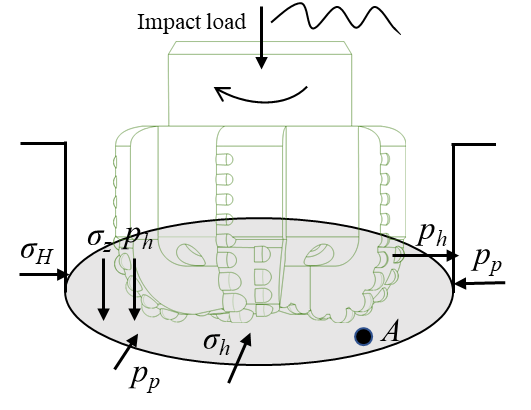
Deep geothermal resources are environmentally friendly and represent a highly competitive form of clean energy. However, low rock-breaking energy combined with high rock strength results in a low rate of penetration (ROP), which significantly restricts the efficient utilization of geothermal resources. Previous studies have shown that rock failure is primarily caused by shear stress. Therefore, this paper aims to enhance the shear stress level by increasing the impact load and releasing the confining pressure, thereby improving the ROP. Specifically, the rock-breaking efficiency under the coupling of impact load and confining pressure releasing is analyzed to reveal the influence of confining pressure releasing on shear stress. Furthermore, a rock-breaking model is established, and an impact load generator is employed to validate the proposed model, enabling the evaluation of rock-breaking efficiency under the coupled action of impact load and confining pressure releasing. The results indicate that the ratio of shear stress to $I_1$ dominates the rock-breaking process. When this ratio is low, the rock tends to remain in a compressed state, the hydrostatic pressure effect is enhanced, the shear stress effect is relatively weakened, and the rock-breaking efficiency decreases. The coupling of impact load with confining pressure releasing can achieve effective rock breaking under relatively low weight-on-bit conditions in deep wells, thereby providing theoretical support for improving rock-breaking efficiency in hot dry rock geothermal development.
Graphical Abstract
Keywords
Data Availability Statement
Funding
Conflicts of Interest
AI Use Statement
Ethical Approval and Consent to Participate
References
- Brodsky, E. E., & Lajoie, L. J. (2013). Anthropogenic seismicity rates and operational parameters at the Salton Sea Geothermal Field. Science, 341(6145), 543–546.
[CrossRef] [Google Scholar] - Hammond, A. L. (1973). Dry geothermal wells: Promising experimental results. Science, 182(4107), 43-44.
[CrossRef] [Google Scholar] - Aldannawy, H. A., Rouabhi, A., & Gerbaud, L. (2022). Percussive drilling: Experimental and numerical investigations. Rock Mechanics and Rock Engineering, 55(3), 1555-1570.
[CrossRef] [Google Scholar] - Liao, H., Wang, H., Niu, J., Wei, J., Niu, W., & Liu, J. (2022). Characteristics of stress release during downhole slotting by high-pressure water jet. Acta Petrolei Sinica, 43(9), 1325.
[Google Scholar] - Liu, W., Deng, H., Zhu, X., Li, R., & He, C. (2023). Experimental study of the rock cutting mechanism with PDC cutter under confining pressure condition. Rock Mechanics and Rock Engineering, 56(10), 7377–7396.
[CrossRef] [Google Scholar] - Lundberg, B., & Collet, P. (2015). Optimal wave shape with respect to efficiency in percussive drilling with detachable drill bit. International Journal of Impact Engineering, 86, 179–187.
[CrossRef] [Google Scholar] - Ma, Y., Zhao, H., Wu, Z., Zhang, H., Rong, Z., Zhang, X., & Yang, X. (2024). Study of rock-breaking performance of V-axe-shaped PDC cutter in tight sandstone formation. Geoenergy Science and Engineering, 241, 213123.
[CrossRef] [Google Scholar] - Saksala, T. (2020). Thermal shock assisted percussive drilling: A numerical study on the single-bit axisymmetric case. International Journal of Rock Mechanics and Mining Sciences, 132, 104365.
[CrossRef] [Google Scholar] - Simon, R. (1964). Transfer of the stress wave energy in the drill steel of a percussive drill to the rock. International Journal of Rock Mechanics and Mining Sciences & Geomechanics Abstracts, 1(4), 397–411.
[CrossRef] [Google Scholar] - Song, H., Shi, H., Chen, Z., Li, G., Ji, R., & Chen, H. (2021). Numerical study on impact energy transfer and rock damage mechanism in percussive drilling based on high temperature hard rocks. Geothermics, 96, 102215.
[CrossRef] [Google Scholar] - Wang, H. J., Liao, H. L., Wei, J., Liu, J. S., Niu, W. L., Liu, Y. W., ... & Latham, J. P. (2023). Stress release mechanism of deep bottom hole rock by ultra-high-pressure water jet slotting. Petroleum Science, 20(3), 1828-1842.
[CrossRef] [Google Scholar] - Warren, T. M., & Smith, M. B. (1985). Bottomhole stress factors affecting drilling rate at depth. Journal of petroleum technology, 37(08), 1523-1533.
[CrossRef] [Google Scholar] - Wu, K., & Ye, Z. (2019). The Numerical Research on Rock Breaking and Rising Mechanism of Rotary-Percussive Drilling. Arabian Journal for Science and Engineering, 44(12), 10561–10580.
[CrossRef] [Google Scholar] - Xi, Y., Yao, Y., Zha, C., Li, J., Qi, Y., & Tian, Y. (2024). Experiment study and numerical simulation on the dynamic rock-breaking process of rotary percussive drilling with different cyclic and stress-wave frequencies. Petroleum Science and Technology, 42(23), 3497-3517.
[CrossRef] [Google Scholar] - Yang, H., Yang, Y., Huang, Y., Zhang, H., & Xie, L. (2024a). Development and Optimization of a High-Frequency Axial-Torsional Composite Percussion Drilling Tool for Enhanced Impact Technology. SPE Journal, 29(2), 860–875.
[CrossRef] [Google Scholar] - Yang, Y., Huang, F., Xu, Y., He, J., Deng, D., Zhan, S., & Zhang, C. (2025). Dynamics study of hot dry rock percussive drilling tool based on the drill string axial vibration. Geoenergy Science and Engineering, 246, 213599.
[CrossRef] [Google Scholar] - Yang, Y., Huang, F., Yan, D., Liao, H., & Niu, J. (2024c). Characteristic analysis of a HDR percussive drilling tool with sinusoidal impact load. Geoenergy Science and Engineering, 238, 212847.
[CrossRef] [Google Scholar] - Yang, Y., Liao, H., Niu, J., Wang, Z., & Chen, J. (2020). Three-dimensional simulation of rock breaking efficiency under various impact drilling loads. Arabian Journal of Geosciences, 13(12), 444.
[CrossRef] [Google Scholar] - Yang, Y., Liao, H., Xu, Y., Niu, J., & Yang, L. (2019). Theoretical investigation of the energy transfer efficiency under percussive drilling loads. Arabian Journal of Geosciences, 12(5), 175.
[CrossRef] [Google Scholar] - Yang, Y., Yan, D., Huang, F., & Liao, H. (2023, October). Hot dry rock breaking with PDC bit under various of impact loads. In ISRM Congress (pp. ISRM-15CONGRESS). ISRM.
[Google Scholar] - Zafarain, H., Ameri, M. J., & Dolatyari, A. (2024). Development of a rock-bit interaction analytical model by considering the in-situ stresses for a bottom-hole element. Scientific Reports, 14(1), 5903.
[CrossRef] [Google Scholar] - Zhu, X., Liu, W., Shi, C., & Zhou, W. (2024). Experiment on the rock-breaking and speed-up mechanism under heavy-duty impact. Acta Petrolei Sinica, 45(10), 1529.
[Google Scholar] - Zhu, X., Wang, Y., & Liu, W. (2024b). The rock-breaking performance of the special-shaped PDC cutter under combined penetration and cutting. Geoenergy Science and Engineering, 243, 213338.
[CrossRef] [Google Scholar] - Zou, Y., Li, J., He, L., & Zhao, J. (2016). Wave propagation in the vicinities of rock fractures under obliquely incident wave. Rock Mechanics and Rock Engineering, 49(5), 1789–1802.
[CrossRef] [Google Scholar]
Cited By (40)
-
Qiang Gao, Yun Bai, Shuaizhi Ji, Junying Zhang, Shitian Wan, Hongxia He, Feng Huang, Junling Lou, Qiang Li. Wellbore Stability Analysis of Shale Formation Considering Sealing Effect of Mud Cake on Drilling Fluid Seepage.
Processes, 2026 , 14 (6).
[CrossRef] -
Fuling Wang, Hongqi Cao, Chenyi Tang, Chengzhe Lu, Yixin Zhang, Rui Deng, Yandong Yang. Factor Analysis and Mechanism Revelation of Reservoir Conditions and Driving Fluids Affecting Geothermal Energy Extraction.
Eng, 2026 , 7 (5).
[CrossRef] -
Xiaoli Zhou, Jiakun Dong, Buxu Sun, Ziyi Yang, Xiaoping Sun, Yu Shen. Slope-Controlled Partitioning of Vertical and Lateral Solute Transport Pathways Revealed by Inclined Leaching Experiments.
Water, 2026 , 18 (6).
[CrossRef] -
Wenhao Zhang, Dandan Wang, Shizhen Li, Xingui Zhou, Yuanlin Meng, Yunbo Zhang, Minfei Wang, Hu Li. Geochemical characteristics and hydrocarbon generation potential of lower cretaceous source rocks in the eastern peripheral basin group of the Songliao Basin, Northeastern China.
Frontiers in Earth Science, 2026 , 14 .
[CrossRef] -
Xiuming Zhang, Yonggang Duan, Yang Ren, Jian Yang, Qishuang Zhou. Production Prediction for Acid Stimulation in Long Horizontal Wells with Along-Well Property Heterogeneity in Carbonate Gas Reservoirs.
Processes, 2026 , 14 (5).
[CrossRef] -
Xingming Wang, Yuanyuan Yang, Le He, Qiaozhu Wang, Bin He. Automatic calibration of wellbore pressure wave velocity using perforation-induced shock waves.
Scientific Reports, 2026 , 16 (1).
[CrossRef] -
Elham Kariri. Interpretable modeling to forecast CO2 solid phase boundaries in cryogenic methane rich systems.
Scientific Reports, 2026 , 16 (1).
[CrossRef] -
Yaoming Zhang, Xuliang Zhang, Fudong Liu, Pengcheng Wang, Jianfei Wang, Fei Zhan, Rui Ma, Yang Liu. Analysis and Optimization Research on the Failure Mechanism of the Sealing Structure of the High-Pressure Casing Hanger.
Processes, 2026 , 14 (6).
[CrossRef] -
Shunsuke Nakaya, Jun Matsushima. Oil Production, Net Energy, and Capital Dynamics: A System-Coupled Lotka–Volterra Approach.
Energies, 2026 , 19 (7).
[CrossRef] -
Bikash Chaudhary, Krishna Kanta Panthi. A Probabilistic Framework for Hydraulic Stability Assessment of Unlined Pressure Tunnels and Shafts.
Geosciences, 2026 , 16 (4).
[CrossRef] -
Beatrice Wanjiru Mwangi, Genson Murithi, Reginah Ngari, Jackson Muthengia, Nancy Mweni Paul, Li Qingchao. Microbial Deterioration Potential and Mitigation Strategies in Blended Cement Structures: A Review.
Advances in Civil Engineering, 2026 , 2026 (1).
[CrossRef] -
Shen Guan, Zhiqiang Hu, Gengchen Li, Xuyue Chen, Minghe Zhang, Yamei Hao. Prediction of Annular Pressure Under Wellhead Uplift Load in Deepwater Subsea Wells.
Processes, 2026 , 14 (11).
[CrossRef] -
Khaled A. Fattah, Salem S. Basaloom, Musaed N. J. AlAwad, Faisal S. Altawati, Mohammed A. Almobarky. Impact of Barite Nanoparticles on Barite Sag in Water-Based Drilling Fluids.
Eng, 2026 , 7 (3).
[CrossRef] -
Jie Yuan, Liangchen Lv, Wen Cheng, Lin Sun, Yulin Zhu, Qian Huang, Hang Yang, Xueyuan Long. Study on the Influence of Crude Oil Emulsion Types on Hydrate Formation.
Processes, 2026 , 14 (5).
[CrossRef] -
Xuhui Zhao, Guangtai Shi, Zonghui Cui, Yanping Zhang. Study of sand particle motion characteristics and distribution patterns in a helical-blade multiphase pump.
Scientific Reports, 2026 , 16 (1).
[CrossRef] -
Ao Feng, Yufa He, Kexin Zhang, Chuanliang Yan. Research on Sensitivity Factors of Wellbore Stability During Directional Well Construction in Deepwater Shallow Soft Hydrate Reservoirs.
Processes, 2026 , 14 (15).
[CrossRef] -
Anxu Ding, Cui Xiao, Li Jia, Liang Wang, Shoujian Peng. Dynamic Evolution of Reservoir Pressure, Temperature, and Deformation During Multi-Coalbed Methane Commingled Production.
Processes, 2026 , 14 (6).
[CrossRef] -
Hyung-Min Baek, Jun Kim, Yeonkang Choi, Jimin Hyun, Sung-chul Shin, Yun-ho Shin, Young-Myung Choi, Eun Jung Chae, Hongrae Park, Eun Soo Kim. Scaling Behavior of Sloshing Impact Pressures Based on Event Distribution and Regime Classification.
Journal of Marine Science and Engineering, 2026 , 14 (10).
[CrossRef] -
Kunlin Ma, Jingsheng Lu, Zhibin Sha, Dongliang Li, Decai Lin, Xiaoya Zang, Deqing Liang. Integrating stimulation and CO2 storage in natural gas hydrate reservoirs: visualization of CO2-foam fracturing and hydrate self-sealing.
Journal of Cleaner Production, 2026 , 566 .
[CrossRef] -
Tianbiao Zhao. A mini review on “from decades to centuries”: temporal gaps in CCUS governance.
Frontiers in Earth Science, 2026 , 14 .
[CrossRef]
Cite This Article
TY  - JOUR
AU  - Yang, Yandong
AU  - Huang, Feifei
AU  - Kang, Shaofei
PY  - 2026
DA  - 2026/01/26
TI  - Mechanism of Penetration Rate Improvement in Hot Dry Rock Under the Coupling of Impact Load and Confining Pressure Release
JO  - Reservoir Science
T2  - Reservoir Science
JF  - Reservoir Science
VL  - 2
IS  - 1
SP  - 52
EP  - 64
DO  - 10.62762/RS.2025.804345
UR  - https://www.icck.org/article/abs/RS.2025.804345
KW  - percussion drilling
KW  - rock breaking efficiency
KW  - rate of penetration
KW  - confining pressure releasing
KW  - impact load
AB  - Deep geothermal resources are environmentally friendly and represent a highly competitive form of clean energy. However, low rock-breaking energy combined with high rock strength results in a low rate of penetration (ROP), which significantly restricts the efficient utilization of geothermal resources. Previous studies have shown that rock failure is primarily caused by shear stress. Therefore, this paper aims to enhance the shear stress level by increasing the impact load and releasing the confining pressure, thereby improving the ROP. Specifically, the rock-breaking efficiency under the coupling of impact load and confining pressure releasing is analyzed to reveal the influence of confining pressure releasing on shear stress. Furthermore, a rock-breaking model is established, and an impact load generator is employed to validate the proposed model, enabling the evaluation of rock-breaking efficiency under the coupled action of impact load and confining pressure releasing. The results indicate that the ratio of shear stress to $I_1$ dominates the rock-breaking process. When this ratio is low, the rock tends to remain in a compressed state, the hydrostatic pressure effect is enhanced, the shear stress effect is relatively weakened, and the rock-breaking efficiency decreases. The coupling of impact load with confining pressure releasing can achieve effective rock breaking under relatively low weight-on-bit conditions in deep wells, thereby providing theoretical support for improving rock-breaking efficiency in hot dry rock geothermal development.
SN  - 3070-2356
PB  - Institute of Central Computation and Knowledge
LA  - English
ER  -
@article{Yang2026Mechanism,
  author = {Yandong Yang and Feifei Huang and Shaofei Kang},
  title = {Mechanism of Penetration Rate Improvement in Hot Dry Rock Under the Coupling of Impact Load and Confining Pressure Release},
  journal = {Reservoir Science},
  year = {2026},
  volume = {2},
  number = {1},
  pages = {52-64},
  doi = {10.62762/RS.2025.804345},
  url = {https://www.icck.org/article/abs/RS.2025.804345},
  abstract = {Deep geothermal resources are environmentally friendly and represent a highly competitive form of clean energy. However, low rock-breaking energy combined with high rock strength results in a low rate of penetration (ROP), which significantly restricts the efficient utilization of geothermal resources. Previous studies have shown that rock failure is primarily caused by shear stress. Therefore, this paper aims to enhance the shear stress level by increasing the impact load and releasing the confining pressure, thereby improving the ROP. Specifically, the rock-breaking efficiency under the coupling of impact load and confining pressure releasing is analyzed to reveal the influence of confining pressure releasing on shear stress. Furthermore, a rock-breaking model is established, and an impact load generator is employed to validate the proposed model, enabling the evaluation of rock-breaking efficiency under the coupled action of impact load and confining pressure releasing. The results indicate that the ratio of shear stress to \$I\_1\$ dominates the rock-breaking process. When this ratio is low, the rock tends to remain in a compressed state, the hydrostatic pressure effect is enhanced, the shear stress effect is relatively weakened, and the rock-breaking efficiency decreases. The coupling of impact load with confining pressure releasing can achieve effective rock breaking under relatively low weight-on-bit conditions in deep wells, thereby providing theoretical support for improving rock-breaking efficiency in hot dry rock geothermal development.},
  keywords = {percussion drilling, rock breaking efficiency, rate of penetration, confining pressure releasing, impact load},
  issn = {3070-2356},
  publisher = {Institute of Central Computation and Knowledge}
}
Publisher's Note
ICCK stays neutral with regard to jurisdictional claims in published maps and institutional affiliations.
Rights and Permissions
 Copyright © 2026 by the Author(s). Published by Institute of Central Computation and Knowledge. This article is an open access article distributed under the terms and conditions of the Creative Commons Attribution (CC BY) license (https://creativecommons.org/licenses/by/4.0/), which permits use, sharing, adaptation, distribution and reproduction in any medium or format, as long as you give appropriate credit to the original author(s) and the source, provide a link to the Creative Commons licence, and indicate if changes were made.

