

Case Studies on Integrating Artificial Intelligence in Finance to Transform Decision Making and Risk Management for Enhanced Financial Outcomes




Article Information
Abstract
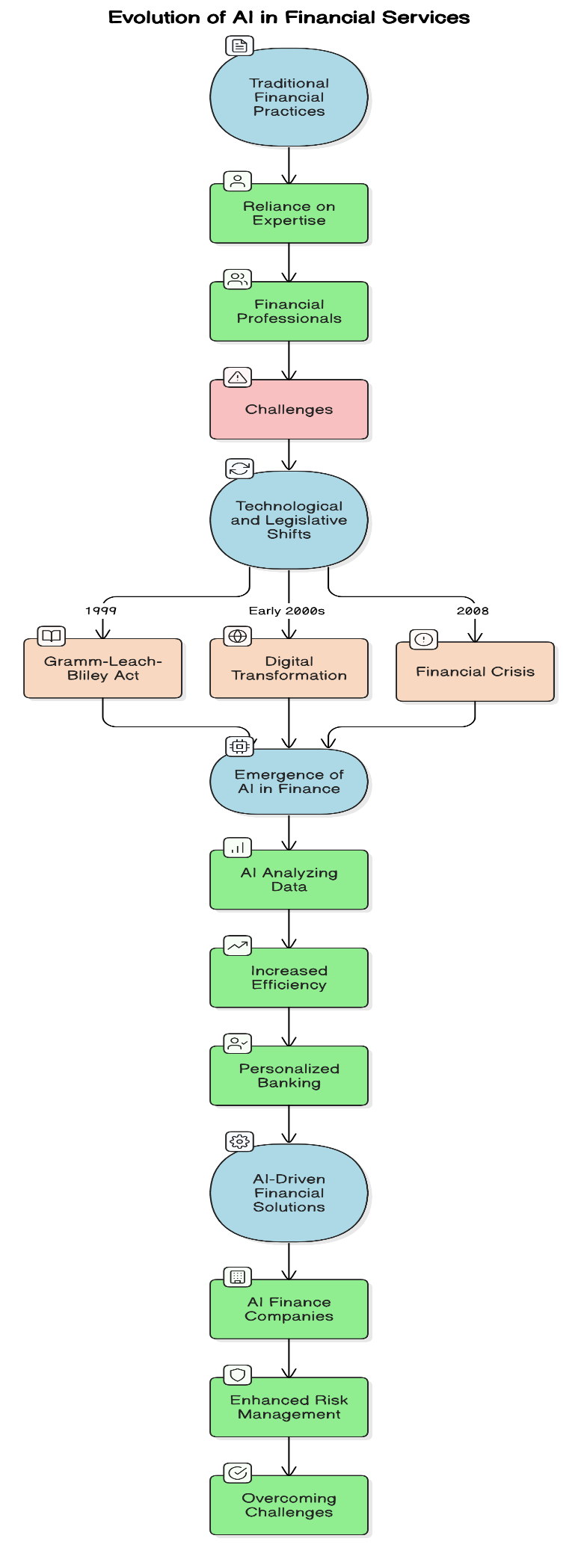
Artificial intelligence (AI) is transforming the financial sector by revolutionizing risk management and enhancing personalized banking experiences. This study examines the role of AI in finance by analyzing how companies such as AlphaSense and Kasisto utilize AI-driven solutions to optimize financial decision-making and customer interactions. AI’s advanced capabilities in data analysis, credit underwriting, and automated customer service have significantly enhanced efficiency, accuracy, and accessibility within the financial services sector. The paper explores key AI technologies, including machine learning, natural language processing (NLP), and generative AI, which drive this transformation. Despite its numerous advantages, the integration of AI in finance presents challenges such as data privacy concerns, ethical considerations, and regulatory compliance. The study highlights the importance of addressing these challenges to ensure the responsible and sustainable adoption of AI in the financial sector. By showcasing the contributions of leading AI-driven financial solutions, this research provides valuable insights into the evolving financial landscape and the potential of AI to redefine financial services, making them more inclusive, efficient, and secure.
Graphical Abstract
Keywords
Data Availability Statement
Funding
Conflicts of Interest
Ethical Approval and Consent to Participate
References
- Ai, Z. (2024). Zest AI’s Credit Models Proven to Increase Loan Approvals for Every Protected Class. PR Newswire.Retrieved from https://www.prnewswire.com/news-releases/zest-ais-credit-models-proven-to-increase-loan-approvals-for-every-protected-class-302048828.html.
[Google Scholar] - Al-Sartawi, A. M. a. M., Hussainey, K., & Razzaque, A. (2022). The role of artificial intelligence in sustainable finance. Journal of Sustainable Finance & Investment, 1–6.
[CrossRef] [Google Scholar] - Azevedo, M. A. (2021). Ocrolus lands \$80M at a \$500M+ valuation to automate document processing for fintechs and banks. TechCrunch. Retrieved from https://techcrunch.com/2021/09/23/ocrolus-lands-80m-to-automate-document-processing-for-fintechs-and-banks/.
[Google Scholar] - Bahoo, S., Cucculelli, M., Goga, X., & Mondolo, J. (2024). Artificial intelligence in Finance: a comprehensive review through bibliometric and content analysis. SN Business & Economics, 4(2).
[CrossRef] [Google Scholar] - Cao, L. (2022). AI in Finance: Challenges, Techniques, and Opportunities. ACM Computing Surveys, 55(3), 1–38.
[CrossRef] [Google Scholar] - Cao, Y., & Zhai, J. (2022). A survey of AI in finance. Journal of Chinese Economic and Business Studies, 20(2), 125–137.
[CrossRef] [Google Scholar] - Choithani, T., Chowdhury, A., Patel, S., Patel, P., Patel, D., & Shah, M. (2022). A comprehensive study of artificial intelligence and cybersecurity on Bitcoin, cryptocurrency, and the banking system. Annals of Data Science, 11(1), 103–135.
[CrossRef] [Google Scholar] - Gogas, P., & Papadimitriou, T. (2021). Machine learning in economics and finance. Computational Economics, 57(1), 1–4.
[CrossRef] [Google Scholar] - Hilton, B. (2025). Preventing an AI-related catastrophe - 80,000 Hours. 80,000 Hours. Retrieved from https://80000hours.org/problem-profiles/artificial-intelligence/.
[Google Scholar] - Home - Zest AI. (2024). Zest AI. Retrieved from https://www.zest.ai/.
[Google Scholar] - Kasisto. (2025). Conversational AI solutions for banking and Finance | Kasisto. https://kasisto.com/
[Google Scholar] - Kearns, J. & Matt Chinworth. (2023). Artificial intelligence. In F&D (p. 38) Retrieved from https://www.elibrary.imf.org/downloadpdf/journals/022/0060/004/article-A010-en.pdf.
[Google Scholar] - Layn, B. (n.d.). Artificial Intelligence in Finance: Transforming Decision-Making and risk management for enhanced financial outcomes. ScholarWorks@UARK. Retrieved from https://scholarworks.uark.edu/finnuht/124.
[Google Scholar] - Lee, J. (2020). Access to finance for artificial intelligence regulation in the financial services industry. European Business Organization Law Review, 21(4), 731–757.
[CrossRef] [Google Scholar] - Lyeonov, S., Draskovic, V., Kubaščikova, Z., & Fenyves, V. (2024). Artificial intelligence and machine learning in combating illegal financial operations: Bibliometric analysis. Human Technology, 20(2), 325–360.
[CrossRef] [Google Scholar] - Max, R., Kriebitz, A., & Von Websky, C. (2021). Ethical considerations about the implications of artificial intelligence in finance. In International handbooks in business ethics (pp. 577–592).
[CrossRef] [Google Scholar] - McDonald, W., & McDonald, W. (2023). Kasisto’s chatbot does the work of 2 FTEs at Meriwest CU. Bank Automation News. Retrieved from https://bankautomationnews.com/allposts/center-of-excellence/kasistos-chatbot-does-work-of-2-ftes-at-meriwest-cu/.
[Google Scholar] - Mhlanga, D. (2020). Industry 4.0 in Finance: The impact of Artificial intelligence (AI) on digital financial inclusion. International Journal of Financial Studies, 8(3), 45.
[CrossRef] [Google Scholar] - Ocrolus. (2024). Intelligent Document Automation Software - Ocrolus. Retrieved from https://www.ocrolus.com/
[Google Scholar] - Ocrolus. (2024). Year in review and looking ahead: leading the charge in document automation and analysis for lenders. Ocrolus. Retrieved from https://www.ocrolus.com/blog/2023-in-review/#:~:text=Powered%20by%20AI%2C%20Instant%20empowers,verification%20for%20lower%2Dquality%20documents.
[Google Scholar] - Owolabi, O. S., Uche, P. C., Adeniken, N. T., Ihejirika, C., Islam, R. B., & Chhetri, B. J. T. (2024). Ethical implication of artificial intelligence (AI) adoption in financial decision making. Computer and Information Science, 17(1), 49.
[CrossRef] [Google Scholar] - Pallathadka, H., Ramirez-Asis, E. H., Loli-Poma, T. P., Kaliyaperumal, K., Ventayen, R. J. M., & Naved, M. (2021). Applications of artificial intelligence in business management, e-commerce and finance. Materials Today Proceedings, 80, 2610–2613.
[CrossRef] [Google Scholar] - Pattnaik, D., Ray, S., & Raman, R. (2023). Applications of artificial intelligence and machine learning in the financial services industry: A bibliometric review. Heliyon, 10(1), e23492.
[CrossRef] [Google Scholar] - Polak, P., Nelischer, C., Guo, H., & Robertson, D. C. (2019). “Intelligent” finance and treasury management: what we can expect. AI & Society, 35(3), 715–726.
[CrossRef] [Google Scholar] - Rane, N. L., Choudhary, S. P., & Rane, J. (2024a). Artificial Intelligence-driven corporate finance: enhancing efficiency and decision-making through machine learning, natural language processing, and robotic process automation in corporate governance and sustainability. Studies in Economics and Business Relations, 5(2), 1–22.
[CrossRef] [Google Scholar] - Singh, G., Garg, V., & Tiwari, P. (2020). Application of artificial intelligence on behavioral finance. In Studies in computational intelligence (pp. 342–353).
[CrossRef] [Google Scholar] - Jiang, X., Yan, L., Vavekanand, R., & Hu, M. (2023). Large Language Models in Healthcare Current Development and Future Directions. In Generative AI Research. https://dx.doi.org/10.5281/zenodo.12705655
[Google Scholar] - Kondoju, V. P., & Kumar, A. (2024). AI-driven innovations in credit scoring models for financial institutions. International Journal for Research in Management and Pharmacy, 13, 10-62.
[Google Scholar] - Talaat, F. M., Aljadani, A., Badawy, M., & Elhosseini, M. (2023a). Toward interpretable credit scoring: integrating explainable artificial intelligence with deep learning for credit card default prediction. Neural Computing and Applications, 36(9), 4847–4865.
[CrossRef] [Google Scholar] - Talaat, F. M., Aljadani, A., Badawy, M., & Elhosseini, M. (2023b). Toward interpretable credit scoring: integrating explainable artificial intelligence with deep learning for credit card default prediction. Neural Computing and Applications, 36(9), 4847–4865.
[CrossRef] [Google Scholar] - Hidayat, M., Defitri, S. Y., & Hilman, H. (2024). The impact of artificial intelligence (AI) on financial management.
[Google Scholar] - Veloso, M., Balch, T., Borrajo, D., Reddy, P., & Shah, S. (2021). Artificial intelligence research in finance: discussion and examples. Oxford Review of Economic Policy, 37(3), 564–584.
[CrossRef] [Google Scholar] - Wasil, A. R., Clymer, J., Krueger, D., Dardaman, E., Campos, S., & Murphy, E. R. (2024). Affirmative safety: An approach to risk management for high-risk AI. arXiv (Cornell University).
[CrossRef] [Google Scholar] - Webadmin. (2025). AlphaSense | market intelligence and search platform. AlphaSense. https://www.alpha-sense.com/
[Google Scholar] - Suchonwanich, N., Nuchitprasitchai, S., & Viriyapant, K. (2024, November). Enhancing Personalized Financial Advisory Application with Generative AI and Chatbot: A Usability Study. In 2024 8th International Conference on Information Technology (InCIT) (pp. 97-102). IEEE.
[CrossRef] [Google Scholar] - Weber, P., Carl, K. V., & Hinz, O. (2023). Applications of Explainable Artificial Intelligence in Finance—a systematic review of Finance, Information Systems, and Computer Science literature. Management Review Quarterly, 74(2), 867–907.
[CrossRef] [Google Scholar]
Cite This Article
TY  - JOUR
AU  - Madiha, Madiha
AU  - Sam, Kira
AU  - Kumar, Sanjai
AU  - Vavekanand, Raja
PY  - 2025
DA  - 2025/05/25
TI  - Case Studies on Integrating Artificial Intelligence in Finance to Transform Decision Making and Risk Management for Enhanced Financial Outcomes
JO  - ICCK Transactions on Computer Science
T2  - ICCK Transactions on Computer Science
JF  - ICCK Transactions on Computer Science
VL  - 2
IS  - 2
SP  - 35
EP  - 50
DO  - 10.62762/TCS.2025.744196
UR  - https://www.icck.org/article/abs/TCS.2025.744196
KW  - AI in finance
KW  - digitalization
KW  - risk management
KW  - financial data analysis
KW  - risk analytics
AB  - Artificial intelligence (AI) is transforming the financial sector by revolutionizing risk management and enhancing personalized banking experiences. This study examines the role of AI in finance by analyzing how companies such as AlphaSense and Kasisto utilize AI-driven solutions to optimize financial decision-making and customer interactions. AI’s advanced capabilities in data analysis, credit underwriting, and automated customer service have significantly enhanced efficiency, accuracy, and accessibility within the financial services sector. The paper explores key AI technologies, including machine learning, natural language processing (NLP), and generative AI, which drive this transformation. Despite its numerous advantages, the integration of AI in finance presents challenges such as data privacy concerns, ethical considerations, and regulatory compliance. The study highlights the importance of addressing these challenges to ensure the responsible and sustainable adoption of AI in the financial sector. By showcasing the contributions of leading AI-driven financial solutions, this research provides valuable insights into the evolving financial landscape and the potential of AI to redefine financial services, making them more inclusive, efficient, and secure.
SN  - request pending
PB  - Institute of Central Computation and Knowledge
LA  - English
ER  -
@article{Madiha2025Case,
  author = {Madiha Madiha and Kira Sam and Sanjai Kumar and Raja Vavekanand},
  title = {Case Studies on Integrating Artificial Intelligence in Finance to Transform Decision Making and Risk Management for Enhanced Financial Outcomes},
  journal = {ICCK Transactions on Computer Science},
  year = {2025},
  volume = {2},
  number = {2},
  pages = {35-50},
  doi = {10.62762/TCS.2025.744196},
  url = {https://www.icck.org/article/abs/TCS.2025.744196},
  abstract = {Artificial intelligence (AI) is transforming the financial sector by revolutionizing risk management and enhancing personalized banking experiences. This study examines the role of AI in finance by analyzing how companies such as AlphaSense and Kasisto utilize AI-driven solutions to optimize financial decision-making and customer interactions. AI’s advanced capabilities in data analysis, credit underwriting, and automated customer service have significantly enhanced efficiency, accuracy, and accessibility within the financial services sector. The paper explores key AI technologies, including machine learning, natural language processing (NLP), and generative AI, which drive this transformation. Despite its numerous advantages, the integration of AI in finance presents challenges such as data privacy concerns, ethical considerations, and regulatory compliance. The study highlights the importance of addressing these challenges to ensure the responsible and sustainable adoption of AI in the financial sector. By showcasing the contributions of leading AI-driven financial solutions, this research provides valuable insights into the evolving financial landscape and the potential of AI to redefine financial services, making them more inclusive, efficient, and secure.},
  keywords = {AI in finance, digitalization, risk management, financial data analysis, risk analytics},
  issn = {request pending},
  publisher = {Institute of Central Computation and Knowledge}
}
Article Metrics
Publisher's Note
ICCK stays neutral with regard to jurisdictional claims in published maps and institutional affiliations.
Rights and Permissions


Portico
