

Effect of Scanning Power on Electrochemical Corrosion Properties of AlCoCrFeNi High Entropy Alloy Coating Melted by Extremely High-speed Laser Cladding



Article Information
Abstract
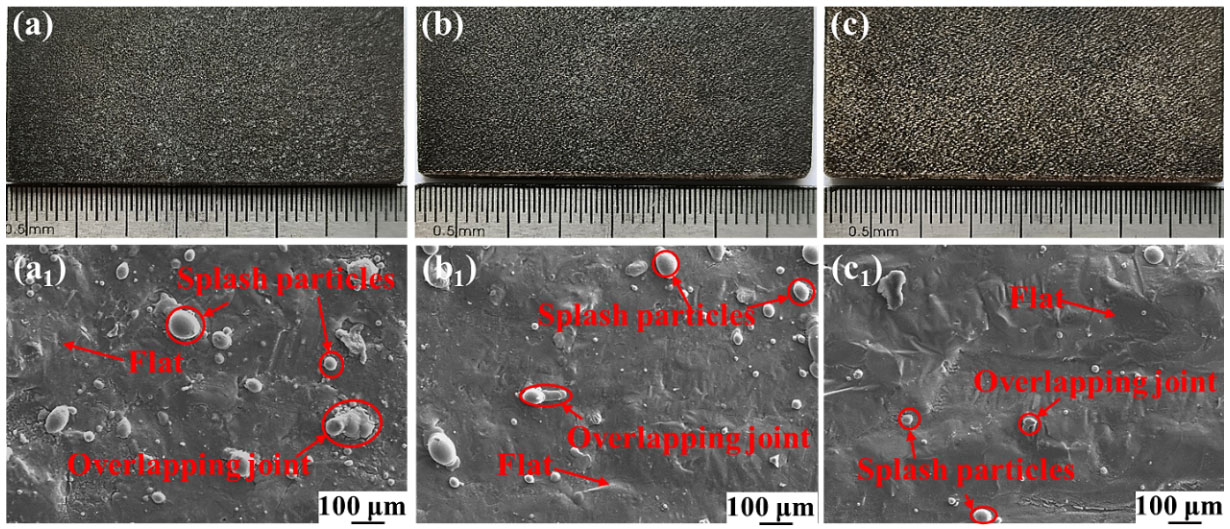
High-entropy alloy (HEA) coatings have become a candidate for corrosion protection of marine engineering equipment in harsh service environments. In this paper, the effect of laser scanning power on the microstructure and electrochemical corrosion resistance of HEA coating prepared by Extremely High-speed Laser Cladding (EHLC) was investigated. The coating was prepared by EHLC technology. The microstructure of the coating was characterized by XRD and SEM. The corrosion resistance of the coating in \(3.5\%\) NaCl solution was investigated by electrochemical measurement. The results show that: With the increase of scanning power, the sputtered particles of the coating decreased, but the surface roughness increased. The coating was composed of FCC+BCC phases; the \(\sigma\) phase appeared at \(200\,\mathrm{W}\) and disappeared at \(250\,\mathrm{W}\), and the lattice expanded with the increase of scanning power. The corrosion resistance test showed that the corrosion resistance of the coating at \(200\,\mathrm{W}\) was the best (\(E_{\mathrm{corr}} = -0.69\,\mathrm{V}\), \(I_{\mathrm{corr}} = 6.29 \times 10^{-6}\,\mathrm{A/cm^{2}}\), \(R_{p} = 5631.67\,\Omega\cdot\mathrm{cm^{2}}\) and \(R_{\mathrm{ct}} = 3030.00\,\Omega\cdot\mathrm{cm^{2}}\), respectively), followed by \(250\,\mathrm{W}\) and \(150\,\mathrm{W}\). The microstructure uniformity of the coating can be optimized by moderately increasing the scanning power (\(200\,\mathrm{W}\)), and the corrosion resistance of the coating can be significantly improved, which provides a process guide for the preparation of protective coatings for offshore engineering equipment.
Graphical Abstract
Keywords
Data Availability Statement
Funding
Conflicts of Interest
AI Use Statement
Ethical Approval and Consent to Participate
References
- Wu, Y., Zhao, W., & Wang, L. (2025). State of the art and current trends on the metal corrosion and protection strategies in deep sea. Journal of Materials Science & Technology, 215, 192-213.
[CrossRef] [Google Scholar] - Liang, J., Wang, W., Cao, Z., Guo, J., Sun, Z., & Hai, Y. (2024). Corrosion resistance and mechanism of high‐entropy alloys: A review. Materials and Corrosion, 75(4), 424-432.
[CrossRef] [Google Scholar] - Zhang, B. B., Zhang, R. Y., Wang, Y., Wang, W., & Sand, W. (2024). Preface: Corrosion and protection in marine environment. Journal of Central South University, 31(10), 3349-3351.
[CrossRef] [Google Scholar] - Nassar, N. E. A. (2022). Corrosion in marine and offshore steel structures: Classification and overview. International Journal of Advanced Engineering, Sciences and Applications, 3(1), 7-11.
[CrossRef] [Google Scholar] - Wang, J., Wen, W., Xie, F., Wu, B., Yang, Y., Cheng, J., ... & Zhang, X. (2024). Effects of oxygen concentration on the corrosion behavior of high entropy alloy AlCoCrFeNi in simulated deep sea. Heliyon, 10(12).
[CrossRef] [Google Scholar] - Nartita, R., Ionita, D., & Demetrescu, I. (2024). A modern approach to HEAs: from structure to properties and potential applications. Crystals, 14(5), 451.
[CrossRef] [Google Scholar] - Liu, C., Tong, S., Yue, Y., Wang, H., Song, J., Li, Y., ... & Wang, Z. (2024). Laser-based fabrication of superwetting titanium alloy with enhanced corrosion and erosion-corrosion resistance. Colloids and Surfaces A: Physicochemical and Engineering Aspects, 688, 133648.
[CrossRef] [Google Scholar] - Wang, K., Zhu, Y., Wang, P. W., Li, X., Malomo, B., & Yang, L. (2024). Enhancing corrosion resistance in CoCrFeNiTa high entropy alloys via Mo addition. Electrochimica Acta, 480, 143951.
[CrossRef] [Google Scholar] - Wang, Y., Li, G., Qi, H., Zhang, W., Chen, R., Su, R., & Qu, Y. (2024). Effect of Al content on the corrosion behavior and mechanism of AlxCoCrFeNi high-entropy alloys. Journal of Materials Research and Technology, 30, 5977-5989.
[CrossRef] [Google Scholar] - Wang, J., Jiang, H., Chang, X., Zhang, L., Wang, H., Zhu, L., & Qin, S. (2023). Effect of Cu content on the microstructure and corrosion resistance of AlCrFeNi3Cux high entropy alloys. Corrosion Science, 221, 111313.
[CrossRef] [Google Scholar] - Fu, Y., Li, J., Luo, H., Du, C., & Li, X. (2021). Recent advances on environmental corrosion behavior and mechanism of high-entropy alloys. Journal of Materials Science & Technology, 80, 217-233.
[CrossRef] [Google Scholar] - Zhang, C., Huang, L., Li, S., Li, K., Lu, S., & Li, J. (2023). Improved corrosion resistance of laser melting deposited CoCrFeNi-series high-entropy alloys by Al addition. Corrosion Science, 225, 111599.
[CrossRef] [Google Scholar] - Wu, X., & Lu, Y. (2022). Study on the corrosion resistance of laser clad Al0.7FeCoCrNiCux high-entropy alloy coating in marine environment. Coatings, 12(12), 1855.
[CrossRef] [Google Scholar] - Tabernero, I., Lamikiz, A., Martínez, S., Ukar, E., & De Lacalle, L. L. (2012). Modelling of energy attenuation due to powder flow-laser beam interaction during laser cladding process. Journal of materials processing technology, 212(2), 516-522.
[CrossRef] [Google Scholar] - Liu, J., Bai, M., Xu, W., & Chu, T. (2025). Effect of Processing Parameters on the Microstructure and Corrosion Properties of AlCrFeCoNi High-Entropy Alloy Coatings Fabricated by Laser Cladding. Metals, 15(3), 231.
[CrossRef] [Google Scholar] - Zhang, Q., Wang, Q., Han, B., Li, M., Hu, C., & Wang, J. (2023). Comparative studies on microstructure and properties of CoCrFeMnNi high entropy alloy coatings fabricated by high-speed laser cladding and normal laser cladding. Journal of Alloys and Compounds, 947, 169517.
[CrossRef] [Google Scholar] - Zhou, L., Ma, G., Zhao, H., Mou, H., Xu, J., Wang, W., ... & Wang, H. (2024). Research status and prospect of extreme high-speed laser cladding technology. Optics & Laser Technology, 168, 109800.
[CrossRef] [Google Scholar] - Li, Y., Wang, L., Zhang, J., Liu, M., Guo, S., Liu, J., & Cao, L. (2024). Effect of multiple laser remelting on microstructure and corrosion resistance of Fe0. 5CoCrNi1. 5Nb0. 68Mo0. 3 high entropy alloy coatings. Journal of Materials Research and Technology, 31, 3935-3949.
[CrossRef] [Google Scholar] - Zhan, X., Qi, C., Gao, Z., Tian, D., & Wang, Z. (2019). The influence of heat input on microstructure and porosity during laser cladding of Invar alloy. Optics & Laser Technology, 113, 453-461.
[CrossRef] [Google Scholar] - Li, B., Zhu, H., Qiu, C., & Guo, D. (2020). Development of multi-principal-component alloy coating by laser cladding with excellent mechanical and corrosion properties. Journal of Alloys and Compounds, 820, 153071.
[CrossRef] [Google Scholar] - Zhang, Z., Zhao, Y., Chen, Y., Su, Z., Shan, J., Wu, A., ... & Tang, X. (2021). The role of the pulsed-wave laser characteristics on restraining hot cracking in laser cladding non-weldable nickel-based superalloy. Materials & Design, 198, 109346.
[CrossRef] [Google Scholar] - Sun, P., Liang, J., Ma, D., Tang, C., Wang, D., Lai, T., & Zhang, H. (2025). Microstructural evolution and corrosion behavior of Fe-Cr-B alloy coatings: A comparative study between extreme high-speed and traditional laser cladding. Surface and Coatings Technology, 513, 132542.
[CrossRef] [Google Scholar] - Liang, Y., Liao, Z. Y., Zhang, L. L., Cai, M. W., Wei, X. S., & Shen, J. (2023). A review on coatings deposited by extreme high-speed laser cladding: processes, materials, and properties. Optics & Laser Technology, 164, 109472.
[CrossRef] [Google Scholar] - Zhou, J. L., Cheng, Y. H., He, B., Wan, Y. X., Chen, H., Wang, Y. F., & Yang, J. Y. (2025). Enhancement of high-entropy alloy coatings with multi-scale TiC ceramic particles via high-speed laser cladding: Microstructure, wear and corrosion. Applied Surface Science, 685, 162061.
[CrossRef] [Google Scholar] - Chong, Z., Sun, Y., Cheng, W., Huang, L., Han, C., Ma, X., & Meng, A. (2022). Laser remelting induces grain refinement and properties enhancement in high-speed laser cladding AlCoCrFeNi high-entropy alloy coatings. Intermetallics, 150, 107686.
[CrossRef] [Google Scholar] - Meghwal, A., Pinches, S., Anupam, A., Lie, L., Munroe, P., Berndt, C. C., & Ang, A. S. M. (2023). Structure-property correlation of a CoCrFeNi medium-entropy alloy manufactured using extreme high-speed laser material deposition (EHLA). Intermetallics, 152, 107769.
[CrossRef] [Google Scholar] - Chen, S., Zhou, Y., Peng, P., Guo, S., Yang, L., & Guo, C. (2025). Wear and corrosion resistance of 304SS coating using high speed laser cladding. International Journal of Precision Engineering and Manufacturing, 26(6), 1527-1539.
[CrossRef] [Google Scholar] - Shen, F., Tao, W., Li, L., Zhou, Y., Wang, W., & Wang, S. (2020). Effect of microstructure on the corrosion resistance of coatings by extreme high speed laser cladding. Applied Surface Science, 517, 146085.
[CrossRef] [Google Scholar] - Wu, Y., Lu, K., Zhu, J., Guo, D., Yang, M., Sun, H., Wang, Z., & Hui, X. (2022). Microstructures, corrosion resistance and wear resistance of high-entropy alloys coatings with various compositions prepared by laser cladding: A review. Coatings, 12(7), 1023.
[CrossRef] [Google Scholar] - Gao, Q., Liu, H., Chen, P., Liu, X., Yang, H., & Hao, J. (2023). Multi-objective optimization for laser cladding refractory MoNbTiZr high-entropy alloy coating on Ti6Al4V. Optics & Laser Technology, 161, 109220.
[CrossRef] [Google Scholar] - Zhang, H., Qiao, M., Liu, X., Wang, Y., & Duan, J. (2025). Research on the laser melting coating process of an AlCoCrFeNi high‐entropy alloy. International Journal of Applied Ceramic Technology, 22(2), e14937.
[CrossRef] [Google Scholar] - Xie, F., Zhai, C., Zhang, X., Emre, A., Zheng, H., Zhang, X., ... & Hua, X. (2025). Microstructure, dislocation and high-temperature oxidation behavior of as-cladding NiCoFeCrMo high-entropy alloy coatings: Laser cladding vs vacuum cladding. Journal of Alloys and Compounds, 1033, 181278.
[CrossRef] [Google Scholar] - Zhang, Q., Li, M., Wang, Q., Qi, F., Kong, M., & Han, B. (2023). Investigation of the microstructure and properties of CoCrFeNiMo high-entropy alloy coating prepared through high-speed laser cladding. Coatings, 13(7), 1211.
[CrossRef] [Google Scholar] - Cui, Y., Shen, J., Manladan, S. M., Geng, K., & Hu, S. (2020). Strengthening mechanism in two-phase FeCoCrNiMnAl high entropy alloy coating. Applied Surface Science, 530, 147205.
[CrossRef] [Google Scholar] - Sun, S., Wu, Z., Pang, M., Chang, J., Xuan, Y., Qi, H., ... & Wu, Y. (2024). Microstructure and corrosion behavior of chromium-rich stainless steel coatings deposited by different laser cladding processes. Journal of Materials Research and Technology, 29, 3879-3890.
[CrossRef] [Google Scholar] - Meghwal, A., Singh, S., Anupam, A., King, H. J., Schulz, C., Hall, C., ... & Ang, A. S. M. (2022). Nano-and micro-mechanical properties and corrosion performance of a HVOF sprayed AlCoCrFeNi high-entropy alloy coating. Journal of Alloys and Compounds, 912, 165000.
[CrossRef] [Google Scholar] - Meghwal, A., Anupam, A., Luzin, V., Schulz, C., Hall, C., Murty, B. S., ... & Ang, A. S. M. (2021). Multiscale mechanical performance and corrosion behaviour of plasma sprayed AlCoCrFeNi high-entropy alloy coatings. Journal of Alloys and Compounds, 854, 157140.
[CrossRef] [Google Scholar] - Haixiang, C., & Dejun, K. (2020). Comparison on electrochemical corrosion performances of arc and laser thermal sprayed Al–Ti–Ni coatings in marine environment. Materials Chemistry and Physics, 251, 123200.
[CrossRef] [Google Scholar] - Wu, W., & Lin, S. (2024). Wear and corrosion resistances of arc-sprayed FeCr alloy and Fe-based coatings for boiler heat exchanger pipelines. Journal of Thermal Spray Technology, 33(6), 2068-2088.
[CrossRef] [Google Scholar] - Liao, T., Wang, Z., Wu, X., Liu, Q., Guo, Y., Ding, K., & Shang, X. (2023). Effect of V on microstructure, wear and corrosion properties in AlCoCrMoVx high entropy alloy coatings by laser cladding. Journal of Materials Research and Technology, 23, 4420-4431.
[CrossRef] [Google Scholar] - Chen, R., Zheng, C., Ma, H., Yi, G., Ju, D., Zhang, J., ... & Wang, J. (2025). Multi-parameter optimization and corrosion behavior of FeCoNiCrAl HEA coatings via laser cladding. Metals, 15(4), 406.
[CrossRef] [Google Scholar] - Liao, B. K., Liang, Z. X., Luo, Z. G., Liu, Y., Deng, H. W., Zhang, T., ... & Ge, H. E. (2023). Insight into microstructure evolution on anti-corrosion property of Al x CoCrFeNiC0. 01 high-entropy alloys using scanning vibration electrode technique. Rare Metals, 42(10), 3455-3467.
[CrossRef] [Google Scholar] - Bi, D., Chang, Y., Luo, H., Pan, Z., Zhao, Q., Cheng, H., ... & Li, X. (2023). Corrosion behavior and passive film characteristics of AlNbTiZrSix high-entropy alloys in simulated seawater environment. Corrosion Science, 224, 111530.
[CrossRef] [Google Scholar]
Cite This Article
TY  - JOUR
AU  - Zhang, Hao
AU  - Qiao, Mengying
AU  - Yue, Xiujie
AU  - Xin, Miaomiao
PY  - 2026
DA  - 2026/08/12
TI  - Effect of Scanning Power on Electrochemical Corrosion Properties of AlCoCrFeNi High Entropy Alloy Coating Melted by Extremely High-speed Laser Cladding
JO  - Journal of Materials Durability and Engineering
T2  - Journal of Materials Durability and Engineering
JF  - Journal of Materials Durability and Engineering
VL  - 1
IS  - 1
SP  - 23
EP  - 34
DO  - 10.62762/JMDE.2025.161346
UR  - https://www.icck.org/article/abs/JMDE.2025.161346
KW  - extremely high-speed laser cladding
KW  - high entropy alloy coatings
KW  - scanning power
KW  - microstructure
KW  - corrosion resistance
AB  - High-entropy alloy (HEA) coatings have become a candidate for corrosion protection of marine engineering equipment in harsh service environments. In this paper, the effect of laser scanning power on the microstructure and electrochemical corrosion resistance of HEA coating prepared by Extremely High-speed Laser Cladding (EHLC) was investigated. The coating was prepared by EHLC technology. The microstructure of the coating was characterized by XRD and SEM. The corrosion resistance of the coating in \(3.5\%\) NaCl solution was investigated by electrochemical measurement. The results show that: With the increase of scanning power, the sputtered particles of the coating decreased, but the surface roughness increased. The coating was composed of FCC+BCC phases; the \(\sigma\) phase appeared at \(200\,\mathrm{W}\) and disappeared at \(250\,\mathrm{W}\), and the lattice expanded with the increase of scanning power. The corrosion resistance test showed that the corrosion resistance of the coating at \(200\,\mathrm{W}\) was the best (\(E_{\mathrm{corr}} = -0.69\,\mathrm{V}\), \(I_{\mathrm{corr}} = 6.29 \times 10^{-6}\,\mathrm{A/cm^{2}}\), \(R_{p} = 5631.67\,\Omega\cdot\mathrm{cm^{2}}\) and \(R_{\mathrm{ct}} = 3030.00\,\Omega\cdot\mathrm{cm^{2}}\), respectively), followed by \(250\,\mathrm{W}\) and \(150\,\mathrm{W}\). The microstructure uniformity of the coating can be optimized by moderately increasing the scanning power (\(200\,\mathrm{W}\)), and the corrosion resistance of the coating can be significantly improved, which provides a process guide for the preparation of protective coatings for offshore engineering equipment.
SN  - pending
PB  - Institute of Central Computation and Knowledge
LA  - English
ER  -
@article{Zhang2026Effect,
  author = {Hao Zhang and Mengying Qiao and Xiujie Yue and Miaomiao Xin},
  title = {Effect of Scanning Power on Electrochemical Corrosion Properties of AlCoCrFeNi High Entropy Alloy Coating Melted by Extremely High-speed Laser Cladding},
  journal = {Journal of Materials Durability and Engineering},
  year = {2026},
  volume = {1},
  number = {1},
  pages = {23-34},
  doi = {10.62762/JMDE.2025.161346},
  url = {https://www.icck.org/article/abs/JMDE.2025.161346},
  abstract = {High-entropy alloy (HEA) coatings have become a candidate for corrosion protection of marine engineering equipment in harsh service environments. In this paper, the effect of laser scanning power on the microstructure and electrochemical corrosion resistance of HEA coating prepared by Extremely High-speed Laser Cladding (EHLC) was investigated. The coating was prepared by EHLC technology. The microstructure of the coating was characterized by XRD and SEM. The corrosion resistance of the coating in \(3.5\\%\) NaCl solution was investigated by electrochemical measurement. The results show that: With the increase of scanning power, the sputtered particles of the coating decreased, but the surface roughness increased. The coating was composed of FCC+BCC phases; the \(\sigma\) phase appeared at \(200\,\mathrm{W}\) and disappeared at \(250\,\mathrm{W}\), and the lattice expanded with the increase of scanning power. The corrosion resistance test showed that the corrosion resistance of the coating at \(200\,\mathrm{W}\) was the best (\(E\_{\mathrm{corr}} = -0.69\,\mathrm{V}\), \(I\_{\mathrm{corr}} = 6.29 \times 10^{-6}\,\mathrm{A/cm^{2}}\), \(R\_{p} = 5631.67\,\Omega\cdot\mathrm{cm^{2}}\) and \(R\_{\mathrm{ct}} = 3030.00\,\Omega\cdot\mathrm{cm^{2}}\), respectively), followed by \(250\,\mathrm{W}\) and \(150\,\mathrm{W}\). The microstructure uniformity of the coating can be optimized by moderately increasing the scanning power (\(200\,\mathrm{W}\)), and the corrosion resistance of the coating can be significantly improved, which provides a process guide for the preparation of protective coatings for offshore engineering equipment.},
  keywords = {extremely high-speed laser cladding, high entropy alloy coatings, scanning power, microstructure, corrosion resistance},
  issn = {pending},
  publisher = {Institute of Central Computation and Knowledge}
}
Article Metrics
Publisher's Note
ICCK stays neutral with regard to jurisdictional claims in published maps and institutional affiliations.
Rights and Permissions
 Copyright © 2026 by the Author(s). Published by Institute of Central Computation and Knowledge. This article is an open access article distributed under the terms and conditions of the Creative Commons Attribution (CC BY) license (https://creativecommons.org/licenses/by/4.0/), which permits use, sharing, adaptation, distribution and reproduction in any medium or format, as long as you give appropriate credit to the original author(s) and the source, provide a link to the Creative Commons licence, and indicate if changes were made.


Portico
