

Study on the Effect of Cryogenic Pretreatment-Based Abrasive Water Jet Surface Modification on the Surface Integrity of 7075 Aluminum Alloy



Article Information
Abstract
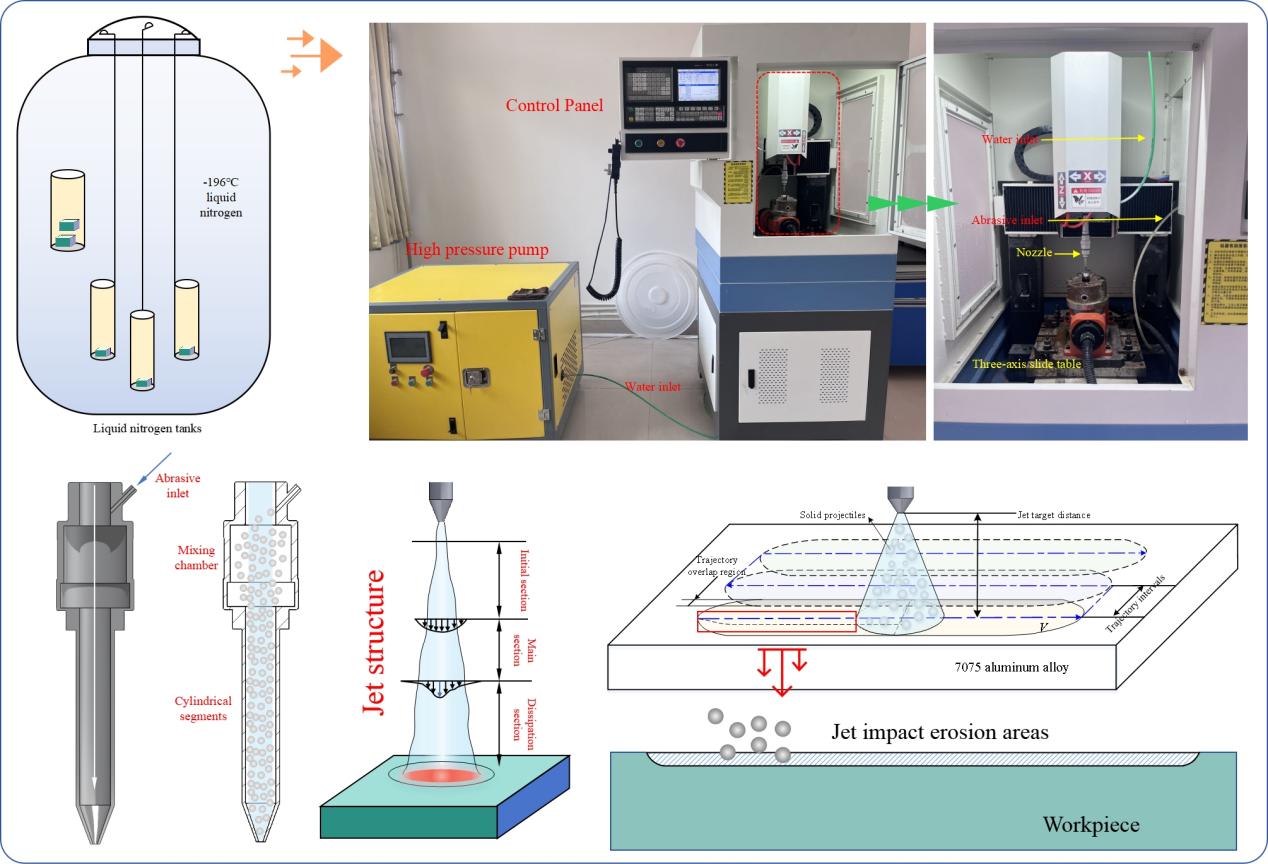
This study investigates the influence of a deep cryogenic treatment-abrasive water jet (DCT-AWJ) composite surface modification process on the surface integrity of 7075 aluminum alloy, with single abrasive water jet (AWJ) treatment as the control. Surface morphology, phase composition, residual stress, and microhardness were characterized by scanning electron microscopy (SEM), X-ray diffraction (XRD), and microhardness testing. Under AWJ treatment, the surface roughness increases with jet pressure (0.864, 1.082, and 1.325~$\mu$m at 5, 10, and 15~MPa). Under DCT-AWJ treatment, the roughness decreases with increasing cryogenic treatment time but increases with jet pressure, and it is lower than that obtained by AWJ alone at the same pressure. All samples exhibit $\alpha$-Al and $\eta$-MgZn$_2$ diffraction peaks, with $\alpha$-Al peaks at $2\theta = 38.5^{\circ}$, $44.7^{\circ}$, $65.1^{\circ}$, and $78.2^{\circ}$, indicating no significant phase transformation; the $\alpha$-Al peaks broaden with increasing jet pressure and cryogenic duration. Both treatments introduce compressive residual stress, whose surface and maximum values increase with jet pressure and, for DCT-AWJ, with cryogenic duration, reaching $-563$~MPa and $-1165$~MPa, respectively. The surface microhardness after AWJ treatment increases with jet pressure (184.71, 185.78, and 189.41~HV), whereas DCT-AWJ treatment raises it to 202.87~HV and deepens the hardened layer to 264.63~$\mu$m. These results indicate that cryogenic pretreatment enhances the surface integrity of 7075 aluminum alloy relative to AWJ treatment alone.
Graphical Abstract
Keywords
Data Availability Statement
Funding
Conflicts of Interest
AI Use Statement
Ethical Approval and Consent to Participate
References
- Jovičević-Klug, P., & Podgornik, B. (2020). Review on the effect of deep cryogenic treatment of metallic materials in automotive applications. Metals, 10(4), 434.
[CrossRef] [Google Scholar] - Baldissera, P., & Delprete, C. (2008). Deep cryogenic treatment: A bibliographic review. The Open Mechanical Engineering Journal, 2(1), 1-11.
[CrossRef] [Google Scholar] - Kalia, S. (2010). Cryogenic processing: a study of materials at low temperatures. Journal of Low Temperature Physics, 158(5), 934-945.
[CrossRef] [Google Scholar] - Altas, E., Bati, S., Rajendrachari, S., Erkan, Ö., Dag, I. E., & Avar, B. (2024). Comprehensive analysis of mechanical properties, wear, and corrosion behavior of AA7075-T6 alloy subjected to cryogenic treatment for aviation and defense applications. Surface and Coatings Technology, 490, 131101.
[CrossRef] [Google Scholar] - Dursun, T., & Soutis, C. (2014). Recent developments in advanced aircraft aluminium alloys. Materials & Design, 56, 862-871.
[CrossRef] [Google Scholar] - Matsuda, K., Ramachandiran, N., & Gerlich, A. P. (2025). Improved fillet weld quality in AA 7075 sheets using flower pattern laser wobbling. Optics & Laser Technology, 192, 113438.
[CrossRef] [Google Scholar] - Magarajan, U., Kumar, S. S., & Rodríguez-Millán, M. (2023). Effect of deep cryogenic treatment on the microstructural, mechanical and ballistic properties of AA7075-T6 aluminum alloy. Defence Technology, 30, 101-110.
[CrossRef] [Google Scholar] - Heinz, A., Haszler, A., Keidel, C., Moldenhauer, S., Benedictus, R., & Miller, W. S. (2000). Recent development in aluminium alloys for aerospace applications. Materials Science and Engineering: A, 280(1), 102-107.
[CrossRef] [Google Scholar] - Santos, M. C., Machado, A. R., Sales, W. F., Barrozo, M. A. S., & Ezugwu, E. O. (2016). Machining of aluminum alloys: A review. The International Journal of Advanced Manufacturing Technology, 86(9-12), 3067-3080.
[CrossRef] [Google Scholar] - Gómez-Parra, A., Álvarez-Alcón, M., Salguero, J., Batista, M., & Marcos, M. (2013). Analysis of the evolution of the Built-Up Edge and Built-Up Layer formation mechanisms in the dry turning of aeronautical aluminium alloys. Wear, 302(1-2), 1209-1218.
[CrossRef] [Google Scholar] - List, G., Nouari, M., Géhin, D., Gomez, S., Manaud, J. P., Le Petitcorps, Y., & Girot, F. (2005). Wear behaviour of cemented carbide tools in dry machining of aluminium alloy. Wear, 259(7-12), 1177-1189.
[CrossRef] [Google Scholar] - Lulay, K. E., Khan, K., & Chaaya, D. (2002). The effect of cryogenic treatments on 7075 aluminum alloy. Journal of Materials Engineering and Performance, 11(5), 479-480.
[CrossRef] [Google Scholar] - Mohan, K., Suresh, J. A., Ramu, P., & Jayaganthan, R. (2016). Microstructure and mechanical behavior of Al 7075-T6 subjected to shallow cryogenic treatment. Journal of Materials Engineering and Performance, 25(6), 2185-2194.
[CrossRef] [Google Scholar] - Dong, N., Sun, L., Ma, H., & Jin, P. (2021). Effects of cryogenic treatment on microstructures and mechanical properties of Mg-2Nd-4Zn alloy. Materials Letters, 305, 130699.
[CrossRef] [Google Scholar] - Abbasi-Baharanchi, M., Karimzadeh, F., & Enayati, M. H. (2017). Mechanical and tribological behavior of severely plastic deformed Al6061 at cryogenic temperatures. Materials Science and Engineering: A, 683, 56-63.
[CrossRef] [Google Scholar] - Yang, Q., Dong, Z., Kang, R., & Wei, Z. (2024). Effect of ultrasonic vibration and deep cryogenic treatment on the residual stress, mechanical properties and microstructures of HR-2 austenitic stainless steel. Materials Science and Engineering: A, 900, 146502.
[CrossRef] [Google Scholar] - Jovičević-Klug, M., Tegg, L., Jovičević-Klug, P., Dražić, G., Almásy, L., Lim, B., ... & Podgornik, B. (2022). Multiscale modification of aluminum alloys with deep cryogenic treatment for advanced properties. Journal of materials research and technology, 21, 3062-3073.
[CrossRef] [Google Scholar] - Yao, E., Zhang, H., Ma, K., Ai, C., Gao, Q., & Lin, X. (2023). Effect of deep cryogenic treatment on microstructures and performances of aluminum alloys: a review. Journal of Materials Research and Technology, 26, 3661-3675.
[CrossRef] [Google Scholar] - Seensattayawong, P., Brodmann, R., Stelzer, G., Seewig, J., & Kerscher, E. (2025). The study of surface in early stages of fatigue failure on carbon steels using a confocal microscope and a scattered light sensor. Engineering Failure Analysis, 178, 109720.
[CrossRef] [Google Scholar] - Li, M., Zhao, W., Li, L., He, N., & Stepan, G. (2024). Influence of milling stability on machined surface integrity and fatigue performance of Ti-6Al-4V titanium alloy. Engineering Failure Analysis, 168, 109103.
[CrossRef] [Google Scholar] - Liu, G., Huang, C., Zhao, B., Wang, W., & Sun, S. (2021). Effect of machined surface integrity on fatigue performance of metal workpiece: a review. Chinese Journal of Mechanical Engineering, 34(1), 118.
[CrossRef] [Google Scholar] - Yang, K., Huang, Q., Zhong, B., Wang, Q., Chen, Q., Chen, Y., Su, N., & Liu, H. (2020). Enhanced extra-long life fatigue resistance of a bimodal titanium alloy by laser shock peening. International Journal of Fatigue, 141, 105868.
[CrossRef] [Google Scholar] - Zhang, P., Gao, Y., Zhang, J., Yue, X., Zhou, H., & Sun, Y. (2024). Inconel 718 alloy strengthening mechanism and fatigue life of microtexture-induced microjet coupled with cavifying water jet. Vacuum, 222, 113060.
[CrossRef] [Google Scholar] - Zhang, P., Yue, X., Jiang, X., & Wang, Y. (2025). Predictive model of residual stress and microstructural evolution in 7075 aluminum alloy modified by ultrasonic impact and water jet combined surface treatment. Journal of Alloys and Compounds, 1036, 181552.
[CrossRef] [Google Scholar] - Novovic, D., Dewes, R. C., Aspinwall, D. K., Voice, W., & Bowen, P. (2004). The effect of machined topography and integrity on fatigue life. International Journal of Machine Tools and Manufacture, 44(2-3), 125-134.
[CrossRef] [Google Scholar] - Suraratchai, M., Limido, J., Mabru, C., & Chieragatti, R. (2008). Modelling the influence of machined surface roughness on the fatigue life of aluminium alloy. International Journal of Fatigue, 30(12), 2119-2126.
[CrossRef] [Google Scholar] - Fu, B., Gu, Y., Lin, J., Fu, L., Gao, T., Yu, H., Wang, T., & Zhang, Y. (2025). Influence mechanism of ultrasonic vibration and pulsed laser on the surface formation of SiCp/Al in cutting. International Journal of Thermal Sciences, 218, 110143.
[CrossRef] [Google Scholar] - Arola, D., & Williams, C. L. (2002). Estimating the fatigue stress concentration factor of machined surfaces. International Journal of Fatigue, 24(9), 923-930.
[CrossRef] [Google Scholar] - Zhang, Z., Liu, Y., & Li, M. (2025). Strengthening 316L stainless steel fabricated by laser powder bed fusion via deep cryogenic treatment. Journal of Materials Science & Technology, 239, 109-123.
[CrossRef] [Google Scholar] - Liu, W., Zhang, L., Ye, F., Liu, X., Song, Y., Li, W., He, D., Yue, X., & Wu, J. (2025). Unveiling the high ductility-strength mechanism induced by honeycomb dislocations and dispersed vacancies in 7A52-DCI4 aluminum alloy. Journal of Materials Science & Technology, 229, 196-202.
[CrossRef] [Google Scholar] - Wan, L., Qian, Y., Li, Y., Wu, S., Kang, Y., & Li, D. (2025). Surface characteristics and tribological performance of Ti6Al4V peened by sinking bead abrasive waterjet. Journal of Manufacturing Processes, 149, 331-344.
[CrossRef] [Google Scholar] - Araghchi, M., Mansouri, H., Vafaei, R., & Guo, Y. (2017). A novel cryogenic treatment for reduction of residual stresses in 2024 aluminum alloy. Materials Science and Engineering: A, 689, 48-52.
[CrossRef] [Google Scholar] - Damir, A., Shi, B., Elsayed, A., Thelin, J., M'Saoubi, R., & Attia, H. (2025). On the tribological and thermal aspects of cryogenic machining of Inconel 718 and their effects on surface integrity. Wear, 571, 205855.
[CrossRef] [Google Scholar] - Su, R., Ma, S., Wang, K., Li, G., Qu, Y., & Li, R. (2022). Effect of cyclic deep cryogenic treatment on corrosion resistance of 7075 alloy. Metals and Materials International, 28(4), 862-870.
[CrossRef] [Google Scholar] - Yao, S., Chi, Y., Zhu, X., Zhang, K., Lu, T., Li, K., ... & Tu, S. (2025). Gradient nanostructure enabled exceptional fretting fatigue properties of Inconel 718 superalloy through submerged abrasive waterjet peening. Chinese Journal of Aeronautics, 38(1), 103297.
[CrossRef] [Google Scholar] - Chi, Y. X., Yao, S. L., Cheng, H. Y., Zhu, X. H., Liu, J. W., Liu, C. L., ... & Zhang, X. C. (2025). Bilateral submerged abrasive waterjet peening improved high-temperature fatigue strength of titanium alloy thin-walled simplified blades. Journal of Manufacturing Processes, 133, 992-1004.
[CrossRef] [Google Scholar] - Siahpour, P., Omar, S. M. T., Griffin, D., Amegadzie, M. Y., Tieu, A., Donaldson, I. W., & Plucknett, K. P. (2024). Evaluating surface mechanical properties and wear resistance of Ti-6Al-4V alloy subjected to ultrasonic pulsed waterjet peening. Wear, 550-551, 205400.
[CrossRef] [Google Scholar] - Lv, Z., Hou, R., Xue, B., Xu, J., & Sun, H. (2025). Study on surface roughness and fatigue property of abrasive waterjet peened aluminum alloy. International Journal of Precision Engineering and Manufacturing-Green Technology, 12(4), 1195-1208.
[CrossRef] [Google Scholar] - Arola, D., McCain, M. L., Kunaporn, S., & Ramulu, M. (2001). Waterjet and abrasive waterjet surface treatment of titanium: A comparison of surface texture and residual stress. Wear, 249(10-11), 943-950.
[CrossRef] [Google Scholar] - Chakkravarthy, V., Manojkumar, P., Jerome, S., Evlashin, S. A., Arackal Narayanan, J., Mendagaliev, R. V., Sidorenko, A. O., & Narayan, R. L. (2024). Effect of impact angle on hot corrosion resistance of abrasive water jet peened Ti-6Al-4V alloy. Surface and Coatings Technology, 494, 131523.
[CrossRef] [Google Scholar] - Liu, Y., Jiang, Q., Gao, J., Xu, Z., Chen, S., Lai, Y., ... & Ye, L. (2025). Influence of heat treatment combined with cryogenic treatment on contact fatigue properties of Cr12Mo1V1 steel members. Scientific Reports, 15(1), 22077.
[CrossRef] [Google Scholar] - Mavi, A., Kaplan, Y., & Aksoz, S. (2021). Effects of aging and deep cryogenic treatment on wear behavior of Al7075 Alloy. Journal of Tribology, 143(12), 121702.
[CrossRef] [Google Scholar] - Gerosa, R., Panzeri, D., Rivolta, B., & Casaroli, A. (2023). Deep cryogenic treatment of AA7050: tensile response and corrosion susceptibility. Discover Materials, 3(1), 2.
[CrossRef] [Google Scholar] - Wang, Z., Ma, Z., Chen, T., Fan, C., Yu, T., & Zhao, J. (2023). Experimental investigation into the effect of process parameters on the Inconel 718 surface integrity for abrasive waterjet peening. Surface and Coatings Technology, 454, 129186.
[CrossRef] [Google Scholar] - Yao, S. L., Wang, G. Y., Yu, H., Wang, J., Li, K. S., Liu, S., Zhang, X. C., & Tu, S. T. (2022). Influence of submerged micro-abrasive waterjet peening on surface integrity and fatigue performance of TA19 titanium alloy. International Journal of Fatigue, 164, 107076.
[CrossRef] [Google Scholar] - Yao, S., Wang, G., Li, K., Wang, N., Zhang, C., Liu, S., ... & Tu, S. (2022). Cavitation abrasive integrated waterjet peening process and the effect of process parameters on the surface integrity of TA19 titanium alloy. Surface and Coatings Technology, 440, 128477.
[CrossRef] [Google Scholar] - Niu, X., Chen, Z., Jing, L., Huang, Y., & Liu, Y. (2024). Effect of cryogenic treatment on residual stress and microstructure of 6061 aluminum alloy and optimization of parameters. Materials, 17(19), 4873.
[CrossRef] [Google Scholar] - Chankitmunkong, S., Eskin, D. G., Patakham, U., Chancharoen, W., Seehanam, S., Limmaneevichitr, C., & Pandee, P. (2024). The improvement of deformability in AA7075 alloy through cryogenic treatment and its correlation with microstructural evolution and FE modelling. Scientific Reports, 14(1), 16755.
[CrossRef] [Google Scholar]
Cite This Article
TY  - JOUR
AU  - Yue, Xiujie
AU  - Gao, Yeran
AU  - Wang, Youqiang
AU  - Zhang, Ping
PY  - 2026
DA  - 2026/10/12
TI  - Study on the Effect of Cryogenic Pretreatment-Based Abrasive Water Jet Surface Modification on the Surface Integrity of 7075 Aluminum Alloy
JO  - Journal of Materials Durability and Engineering
T2  - Journal of Materials Durability and Engineering
JF  - Journal of Materials Durability and Engineering
VL  - 2
IS  - 1
SP  - 1
EP  - 13
DO  - 10.62762/JMDE.2025.826186
UR  - https://www.icck.org/article/abs/JMDE.2025.826186
KW  - 7075 aluminum alloy
KW  - deep cryogenic treatment
KW  - abrasive water jet
KW  - surface roughness
KW  - surface quality
KW  - residual stress
KW  - microhardness
AB  - This study investigates the influence of a deep cryogenic treatment-abrasive water jet (DCT-AWJ) composite surface modification process on the surface integrity of 7075 aluminum alloy, with single abrasive water jet (AWJ) treatment as the control. Surface morphology, phase composition, residual stress, and microhardness were characterized by scanning electron microscopy (SEM), X-ray diffraction (XRD), and microhardness testing. Under AWJ treatment, the surface roughness increases with jet pressure (0.864, 1.082, and 1.325~$\mu$m at 5, 10, and 15~MPa). Under DCT-AWJ treatment, the roughness decreases with increasing cryogenic treatment time but increases with jet pressure, and it is lower than that obtained by AWJ alone at the same pressure. All samples exhibit $\alpha$-Al and $\eta$-MgZn$_2$ diffraction peaks, with $\alpha$-Al peaks at $2\theta = 38.5^{\circ}$, $44.7^{\circ}$, $65.1^{\circ}$, and $78.2^{\circ}$, indicating no significant phase transformation; the $\alpha$-Al peaks broaden with increasing jet pressure and cryogenic duration. Both treatments introduce compressive residual stress, whose surface and maximum values increase with jet pressure and, for DCT-AWJ, with cryogenic duration, reaching $-563$~MPa and $-1165$~MPa, respectively. The surface microhardness after AWJ treatment increases with jet pressure (184.71, 185.78, and 189.41~HV), whereas DCT-AWJ treatment raises it to 202.87~HV and deepens the hardened layer to 264.63~$\mu$m. These results indicate that cryogenic pretreatment enhances the surface integrity of 7075 aluminum alloy relative to AWJ treatment alone.
SN  - pending
PB  - Institute of Central Computation and Knowledge
LA  - English
ER  -
@article{Yue2026Study,
  author = {Xiujie Yue and Yeran Gao and Youqiang Wang and Ping Zhang},
  title = {Study on the Effect of Cryogenic Pretreatment-Based Abrasive Water Jet Surface Modification on the Surface Integrity of 7075 Aluminum Alloy},
  journal = {Journal of Materials Durability and Engineering},
  year = {2026},
  volume = {2},
  number = {1},
  pages = {1-13},
  doi = {10.62762/JMDE.2025.826186},
  url = {https://www.icck.org/article/abs/JMDE.2025.826186},
  abstract = {This study investigates the influence of a deep cryogenic treatment-abrasive water jet (DCT-AWJ) composite surface modification process on the surface integrity of 7075 aluminum alloy, with single abrasive water jet (AWJ) treatment as the control. Surface morphology, phase composition, residual stress, and microhardness were characterized by scanning electron microscopy (SEM), X-ray diffraction (XRD), and microhardness testing. Under AWJ treatment, the surface roughness increases with jet pressure (0.864, 1.082, and 1.325~\$\mu\$m at 5, 10, and 15~MPa). Under DCT-AWJ treatment, the roughness decreases with increasing cryogenic treatment time but increases with jet pressure, and it is lower than that obtained by AWJ alone at the same pressure. All samples exhibit \$\alpha\$-Al and \$\eta\$-MgZn\$\_2\$ diffraction peaks, with \$\alpha\$-Al peaks at \$2\theta = 38.5^{\circ}\$, \$44.7^{\circ}\$, \$65.1^{\circ}\$, and \$78.2^{\circ}\$, indicating no significant phase transformation; the \$\alpha\$-Al peaks broaden with increasing jet pressure and cryogenic duration. Both treatments introduce compressive residual stress, whose surface and maximum values increase with jet pressure and, for DCT-AWJ, with cryogenic duration, reaching \$-563\$~MPa and \$-1165\$~MPa, respectively. The surface microhardness after AWJ treatment increases with jet pressure (184.71, 185.78, and 189.41~HV), whereas DCT-AWJ treatment raises it to 202.87~HV and deepens the hardened layer to 264.63~\$\mu\$m. These results indicate that cryogenic pretreatment enhances the surface integrity of 7075 aluminum alloy relative to AWJ treatment alone.},
  keywords = {7075 aluminum alloy, deep cryogenic treatment, abrasive water jet, surface roughness, surface quality, residual stress, microhardness},
  issn = {pending},
  publisher = {Institute of Central Computation and Knowledge}
}
Article Metrics
Publisher's Note
ICCK stays neutral with regard to jurisdictional claims in published maps and institutional affiliations.
Rights and Permissions
 Copyright © 2026 by the Author(s). Published by Institute of Central Computation and Knowledge. This article is an open access article distributed under the terms and conditions of the Creative Commons Attribution (CC BY) license (https://creativecommons.org/licenses/by/4.0/), which permits use, sharing, adaptation, distribution and reproduction in any medium or format, as long as you give appropriate credit to the original author(s) and the source, provide a link to the Creative Commons licence, and indicate if changes were made.


Portico
