
Are the Hexameters and Hendecasyllables of Classical Poetry a Mathematical Imprint of Short-Term Memory?



Article Information
Abstract
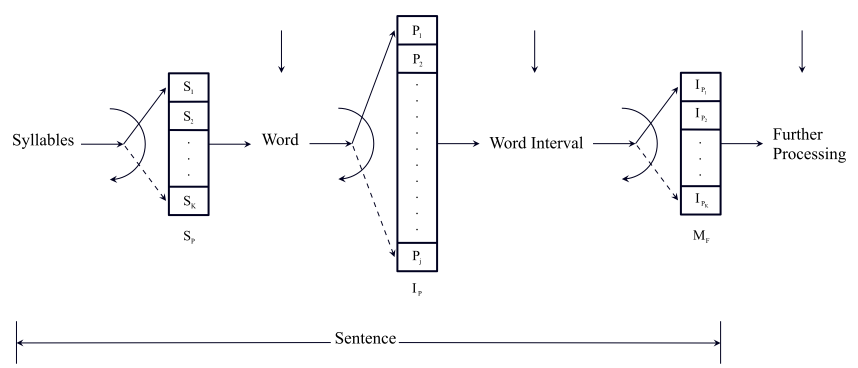
The hexameter of Greek and Latin epic and the Italian hendecasyllable are usually described in terms of syllables, feet and accents. This paper tests a different hypothesis: that both verses were shaped, without the poets being aware of it, by the number of words a line can hold, a number close to the central value of Miller's $7 \pm 2$ law. On this view the two metres are an imprint of short-term memory, the stage through which information must pass before it is stored in long-term memory and later recalled, as was required in societies where poetry was learned and recited by heart. The hypothesis is examined on Virgil's Aeneid and Lucretius' De Rerum Natura, both written in Latin hexameters, on their classical Italian translations in unrhymed hendecasyllables by Annibale Caro and Alessandro Marchetti, and on Dante's Divina Commedia. For each book, characters, words, sentences, punctuation marks and lines were counted; from these counts I computed word length, sentence length, the word interval (words between two punctuation marks), the number of word intervals per sentence and the number of words per line. A uniformity index is introduced to measure how evenly each parameter is distributed across books. Word length and words per line are almost constant in every text (about 6.4-6.6 words per hexameter and 6.8-7.0 per hendecasyllable), whereas sentence length and word interval change from book to book and, in the Aeneid, between the two hexads. The results suggest that the poets controlled punctuation and sentence structure deliberately, while the length of the line in words was set by short-term memory rather than by syllable counting alone.
Graphical Abstract
Keywords
Data Availability Statement
Funding
Conflicts of Interest
AI Use Statement
Ethical Approval and Consent to Participate
References
- Matricciani, E. (2025). A multidimensional mathematical analysis of Dante's Divina Commedia. Journal of Mathematical Studies of Literature, 1(1), 4-20.
[CrossRef] [Google Scholar] - Miller, G. A. (1956). The magical number seven, plus or minus two: Some limits on our capacity for processing information. Psychological Review, 63(2), 81-97.
[CrossRef] [Google Scholar] - Nagy, B. (2022). Rhyme in classical Latin poetry: Stylistic or stochastic? Digital Scholarship in the Humanities, 37(4), 1097-1118.
[CrossRef] [Google Scholar] - Duckworth, G. E. (1969). Vergil and Classical Hexameter Poetry: A Study in Metrical Variety. Ann Arbor, MI: University of Michigan Press.
[CrossRef] [Google Scholar] - Young, A. M. (1932). Schematized word order in Vergil. The Classical Journal, 27(7), 515-522. https://www.jstor.org/stable/3289987?seq=1
[Google Scholar] - Roberts, L. (1977). A Concordance of Lucretius. New York: Garland. https://search.catalog.loc.gov/instances/ac86362e-be55-5ade-a232-de94d5f949b7?option=lccn&query=77070759
[Google Scholar] - Allen, W. S. (1973). Accent and Rhythm: Prosodic Features of Latin and Greek. A Study in Theory and Reconstruction. Cambridge: Cambridge University Press. https://archive.org/details/accentrhythmpros0000alle/page/n3/mode/2up
[Google Scholar] - Duffell, M. J. (2012). Syllabic verse. In R. Greene & S. Cushman (Eds.), The Princeton Encyclopedia of Poetry and Poetics (4th ed., pp. 1388-1390). Princeton, NJ: Princeton University Press. https://www.oxfordreference.com/display/10.1093/acref/9780190681173.001.0001/acref-9780190681173-e-1101
[Google Scholar] - West, M. L. (1982). Greek Metre. Oxford: Clarendon Press. https://ancientlibrary.yatsishin.com/download/28/pdf/28.pdf
[Google Scholar] - Parkes, M. B. (1993). Pause and Effect: An Introduction to the History of Punctuation in the West. Berkeley: University of California Press. https://archive.org/details/pauseeffectintro0000park
[Google Scholar] - Feeney, D. (1993). The Aeneid as a poem of history. The Classical Outlook, 70(3), 94-96 (first published in Omnibus, 23, 1992, 19-21). https://www.jstor.org/stable/43937473?seq=1
[Google Scholar] - Fendel, V. (2025). Switchpoints: Half-lines in Vergil's Aeneid from an attention perspective. Rosetta, 30, 9-27.
[CrossRef] [Google Scholar] - Thomas, R. F. (2001). Virgil and the Augustan Reception. Cambridge: Cambridge University Press.
[CrossRef] [Google Scholar] - Duckworth, G. E. (1962). Structural Patterns and Proportions in Vergil's Aeneid: A Study in Mathematical Composition. Ann Arbor, MI: University of Michigan Press.
[CrossRef] [Google Scholar] - Kenney, E. J. (2007). Lucretian texture: Style, metre and rhetoric in the De rerum natura. In S. Gillespie & P. Hardie (Eds.), The Cambridge Companion to Lucretius (pp. 92-110). Cambridge: Cambridge University Press.
[CrossRef] [Google Scholar] - Farrell, J. (2007). Lucretian architecture: the structure and argument of the De rerum natura. The Cambridge Companion to Lucretius, (88), 76-91. https://repository.upenn.edu/server/api/core/bitstreams/831447c7-1dc2-41e6-a310-b043b70d68f5/content
[Google Scholar] - Taylor, B. (2020). Lucretius and the Language of Nature. Oxford: Oxford University Press.
[CrossRef] [Google Scholar] - Sedley, D. (1998). Lucretius and the Transformation of Greek Wisdom. Cambridge: Cambridge University Press. https://archive.org/details/lucretiustransfo0000sedl
[Google Scholar] - Sedley, D. (1999). Lucretius' use and avoidance of Greek. In J. N. Adams & R. G. Mayer (Eds.), Aspects of the Language of Latin Poetry (Proceedings of the British Academy, 93, pp. 227-246). Oxford: Oxford University Press. https://www.thebritishacademy.ac.uk/documents/3903/93p227.pdf
[Google Scholar] - Swanson, D. C. (1962). A Formal Analysis of Lucretius' Vocabulary. Minneapolis, MN: Perine Book Company.
[Google Scholar] - Robey, D. (1993). Scanning Dante's Divine Comedy: A computer-based approach. Literary and Linguistic Computing, 8(2), 81-84.
[CrossRef] [Google Scholar] - Dexter, J. P., Tripuraneni, N., Dasgupta, T., Kannan, A., Brofos, J. A., Bonilla Lopez, J. A., ... & Chaudhuri, P. (2017). Quantitative criticism of literary relationships. Proceedings of the National Academy of Sciences, 114(16), E3195-E3204.
[CrossRef] [Google Scholar] - Perveen, T., Munawar, H., Zahra, M., & Lodhi, M. A. (2025). Corpus stylistic exploration of lexical patterns, semantic fields, and contextual meaning in Dante's Divine Comedy. Contemporary Journal of Social Science Review, 3(4), 114-131. https://www.researchgate.net/figure/Review-of-the-previous-researches_tbl2_398932256
[Google Scholar] - Re, A. (2026). Applicazioni alle lingue e alle letterature classiche delle tecniche di analisi digitale. Umanistica Digitale, 24, 263-288.
[CrossRef] [Google Scholar] - Matricciani, E. (2019). Deep language statistics of Italian throughout seven centuries of literature and empirical connections with Miller's $7 \pm 2$ law and short-term memory. Open Journal of Statistics, 9, 373-406.
[CrossRef] [Google Scholar] - Matricciani, E. (2020) A Statistical Theory of Language Translation Based on Communication Theory. Open Journal of Statistics, 10, 936–997.
[CrossRef] [Google Scholar] - Matricciani, E. (2025). Revealing Short-Term Memory Communication Channels Embedded in Alphabetical Texts: Theory and Experiments. Information, 16(10), 847.
[CrossRef] [Google Scholar]
[Google Scholar]
[CrossRef] [Google Scholar]- Baddeley, A. (2000). The episodic buffer: A new component of working memory? Trends in Cognitive Sciences, 4(11), 417-423.
[CrossRef] [Google Scholar] - Matricciani, E. (2024). Multi–Dimensional Data Analysis of Deep Language in JRR Tolkien and CS Lewis Reveals Tight Mathematical Connections. AppliedMath, 4(3), 927-949.
[CrossRef] [Google Scholar] - Matricciani, E. (2023) Readability Indices Do Not Say It All on a Text Readability. Analytics, 2, 296-314.
[CrossRef] [Google Scholar] - De Sanctis, F. (2006). Storia della letteratura italiana (first published 1870). Milano: Rizzoli. https://skypescuola.wordpress.com/wp-content/uploads/2015/05/de-sanctis-storia-della-letteratura-italiana.pdf
[Google Scholar] - Ferroni, G. (2021). Storia della letteratura italiana. Dalle origini al Quattrocento. Milano: Mondadori Università. https://www.mondadoriuniversita.it/libri-universitari/storia-della-letteratura-italiana-giulio-ferroni/
[Google Scholar] - Frare, P., & Brenna, S. (2023). Dalle origini a Leopardi. La letteratura italiana e le sue grandi opere. Milano: Pearson. https://publicatt.unicatt.it/handle/10807/230632
[Google Scholar] - Maiden, M. (1995). A Linguistic History of Italian. London: Longman.
[CrossRef] [Google Scholar]
Cite This Article
TY  - JOUR
AU  - Matricciani, Emilio
PY  - 2026
DA  - 2026/11/10
TI  - Are the Hexameters and Hendecasyllables of Classical Poetry a Mathematical Imprint of Short-Term Memory?
JO  - Journal of Mathematical Studies of Literature
T2  - Journal of Mathematical Studies of Literature
JF  - Journal of Mathematical Studies of Literature
VL  - 1
IS  - 1
SP  - 28
EP  - 48
DO  - 10.62762/JMSL.2026.283501
UR  - https://www.icck.org/article/abs/jmsl.2026.283501
KW  - Aeneid
KW  - De Rerum Natura
KW  - hendecasyllable
KW  - hexameter
KW  - Italian poetry
KW  - linguistic parameters
KW  - Miller's law
KW  - short-term memory
AB  - The hexameter of Greek and Latin epic and the Italian hendecasyllable are usually described in terms of syllables, feet and accents. This paper tests a different hypothesis: that both verses were shaped, without the poets being aware of it, by the number of words a line can hold, a number close to the central value of Miller's $7 \pm 2$ law. On this view the two metres are an imprint of short-term memory, the stage through which information must pass before it is stored in long-term memory and later recalled, as was required in societies where poetry was learned and recited by heart. The hypothesis is examined on Virgil's Aeneid and Lucretius' De Rerum Natura, both written in Latin hexameters, on their classical Italian translations in unrhymed hendecasyllables by Annibale Caro and Alessandro Marchetti, and on Dante's Divina Commedia. For each book, characters, words, sentences, punctuation marks and lines were counted; from these counts I computed word length, sentence length, the word interval (words between two punctuation marks), the number of word intervals per sentence and the number of words per line. A uniformity index is introduced to measure how evenly each parameter is distributed across books. Word length and words per line are almost constant in every text (about 6.4-6.6 words per hexameter and 6.8-7.0 per hendecasyllable), whereas sentence length and word interval change from book to book and, in the Aeneid, between the two hexads. The results suggest that the poets controlled punctuation and sentence structure deliberately, while the length of the line in words was set by short-term memory rather than by syllable counting alone.
SN  - pending
PB  - Institute of Central Computation and Knowledge
LA  - English
ER  -
@article{Matricciani2026Are,
  author = {Emilio Matricciani},
  title = {Are the Hexameters and Hendecasyllables of Classical Poetry a Mathematical Imprint of Short-Term Memory?},
  journal = {Journal of Mathematical Studies of Literature},
  year = {2026},
  volume = {1},
  number = {1},
  pages = {28-48},
  doi = {10.62762/JMSL.2026.283501},
  url = {https://www.icck.org/article/abs/jmsl.2026.283501},
  abstract = {The hexameter of Greek and Latin epic and the Italian hendecasyllable are usually described in terms of syllables, feet and accents. This paper tests a different hypothesis: that both verses were shaped, without the poets being aware of it, by the number of words a line can hold, a number close to the central value of Miller's \$7 \pm 2\$ law. On this view the two metres are an imprint of short-term memory, the stage through which information must pass before it is stored in long-term memory and later recalled, as was required in societies where poetry was learned and recited by heart. The hypothesis is examined on Virgil's Aeneid and Lucretius' De Rerum Natura, both written in Latin hexameters, on their classical Italian translations in unrhymed hendecasyllables by Annibale Caro and Alessandro Marchetti, and on Dante's Divina Commedia. For each book, characters, words, sentences, punctuation marks and lines were counted; from these counts I computed word length, sentence length, the word interval (words between two punctuation marks), the number of word intervals per sentence and the number of words per line. A uniformity index is introduced to measure how evenly each parameter is distributed across books. Word length and words per line are almost constant in every text (about 6.4-6.6 words per hexameter and 6.8-7.0 per hendecasyllable), whereas sentence length and word interval change from book to book and, in the Aeneid, between the two hexads. The results suggest that the poets controlled punctuation and sentence structure deliberately, while the length of the line in words was set by short-term memory rather than by syllable counting alone.},
  keywords = {Aeneid, De Rerum Natura, hendecasyllable, hexameter, Italian poetry, linguistic parameters, Miller's law, short-term memory},
  issn = {pending},
  publisher = {Institute of Central Computation and Knowledge}
}
Article Metrics
Publisher's Note
ICCK stays neutral with regard to jurisdictional claims in published maps and institutional affiliations.
Rights and Permissions
 Copyright © 2026 by the Author(s). Published by Institute of Central Computation and Knowledge. This article is an open access article distributed under the terms and conditions of the Creative Commons Attribution (CC BY) license (https://creativecommons.org/licenses/by/4.0/), which permits use, sharing, adaptation, distribution and reproduction in any medium or format, as long as you give appropriate credit to the original author(s) and the source, provide a link to the Creative Commons licence, and indicate if changes were made.


Portico
