

Green Innovation and Environmental Regulation in Corporate Carbon Abatement



Article Information
Abstract
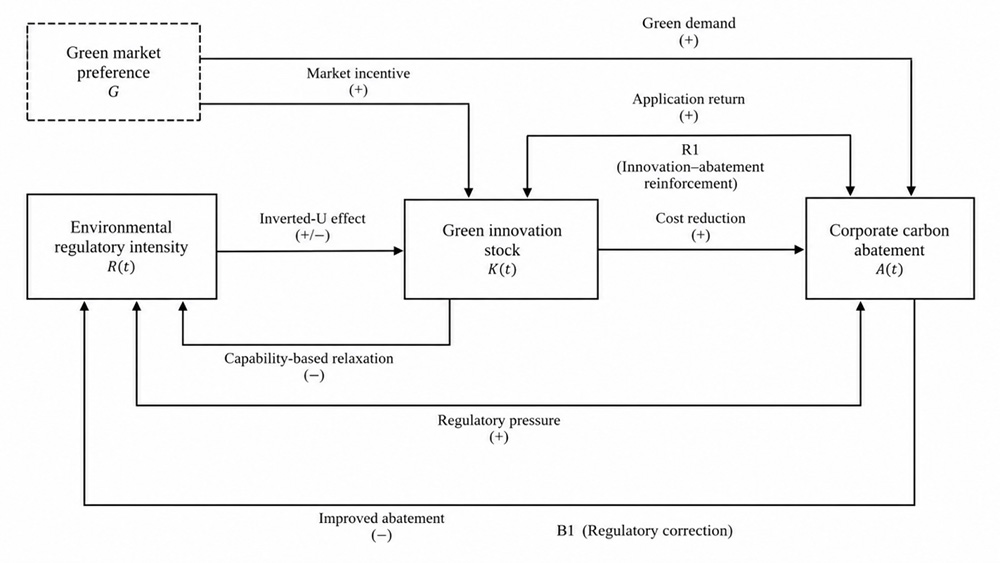
Corporate carbon abatement is commonly modeled as a direct and continuous response to environmental regulation or green innovation. Such representations cannot fully explain persistent differences among firms facing similar policy conditions or distinguish the pressure required to initiate a low-carbon transition from that needed to sustain it. This study develops a three-state continuous-time model linking corporate carbon abatement, accumulated green innovation, and effective regulatory pressure, with green market preference treated as an external demand-pull parameter. Green innovation lowers the marginal cost of abatement, abatement generates learning and commercial returns to innovation, and regulatory pressure responds to residual emissions while relaxing as abatement and credible green capability improve. The regulation--innovation channel is non-monotonic: moderate pressure strengthens innovation incentives, whereas the marginal stimulus declines at high pressure. The analysis combines equilibrium and stability analysis, saddle-node verification, attraction-basin classification, temporary-policy simulations, regime mapping, and global sensitivity analysis. Under the baseline configuration, two locally stable equilibria are separated by a saddle, and nondegenerate saddle-node thresholds generate hysteresis between low- and high-abatement states. Green market preference lowers the transition threshold, while temporary regulation succeeds only when both intensity and duration are sufficient. Regulatory adjustment may generate damped oscillatory modes, but no Hopf crossing is detected within the examined range. The findings show that regulatory pressure acts as an adaptive state-transition mechanism through which initial capability, policy timing, and market demand shape persistent corporate carbon-abatement outcomes. Broader stress tests confirm that bistability is conditional and can disappear under weak innovation capacity or combined adverse structural conditions. The numerical procedures developed here---multistart root finding,adaptive Runge--Kutta integration, analytical Jacobian evaluation,and Latin-hypercube sensitivity design---are transferable tocontinuous-time state-transition models in other applied domains.
Graphical Abstract
Keywords
Data Availability Statement
Funding
Conflicts of Interest
AI Use Statement
Ethical Approval and Consent to Participate
References
[Google Scholar]- . IPCC, Geneva, Switzerland, 184 pp.
[CrossRef] [Google Scholar] - Porter, M. E., & Linde, C. V. D. (1995). Toward a new conception of the environment-competitiveness relationship. Journal of economic perspectives, 9(4), 97-118.
[CrossRef] [Google Scholar] - Ambec, S., Cohen, M. A., Elgie, S., & Lanoie, P. (2013). The Porter hypothesis at 20: Can environmental regulation enhance innovation and competitiveness? Review of Environmental Economics and Policy, 7(1), 2-22.
[CrossRef] [Google Scholar] - Dechezleprêtre, A., & Sato, M. (2017). The impacts of environmental regulations on competitiveness. Review of Environmental Economics and Policy, 11(2), 183-206.
[CrossRef] [Google Scholar] - Cohen, M. A., & Tubb, A. (2018). The impact of environmental regulation on firm and country competitiveness: A meta-analysis of the Porter hypothesis. Journal of the Association of Environmental and Resource Economists, 5(2), 371-399.
[CrossRef] [Google Scholar] - Rennings, K. (2000). Redefining innovation-Eco-innovation research and the contribution from ecological economics. Ecological Economics, 32(2), 319-332.
[CrossRef] [Google Scholar] - Lee, K. H., & Min, B. (2015). Green R&D for eco-innovation and its impact on carbon emissions and firm performance. Journal of Cleaner Production, 108, 534-542.
[CrossRef] [Google Scholar] - Su, L. (2025). Environmental regulation and corporate green innovation: evidence from the implementation of the total energy consumption target in China. Journal of Business Economics, 95(4), 499-526.
[CrossRef] [Google Scholar] - Zhou, P., Song, F. M., & Huang, X. (2023). Environmental regulations and firms' green innovations: Transforming pressure into incentives. International Review of Financial Analysis, 86, 102504.
[CrossRef] [Google Scholar] - Li, J., Gao, J., & Liao, M. (2024). Operating risk of enterprises when adopting environmental regulation: Evidence from environmental protection law in China. Economic Analysis and Policy, 81, 901-914.
[CrossRef] [Google Scholar] - Song, M., Wang, S., & Zhang, H. (2020). Could environmental regulation and R&D tax incentives affect green product innovation?. Journal of cleaner production, 258, 120849.
[CrossRef] [Google Scholar] - Yu, P., & Zeng, L. (2024). The impact of consumer environmental preferences on the green technological innovation of Chinese listed companies. Sustainability, 16(7), 2951.
[CrossRef] [Google Scholar] - Zhan, Y., Ren, Y., & Xu, J. (2025). Willingness to pay a premium for eco-label products in China: a mediation model based on quality value. Scientific Reports, 15(1), 1783.
[CrossRef] [Google Scholar] - Levinthal, D. A., & March, J. G. (1993). The myopia of learning. Strategic Management Journal, 14(S2), 95-112.
[CrossRef] [Google Scholar] - Arthur, W. B. (1989). Competing technologies, increasing returns, and lock-in by historical events. The Economic Journal, 99(394), 116-131.
[CrossRef] [Google Scholar] - Acemoglu, D., Aghion, P., Bursztyn, L., & Hemous, D. (2012). The environment and directed technical change. American Economic Review, 102(1), 131-166.
[CrossRef] [Google Scholar] - Popp, D. (2002). Induced innovation and energy prices. American Economic Review, 92(1), 160-180.
[CrossRef] [Google Scholar] - Aghion, P., Dechezleprêtre, A., Hemous, D., Martin, R., & Van Reenen, J. (2016). Carbon taxes, path dependency, and directed technical change: Evidence from the auto industry. Journal of Political Economy, 124(1), 1-51.
[CrossRef] [Google Scholar] - Zhu, Y., & Liu, S. (2024). Nonlinear relationship between technological innovation and carbon emission: Evidence from maximal information coefficient approach. International Journal of Low-Carbon Technologies, 19, 1633-1639.
[CrossRef] [Google Scholar] - Du, K., Li, P., & Yan, Z. (2019). Do green technology innovations contribute to carbon dioxide emission reduction? Empirical evidence from patent data. Technological Forecasting and Social Change, 146, 297-303.
[CrossRef] [Google Scholar] - Töbelmann, D., & Wendler, T. (2020). The impact of environmental innovation on carbon dioxide emissions. Journal of Cleaner Production, 244, 118787.
[CrossRef] [Google Scholar] - Lin, B., & Ma, R. (2022). Green technology innovations, urban innovation environment and CO2 emission reduction in China: Fresh evidence from a partially linear functional-coefficient panel model. Technological forecasting and social change, 176, 121434.
[CrossRef] [Google Scholar] - Yan, Z., Yu, Y., Du, K., & Zhang, N. (2024). How does environmental regulation promote green technology innovation? Evidence from China's total emission control policy. Ecological Economics, 219, 108137.
[CrossRef] [Google Scholar] - Chen, Y., Yao, Z., & Zhong, K. (2022). Do environmental regulations of carbon emissions and air pollution foster green technology innovation? Evidence from China's prefecture-level cities. Journal of Cleaner Production, 350, 131537.
[CrossRef] [Google Scholar] - Zhang, B., Chen, X., & Guo, H. (2018). Does central supervision enhance local environmental enforcement? Quasi-experimental evidence from China. Journal of public economics, 164, 70-90.
[CrossRef] [Google Scholar] - Feng, L., Shi, Y., Yang, Z., Lam, J. F. I., Lin, S., Zhan, J., & Chen, H. (2025). Dynamic correlation of environmental regulation, technological innovation, and corporate carbon emissions: Empirical evidence from China listed companies. Scientific Reports, 15(1), 8433.
[CrossRef] [Google Scholar] - Li, Z., Huang, Z., & Su, Y. (2023). New media environment, environmental regulation and corporate green technology innovation: Evidence from China. Energy Economics, 119, 106545.
[CrossRef] [Google Scholar] - Xu, B. (2024). Environmental regulations, technological innovation, and low carbon transformation: A case of the logistics industry in China. Journal of Cleaner Production, 439, 140710.
[CrossRef] [Google Scholar] - Cao, Y., Ren, W., & Yue, L. (2024). Environmental regulation and carbon emissions: New mechanisms in game theory. Cities, 149, 104945.
[CrossRef] [Google Scholar] - Borsatto, J. M. L. S., & Amui, L. B. L. (2019). Green innovation: Unfolding the relation with environmental regulations and competitiveness. Resources, conservation and recycling, 149, 445-454.
[CrossRef] [Google Scholar] - Martínez-Zarzoso, I., Bengochea-Morancho, A., & Morales-Lage, R. (2019). Does environmental policy stringency foster innovation and productivity in OECD countries?. Energy Policy, 134, 110982.
[CrossRef] [Google Scholar] - Zhang, D. (2022). Environmental regulation, green innovation, and export product quality: What is the role of greenwashing?. International Review of Financial Analysis, 83, 102311.
[CrossRef] [Google Scholar] - Sterman, J. D. (2000). Business dynamics: Systems thinking and modeling for a complex world. McGraw-Hill. \url{https://dspace.mit.edu/entities/publication/db56999e-b889-4740-a4fb-ebdd3eb394c2
[Google Scholar] - Strogatz, S. H. (2018). Nonlinear dynamics and chaos: With applications to physics, biology, chemistry, and engineering (2nd ed.). CRC Press.
[CrossRef] [Google Scholar] - Kuznetsov, Y. A. (2023). Elements of applied bifurcation theory (5th ed.). Springer.
[CrossRef] [Google Scholar] - Fang, Y., & Shao, Z. (2022). Whether green finance can effectively moderate the green technology innovation effect of heterogeneous environmental regulation. International Journal of Environmental Research and Public Health, 19(6), 3646.
[CrossRef] [Google Scholar] - Scheffer, M., Carpenter, S., Foley, J. A., Folke, C., & Walker, B. (2001). Catastrophic shifts in ecosystems. Nature, 413, 591-596.
[CrossRef] [Google Scholar] - Lenton, T. M., Held, H., Kriegler, E., Hall, J. W., Lucht, W., Rahmstorf, S., & Schellnhuber, H. J. (2008). Tipping elements in the Earth's climate system. Proceedings of the national Academy of Sciences, 105(6), 1786-1793.
[CrossRef] [Google Scholar] - Scheffer, M., Bascompte, J., Brock, W. A., Brovkin, V., Carpenter, S. R., Dakos, V., ... & Sugihara, G. (2009). Early-warning signals for critical transitions. Nature, 461(7260), 53-59.
[CrossRef] [Google Scholar] - Ashwin, P., Wieczorek, S., Vitolo, R., & Cox, P. (2012). Tipping points in open systems: bifurcation, noise-induced and rate-dependent examples in the climate system. Philosophical Transactions: Mathematical, Physical and Engineering Sciences, 1166-1184.
[CrossRef] [Google Scholar] - Gao, Y., Ning, J., & Zhang, M. (2024). An evolutionary game dynamic analysis of enterprise technological innovation implementation strategy: From the perspective of green bonds. IEEE Transactions on Engineering Management, 71, 11551-11564.
[CrossRef] [Google Scholar]
Cite This Article
TY  - JOUR
AU  - Sun, Fang
PY  - 2026
DA  - 2026/10/09
TI  - Green Innovation and Environmental Regulation in Corporate Carbon Abatement
JO  - Journal of Numerical Simulations in Physics and Mathematics
T2  - Journal of Numerical Simulations in Physics and Mathematics
JF  - Journal of Numerical Simulations in Physics and Mathematics
VL  - 3
IS  - 1
SP  - 19
EP  - 37
DO  - 10.62762/JNSPM.2026.289453
UR  - https://www.icck.org/article/abs/JNSPM.2026.289453
KW  - Corporate carbon abatement
KW  - green innovation
KW  - environmental regulation
KW  - regulatory thresholds
KW  - green market preference
AB  - Corporate carbon abatement is commonly modeled as a direct and continuous response to environmental regulation or green innovation. Such representations cannot fully explain persistent differences among firms facing similar policy conditions or distinguish the pressure required to initiate a low-carbon transition from that needed to sustain it. This study develops a three-state continuous-time model linking corporate carbon abatement, accumulated green innovation, and effective regulatory pressure, with green market preference treated as an external demand-pull parameter. Green innovation lowers the marginal cost of abatement, abatement generates learning and commercial returns to innovation, and regulatory pressure responds to residual emissions while relaxing as abatement and credible green capability improve. The regulation--innovation channel is non-monotonic: moderate pressure strengthens innovation incentives, whereas the marginal stimulus declines at high pressure. The analysis combines equilibrium and stability analysis, saddle-node verification, attraction-basin classification, temporary-policy simulations, regime mapping, and global sensitivity analysis. Under the baseline configuration, two locally stable equilibria are separated by a saddle, and nondegenerate saddle-node thresholds generate hysteresis between low- and high-abatement states. Green market preference lowers the transition threshold, while temporary regulation succeeds only when both intensity and duration are sufficient. Regulatory adjustment may generate damped oscillatory modes, but no Hopf crossing is detected within the examined range. The findings show that regulatory pressure acts as an adaptive state-transition mechanism through which initial capability, policy timing, and market demand shape persistent corporate carbon-abatement outcomes. Broader stress tests confirm that bistability is conditional and can disappear under weak innovation capacity or combined adverse structural conditions. The numerical procedures developed here---multistart root finding,adaptive Runge--Kutta integration, analytical Jacobian evaluation,and Latin-hypercube sensitivity design---are transferable tocontinuous-time state-transition models in other applied domains.
SN  - 3068-9082
PB  - Institute of Central Computation and Knowledge
LA  - English
ER  -
@article{Sun2026Green,
  author = {Fang Sun},
  title = {Green Innovation and Environmental Regulation in Corporate Carbon Abatement},
  journal = {Journal of Numerical Simulations in Physics and Mathematics},
  year = {2026},
  volume = {3},
  number = {1},
  pages = {19-37},
  doi = {10.62762/JNSPM.2026.289453},
  url = {https://www.icck.org/article/abs/JNSPM.2026.289453},
  abstract = {Corporate carbon abatement is commonly modeled as a direct and continuous response to environmental regulation or green innovation. Such representations cannot fully explain persistent differences among firms facing similar policy conditions or distinguish the pressure required to initiate a low-carbon transition from that needed to sustain it. This study develops a three-state continuous-time model linking corporate carbon abatement, accumulated green innovation, and effective regulatory pressure, with green market preference treated as an external demand-pull parameter. Green innovation lowers the marginal cost of abatement, abatement generates learning and commercial returns to innovation, and regulatory pressure responds to residual emissions while relaxing as abatement and credible green capability improve. The regulation--innovation channel is non-monotonic: moderate pressure strengthens innovation incentives, whereas the marginal stimulus declines at high pressure. The analysis combines equilibrium and stability analysis, saddle-node verification, attraction-basin classification, temporary-policy simulations, regime mapping, and global sensitivity analysis. Under the baseline configuration, two locally stable equilibria are separated by a saddle, and nondegenerate saddle-node thresholds generate hysteresis between low- and high-abatement states. Green market preference lowers the transition threshold, while temporary regulation succeeds only when both intensity and duration are sufficient. Regulatory adjustment may generate damped oscillatory modes, but no Hopf crossing is detected within the examined range. The findings show that regulatory pressure acts as an adaptive state-transition mechanism through which initial capability, policy timing, and market demand shape persistent corporate carbon-abatement outcomes. Broader stress tests confirm that bistability is conditional and can disappear under weak innovation capacity or combined adverse structural conditions. The numerical procedures developed here---multistart root finding,adaptive Runge--Kutta integration, analytical Jacobian evaluation,and Latin-hypercube sensitivity design---are transferable tocontinuous-time state-transition models in other applied domains.},
  keywords = {Corporate carbon abatement, green innovation, environmental regulation, regulatory thresholds, green market preference},
  issn = {3068-9082},
  publisher = {Institute of Central Computation and Knowledge}
}
Article Metrics
Publisher's Note
ICCK stays neutral with regard to jurisdictional claims in published maps and institutional affiliations.
Rights and Permissions
 Copyright © 2026 by the Author(s). Published by Institute of Central Computation and Knowledge. This article is an open access article distributed under the terms and conditions of the Creative Commons Attribution (CC BY) license (https://creativecommons.org/licenses/by/4.0/), which permits use, sharing, adaptation, distribution and reproduction in any medium or format, as long as you give appropriate credit to the original author(s) and the source, provide a link to the Creative Commons licence, and indicate if changes were made.


Portico
