


Journal of Numerical Simulations in Physics and Mathematics

Publishing Model:
ISSN:
  ISSN:  3068-9082 (online)  |  3068-9074 (print)
Journal of Numerical Simulations in Physics and Mathematics is dedicated to publishing high-quality research that explores the use of numerical methods and simulations to solve problems in physics and mathematics.
E-mail:[email protected]  DOI Prefix: 10.62762/JNSPM
-
Impact Factor
-
CiteScore

Recent Articles

Open Access | Research Article | 11 December 2025
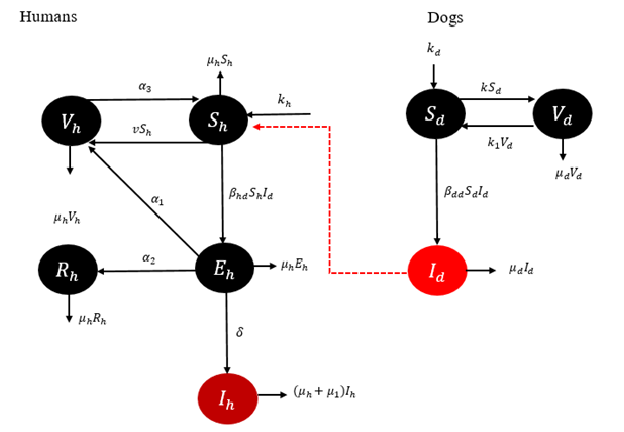
Modeling the Impact of Vaccination and Post-Treatment on Rabies Transmission
Journal of Numerical Simulations in Physics and Mathematics | Volume 1, Issue 2: 84-97, 2025 | DOI: 10.62762/JNSPM.2025.826101
Abstract
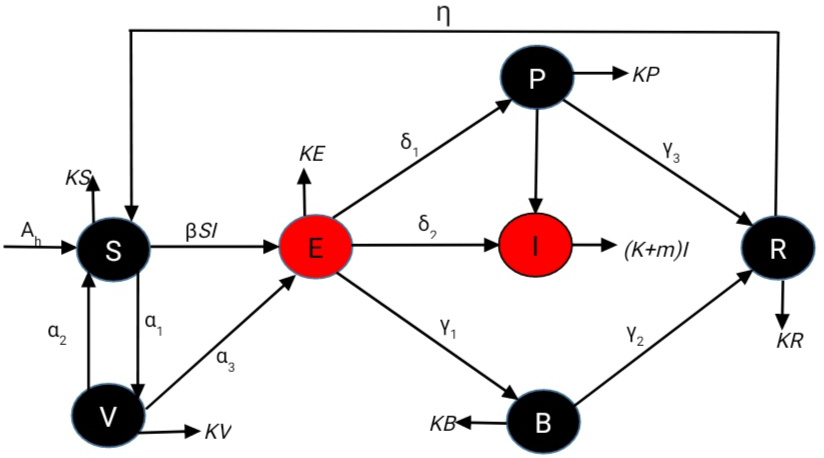
Rabies remains a serious public health concern, as dog bites account for the majority of human cases. In this study, we develop a comprehensive mathematical model to investigate the dynamics of rabies transmission by incorporating two key intervention strategies: an asymptotic class (\(P\)) and a booster vaccination class (\(B\)). The basic reproduction number (\(R_0\)) is derived as a threshold parameter that governs whether the disease spreads or dies out, based on a system of nonlinear differential equations. A sensitivity analysis of \(R_0\) is conducted to identify the most influential parameters affecting disease transmission. The results indicate that the transmission rate (\(\beta\))... More >

Graphical Abstract
Modeling the Impact of Vaccination and Post-Treatment on Rabies Transmission

Open Access | Research Article | 08 December 2025
On the Convergence of Nonconcave-Nonconvex Max-Min Optimization Problem
Journal of Numerical Simulations in Physics and Mathematics | Volume 1, Issue 2: 76-83, 2025 | DOI: 10.62762/JNSPM.2025.112121
Abstract
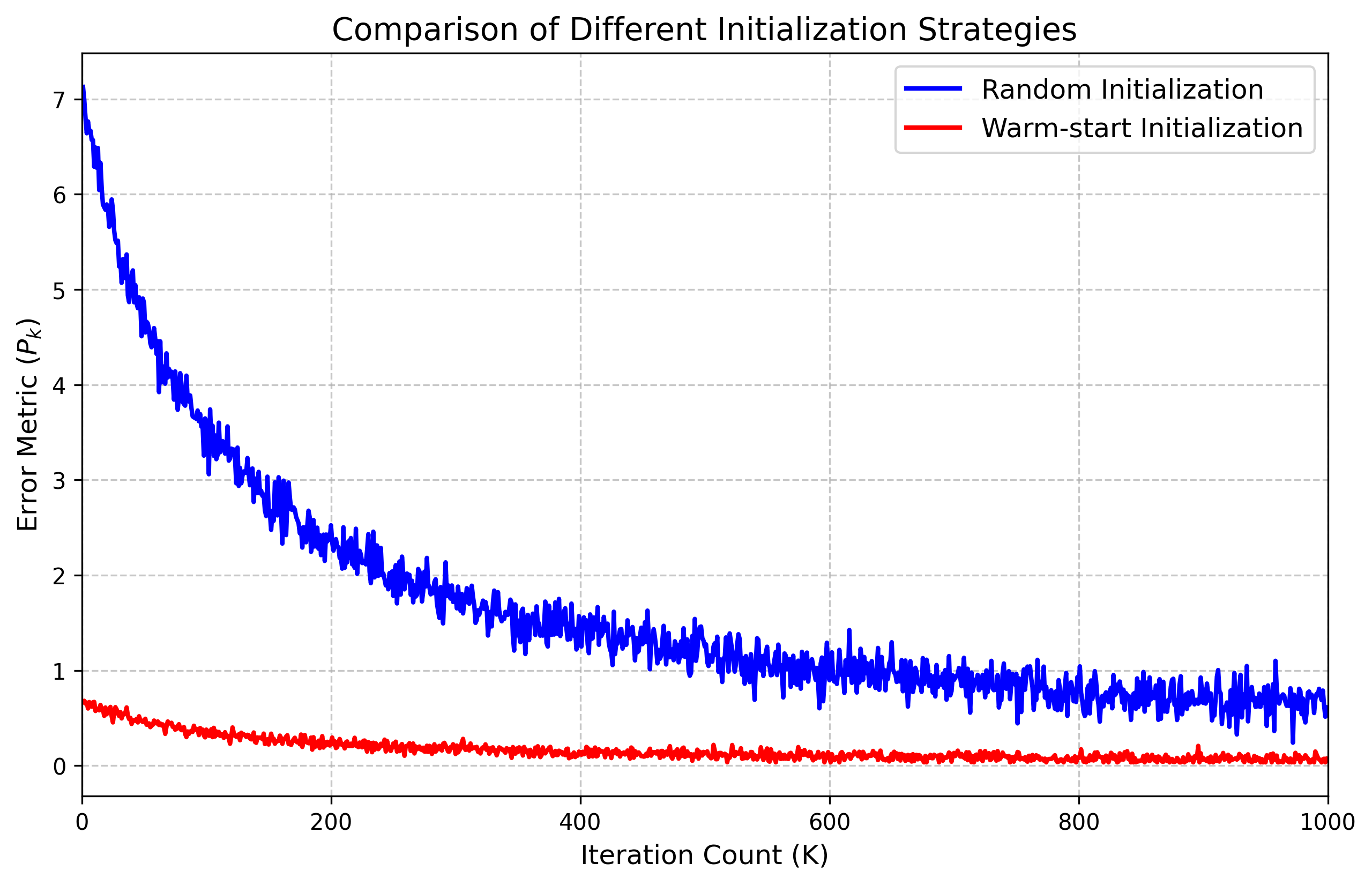
Despite extensive study of max--min problems, convergence analysis for the challenging nonconvex--nonconcave setting remains limited. This paper addresses the convergence analysis of nonconvex--nonconcave max--min problems. A novel analytical framework is developed by employing carefully constructed auxiliary functions and leveraging two-sided Polyak--Łojasiewicz (PL) and Quadratic Growth (QG) conditions to characterize the convergence behavior. Under these conditions, it is shown that the Stochastic Alternating Gradient Descent Ascent (SAGDA) algorithm achieves a convergence rate of $\mathcal{O}\left(1/K\right)$, where $K$ denotes the number of iterations. Notably, this result matches conv... More >

Graphical Abstract
On the Convergence of Nonconcave-Nonconvex Max-Min Optimization Problem

Open Access | Research Article | 23 November 2025
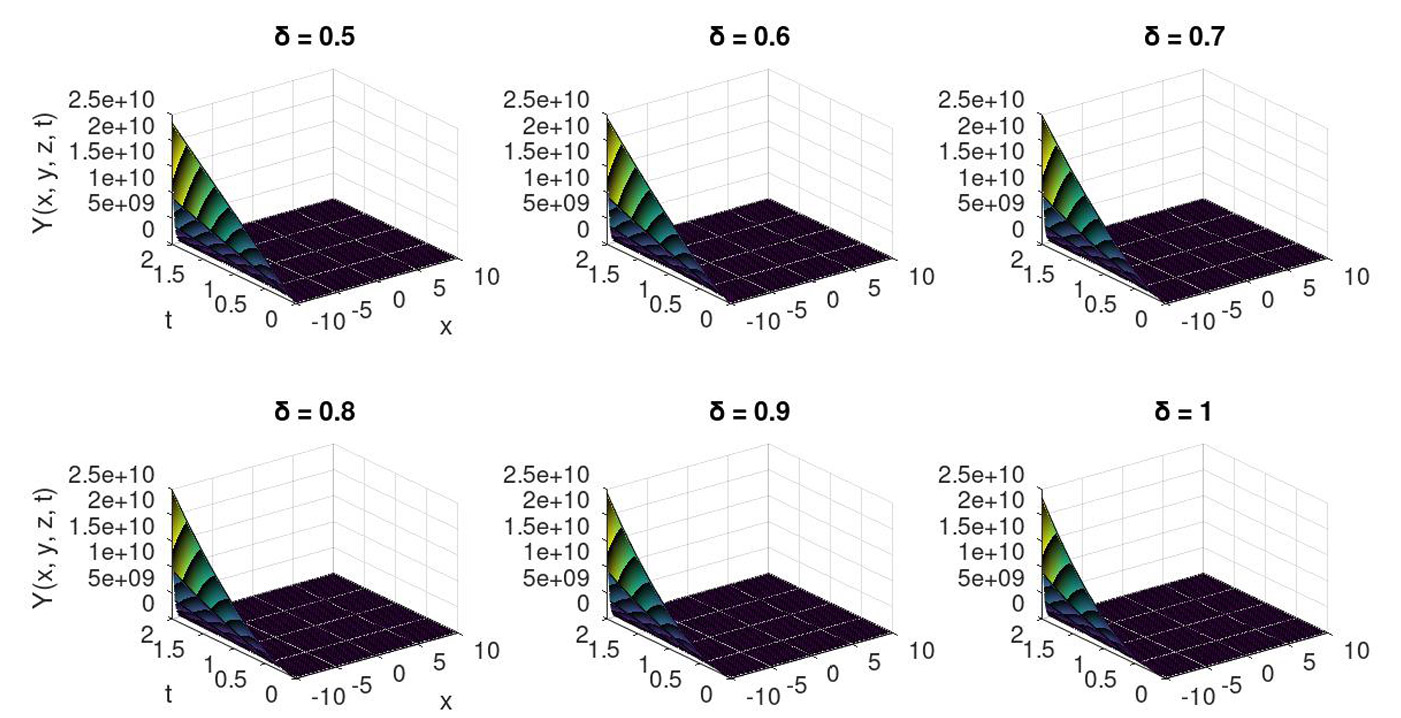
Cosmological Evolution: A Study of Transition Periods
Journal of Numerical Simulations in Physics and Mathematics | Volume 1, Issue 2: 67-75, 2025 | DOI: 10.62762/JNSPM.2025.159712
Abstract
This study investigates two transitions in cosmology: radiation-matter and matter-dark energy. For each transition, a parameter $\chi$ is employed, representing the ratio of the two energy densities involved in the relevant transition. The focus on the second transition is motivated by the need to understand an accelerating universe. In examining potential cosmic acceleration due to dynamic dark energy, a dynamical equation of state for dark energy is considered in terms of the ratio $\chi$ and the deceleration parameter $q$. The resulting system of equations is analyzed by varying parameters to investigate their influence on the evolution of the universe. To achieve cosmic acceleration, the... More >

Graphical Abstract
Cosmological Evolution: A Study of Transition Periods

Open Access | Research Article | 29 October 2024
Computer Simulation of Diffusion in a Mixture of Ideal Gases Considering the Dependence of the Diffusion Coefficient on the Entropy of Mixing Using Finite Element Method
Journal of Numerical Simulations in Physics and Mathematics | Volume 1, Issue 2: 60-66, 2025 | DOI: 10.62762/JNSPM.2025.504999
Abstract
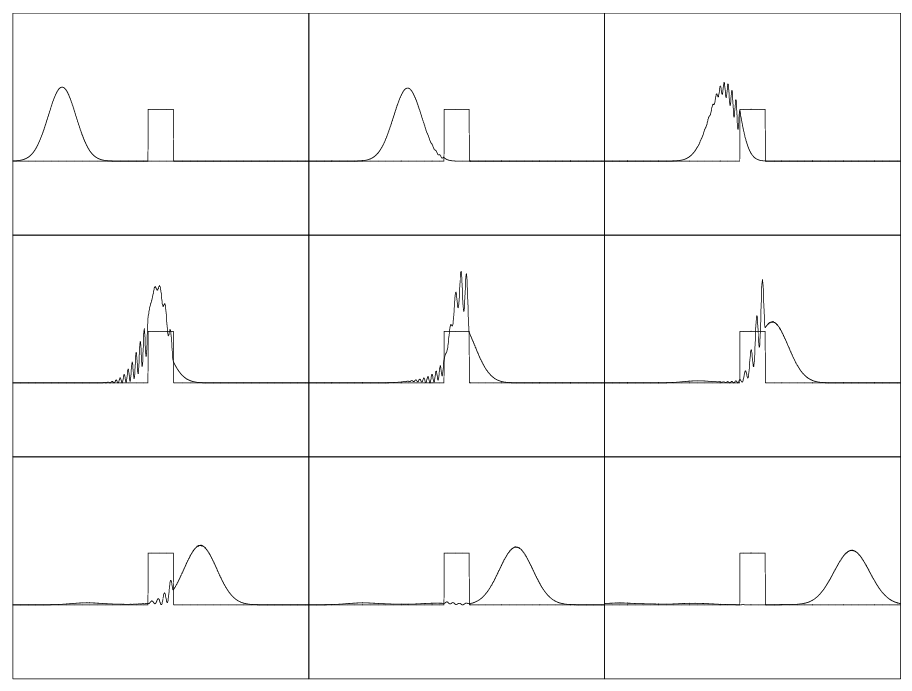
The objective of the research was to perform computer simulation of diffusion in a mixture of ideal gases considering the dependence of the diffusion coefficient on the entropy of mixing according to the proposed mathematical model. Computer simulation was carried out in one-dimensional and two-dimensional settings using finite element method and Python programming language with the use of NumPy and SciPy libraries. The obtained results show that the proposed mathematical model of diffusion in a mixture of ideal gases could be used to solve computer simulation tasks of gas diffusion satisfying the principle of mass conservation, because the entropy is considered via the chemical potential. More >

Graphical Abstract
Computer Simulation of Diffusion in a Mixture of Ideal Gases Considering the Dependence of the Diffusion Coefficient on the Entropy of Mixing Using Finite Element Method

Open Access | Research Article | 18 September 2025
Exponential Inequality for the Dependent V-statistics of Bivariate Affine Functions
Journal of Numerical Simulations in Physics and Mathematics | Volume 1, Issue 2: 54-59, 2025 | DOI: 10.62762/JNSPM.2025.502885
Abstract
Binary functions have a wide range of applications in the fields of machine learning, statistical learning, and so on. In this paper, we investigate the exponential inequalities for the independent $V$-statistics of binary affine functions and obtain a universal inequality for $V$-statistics. Due to the typical characteristics of this kind of binary function, including symmetry and affinity, this work has great practical significance. Finally, we derive the corresponding inequalities in the context of specific similarity learning. More >

Open Access | Research Article | 30 June 2025
A New Two-grid Crank-Nicolson Mixed Finite Element Method for Convective FitzHugh-Nagumo Equation
Journal of Numerical Simulations in Physics and Mathematics | Volume 1, Issue 1: 42-53, 2025 | DOI: 10.62762/JNSPM.2025.522377
Abstract
In this article, we mainly develop a new two-grid Crank-Nicolson (CN) mixed finite element (FE) (TGCNMFE) method for the convective FitzHugh-Nagumo equation. For the purpose, a new time semi-discrete CN mixed (TSDCNM) scheme is created, and the existence, steadiness, and estimates of errors for the TSDCNM solutions are attested. Thereafter, a new TGCNMFE method is developed, and the existence, steadiness, and estimates of errors for the TGCNMFE solutions are discussed. Lastly, the rightness of the procured theoretical results and the effectiveness of the TGCNMFE method are attested through several numerical experiments. More >

Open Access | Research Article | 30 June 2025
A New Natural Boundary Element Method for the 2D Viscoelastic Wave Equation
Journal of Numerical Simulations in Physics and Mathematics | Volume 1, Issue 1: 32-41, 2025 | DOI: 10.62762/JNSPM.2025.358007
Abstract
The natural boundary element (NBE) method is herein mainly adopted to compute the numerical solutions of the viscoelastic wave equation in a two-dimensional (2D) unbounded domain. To this end, a new time semi-discrete (TSD) scheme is constructed for the viscoelastic wave equation, and the existence, stability, and error estimates of the time semi-discretized solutions are analyzed. Subsequently, based on the natural boundary naturalization principle, a fully discrete NBE scheme is established. The existence and stability of the fully discrete NBE solutions are examined, and the errors between the analytical solution and the fully discrete NBE solutions are estimated. Finally, several numeric... More >

Graphical Abstract
A New Natural Boundary Element Method for the 2D Viscoelastic Wave Equation

Open Access | Research Article | 29 June 2025
The TGCNMFE Method for the Generalized Nonlinear Time Fractional Fourth-Order Reaction Diffusion Equation
Journal of Numerical Simulations in Physics and Mathematics | Volume 1, Issue 1: 18-31, 2025 | DOI: 10.62762/JNSPM.2025.256666
Abstract
Herein, we mainly focus on developing a new two-grid Crank-Nicolson (CN) mixed finite element (MFE) (TGCNMFE) method for the generalized nonlinear time fractional fourth-order reaction diffusion equation. To do so, by introducing an auxiliary function, the nonlinear time fractional fourth-order reaction diffusion equation is first split into two second-order nonlinear equations. Thereafter, a new time semi-discrete mixed CN (TSDMCN) scheme is constructed through discretizing the time derivative and time fractional derivative by the CN difference quotient, and the existence, steadiness, and errors of the TSDMCN solutions are analysed. Next, a new TGCNMFE method is developed through using tw... More >

Open Access | Research Article | 29 June 2025
Optimal Control Method of Temperature-Controlled Load Energy-Saving Technology for Industrial and Commercial Users Integrating Multi-Modal Target Detection, Identification and Tracking Models
Journal of Numerical Simulations in Physics and Mathematics | Volume 1, Issue 1: 7-17, 2025 | DOI: 10.62762/JNSPM.2025.109244
Abstract
This paper proposed an intelligent temperature-controlled load energy-saving technology based on multi-modal target detection, recognition and tracking, aiming to study the integration of traditional power energy-saving technology and high-tech multi-modal target detection, recognition and tracking technology. The method proposed in this paper was to use the energy management model of temperature-controlled load based on multi-modal target detection, identification and tracking and aggregate response algorithm to carry out energy-saving management of user's temperature-controlled load. The two algorithms jointly carried out energy-saving and optimal management of electrical appliances. Throu... More >

Graphical Abstract
Optimal Control Method of Temperature-Controlled Load Energy-Saving Technology for Industrial and Commercial Users Integrating Multi-Modal Target Detection, Identification and Tracking Models

Open Access | Editorial | 31 May 2025
Editorial for Journal of Numerical Simulations in Physics and Mathematics
Journal of Numerical Simulations in Physics and Mathematics | Volume 1, Issue 1: 1-6, 2025 | DOI: 10.62762/JNSPM.2025.175203
Abstract
This editorial mainly states the meanings for creating the Journal of Numerical Simulations in Physics and Mathematics, and the significance and foreground for the numerical simulations. In particular, the significance and foreground for the three most commonly used numerical methods: the finite element (FE) method, the finite difference (FD) scheme, and the finite volume element (FVE) method, as well as their reduced-dimension methods in the numerical simulations in physics and mathematics will be emphatically introduced and reviewed. More >
Journal Statistics
17
Authors
4
Author Distribution (Countries/Regions)
10
Articles
0
Citations
2025
Published Since
0
Special Issues
3811
Article Views
1421
Article Downloads
Journal of Numerical Simulations in Physics and Mathematics

Journal of Numerical Simulations in Physics and Mathematics

eISSN: 3068-9082 | pISSN: 3068-9074

Email: [email protected]

Crossref

Crossref

Member of Crossref
https://www.crossref.org