-
CiteScore
-
Impact Factor
Volume 1, Issue 2, Journal of Numerical Simulations in Physics and Mathematics
Volume 1, Issue 2, 2025
Submit Manuscript Edit a Special Issue
Article QR Code
Article QR Code
Scan the QR code for reading
Popular articles
Journal of Numerical Simulations in Physics and Mathematics, Volume 1, Issue 2, 2025: 67-75

Open Access | Research Article | 23 November 2025
Cosmological Evolution: A Study of Transition Periods
by
1 Cosmology and Gravity Group, Department of Mathematics and Applied Mathematics, University of Cape Town, Rondebosch 7701, South Africa
2 Centre for Higher Education Development, University of Cape Town, Rondebosch 7701, South Africa
* Corresponding Author: Bob Osano, [email protected]
ARK: ark:/57805/jnspm.2025.159712
Received: 09 September 2025, Accepted: 18 September 2025, Published: 23 November 2025  
Abstract
This study investigates two transitions in cosmology: radiation-matter and matter-dark energy. For each transition, a parameter $\chi$ is employed, representing the ratio of the two energy densities involved in the relevant transition. The focus on the second transition is motivated by the need to understand an accelerating universe. In examining potential cosmic acceleration due to dynamic dark energy, a dynamical equation of state for dark energy is considered in terms of the ratio $\chi$ and the deceleration parameter $q$. The resulting system of equations is analyzed by varying parameters to investigate their influence on the evolution of the universe. To achieve cosmic acceleration, the equation of state for dynamic dark energy (denoted $\omega$) must satisfy $\omega<-2/3$ at the matter-dark energy transition, corresponding to $\omega<-0.47$ at present.

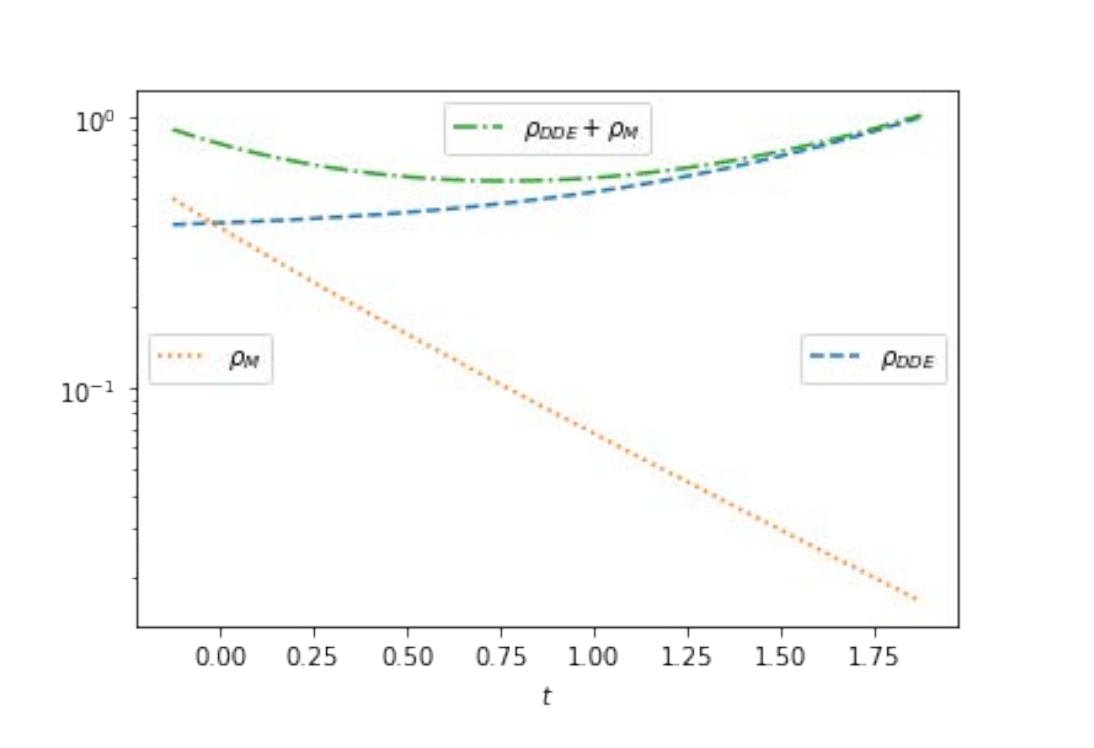
Graphical Abstract
Cosmological Evolution: A Study of Transition Periods

Keywords
cosmological transitions
dark energy dynamics
deceleration parameter
friedmann equations
equation of state

Data Availability Statement
Data will be made available on request.

Funding
This work was supported by the University of Cape Town’s NGP.

Conflicts of Interest
The author declares no conflicts of interest.

Ethical Approval and Consent to Participate
Not applicable.

References
  1. Weinberg, D. H., Mortonson, M. J., Eisenstein, D. J., Hirata, C., Riess, A. G., & Rozo, E. (2013). Observational probes of cosmic acceleration. Physics reports, 530(2), 87-255.
    [CrossRef]   [Google Scholar]
  2. Force, D. E. T. (2006). Report of the dark energy task force. Available online from NSF.
    [Google Scholar]
  3. Riess, A. G., Filippenko, A. V., Challis, P., Clocchiatti, A., Diercks, A., Garnavich, P. M., ... & Tonry, J. (1998). Observational evidence from supernovae for an accelerating universe and a cosmological constant. The astronomical journal, 116(3), 1009.
    [CrossRef]   [Google Scholar]
  4. Lahav, O., & Liddle, A. R. (2004). The cosmological parameters. arXiv preprint astro-ph/0406681.
    [Google Scholar]
  5. Hinshaw, G., Larson, D., Komatsu, E., Spergel, D. N., Bennett, C., Dunkley, J., ... & Wright, E. L. (2013). Nine-year Wilkinson Microwave Anisotropy Probe (WMAP) observations: cosmological parameter results. The Astrophysical Journal Supplement Series, 208(2), 19.
    [CrossRef]   [Google Scholar]
  6. Aghanim, N., Akrami, Y., Ashdown, M., Aumont, J., Baccigalupi, C., Ballardini, M., ... & Roudier, G. (2020). Planck 2018 results-VI. Cosmological parameters. Astronomy & Astrophysics, 641, A6. https://www.aanda.org/10.1051/0004-6361/201833910e
    [Google Scholar]
  7. Riess, A. G., Casertano, S., Yuan, W., Macri, L., Bucciarelli, B., Lattanzi, M. G., ... & Anderson, R. I. (2018). Milky Way Cepheid standards for measuring cosmic distances and application to Gaia DR2: implications for the Hubble constant. The Astrophysical Journal, 861(2), 126.
    [CrossRef]   [Google Scholar]
  8. Riess, A. G., Anand, G. S., Yuan, W., Casertano, S., Dolphin, A., Macri, L. M., ... & Anderson, R. I. (2024). JWST observations reject unrecognized crowding of Cepheid photometry as an explanation for the Hubble tension at 8$\sigma$ confidence. The Astrophysical Journal Letters, 962(1), L17.
    [CrossRef]   [Google Scholar]
  9. Cunnington, S. (2022). Detecting the power spectrum turnover with H i intensity mapping. Monthly Notices of the Royal Astronomical Society, 512(2), 2408-2425.
    [CrossRef]   [Google Scholar]
  10. Eisenstein, D. J., & Hu, W. (1998). Baryonic features in the matter transfer function. The Astrophysical Journal, 496(2), 605.
    [CrossRef]   [Google Scholar]
  11. Dodelson, S., & Schmidt, F. (2020). Modern cosmology. Academic press.
    [Google Scholar]
  12. Vagnozzi, S. (2020). New physics in light of the $H_{0$ tension: An alternative view. Physical Review D, 102(2), 023518.
    [CrossRef]   [Google Scholar]
  13. Birrer, S., Treu, T., Rusu, C. E., Bonvin, V., Fassnacht, C. D., Chan, J. H. H., ... & Meylan, G. (2019). H0LiCOW–IX. Cosmographic analysis of the doubly imaged quasar SDSS 1206+ 4332 and a new measurement of the Hubble constant. Monthly Notices of the Royal Astronomical Society, 484(4), 4726-4753.
    [CrossRef]   [Google Scholar]
  14. Knox, L., & Millea, M. (2020). Hubble constant hunter’s guide. Physical Review D, 101(4), 043533.
    [CrossRef]   [Google Scholar]
  15. Chamings, F. N., Avgoustidis, A., Copeland, E. J., Green, A. M., & Pourtsidou, A. (2020). Understanding the suppression of structure formation from dark matter-dark energy momentum coupling. Physical Review D, 101(4), 043531.
    [CrossRef]   [Google Scholar]
  16. Mortonson, M. J., Weinberg, D. H., & White, M. (2013). Dark energy: a short review. arXiv preprint arXiv:1401.0046.
    [Google Scholar]
  17. Tsujikawa, S. (2011). Dark energy: investigation and modeling. In Dark Matter and Dark Energy: A Challenge for Modern Cosmology (pp. 331-402). Dordrecht: Springer Netherlands.
    [CrossRef]   [Google Scholar]
  18. Li, M., Li, X. D., Wang, S., & Wang, Y. (2011). Dark energy. Communications in theoretical physics, 56(3), 525.
    [CrossRef]   [Google Scholar]
  19. Weinberg, S. (2013). Gravitation and cosmology: principles and applications of the general theory of relativity. John Wiley & Sons.
    [CrossRef]   [Google Scholar]
  20. Peebles, P. J. E. (1993). Principles of physical cosmology. Princeton University Press.
    [Google Scholar]
  21. Tian, S. (2017). The relation between cosmological redshift and scale factor for photons. The Astrophysical Journal, 846(2), 90.
    [CrossRef]   [Google Scholar]
  22. Perlmutter, S., Aldering, G., Goldhaber, G., Knop, R. A., Nugent, P., Castro, P. G., ... & Supernova Cosmology Project. (1999). Measurements of $\Omega$ and $\Lambda$ from 42 high-redshift supernovae. The Astrophysical Journal, 517(2), 565–586.
    [CrossRef]   [Google Scholar]
  23. Maartens, R. (1996). Causal thermodynamics in relativity. arXiv:astro-ph/9609119.
    [Google Scholar]
  24. Israel, W. (2009). Relativistic thermodynamics. In ECG Stueckelberg, An Unconventional Figure of Twentieth Century Physics: Selected Scientific Papers with Commentaries (pp. 101-113). Basel: Birkhäuser Basel.
    [CrossRef]   [Google Scholar]
  25. Israel, W., & Stewart, J. M. (1979). Transient relativistic thermodynamics and kinetic theory. Annals of Physics, 118(2), 341-372.
    [CrossRef]   [Google Scholar]
  26. Hiscock, W., & Lindblom, L. (1983). Stability and causality in dissipative relativistic fluids. Annals of Physics, 151(2), 466–496.
    [CrossRef]   [Google Scholar]
  27. Osano, B. (2020). The thermodynamics of relativistic multifluid systems. Letters in High Energy Physics, 2020(141), 1–8. https://ui.adsabs.harvard.edu/link_gateway/2020LHEP....3..141O/doi:10.31526/lhep.2020.141
    [Google Scholar]
  28. Barkana, R. (2018). Possible interaction between baryons and dark-matter particles revealed by the first stars. Nature, 555(7694), 71–74.
    [CrossRef]   [Google Scholar]
  29. Osano, B. (2020). Evolution of cosmological total energy density and transient periods in cosmology. arXiv preprint arXiv:2002.08875.
    [Google Scholar]
  30. Osano, B. (2025). Dark energy: A dynamical systems approach to the reconstruction of the equation of state. Journal of Mathematical Physics, 66(9).
    [CrossRef]   [Google Scholar]
  31. Bahr-Kalus, B., Parkinson, D., & Mueller, E. M. (2023). Measurement of the matter-radiation equality scale using the extended baryon oscillation spectroscopic survey quasar sample. Monthly Notices of the Royal Astronomical Society, 524(2), 2463-2476.
    [CrossRef]   [Google Scholar]
  32. Hu, W., & Sugiyama, N. (1995). Small scale cosmological perturbations: An analytic approach. The Astrophysical Journal, 471(2), 542–570.
    [CrossRef]   [Google Scholar]
  33. Chevallier, M., & Polarski, D. (2001). Accelerating universes with scaling dark matter. International Journal of Modern Physics D, 10(02), 213-223.
    [CrossRef]   [Google Scholar]
  34. Linder, E. V. (2008). The dynamics of quintessence, the quintessence of dynamics. General Relativity and Gravitation, 40(2), 329–356.
    [CrossRef]   [Google Scholar]
  35. Barboza Jr, E. M., & Alcaniz, J. S. (2008). A parametric model for dark energy. Physics Letters B, 666(5), 415–419.
    [CrossRef]   [Google Scholar]
  36. Wang, Y. (2008). Figure of merit for dark energy constraints from current observational data. Physical Review D, 77(12), 123525.
    [CrossRef]   [Google Scholar]
  37. Bouali, A., Chaudhary, H., Debnath, U., Sardar, A., & Mustafa, G. (2023). Data analysis of three parameter models of deceleration parameter in FLRW universe. The European Physical Journal Plus, 138(9), 1-26.
    [CrossRef]   [Google Scholar]
  38. Alam, U., Sahni, V., Deep Saini, T., & Starobinsky, A. A. (2004). Is there supernova evidence for dark energy metamorphosis?. Monthly Notices of the Royal Astronomical Society, 354(1), 275-291.
    [CrossRef]   [Google Scholar]
  39. Alam, U., Sahni, V., & Starobinsky, A. A. (2004). The case for dynamical dark energy revisited. Journal of Cosmology and Astroparticle Physics, 2004(06), 008.
    [CrossRef]   [Google Scholar]
  40. Escamilla-Rivera, C. & Nájera, A. (2022). Dynamic dark energy models in the light of Gravitational-Wave Transient Catalogues. Journal of Cosmology and Astroparticle Physics, 2022(03), 060.
    [CrossRef]   [Google Scholar]
  41. Kundu, R., Debnath, U., & Pradhan, A. (2023). Studying the optical depth behavior of parametrized deceleration parameter in non-flat universe. International Journal of Geometric Methods in Modern Physics, 20(07), 2350110.
    [CrossRef]   [Google Scholar]
  42. Pourojaghi, S., & Malekjani, M. (2021). A new comparison between holographic dark energy and standard Λ-cosmology in the context of cosmography method. The European Physical Journal C, 81(7), 575.
    [CrossRef]   [Google Scholar]
  43. Wei, H., Yan, X. P., & Zhou, Y. N. (2014). Cosmological applications of Pade approximant. Journal of Cosmology and Astroparticle Physics, 2014(01), 045.
    [CrossRef]   [Google Scholar]
  44. Rezaei, M., Malekjani, M., Basilakos, S., Mehrabi, A., & Mota, D. F. (2017). Constraints to dark energy using PADE parameterizations. The Astrophysical Journal, 843(1), 65.
    [CrossRef]   [Google Scholar]
  45. Frieman, J. A., Turner, M. S., & Huterer, D. (2008). Dark energy and the accelerating universe. Annu. Rev. Astron. Astrophys., 46(1), 385-432.
    [CrossRef]   [Google Scholar]
  46. Kopp, M., Skordis, C., Thomas, D. B., & Ilić, S. (2018). Dark matter equation of state through cosmic history. Physical Review Letters, 120(22), 221102.
    [CrossRef]   [Google Scholar]
  47. Li, M., Qiu, T., Cai, Y., & Zhang, X. (2012). On dark energy models of single scalar field. Journal of Cosmology and Astroparticle Physics, 2012(04), 003.
    [CrossRef]   [Google Scholar]
  48. Caldwell, R. R., Doran, M., Müller, C. M., Schäfer, G., & Wetterich, C. (2003). Early quintessence in light of the Wilkinson Microwave Anisotropy Probe. The Astrophysical Journal, 591(2), L75.
    [CrossRef]   [Google Scholar]
  49. Rahman, S. F. (2020). Dynamic dark energy equation of state (EoS) and Hubble constant analysis using type Ia supernovae from Union 2.1 dataset. Astronomy Reports, 64(4), 354–367.
    [CrossRef]   [Google Scholar]

Cite This Article
APA Style
Osano, B. (2025). Cosmological Evolution: A Study of Transition Periods. Journal of Numerical Simulations in Physics and Mathematics, 1(2), 67–75. https://doi.org/10.62762/JNSPM.2025.159712
Export Citation
RIS Format
Compatible with EndNote, Zotero, Mendeley, and other reference managers
RIS format data for reference managers
TY  - JOUR
AU  - Osano, Bob
PY  - 2025
DA  - 2025/11/23
TI  - Cosmological Evolution: A Study of Transition Periods
JO  - Journal of Numerical Simulations in Physics and Mathematics
T2  - Journal of Numerical Simulations in Physics and Mathematics
JF  - Journal of Numerical Simulations in Physics and Mathematics
VL  - 1
IS  - 2
SP  - 67
EP  - 75
DO  - 10.62762/JNSPM.2025.159712
UR  - https://www.icck.org/article/abs/JNSPM.2025.159712
KW  - cosmological transitions
KW  - dark energy dynamics
KW  - deceleration parameter
KW  - friedmann equations
KW  - equation of state
AB  - This study investigates two transitions in cosmology: radiation-matter and matter-dark energy. For each transition, a parameter $\chi$ is employed, representing the ratio of the two energy densities involved in the relevant transition. The focus on the second transition is motivated by the need to understand an accelerating universe. In examining potential cosmic acceleration due to dynamic dark energy, a dynamical equation of state for dark energy is considered in terms of the ratio $\chi$ and the deceleration parameter $q$. The resulting system of equations is analyzed by varying parameters to investigate their influence on the evolution of the universe. To achieve cosmic acceleration, the equation of state for dynamic dark energy (denoted $\omega$) must satisfy $\omega
SN  - 3068-9082
PB  - Institute of Central Computation and Knowledge
LA  - English
ER  - 
BibTeX Format
Compatible with LaTeX, BibTeX, and other reference managers
BibTeX format data for LaTeX and reference managers
@article{Osano2025Cosmologic,
  author = {Bob Osano},
  title = {Cosmological Evolution: A Study of Transition Periods},
  journal = {Journal of Numerical Simulations in Physics and Mathematics},
  year = {2025},
  volume = {1},
  number = {2},
  pages = {67-75},
  doi = {10.62762/JNSPM.2025.159712},
  url = {https://www.icck.org/article/abs/JNSPM.2025.159712},
  abstract = {This study investigates two transitions in cosmology: radiation-matter and matter-dark energy. For each transition, a parameter \$\chi\$ is employed, representing the ratio of the two energy densities involved in the relevant transition. The focus on the second transition is motivated by the need to understand an accelerating universe. In examining potential cosmic acceleration due to dynamic dark energy, a dynamical equation of state for dark energy is considered in terms of the ratio \$\chi\$ and the deceleration parameter \$q\$. The resulting system of equations is analyzed by varying parameters to investigate their influence on the evolution of the universe. To achieve cosmic acceleration, the equation of state for dynamic dark energy (denoted \$\omega\$) must satisfy \$\omega},
  keywords = {cosmological transitions, dark energy dynamics, deceleration parameter, friedmann equations, equation of state},
  issn = {3068-9082},
  publisher = {Institute of Central Computation and Knowledge}
}

Article Metrics
Citations:

Crossref

0

Scopus

0

Web of Science

0
Article Access Statistics:
Views: 295
PDF Downloads: 66

Publisher's Note
ICCK stays neutral with regard to jurisdictional claims in published maps and institutional affiliations.

Rights and Permissions
CC BY Copyright © 2025 by the Author(s). Published by Institute of Central Computation and Knowledge. This article is an open access article distributed under the terms and conditions of the Creative Commons Attribution (CC BY) license (https://creativecommons.org/licenses/by/4.0/), which permits use, sharing, adaptation, distribution and reproduction in any medium or format, as long as you give appropriate credit to the original author(s) and the source, provide a link to the Creative Commons licence, and indicate if changes were made.
Journal of Numerical Simulations in Physics and Mathematics

Journal of Numerical Simulations in Physics and Mathematics

ISSN: 3068-9082 (Online) | ISSN: 3068-9074 (Print)

Email: [email protected]

Portico

Portico

All published articles are preserved here permanently:
https://www.portico.org/publishers/icck/