

MHD Double-Diffusive Convection in a Darcy--Forchheimer Porous Wavy Cavity with Radiation and Viscous Dissipation: A Finite Element Study




Article Information
Abstract
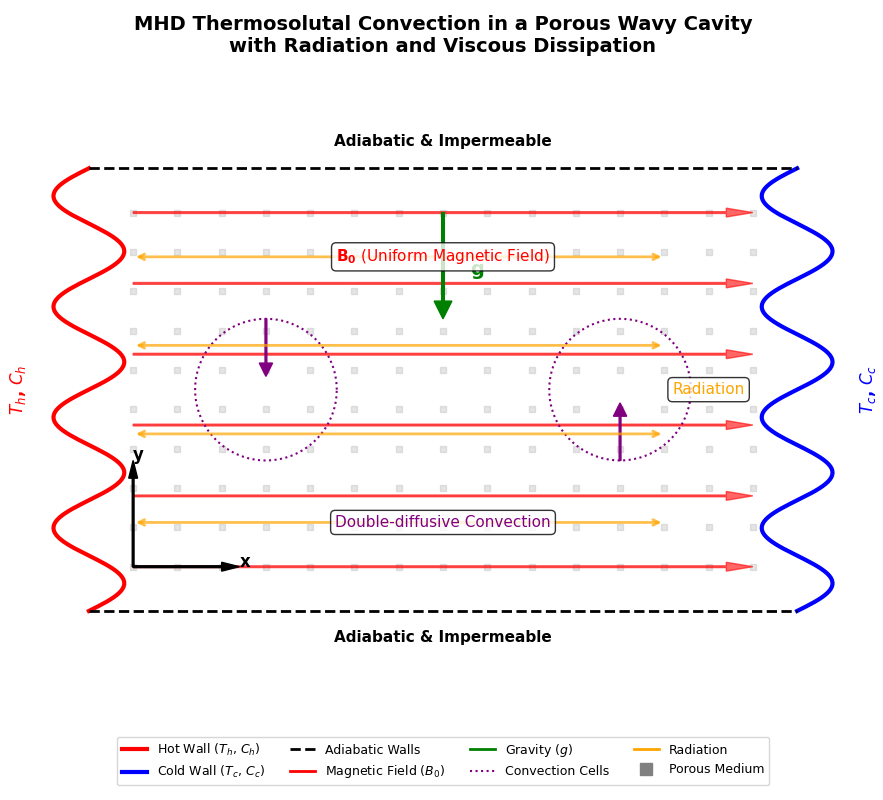
This paper investigates the combined effects of magnetohydrodynamics (MHD), double-diffusive convection, radiative heat transfer, and viscous dissipation in a porous wavy cavity. The Darcy–Forchheimer model and Rosseland approximation are employed; the dimensionless governing equations are solved using the Galerkin finite element method with triangular elements. Key quantitative findings include: the Hartmann number suppresses convective transport, reducing average Nusselt and Sherwood numbers by up to 59% at $Ha=50$; the radiation parameter $N_1$ enhances heat transfer by 169% as $N_1$ varies from 0.01 to 10; viscous dissipation paradoxically reduces wall heat flux by 33% despite increasing bulk fluid temperatures; and wavy walls improve heat/mass transfer by 25--30% compared to flat walls. Parametric analysis ranks $Ra$ as the most influential parameter (+511% effect), followed by $Ha$ (-59%), $N_1$ (+169%), $Ec$ (-33%), and $Le$ (+17%). These results provide quantitative guidance for designing MHD-based thermal management systems, nuclear reactor cooling, and material processing equipment where multiple transport mechanisms coexist.
Graphical Abstract
Keywords
Data Availability Statement
Funding
Conflicts of Interest
AI Use Statement
Ethical Approval and Consent to Participate
References
- Cheng, P. (1979). Heat transfer in geothermal systems. In Advances in heat transfer (Vol. 14, pp. 1-105). Elsevier.
[CrossRef] [Google Scholar] - Nield, D. A., & Bejan, A. (2013). Convection in Porous Media (4th ed.). Springer.
[CrossRef] [Google Scholar] - Kaviany, M. (2012). Principles of Heat Transfer in Porous Media (2nd ed.). Springer.
[CrossRef] [Google Scholar] - Vafai, K., & Tien, C. L. (1981). Boundary and inertia effects on flow and heat transfer in porous media. International Journal of Heat and Mass Transfer, 24(2), 195-203.
[CrossRef] [Google Scholar] - Beckermann, C., & Viskanta, R. (1988). Double-diffusive convection during dendritic solidification of a binary mixture. PhysicoChemical Hydrodynamics, 10(2), 195-213.
[Google Scholar] - Davidson, P. A. (2001). An Introduction to Magnetohydrodynamics. Cambridge University Press.
[CrossRef] [Google Scholar] - Modest, M. F. (2013). Radiative Heat Transfer (3rd ed.). Academic Press.
[CrossRef] [Google Scholar] - Bakier, A. Y. (2001). Thermal radiation effect on mixed convection from vertical surfaces in saturated porous media. International communications in heat and mass transfer, 28(1), 119-126.
[CrossRef] [Google Scholar] - Turner, J. S. (1979). Buoyancy Effects in Fluids. Cambridge University Press.
[CrossRef] [Google Scholar] - Mehrabian, R., Keane, M., & Flemings, M. C. (1970). Interdendritic fluid flow and macrosegregation; influence of gravity. Metallurgical Transactions, 1(5), 1209-1220.
[CrossRef] [Google Scholar] - Ingham, D. B., & Pop, I. (2005). Transport Phenomena in Porous Media III. Elsevier.
[CrossRef] [Google Scholar] - Darcy, H. (1856). Les fontaines publiques de la ville de Dijon. Victor Dalmont. https://archive.org/details/bub_gb_42EUAAAAQAAJ
[Google Scholar] - Forchheimer, P. (1901). Wasserbewegung durch Boden. Zeitschrift des Vereines Deutscher Ingenieure, 45, 1781-1788. https://archive.org/details/zeitschrift-des-vereines-deutscher-ingenieure-45.1901-teil-2/page/1781/mode/2up
[Google Scholar] - Trevisan, O. V., & Bejan, A. (1985). Natural convection with combined heat and mass transfer buoyancy effects in a porous medium. International Journal of Heat and Mass Transfer, 28(8), 1597-1611.
[CrossRef] [Google Scholar] - Bejan, A., & Khair, K. R. (1985). Heat and mass transfer by natural convection in a porous medium. International Journal of Heat and Mass Transfer, 28(5), 909-918.
[CrossRef] [Google Scholar] - Rudraiah, N., Barron, R. M., Venkatachalappa, M., & Subbaraya, C. K. (1995). Effect of a magnetic field on free convection in a rectangular enclosure. International Journal of Engineering Science, 33(8), 1075-1084.
[CrossRef] [Google Scholar] - Chamkha, A. J. (1997). MHD-free convection from a vertical plate embedded in a thermally stratified porous medium with Hall effects. Applied Mathematical Modelling, 21(10), 603-609.
[CrossRef] [Google Scholar] - Bejan, A. (2013). Convection Heat Transfer (4th ed.). Wiley.
[CrossRef] [Google Scholar] - Mahmud, S., Das, P. K., Hyder, N., & Islam, A. S. (2002). Free convection in an enclosure with vertical wavy walls. International Journal of Thermal Sciences, 41(5), 440-446.
[CrossRef] [Google Scholar] - Molla, M. M., Hossain, M. A., & Yao, L. S. (2004). Natural convection flow along a vertical wavy surface with uniform surface temperature in presence of heat generation/absorption. International Journal of Thermal Sciences, 43(2), 157-163.
[CrossRef] [Google Scholar] - Howell, J. R., Menguc, M. P., & Siegel, R. (2010). Thermal radiation heat transfer. CRC press.
[CrossRef] [Google Scholar] - Hossain, M. A., & Takhar, H. S. (1996). Radiation effect on mixed convection along a vertical plate with uniform surface temperature. Heat and Mass transfer, 31(4), 243-248.
[CrossRef] [Google Scholar] - Gebhart, B., & Mollendorf, J. (1969). Viscous dissipation in external natural convection flows. Journal of fluid Mechanics, 38(1), 97-107.
[CrossRef] [Google Scholar] - Reddy, J. N., & Gartling, D. K. (2010). The Finite Element Method in Heat Transfer and Fluid Dynamics (3rd ed.). CRC Press.
[CrossRef] [Google Scholar] - Teamah, M. A., Elsafty, A. F., & Massoud, E. Z. (2012). Numerical simulation of double-diffusive natural convective flow in an inclined rectangular enclosure in the presence of magnetic field and heat source. International journal of thermal sciences, 52, 161-175.
[CrossRef] [Google Scholar] - Ahmed, S. E., Hussein, A. K., Mohammed, H. A., Adegun, I. K., Zhang, X., Kolsi, L., ... & Sivasankaran, S. (2014). Viscous dissipation and radiation effects on MHD natural convection in a square enclosure filled with a porous medium. Nuclear Engineering and Design, 266, 34-42.
[CrossRef] [Google Scholar] - Pal, D., & Mondal, H. (2012). Hydromagnetic convective diffusion of species in Darcy–Forchheimer porous medium with non-uniform heat source/sink and variable viscosity. International Communications in Heat and Mass Transfer, 39(7), 913-917.
[CrossRef] [Google Scholar] - Goyeau, B., Songbe, J. P., & Gobin, D. (1996). Numerical study of double-diffusive natural convection in a porous cavity using the Darcy-Brinkman formulation. International Journal of Heat and Mass Transfer, 39(7), 1363-1378.
[CrossRef] [Google Scholar] - Parveen, R., & Mahapatra, T. R. (2019). Numerical simulation of MHD double diffusive natural convection and entropy generation in a wavy enclosure filled with nanofluid with discrete heating. Heliyon, 5(9), e02496.
[CrossRef] [Google Scholar] - Alsabery, A. I., Saleh, H., & Hashim, I. (2017). Effects of viscous dissipation and radiation on MHD natural convection in oblique porous cavity with constant heat flux. Advances in Applied Mathematics and Mechanics, 9(2), 463-484.
[CrossRef] [Google Scholar] - Guedri, K., Zaim, A. N., Sajadi, S. M., Jasim, D. J., Aissa, A., Salahshour, S., ... & Al-Kouz, W. (2024). Investigation of free convection in a wavy trapezoidal porous cavity with MWCNT-Fe3O4/Water hybrid nanofluid under MHD effects: Galerkin finite element analysis. Case Studies in Thermal Engineering, 56, 104243.
[CrossRef] [Google Scholar] - Nithiarasu, P., Seetharamu, K. N., & Sundararajan, T. (1996). Double-diffusive natural convection in an enclosure filled with fluid-saturated porous medium: a generalized non-Darcy approach. Numerical Heat Transfer, Part A Applications, 30(4), 413-426.
[CrossRef] [Google Scholar] - Hansda, S., Majhi, D., Hussein, A. K., Al-Sharify, Z. T., & Abdulameer, S. F. (2025). Magento-double diffusive natural convection in a partially heated wavy porous cavity filled with a radiative hybrid nanofluid. Journal of Thermal Analysis and Calorimetry, 150(13), 10489-10512.
[CrossRef] [Google Scholar] - Sharifi, M., & Rasouli, N. (2025). A comprehensive review of double diffusive convection: Effects of flow geometries, external forces, and porous media. International Communications in Heat and Mass Transfer, 160, 108380.
[CrossRef] [Google Scholar] - Chamkha, A. J. (2002). Double-diffusive convection in a porous enclosure with cooperating temperature and concentration gradients and heat generation or absorption effects. Numerical Heat Transfer: Part A: Applications, 41(1), 65-87.
[CrossRef] [Google Scholar] - Afsana, S., Molla, M. M., Nag, P., Saha, L. K., & Siddiqa, S. (2021). MHD natural convection and entropy generation of non-Newtonian ferrofluid in a wavy enclosure. International Journal of Mechanical Sciences, 198, 106350.
[CrossRef] [Google Scholar]
Cite This Article
TY  - JOUR
AU  - Biradar, Mahadev
PY  - 2026
DA  - 2026/09/19
TI  - MHD Double-Diffusive Convection in a Darcy--Forchheimer Porous Wavy Cavity with Radiation and Viscous Dissipation: A Finite Element Study
JO  - Journal of Numerical Simulations in Physics and Mathematics
T2  - Journal of Numerical Simulations in Physics and Mathematics
JF  - Journal of Numerical Simulations in Physics and Mathematics
VL  - 2
IS  - 2
SP  - 117
EP  - 129
DO  - 10.62762/JNSPM.2026.403753
UR  - https://www.icck.org/article/abs/JNSPM.2026.403753
KW  - MHD
KW  - double-diffusive convection
KW  - Darcy–Forchheimer
KW  - porous medium
KW  - radiation
KW  - viscous dissipation
KW  - wavy cavity
KW  - finite element method
AB  - This paper investigates the combined effects of magnetohydrodynamics (MHD), double-diffusive convection, radiative heat transfer, and viscous dissipation in a porous wavy cavity. The Darcy–Forchheimer model and Rosseland approximation are employed; the dimensionless governing equations are solved using the Galerkin finite element method with triangular elements. Key quantitative findings include: the Hartmann number suppresses convective transport, reducing average Nusselt and Sherwood numbers by up to 59% at $Ha=50$; the radiation parameter $N_1$ enhances heat transfer by 169% as $N_1$ varies from 0.01 to 10; viscous dissipation paradoxically reduces wall heat flux by 33% despite increasing bulk fluid temperatures; and wavy walls improve heat/mass transfer by 25--30% compared to flat walls. Parametric analysis ranks $Ra$ as the most influential parameter (+511% effect), followed by $Ha$ (-59%), $N_1$ (+169%), $Ec$ (-33%), and $Le$ (+17%). These results provide quantitative guidance for designing MHD-based thermal management systems, nuclear reactor cooling, and material processing equipment where multiple transport mechanisms coexist.
SN  - 3068-9082
PB  - Institute of Central Computation and Knowledge
LA  - English
ER  -
@article{Biradar2026MHD,
  author = {Mahadev Biradar},
  title = {MHD Double-Diffusive Convection in a Darcy--Forchheimer Porous Wavy Cavity with Radiation and Viscous Dissipation: A Finite Element Study},
  journal = {Journal of Numerical Simulations in Physics and Mathematics},
  year = {2026},
  volume = {2},
  number = {2},
  pages = {117-129},
  doi = {10.62762/JNSPM.2026.403753},
  url = {https://www.icck.org/article/abs/JNSPM.2026.403753},
  abstract = {This paper investigates the combined effects of magnetohydrodynamics (MHD), double-diffusive convection, radiative heat transfer, and viscous dissipation in a porous wavy cavity. The Darcy–Forchheimer model and Rosseland approximation are employed; the dimensionless governing equations are solved using the Galerkin finite element method with triangular elements. Key quantitative findings include: the Hartmann number suppresses convective transport, reducing average Nusselt and Sherwood numbers by up to 59\% at \$Ha=50\$; the radiation parameter \$N\_1\$ enhances heat transfer by 169\% as \$N\_1\$ varies from 0.01 to 10; viscous dissipation paradoxically reduces wall heat flux by 33\% despite increasing bulk fluid temperatures; and wavy walls improve heat/mass transfer by 25--30\% compared to flat walls. Parametric analysis ranks \$Ra\$ as the most influential parameter (+511\% effect), followed by \$Ha\$ (-59\%), \$N\_1\$ (+169\%), \$Ec\$ (-33\%), and \$Le\$ (+17\%). These results provide quantitative guidance for designing MHD-based thermal management systems, nuclear reactor cooling, and material processing equipment where multiple transport mechanisms coexist.},
  keywords = {MHD, double-diffusive convection, Darcy–Forchheimer, porous medium, radiation, viscous dissipation, wavy cavity, finite element method},
  issn = {3068-9082},
  publisher = {Institute of Central Computation and Knowledge}
}
Article Metrics
Publisher's Note
ICCK stays neutral with regard to jurisdictional claims in published maps and institutional affiliations.
Rights and Permissions
 Copyright © 2026 by the Author(s). Published by Institute of Central Computation and Knowledge. This article is an open access article distributed under the terms and conditions of the Creative Commons Attribution (CC BY) license (https://creativecommons.org/licenses/by/4.0/), which permits use, sharing, adaptation, distribution and reproduction in any medium or format, as long as you give appropriate credit to the original author(s) and the source, provide a link to the Creative Commons licence, and indicate if changes were made.


Portico
