
Comparative Analysis of Intensity Scintillation and Phase Structure Functions under Three Atmospheric Turbulence Spectral Models




Article Information
Abstract
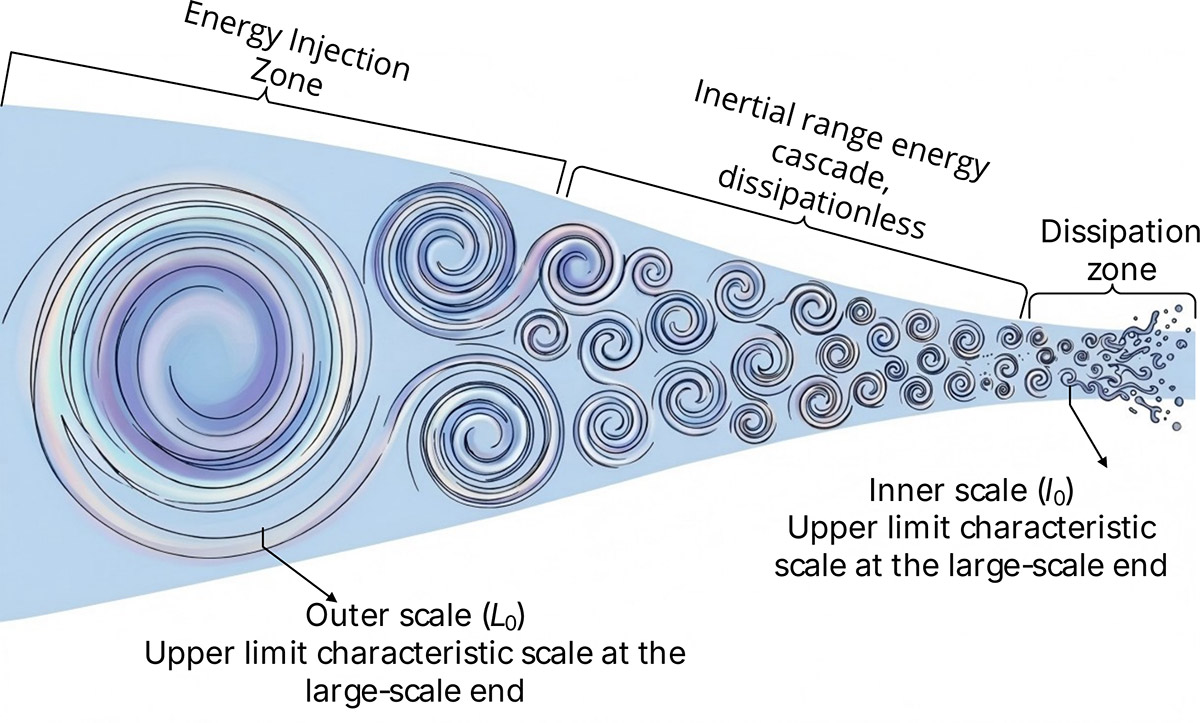
To investigate the effects of different atmospheric turbulence power spectrum models on the statistical characteristics of optical field propagation, this study considers the non-Kolmogorov spectrum, the generalized von Kármán spectrum and the generalized modified atmospheric spectrum. The spectral distributions of the three models over different spatial-frequency ranges are compared, and the intensity scintillation indices and phase structure functions of plane and spherical waves under different turbulence conditions are analyzed. Based on the relevant theoretical models, the effects of propagation distance, power-law spectral exponent, and turbulence inner scale on intensity fluctuations, and of the power-law spectral exponent on wavefront phase distortions, are examined numerically, while the roles of the turbulence inner and outer scales are analyzed through the spectral models and spatial filtering functions. Analytical expressions for the phase structure functions under the three spectral models are derived and compared. The results indicate that the spectral models differ in their descriptions of low-frequency energy limitation, high-frequency dissipation and spectral corrections near the dissipation range, which changes the predicted intensity scintillation and phase fluctuations. Plane and spherical waves also respond differently because the propagation geometry changes how turbulence-induced disturbances accumulate along the path. The derived expressions relate the spectral parameters directly to the scintillation index and phase structure function and can be used to evaluate atmospheric optical links.
Graphical Abstract
Keywords
Data Availability Statement
Funding
Conflicts of Interest
AI Use Statement
Ethical Approval and Consent to Participate
References
- Kolmogorov, A. N. (1991). The local structure of turbulence in incompressible viscous fluid for very large Reynolds numbers. Proceedings: Mathematical and Physical Sciences, 434(1890), 9-13. https://www.jstor.org/stable/51980
[Google Scholar]
[Google Scholar]
[Google Scholar]- Fante, R. L. (1980). Electromagnetic beam propagation in turbulent media: an update. Proceedings of the IEEE, 68(11), 1424-1443.
[CrossRef] [Google Scholar] - Andrews, L. C., & Phillips, R. L. (2005). Laser Beam Propagation through Random Media (2nd ed.). Bellingham: SPIE Press. https://spie.org/samples/PM354.pdf
[Google Scholar] - Tatarskii, V. I., & Zavorotnyi, V. U. (1985). Wave propagation in random media with fluctuating turbulent parameters. Journal of the Optical Society of America A, 2(12), 2069-2076.
[CrossRef] [Google Scholar] - Yura, H. T. (1974). Physical model for strong optical-amplitude fluctuations in a turbulent medium. Journal of the Optical Society of America, 64(1), 59-67.
[CrossRef] [Google Scholar] - Clifford, S. F., Ochs, G. R., & Lawrence, R. S. (1974). Saturation of optical scintillation by strong turbulence. Journal of the Optical Society of America, 64(2), 148-154.
[CrossRef] [Google Scholar] - Hill, R. J., & Clifford, S. F. (1981). Theory of saturation of optical scintillation by strong turbulence for arbitrary refractive-index spectra. Journal of the Optical Society of America, 71(6), 675-686.
[CrossRef] [Google Scholar] - Andrews, L. C., Phillips, R. L., Hopen, C. Y., & Al-Habash, M. A. (1999). Theory of optical scintillation. Journal of the Optical Society of America A, 16(6), 1417-1429.
[CrossRef] [Google Scholar] - Fried, D. L. (1965). Statistics of a geometric representation of wavefront distortion. Journal of the optical society of America, 55(11), 1427-1435.
[CrossRef] [Google Scholar] - Reynolds, O. (1895). On the dynamical theory of incompressible viscous fluids and the determination of the criterion. Philosophical Transactions of the Royal Society of London. A, 186, 123-164.
[CrossRef] [Google Scholar] - Toselli, I., Andrews, L. C., Phillips, R. L., & Ferrero, V. (2008). Free-space optical system performance for laser beam propagation through non-Kolmogorov turbulence. Optical Engineering, 47(2), 026003-026003.
[CrossRef] [Google Scholar] - Ata, Y., Baykal, Y., & Gökçe, M. C. (2022). Performance of a free-space optical communication system employing receive diversity techniques in anisotropic atmospheric non-Kolmogorov turbulence. Journal of the Optical Society of America B, 39(8), 2100-2108.
[CrossRef] [Google Scholar] - Toselli, I., Agrawal, B., & Restaino, S. (2011). Light propagation through anisotropic turbulence. Journal of the Optical Society of America A, 28(3), 483-488.
[CrossRef] [Google Scholar] - Andrews, L. C., Phillips, R. L., & Hopen, C. Y. (2001). Laser Beam Scintillation with Applications. Bellingham: SPIE Press.
[CrossRef] [Google Scholar] - Toselli, I., Andrews, L. C., Phillips, R. L., & Ferrero, V. (2009). Free space optical system performance for a Gaussian beam propagating through non-Kolmogorov weak turbulence. IEEE Transactions on Antennas and Propagation, 57(6), 1783-1788.
[CrossRef] [Google Scholar] - Stribling, B. E., Welsh, B. M., & Roggemann, M. C. (1995, June). Optical propagation in non-Kolmogorov atmospheric turbulence. In Atmospheric propagation and remote sensing IV (Vol. 2471, pp. 181-196). SPIE.
[CrossRef] [Google Scholar] - Beland, R. R. (1995, April). Some aspects of propagation through weak isotropic nonkolmogorov turbulence. In Beam Control, Diagnostics, Standards, and Propagation (Vol. 2375, pp. 6-16). SPIE.
[CrossRef] [Google Scholar] - Toselli, I., Andrews, L. C., Phillips, R. L., & Ferrero, V. (2007, May). Angle of arrival fluctuations for free space laser beam propagation through non Kolmogorov turbulence. In Atmospheric Propagation IV (Vol. 6551, pp. 149-160). SPIE.
[CrossRef] [Google Scholar] - Cui, L., Xue, B., Zheng, S., Xue, W., Bai, X., Cao, X., & Zhou, F. (2012). Atmospheric spectral model and theoretical expressions of irradiance scintillation index for optical wave propagating through moderate-to-strong non-Kolmogorov turbulence. Journal of the Optical Society of America A, 29(6), 1091-1098.
[CrossRef] [Google Scholar] - Hill, R. J., & Clifford, S. F. (1978). Modified spectrum of atmospheric temperature fluctuations and its application to optical propagation. Journal of the Optical Society of America, 68(7), 892-899.
[CrossRef] [Google Scholar] - Xue, B., Cui, L., Xue, W., Bai, X., & Zhou, F. (2011). Generalized modified atmospheric spectral model for optical wave propagating through non-Kolmogorov turbulence. Journal of the Optical Society of America A, 28(5), 912-916.
[CrossRef] [Google Scholar] - Andrews, L. C. (1992). An analytical model for the refractive index power spectrum and its application to optical scintillations in the atmosphere. Journal of modern optics, 39(9), 1849-1853.
[CrossRef] [Google Scholar] - Yi, X., Liu, Z., & Yue, P. (2012). Inner-and outer-scale effects on the scintillation index of an optical wave propagating through moderate-to-strong non-Kolmogorov turbulence. Optics Express, 20(4), 4232-4247.
[CrossRef] [Google Scholar] - Ma, J., Fu, Y. L., Yu, S. Y., Xie, X. L., & Tan, L. Y. (2018). Further analysis of scintillation index for a laser beam propagating through moderate-to-strong non-Kolmogorov turbulence based on generalized effective atmospheric spectral model. Chinese Physics B, 27(3), 034201.
[CrossRef] [Google Scholar] - Toselli, I., Andrews, L. C., Phillips, R. L., & Ferrero, V. (2007). Scintillation index of optical plane wave propagating through non Kolmogorov moderate-strong turbulence. Proceedings of SPIE, 6747, 67470B.
[CrossRef] [Google Scholar] - Yi, X., Liu, Z., & Yue, P. (2013). Optical scintillations and fade statistics for FSO communications through moderate-to-strong non-Kolmogorov turbulence. Optics & Laser Technology, 47, 199-207.
[CrossRef] [Google Scholar] - Deng, P., Yuan, X. H., & Huang, D. (2012). Scintillation of a laser beam propagation through non-Kolmogorov strong turbulence. Optics Communications, 285(6), 880-887.
[CrossRef] [Google Scholar] - Cui, L., Xue, B., Xue, W., Bai, X., Cao, X., & Zhou, F. (2012). Expressions of the scintillation index for optical waves propagating through weak non-Kolmogorov turbulence based on the generalized atmospheric spectral model. Optics & Laser Technology, 44(8), 2453-2458.
[CrossRef] [Google Scholar] - Andrews, L. C., Al-Habash, M. A., Hopen, C. Y., & Phillips, R. L. (2001). Theory of optical scintillation: Gaussian-beam wave model. Waves in Random Media, 11(3), 271-291.
[CrossRef] [Google Scholar] - Lawrence, R. S., & Strohbehn, J. W. (1970). A survey of clear-air propagation effects relevant to optical communications. Proceedings of the IEEE, 58(10), 1523-1545.
[CrossRef] [Google Scholar] - Lutomirski, R. F., & Yura, H. T. (1971). Wave structure function and mutual coherence function of an optical wave in a turbulent atmosphere. Journal of the Optical Society of America, 61(4), 482-487.
[CrossRef] [Google Scholar] - Sasiela, R. J., & Shelton, J. D. (1993). Transverse spectral filtering and Mellin transform techniques applied to the effect of outer scale on tilt and tilt anisoplanatism. Journal of the Optical Society of America A, 10(4), 646-660.
[CrossRef] [Google Scholar] - Chesnokov, S. S., & Skipetrov, S. E. (1997). Optical resolution through atmospheric turbulence with finite outer scale. Optics Communications, 141(3-4), 113-117.
[CrossRef] [Google Scholar] - Andrews, L. C., Vester, S., & Richardson, C. E. (1993). Analytic expressions for the wave structure function based on a bump spectral model for refractive index fluctuations. Journal of Modern Optics, 40(5), 931-938.
[CrossRef] [Google Scholar]
Cite This Article
TY  - JOUR
AU  - Wang, Rui
AU  - Ke, Xizheng
PY  - 2026
DA  - 2026/11/21
TI  - Comparative Analysis of Intensity Scintillation and Phase Structure Functions under Three Atmospheric Turbulence Spectral Models
JO  - Optical Wireless Communication
T2  - Optical Wireless Communication
JF  - Optical Wireless Communication
VL  - 2
IS  - 1
SP  - 1
EP  - 47
DO  - 10.62762/OWC.2026.211491
UR  - https://www.icck.org/article/abs/owc.2026.211491
KW  - atmospheric turbulence power spectrum
KW  - intensity scintillation index
KW  - phase structure function
AB  - To investigate the effects of different atmospheric turbulence power spectrum models on the statistical characteristics of optical field propagation, this study considers the non-Kolmogorov spectrum, the generalized von Kármán spectrum and the generalized modified atmospheric spectrum. The spectral distributions of the three models over different spatial-frequency ranges are compared, and the intensity scintillation indices and phase structure functions of plane and spherical waves under different turbulence conditions are analyzed. Based on the relevant theoretical models, the effects of propagation distance, power-law spectral exponent, and turbulence inner scale on intensity fluctuations, and of the power-law spectral exponent on wavefront phase distortions, are examined numerically, while the roles of the turbulence inner and outer scales are analyzed through the spectral models and spatial filtering functions. Analytical expressions for the phase structure functions under the three spectral models are derived and compared. The results indicate that the spectral models differ in their descriptions of low-frequency energy limitation, high-frequency dissipation and spectral corrections near the dissipation range, which changes the predicted intensity scintillation and phase fluctuations. Plane and spherical waves also respond differently because the propagation geometry changes how turbulence-induced disturbances accumulate along the path. The derived expressions relate the spectral parameters directly to the scintillation index and phase structure function and can be used to evaluate atmospheric optical links.
SN  - 5 Articles Required
PB  - Institute of Central Computation and Knowledge
LA  - English
ER  -
@article{Wang2026Comparativ,
  author = {Rui Wang and Xizheng Ke},
  title = {Comparative Analysis of Intensity Scintillation and Phase Structure Functions under Three Atmospheric Turbulence Spectral Models},
  journal = {Optical Wireless Communication},
  year = {2026},
  volume = {2},
  number = {1},
  pages = {1-47},
  doi = {10.62762/OWC.2026.211491},
  url = {https://www.icck.org/article/abs/owc.2026.211491},
  abstract = {To investigate the effects of different atmospheric turbulence power spectrum models on the statistical characteristics of optical field propagation, this study considers the non-Kolmogorov spectrum, the generalized von Kármán spectrum and the generalized modified atmospheric spectrum. The spectral distributions of the three models over different spatial-frequency ranges are compared, and the intensity scintillation indices and phase structure functions of plane and spherical waves under different turbulence conditions are analyzed. Based on the relevant theoretical models, the effects of propagation distance, power-law spectral exponent, and turbulence inner scale on intensity fluctuations, and of the power-law spectral exponent on wavefront phase distortions, are examined numerically, while the roles of the turbulence inner and outer scales are analyzed through the spectral models and spatial filtering functions. Analytical expressions for the phase structure functions under the three spectral models are derived and compared. The results indicate that the spectral models differ in their descriptions of low-frequency energy limitation, high-frequency dissipation and spectral corrections near the dissipation range, which changes the predicted intensity scintillation and phase fluctuations. Plane and spherical waves also respond differently because the propagation geometry changes how turbulence-induced disturbances accumulate along the path. The derived expressions relate the spectral parameters directly to the scintillation index and phase structure function and can be used to evaluate atmospheric optical links.},
  keywords = {atmospheric turbulence power spectrum, intensity scintillation index, phase structure function},
  issn = {5 Articles Required},
  publisher = {Institute of Central Computation and Knowledge}
}
Article Metrics
Publisher's Note
ICCK stays neutral with regard to jurisdictional claims in published maps and institutional affiliations.
Rights and Permissions
 Copyright © 2026 by the Author(s). Published by Institute of Central Computation and Knowledge. This article is an open access article distributed under the terms and conditions of the Creative Commons Attribution (CC BY) license (https://creativecommons.org/licenses/by/4.0/), which permits use, sharing, adaptation, distribution and reproduction in any medium or format, as long as you give appropriate credit to the original author(s) and the source, provide a link to the Creative Commons licence, and indicate if changes were made.


Portico
