

AI Integration in Unmanned Aerial Vehicles: Key Challenges, Enabling Technologies, and Practical Solutions




Article Information
Abstract
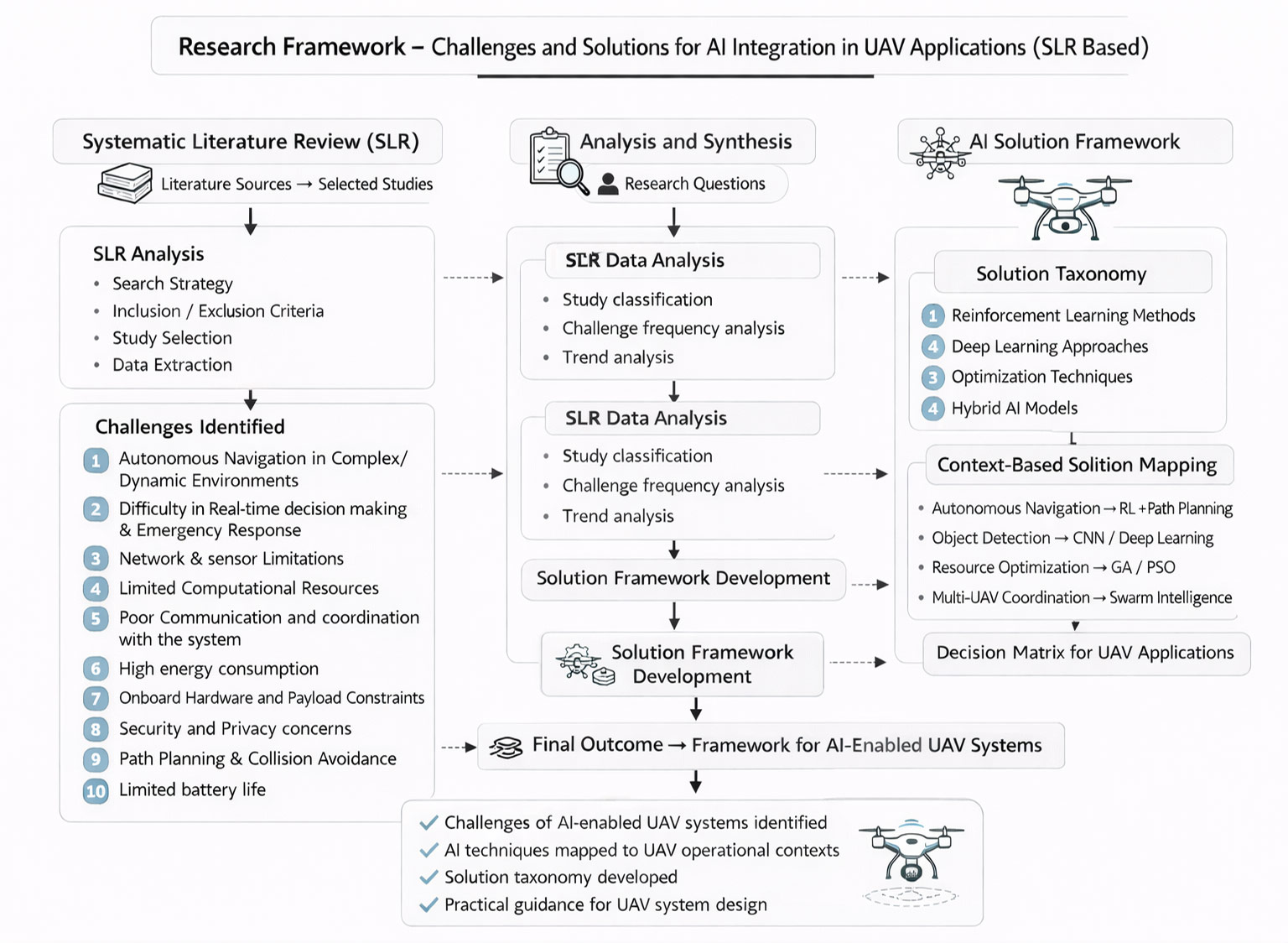
Over the last decade, Unmanned Aerial Vehicle (UAV) technology has rapidly developed by integrating AI tools and methodologies. UAVs are used across many fields, including wireless communication, logistics, agriculture, construction, security, and exploration. UAV systems are inherently complex and present numerous challenges. This study conducted a systematic literature review to identify the main challenges and the solutions researchers have proposed. A total of 141 research papers were collected and analyzed, with no restriction on publication year. The review identified 10 main challenges affecting AI in UAVs. These include problems with autonomous navigation, real-time decision-making, network and sensor limits, limited computational power, poor communication and coordination, high energy consumption, hardware and payload restrictions, security and privacy issues, path planning and collision avoidance, and limited battery life. In addition, the review identified over 100 solutions/practices, including lightweight AI models, improved communication systems, energy-efficient methods, and enhanced security measures. This review is useful for both researchers and practitioners. It clearly organizes the challenges and solutions, identifies gaps for future research, and offers practical ideas for building better UAV systems. Solving these challenges will make UAVs more reliable and effective in many sectors, leading to improvements in safety, productivity, and economic growth.
Graphical Abstract
Keywords
Data Availability Statement
Funding
Conflicts of Interest
AI Use Statement
Ethical Approval and Consent to Participate
References
- Ariante, G., & Del Core, G. (2025). Unmanned aircraft systems (UASs): Current state, emerging technologies, and future trends. Drones, 9(1), 59.
[CrossRef] [Google Scholar] - Alsaeedy, A. A., & Chong, E. K. (2020). 5G and UAVs for mission-critical communications: Swift network recovery for search-and-rescue operations. Mobile Networks and Applications, 25(5), 2063-2081.
[CrossRef] [Google Scholar] - Caballero-Martin, D., Lopez-Guede, J. M., Estevez, J., & Graña, M. (2024). Artificial intelligence applied to drone control: A state of the art. Drones, 8(7), 296.
[CrossRef] [Google Scholar] - Chen, C., Zheng, Z., Xu, T., Guo, S., Feng, S., Yao, W., & Lan, Y. (2023). Yolo-based uav technology: A review of the research and its applications. Drones, 7(3), 190.
[CrossRef] [Google Scholar] - Sai, S., Garg, A., Jhawar, K., Chamola, V., & Sikdar, B. (2023). A comprehensive survey on artificial intelligence for unmanned aerial vehicles. IEEE Open Journal of Vehicular Technology, 4, 713-738.
[CrossRef] [Google Scholar] - Lu, Y., Xue, Z., Xia, G. S., & Zhang, L. (2018). A survey on vision-based UAV navigation. Geo-spatial information science, 21(1), 21-32.
[CrossRef] [Google Scholar] - Liu, X., Chen, M., Liu, Y., Chen, Y., Cui, S., & Hanzo, L. (2020). Artificial intelligence aided next-generation networks relying on UAVs. IEEE Wireless Communications, 28(1), 120-127.
[CrossRef] [Google Scholar] - Bouguettaya, A., Zarzour, H., Kechida, A., & Taberkit, A. M. (2023). A survey on deep learning-based identification of plant and crop diseases from UAV-based aerial images. Cluster Computing, 26(2), 1297-1317.
[CrossRef] [Google Scholar] - McEnroe, P., Wang, S., & Liyanage, M. (2022). A survey on the convergence of edge computing and AI for UAVs: Opportunities and challenges. IEEE Internet of Things Journal, 9(17), 15435-15459.
[CrossRef] [Google Scholar] - Li, A., Hansen, M., & Zou, B. (2022). Traffic management and resource allocation for UAV-based parcel delivery in low-altitude urban space. Transportation Research Part C: Emerging Technologies, 143, 103808.
[CrossRef] [Google Scholar] - Mohsan, S. A. H., Othman, N. Q. H., Li, Y., Alsharif, M. H., & Khan, M. A. (2023). Unmanned aerial vehicles (UAVs): Practical aspects, applications, open challenges, security issues, and future trends. Intelligent service robotics, 16(1), 109-137.
[CrossRef] [Google Scholar] - Vashishth, T. K., Sharma, V., Sharma, K. K., Chaudhary, S., Kumar, B., & Panwar, R. (2024). Integration of unmanned aerial vehicles (UAVs) and IoT for crop monitoring and spraying. In Internet of Things applications and technology (pp. 95-117). Auerbach Publications.
[Google Scholar] - Albeaino, G., Gheisari, M., & Franz, B. W. (2019). A systematic review of unmanned aerial vehicle application areas and technologies in the AEC domain. Journal of Information Technology in Construction, 24.
[Google Scholar] - Ham, Y., Han, K. K., Lin, J. J., & Golparvar-Fard, M. (2016). Visual monitoring of civil infrastructure systems via camera-equipped Unmanned Aerial Vehicles (UAVs): a review of related works. Visualization in Engineering, 4(1), 1.
[CrossRef] [Google Scholar] - Rogge, A., Anter, L., Kunze, D., Pomsel, K., & Willenbrock, G. (2024). Standardized sampling for systematic literature reviews (STAMP method): ensuring reproducibility and replicability. Media and Communication, 12.
[CrossRef] [Google Scholar] - Marzi, G., Balzano, M., Caputo, A., & Pellegrini, M. M. (2025). Guidelines for bibliometric‐systematic literature reviews: 10 steps to combine analysis, synthesis and theory development. International Journal of Management Reviews, 27(1), 81-103.
[CrossRef] [Google Scholar] - Cabrera, D., & Cabrera, L. L. (2023). The steps to doing a systems literature review (SLR). Journal of Systems Thinking Preprints.
[CrossRef] [Google Scholar] - Duque, L., Seo, J., & Wacker, J. (2018). Bridge deterioration quantification protocol using UAV. Journal of Bridge Engineering, 23(10), 04018080.
[CrossRef] [Google Scholar] - Khan, A., Gupta, S., & Gupta, S. K. (2022). Emerging UAV technology for disaster detection, mitigation, response, and preparedness. Journal of Field Robotics, 39(6), 905-955.
[CrossRef] [Google Scholar] - ul Husnain, A., Mokhtar, N., Mohamed Shah, N., Dahari, M., & Iwahashi, M. (2023). A systematic literature review (SLR) on autonomous path planning of unmanned aerial vehicles. Drones, 7(2), 118.
[CrossRef] [Google Scholar] - Lakew, D. S., Sa’ad, U., Dao, N. N., Na, W., & Cho, S. (2020). Routing in flying ad hoc networks: A comprehensive survey. IEEE communications surveys & tutorials, 22(2), 1071-1120.
[CrossRef] [Google Scholar] - Afzal, W., Torkar, R., & Feldt, R. (2009). A systematic review of search-based testing for non-functional system properties. Information and Software Technology, 51(6), 957-976.
[CrossRef] [Google Scholar] - Bouzid, T., Chaib, N., Bensaad, M. L., & Oubbati, O. S. (2023). 5G network slicing with unmanned aerial vehicles: Taxonomy, survey, and future directions. Transactions on Emerging Telecommunications Technologies, 34(3), e4721.
[CrossRef] [Google Scholar] - Velusamy, P., Rajendran, S., Mahendran, R. K., Naseer, S., Shafiq, M., & Choi, J. G. (2021). Unmanned Aerial Vehicles (UAV) in precision agriculture: Applications and challenges. Energies, 15(1), 217.
[CrossRef] [Google Scholar] - Kabir, M. M., Jim, J. R., & Istenes, Z. (2025). Terrain detection and segmentation for autonomous vehicle navigation: A state-of-the-art systematic review. Information Fusion, 113, 102644.
[CrossRef] [Google Scholar] - Selvan, C. P., Ramanujam, S. K., Jasim, A. S., Hussain, M. J. M., Selvan, C. P., Ramanujam, S. K., ... & Hussain, M. J. M. (2024). Enhancing robotic navigation in dynamic environments. Int. J. Comput. Math. Comput. Sci, 10(313319), 20240101.
[Google Scholar] - Chronis, C., Anagnostopoulos, G., Politi, E., Dimitrakopoulos, G., & Varlamis, I. (2023). Dynamic navigation in unconstrained environments using reinforcement learning algorithms. IEEE Access, 11, 117984-118001.
[CrossRef] [Google Scholar] - Sun, H., Xu, R., Luo, J., & Cheng, H. (2025). Review of the Application of UAV Edge Computing in Fire Rescue. Sensors, 25(11), 3304.
[CrossRef] [Google Scholar] - Sarkar, M., & Sahoo, P. K. (2024). Leveraging edge computing for video data streaming in uav-based emergency response systems. Sensors, 24(15), 5076.
[CrossRef] [Google Scholar] - Hayat, S., Yanmaz, E., & Muzaffar, R. (2016). Survey on unmanned aerial vehicle networks for civil applications: A communications viewpoint. IEEE Communications Surveys & Tutorials, 18(4), 2624-2661.
[CrossRef] [Google Scholar] - Yan, H., Wang, J., Tang, L., Zhang, E., Yan, K., Yu, K., & Peng, J. (2021). A 3D cascaded spectral-spatial element attention network for hyperspectral image classification. Remote Sensing, 13(13), 2451.
[CrossRef] [Google Scholar] - Li, Y., Rao, J., Wang, L., Xiao, Y., Ge, X., & Shi, G. (2025). Distributed optimization of resource efficiency for federated edge intelligence in AAV-enabled IoT networks. IEEE Internet of Things Journal, 12(8), 9449-9464.
[CrossRef] [Google Scholar] - Zeng, Y., Lyu, J., & Zhang, R. (2018). Cellular-connected UAV: Potential, challenges, and promising technologies. IEEE Wireless Communications, 26(1), 120-127.
[CrossRef] [Google Scholar] - Campion, M., Ranganathan, P., & Faruque, S. (2018). UAV swarm communication and control architectures: a review. Journal of Unmanned Vehicle Systems, 7(2), 93-106.
[CrossRef] [Google Scholar] - Xu, S., Liu, Q., Gong, C., & Wen, X. (2025). Energy-efficient multi-agent deep reinforcement learning task offloading and resource allocation for UAV edge computing. Sensors, 25(11), 3403.
[CrossRef] [Google Scholar] - Gupta, L., Jain, R., & Vaszkun, G. (2015). Survey of important issues in UAV communication networks. IEEE Communications Surveys & Tutorials, 18(2), 1123-1152.
[CrossRef] [Google Scholar] - Golda, A., Mekonen, K., Pandey, A., Singh, A., Hassija, V., Chamola, V., & Sikdar, B. (2024). Privacy and security concerns in generative AI: A comprehensive survey. IEEE Access, 12, 48126-48144.
[CrossRef] [Google Scholar] - Chowdhury, A. (2023). Dynamic risk assessment of unmanned aerial vehicles (UAVs) [Master’s thesis, University of Alberta].
[Google Scholar] - Ali, K. Y., Akter, S., Islam, S., & Mridha, M. E. (2025). Advancing computational intelligence: AI-based algorithm design and optimization in programming. Journal of Computer Science and Technology Studies, 7(1), 122-138.
[CrossRef] [Google Scholar] - Shakhatreh, H., Sawalmeh, A. H., Al-Fuqaha, A., Dou, Z., Almaita, E., Khalil, I., ... & Guizani, M. (2019). Unmanned aerial vehicles (UAVs): A survey on civil applications and key research challenges. IEEE Access, 7, 48572-48634.
[CrossRef] [Google Scholar] - Wohlin, C., Mendes, E., Felizardo, K. R., & Kalinowski, M. (2020). Guidelines for the search strategy to update systematic literature reviews in software engineering. Information and software technology, 127, 106366.
[CrossRef] [Google Scholar] - Hashesh, A. O., Hashima, S., Zaki, R. M., Fouda, M. M., Hatano, K., & Eldien, A. S. T. (2022). AI-enabled UAV communications: Challenges and future directions. IEEE Access, 10, 92048-92066.
[CrossRef] [Google Scholar] - Qin, Y., Kishk, M. A., & Alouini, M. S. (2025). A survey on integrating uavs into public safety networks: Advantages and potential risks. IEEE Open Journal of the Communications Society.
[CrossRef] [Google Scholar] - Sornek, K., Augustyn-Nadzieja, J., Rosikoń, I., Łopusiewicz, R., & Łopusiewicz, M. (2025). Status and development prospects of solar-powered unmanned aerial vehicles—a literature review. Energies, 18(8), 1924.
[CrossRef] [Google Scholar] - Betalo, M. L., Ullah, I., Tesema, F. B., Wu, Z., Li, J., & Bai, X. (2025). Generative AI-Driven Multi-Agent DRL for task allocation in UAV-Assisted EMPD within 6G-Enabled SAGIN networks. IEEE Internet of Things Journal.
[CrossRef] [Google Scholar] - Kitchenham, B., & Charters, S. (2007). Guidelines for performing systematic literature reviews in software engineering (Version 2.3, EBSE Technical Report EBSE-2007-01). Keele University and University of Durham.
[Google Scholar] - Rachmawati, T. S. N., & Kim, S. (2022). Unmanned Aerial Vehicles (UAV) integration with digital technologies toward construction 4.0: A systematic literature review. Sustainability, 14(9), 5708.
[CrossRef] [Google Scholar] - Khawaja, W., Ezuma, M., Semkin, V., Erden, F., Ozdemir, O., & Guvenc, I. (2025). A survey on detection, classification, and tracking of UAVs using radar and communications systems. IEEE Communications Surveys & Tutorials.
[CrossRef] [Google Scholar] - Damaševičius, R., Bacanin, N., & Misra, S. (2023). From sensors to safety: Internet of Emergency Services (IoES) for emergency response and disaster management. Journal of Sensor and Actuator Networks, 12(3), 41.
[CrossRef] [Google Scholar] - Liang, X., Kukko, A., Balenović, I., Saarinen, N., Junttila, S., Kankare, V., Holopainen, M., Mokroš, M., Surový, P., Kaartinen, H., & others (2022). Close-range remote sensing of forests: The state of the art, challenges, and opportunities for systems and data acquisitions. IEEE Geoscience and Remote Sensing Magazine, 10(3), 32-71.
[CrossRef] [Google Scholar] - Anagnostis, I., Kotzanikolaou, P., & Douligeris, C. (2025). Understanding and securing the risks of unmanned aerial vehicle services. IEEE Access.
[CrossRef] [Google Scholar] - Park, S. G. (2025). AI and Systematic Reviews: Can AI Tools Replace Librarians in the Systematic Search Process? Science & Technology Libraries, 1-22.
[CrossRef] [Google Scholar] - Choi, Y. H., & Kee, S. C. (2026). CNN-Transformer Fusion Network with Guided Deconvolution Block for Edge-Aware Depth Completion. IEEE Access.
[CrossRef] [Google Scholar]
Cite This Article
TY  - JOUR
AU  - Haider, Waqas
AU  - Muhammad, Yar
AU  - Khan, Adnan
AU  - Khan, Gul Zaman
AU  - Ihsan, Samreen
PY  - 2026
DA  - 2026/04/20
TI  - AI Integration in Unmanned Aerial Vehicles: Key Challenges, Enabling Technologies, and Practical Solutions
JO  - ICCK Transactions on Applied Intelligence and Cybernetics
T2  - ICCK Transactions on Applied Intelligence and Cybernetics
JF  - ICCK Transactions on Applied Intelligence and Cybernetics
VL  - 1
IS  - 1
SP  - 67
EP  - 95
DO  - 10.62762/TAIC.2026.456667
UR  - https://www.icck.org/article/abs/TAIC.2026.456667
KW  - artificial intelligence
KW  - unmanned aerial vehicles
KW  - AI integration in UAVs
KW  - systematic literature review
KW  - challenges of AI in UAVs
AB  - Over the last decade, Unmanned Aerial Vehicle (UAV) technology has rapidly developed by integrating AI tools and methodologies. UAVs are used across many fields, including wireless communication, logistics, agriculture, construction, security, and exploration. UAV systems are inherently complex and present numerous challenges. This study conducted a systematic literature review to identify the main challenges and the solutions researchers have proposed. A total of 141 research papers were collected and analyzed, with no restriction on publication year. The review identified 10 main challenges affecting AI in UAVs. These include problems with autonomous navigation, real-time decision-making, network and sensor limits, limited computational power, poor communication and coordination, high energy consumption, hardware and payload restrictions, security and privacy issues, path planning and collision avoidance, and limited battery life. In addition, the review identified over 100 solutions/practices, including lightweight AI models, improved communication systems, energy-efficient methods, and enhanced security measures. This review is useful for both researchers and practitioners. It clearly organizes the challenges and solutions, identifies gaps for future research, and offers practical ideas for building better UAV systems. Solving these challenges will make UAVs more reliable and effective in many sectors, leading to improvements in safety, productivity, and economic growth.
SN  - 3143-0309
PB  - Institute of Central Computation and Knowledge
LA  - English
ER  -
@article{Haider2026AI,
  author = {Waqas Haider and Yar Muhammad and Adnan Khan and Gul Zaman Khan and Samreen Ihsan},
  title = {AI Integration in Unmanned Aerial Vehicles: Key Challenges, Enabling Technologies, and Practical Solutions},
  journal = {ICCK Transactions on Applied Intelligence and Cybernetics},
  year = {2026},
  volume = {1},
  number = {1},
  pages = {67-95},
  doi = {10.62762/TAIC.2026.456667},
  url = {https://www.icck.org/article/abs/TAIC.2026.456667},
  abstract = {Over the last decade, Unmanned Aerial Vehicle (UAV) technology has rapidly developed by integrating AI tools and methodologies. UAVs are used across many fields, including wireless communication, logistics, agriculture, construction, security, and exploration. UAV systems are inherently complex and present numerous challenges. This study conducted a systematic literature review to identify the main challenges and the solutions researchers have proposed. A total of 141 research papers were collected and analyzed, with no restriction on publication year. The review identified 10 main challenges affecting AI in UAVs. These include problems with autonomous navigation, real-time decision-making, network and sensor limits, limited computational power, poor communication and coordination, high energy consumption, hardware and payload restrictions, security and privacy issues, path planning and collision avoidance, and limited battery life. In addition, the review identified over 100 solutions/practices, including lightweight AI models, improved communication systems, energy-efficient methods, and enhanced security measures. This review is useful for both researchers and practitioners. It clearly organizes the challenges and solutions, identifies gaps for future research, and offers practical ideas for building better UAV systems. Solving these challenges will make UAVs more reliable and effective in many sectors, leading to improvements in safety, productivity, and economic growth.},
  keywords = {artificial intelligence, unmanned aerial vehicles, AI integration in UAVs, systematic literature review, challenges of AI in UAVs},
  issn = {3143-0309},
  publisher = {Institute of Central Computation and Knowledge}
}
Article Metrics
Publisher's Note
ICCK stays neutral with regard to jurisdictional claims in published maps and institutional affiliations.
Rights and Permissions
 Copyright © 2026 by the Author(s). Published by Institute of Central Computation and Knowledge. This article is an open access article distributed under the terms and conditions of the Creative Commons Attribution (CC BY) license (https://creativecommons.org/licenses/by/4.0/), which permits use, sharing, adaptation, distribution and reproduction in any medium or format, as long as you give appropriate credit to the original author(s) and the source, provide a link to the Creative Commons licence, and indicate if changes were made.


Portico
