

Simplifying Complex Wireless Intelligence and Security Education: An Outcome-Based Blended Learning Approach for Mobile Engineering




Article Information
Abstract
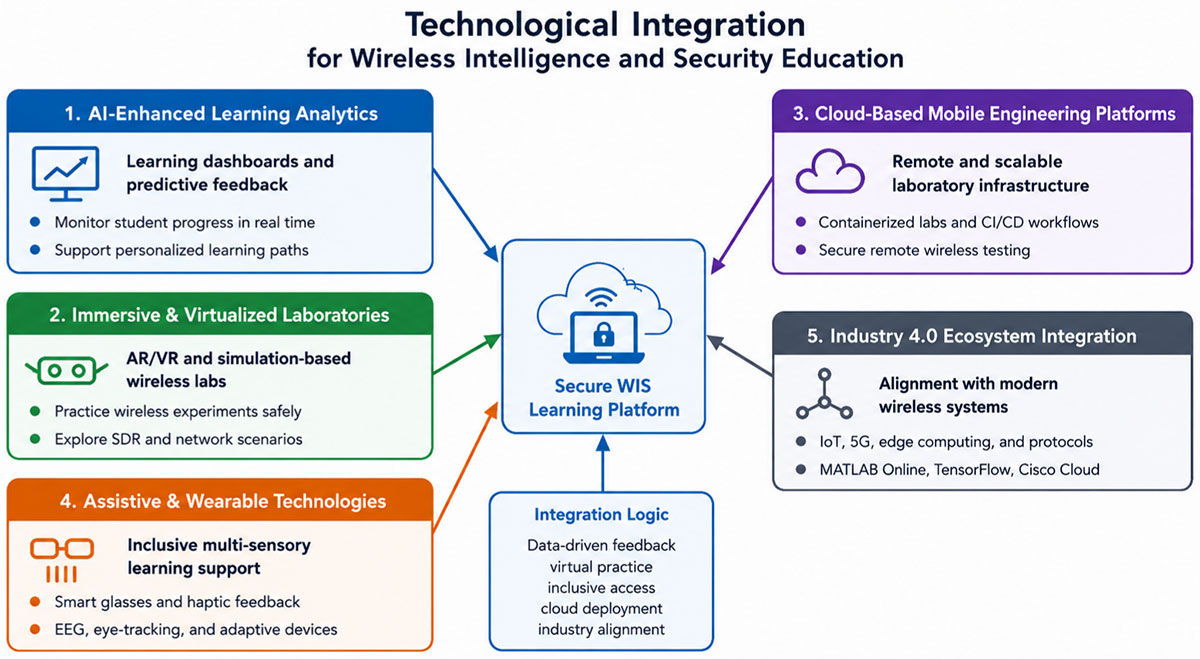
The growing complexity of wireless communication systems and mobile security threats demands a new generation of engineers capable of operating at the intersection of intelligent wireless infrastructure, software-defined radio (SDR), and mobile AI. This paper proposes an intelligent mobile security education platform that integrates AI-driven learning analytics, SDR-based practical interfaces, and cloud-based wireless simulation environments within an Outcome-Based Education (OBE) and Cognitive Load Theory (CLT) framework. The platform transforms passive learners into active creators of wireless security content via Student-Generated Multimedia (SGM), while AI dashboards monitor cognitive readiness and adapt task difficulty in real time. Inclusive design extends platform accessibility through wearable biometric sensors and AR-assisted visualization of 3D wireless signal data. A pilot study was conducted with two student cohorts ($n = 13$ per group) to evaluate the SGM component of the platform within a blended learning delivery model. The active multimedia group achieved a 76.9\% pass rate (10/13) against 23.1\% (3/13) in the traditional control group, with a statistically significant and large effect ($t(24) = 3.28$, $p = 0.003$, Cohen's $d = 1.29$). These results provide preliminary evidence that the platform's intelligent, active-learning approach substantially improves training outcomes for mobile wireless security engineering. Full empirical validation of the AI analytics, AR/VR laboratory, and 5G/IoT edge-computing modules is planned for future work.
Graphical Abstract
Keywords
Data Availability Statement
Funding
Conflicts of Interest
AI Use Statement
Ethical Approval and Consent to Participate
References
- Limniou, M., Sedghi, N., Kumari, D., & Drousiotis, E. (2022). Student engagement, learning environments and the COVID-19 pandemic: A comparison between psychology and engineering undergraduate students in the UK. Education Sciences, 12(10), 671.
[CrossRef] [Google Scholar] - García-Morales, V. J., Garrido-Moreno, A., & Martín-Rojas, R. (2021). The transformation of higher education after the COVID disruption: Emerging challenges in an online learning scenario. Frontiers in psychology, 12, 616059.
[CrossRef] [Google Scholar] - Freeman, S., Eddy, S. L., McDonough, M., Smith, M. K., Okoroafor, N., Jordt, H., & Wenderoth, M. P. (2014). Active learning increases student performance in science, engineering, and mathematics. Proceedings of the national academy of sciences, 111(23), 8410-8415.
[CrossRef] [Google Scholar] - Çeken, B., & Taşkın, N. (2022). Multimedia learning principles in different learning environments: A systematic review. Smart Learning Environments, 9(1), 19.
[CrossRef] [Google Scholar] - Bernard, R. M., Borokhovski, E., Schmid, R. F., Tamim, R. M., & Abrami, P. C. (2014). A meta-analysis of blended learning and technology use in higher education: From the general to the applied. Journal of Computing in Higher Education, 26(1), 87-122.
[CrossRef] [Google Scholar] - Wyglinski, A. M., Orofino, D. P., Ettus, M. N., & Rondeau, T. W. (2016). Revolutionizing software defined radio: case studies in hardware, software, and education. IEEE Communications magazine, 54(1), 68-75.
[CrossRef] [Google Scholar] - Gómez Puente, S. M., Van Eijck, M., & Jochems, W. (2013). A sampled literature review of design-based learning approaches: A search for key characteristics. International Journal of Technology and Design Education, 23(3), 717-732.
[CrossRef] [Google Scholar] - Mayer, R. E. (2021). Evidence-based principles for how to design effective instructional videos. Journal of Applied Research in Memory and Cognition, 10(2), 229. https://psycnet.apa.org/doi/10.1016/j.jarmac.2021.03.007
[Google Scholar] - Mahrishi, M., Ramakrishna, S., Hosseini, S., & Abbas, A. (2025). A systematic literature review of the global trends of outcome-based education (OBE) in higher education with an SDG perspective related to engineering education. Discover Sustainability, 6(1), 620.
[CrossRef] [Google Scholar] - National Academies of Sciences, Engineering, and Medicine. (2025). Transforming undergraduate STEM education: Supporting equitable and effective teaching. The National Academies Press. https://eric.ed.gov/?id=ED674483
[Google Scholar] - Chiu, T. K. (2024). Future research recommendations for transforming higher education with generative AI. Computers and education: Artificial intelligence, 6, 100197.
[CrossRef] [Google Scholar] - Chen, J., Kolmos, A., & Du, X. (2021). Forms of implementation and challenges of PBL in engineering education: a review of literature. European Journal of Engineering Education, 46(1), 90-115.
[CrossRef] [Google Scholar]
Cite This Article
TY  - JOUR
AU  - Haque, A. K. M. Fazlul
AU  - Hridoy, Raihan Ahmed
AU  - Islam, Tasikul
AU  - Akter, Taslima
PY  - 2026
DA  - 2026/08/13
TI  - Simplifying Complex Wireless Intelligence and Security Education: An Outcome-Based Blended Learning Approach for Mobile Engineering
JO  - ICCK Transactions on Mobile and Wireless Intelligence
T2  - ICCK Transactions on Mobile and Wireless Intelligence
JF  - ICCK Transactions on Mobile and Wireless Intelligence
VL  - 2
IS  - 2
SP  - 56
EP  - 67
DO  - 10.62762/TMWI.2026.248090
UR  - https://www.icck.org/article/abs/TMWI.2026.248090
KW  - wireless intelligence and security (WIS)
KW  - mobile security education platform
KW  - AI-driven learning analytics
KW  - software-defined radio (SDR)
KW  - intelligent wireless training systems
KW  - outcome-based education (OBE)
AB  - The growing complexity of wireless communication systems and mobile security threats demands a new generation of engineers capable of operating at the intersection of intelligent wireless infrastructure, software-defined radio (SDR), and mobile AI. This paper proposes an intelligent mobile security education platform that integrates AI-driven learning analytics, SDR-based practical interfaces, and cloud-based wireless simulation environments within an Outcome-Based Education (OBE) and Cognitive Load Theory (CLT) framework. The platform transforms passive learners into active creators of wireless security content via Student-Generated Multimedia (SGM), while AI dashboards monitor cognitive readiness and adapt task difficulty in real time. Inclusive design extends platform accessibility through wearable biometric sensors and AR-assisted visualization of 3D wireless signal data. A pilot study was conducted with two student cohorts ($n = 13$ per group) to evaluate the SGM component of the platform within a blended learning delivery model. The active multimedia group achieved a 76.9\% pass rate (10/13) against 23.1\% (3/13) in the traditional control group, with a statistically significant and large effect ($t(24) = 3.28$, $p = 0.003$, Cohen's $d = 1.29$). These results provide preliminary evidence that the platform's intelligent, active-learning approach substantially improves training outcomes for mobile wireless security engineering. Full empirical validation of the AI analytics, AR/VR laboratory, and 5G/IoT edge-computing modules is planned for future work.
SN  - 3069-0692
PB  - Institute of Central Computation and Knowledge
LA  - English
ER  -
@article{Haque2026Simplifyin,
  author = {A. K. M. Fazlul Haque and Raihan Ahmed Hridoy and Tasikul Islam and Taslima Akter},
  title = {Simplifying Complex Wireless Intelligence and Security Education: An Outcome-Based Blended Learning Approach for Mobile Engineering},
  journal = {ICCK Transactions on Mobile and Wireless Intelligence},
  year = {2026},
  volume = {2},
  number = {2},
  pages = {56-67},
  doi = {10.62762/TMWI.2026.248090},
  url = {https://www.icck.org/article/abs/TMWI.2026.248090},
  abstract = {The growing complexity of wireless communication systems and mobile security threats demands a new generation of engineers capable of operating at the intersection of intelligent wireless infrastructure, software-defined radio (SDR), and mobile AI. This paper proposes an intelligent mobile security education platform that integrates AI-driven learning analytics, SDR-based practical interfaces, and cloud-based wireless simulation environments within an Outcome-Based Education (OBE) and Cognitive Load Theory (CLT) framework. The platform transforms passive learners into active creators of wireless security content via Student-Generated Multimedia (SGM), while AI dashboards monitor cognitive readiness and adapt task difficulty in real time. Inclusive design extends platform accessibility through wearable biometric sensors and AR-assisted visualization of 3D wireless signal data. A pilot study was conducted with two student cohorts (\$n = 13\$ per group) to evaluate the SGM component of the platform within a blended learning delivery model. The active multimedia group achieved a 76.9\\% pass rate (10/13) against 23.1\\% (3/13) in the traditional control group, with a statistically significant and large effect (\$t(24) = 3.28\$, \$p = 0.003\$, Cohen's \$d = 1.29\$). These results provide preliminary evidence that the platform's intelligent, active-learning approach substantially improves training outcomes for mobile wireless security engineering. Full empirical validation of the AI analytics, AR/VR laboratory, and 5G/IoT edge-computing modules is planned for future work.},
  keywords = {wireless intelligence and security (WIS), mobile security education platform, AI-driven learning analytics, software-defined radio (SDR), intelligent wireless training systems, outcome-based education (OBE)},
  issn = {3069-0692},
  publisher = {Institute of Central Computation and Knowledge}
}
Article Metrics
Publisher's Note
ICCK stays neutral with regard to jurisdictional claims in published maps and institutional affiliations.
Rights and Permissions


Portico
