

Performance Analysis of Relay-Based Communication for FANET in 5G and Beyond



Article Information
Abstract
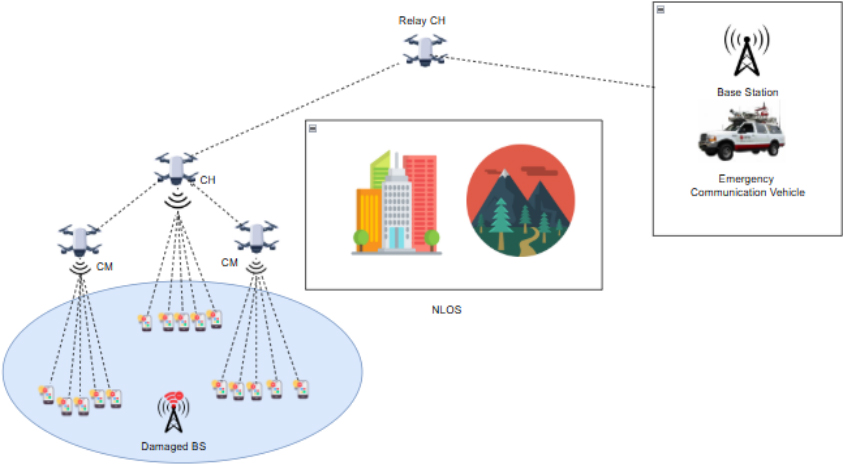
Unmanned aerial vehicles (UAVs) have great potential in 5G and 6G networks due to their communication capabilities, low-cost, and adaptable deployment opportunities. The use of multiple Unmanned Aerial Vehicles (UAV) systems is a more cost-effective and operationally efficient approach compared to using a single UAV system. Compared to a large UAV, flying ad hoc networks (FANETs) with small UAVs have many advantages. This UAV-based architecture typically uses clusters of UAVs, where the UAV acts as a cluster head (CH), collecting information from other UAVs and sending it to the emergency communication vehicle (ECV). Although this model works well in open areas, Non-line-of-sight (NLoS) issues caused by tall buildings, trees, places like hills, or other obstacles significantly damage its performance in urban environments. Due to their closeness to ground users, UAVs operating at low altitudes generally provide stronger signals and faster response times; however, they are more likely to encounter NLoS issues. We propose a reliable communication architecture that uses relay drones between CH and ECV to avoid these limitations. To prevent NLoS obstructions and assure a reliable and high-quality connection, these relay drones are deployed at strategic locations and altitudes. Our model dynamically adjusts altitude and position when obstacles arise to provide connectivity in urban environments, overcoming signal obstructions and improving the coverage. Simulation results show that our proposed architecture provides a reliable and adaptive communication framework in urban disaster situations to significantly improve important network performance metrics such as throughput, path loss, and outage probability under Nakagami-m fading channel and relay supported communication compared to traditional UAV clustering models, this improved model assures continuous information flow during critical search and rescue operations.
Graphical Abstract
Keywords
Data Availability Statement
Funding
Conflicts of Interest
Ethical Approval and Consent to Participate
References
- Saif, A., Dimyati, K., Noordin, K. A., Shah, N. S. M., Abdullah, Q., Mohamad, M., ... & Al-Saman, A. M. (2021). Unmanned aerial vehicle and optimal relay for extending coverage in post-disaster scenarios. arXiv preprint arXiv:2104.06037.
[CrossRef] [Google Scholar] - Shah, A. S. (2022). Architecture of emergency communication systems in disasters through UAVs in 5G and beyond. Drones, 7(1), 25.
[CrossRef] [Google Scholar] - Shah, A. S. (2022, January). A survey from 1G to 5G including the advent of 6G: Architectures, multiple access techniques, and emerging technologies. In 2022 IEEE 12th annual computing and communication workshop and conference (CCWC) (pp. 1117-1123). IEEE.
[CrossRef] [Google Scholar] - Sae, J., Yunas, S. F., & Lempiainen, J. (2016, January). Coverage aspects of temporary LAP network. In 2016 12th annual conference on wireless on-demand network systems and services (WONS) (pp. 1-4). IEEE.
[Google Scholar] - Li, B., Chen, C., Zhang, R., Jiang, H., & Guo, X. (2018, July). The energy-efficient UAV-based BS coverage in air-to-ground communications. In 2018 IEEE 10th sensor array and multichannel signal processing workshop (SAM) (pp. 578-581). IEEE.
[CrossRef] [Google Scholar] - Lohi, C., Shukla, P. K., & Agarwal, R. (2023, July). Challenges and open issues in designing MAC protocols for UAV networks: A review. In 2023 IEEE World Conference on Applied Intelligence and Computing (AIC) (pp. 519-523). IEEE.
[CrossRef] [Google Scholar] - Kumar, P., Darshi, S., & Shailendra, S. (2021). Drone assisted device to device cooperative communication for critical environments. IET Communications, 15(7), 957-972.
[CrossRef] [Google Scholar] - Thomas, A., & Raja, G. (2019). FINDER: A D2D based critical communications framework for disaster management in 5G. Peer-to-Peer Networking and Applications, 12(4), 912-923.
[CrossRef] [Google Scholar] - Willink, T. J., Squires, C. C., Colman, G. W., & Muccio, M. T. (2015). Measurement and characterization of low-altitude air-to-ground MIMO channels. IEEE Transactions on Vehicular Technology, 65(4), 2637-2648.
[CrossRef] [Google Scholar] - Chandran, I., & Vipin, K. (2024). Multi-UAV networks for disaster monitoring: challenges and opportunities from a network perspective. Drone Systems and Applications, 12, 1-28.
[CrossRef] [Google Scholar] - Tao, C., Liu, B., Han, Y., Chen, Q., Ye, J., & Zhong, R. (2024, November). A Method of Relay UAV Deployment for Emergency Communication Scenarios in Disaster Areas. In 2024 China Automation Congress (CAC) (pp. 2831-2836). IEEE.
[CrossRef] [Google Scholar] - Liu, X., Yang, B., Liu, J., Xian, L., Jiang, X., & Taleb, T. (2024). Sum-Rate Maximization for D2D-Enabled UAV Networks With Seamless Coverage Constraint. IEEE Internet of Things Journal.
[CrossRef] [Google Scholar] - Tran, T. N., Nguyen, T. L., Hoang, V. T., & Voznak, M. (2023). Sensor clustering using a K-means algorithm in combination with optimized unmanned aerial vehicle trajectory in wireless sensor networks. Sensors, 23(4), 2345.
[CrossRef] [Google Scholar] - Uddin, S., Shah, A. S., Karabulut, M. A., & Ilhan, H. (2025). Cooperative MAC protocol with Optimal Relay Selection algorithm for UAVs ad hoc Network in Disasters. IEEE Transactions on Vehicular Technology.
[CrossRef] [Google Scholar] - Al-Hourani, A., Kandeepan, S., & Lardner, S. (2014). Optimal LAP altitude for maximum coverage. IEEE wireless communications letters, 3(6), 569-572.
[CrossRef] [Google Scholar] - Dutriez, C., Oubbati, O. S., Gueguen, C., & Rachedi, A. (2024, April). Energy efficiency relaying election mechanism for 5G Internet of Things: A deep reinforcement learning technique. In 2024 IEEE Wireless Communications and Networking Conference (WCNC) (pp. 1-6). IEEE.
[CrossRef] [Google Scholar] - Oubbati, O. S., Badis, H., Rachedi, A., Lakas, A., & Lorenz, P. (2023, January). Multi-UAV assisted network coverage optimization for rescue operations using reinforcement learning. In 2023 IEEE 20th consumer communications & networking conference (CCNC) (pp. 1003-1008). IEEE.
[CrossRef] [Google Scholar] - Al-Hourani, A., Kandeepan, S., & Jamalipour, A. (2014, December). Modeling air-to-ground path loss for low altitude platforms in urban environments. In 2014 IEEE global communications conference (pp. 2898-2904). IEEE.
[CrossRef] [Google Scholar] - Ghosh, S., Bhowmick, A., Roy, S. D., & Kundu, S. (2023). UAV‐assisted multi‐hop D2D relaying for communication in large disaster area. International Journal of Communication Systems, 36(18), e5615.
[CrossRef] [Google Scholar] - Tu, H., Zhu, J., & Zou, Y. (2019, October). Optimal power allocation for minimizing outage probability of UAV relay communications. In 2019 11th International Conference on Wireless Communications and Signal Processing (WCSP) (pp. 1-6). IEEE.
[CrossRef] [Google Scholar] - Abualhaol, I. Y., & Matalgah, M. M. (2011). Performance analysis of cooperative multi‐carrier relay‐based UAV networks over generalized fading channels. International Journal of Communication Systems, 24(8), 1049-1064.
[CrossRef] [Google Scholar]
Cite This Article
TY  - JOUR
AU  - Sultana, Sumaiya
AU  - Karabulut, Muhammet Ali
AU  - Shah, A. F. M. Shahen
PY  - 2025
DA  - 2025/08/05
TI  - Performance Analysis of Relay-Based Communication for FANET in 5G and Beyond
JO  - ICCK Transactions on Mobile and Wireless Intelligence
T2  - ICCK Transactions on Mobile and Wireless Intelligence
JF  - ICCK Transactions on Mobile and Wireless Intelligence
VL  - 1
IS  - 1
SP  - 40
EP  - 47
DO  - 10.62762/TMWI.2025.498166
UR  - https://www.icck.org/article/abs/TMWI.2025.498166
KW  - UAVs
KW  - relay
KW  - low-altitude
KW  - maximized coverage
KW  - 5G
KW  - UAV-based BS
KW  - emergency communication
KW  - FANET
AB  - Unmanned aerial vehicles (UAVs) have great potential in 5G and 6G networks due to their communication capabilities, low-cost, and adaptable deployment opportunities. The use of multiple Unmanned Aerial Vehicles (UAV) systems is a more cost-effective and operationally efficient approach compared to using a single UAV system. Compared to a large UAV, flying ad hoc networks (FANETs) with small UAVs have many advantages. This UAV-based architecture typically uses clusters of UAVs, where the UAV acts as a cluster head (CH), collecting information from other UAVs and sending it to the emergency communication vehicle (ECV). Although this model works well in open areas, Non-line-of-sight (NLoS) issues caused by tall buildings, trees, places like hills, or other obstacles significantly damage its performance in urban environments. Due to their closeness to ground users, UAVs operating at low altitudes generally provide stronger signals and faster response times; however, they are more likely to encounter NLoS issues. We propose a reliable communication architecture that uses relay drones between CH and ECV to avoid these limitations. To prevent NLoS obstructions and assure a reliable and high-quality connection, these relay drones are deployed at strategic locations and altitudes. Our model dynamically adjusts altitude and position when obstacles arise to provide connectivity in urban environments, overcoming signal obstructions and improving the coverage. Simulation results show that our proposed architecture provides a reliable and adaptive communication framework in urban disaster situations to significantly improve important network performance metrics such as throughput, path loss, and outage probability under Nakagami-m fading channel and relay supported communication compared to traditional UAV clustering models, this improved model assures continuous information flow during critical search and rescue operations.
SN  - 3069-0692
PB  - Institute of Central Computation and Knowledge
LA  - English
ER  -
@article{Sultana2025Performanc,
  author = {Sumaiya Sultana and Muhammet Ali Karabulut and A. F. M. Shahen Shah},
  title = {Performance Analysis of Relay-Based Communication for FANET in 5G and Beyond},
  journal = {ICCK Transactions on Mobile and Wireless Intelligence},
  year = {2025},
  volume = {1},
  number = {1},
  pages = {40-47},
  doi = {10.62762/TMWI.2025.498166},
  url = {https://www.icck.org/article/abs/TMWI.2025.498166},
  abstract = {Unmanned aerial vehicles (UAVs) have great potential in 5G and 6G networks due to their communication capabilities, low-cost, and adaptable deployment opportunities. The use of multiple Unmanned Aerial Vehicles (UAV) systems is a more cost-effective and operationally efficient approach compared to using a single UAV system. Compared to a large UAV, flying ad hoc networks (FANETs) with small UAVs have many advantages. This UAV-based architecture typically uses clusters of UAVs, where the UAV acts as a cluster head (CH), collecting information from other UAVs and sending it to the emergency communication vehicle (ECV). Although this model works well in open areas, Non-line-of-sight (NLoS) issues caused by tall buildings, trees, places like hills, or other obstacles significantly damage its performance in urban environments. Due to their closeness to ground users, UAVs operating at low altitudes generally provide stronger signals and faster response times; however, they are more likely to encounter NLoS issues. We propose a reliable communication architecture that uses relay drones between CH and ECV to avoid these limitations. To prevent NLoS obstructions and assure a reliable and high-quality connection, these relay drones are deployed at strategic locations and altitudes. Our model dynamically adjusts altitude and position when obstacles arise to provide connectivity in urban environments, overcoming signal obstructions and improving the coverage. Simulation results show that our proposed architecture provides a reliable and adaptive communication framework in urban disaster situations to significantly improve important network performance metrics such as throughput, path loss, and outage probability under Nakagami-m fading channel and relay supported communication compared to traditional UAV clustering models, this improved model assures continuous information flow during critical search and rescue operations.},
  keywords = {UAVs, relay, low-altitude, maximized coverage, 5G, UAV-based BS, emergency communication, FANET},
  issn = {3069-0692},
  publisher = {Institute of Central Computation and Knowledge}
}
Article Metrics
Publisher's Note
ICCK stays neutral with regard to jurisdictional claims in published maps and institutional affiliations.
Rights and Permissions


Portico
