

An Intelligent and Secure Application for Early Detection of Eye Disease





Article Information
Abstract
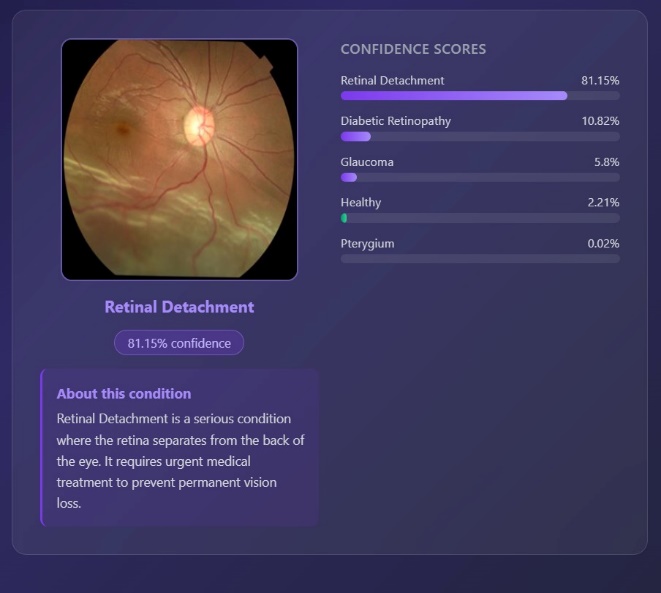
This paper presents a deep learning-based intelligent web application for the early detection of eye diseases using retinal fundus images. The dataset used in this study consists of 4,216 retinal fundus images collected from Kaggle, representing multiple eye disease categories. Multiple deep learning architectures, including CNN, DenseNet, InceptionV3, and ResNet, were evaluated and compared with a proposed modified MobileNetV2 architecture. The proposed architecture enhances the baseline MobileNetV2 by optimizing feature extraction and classification layers for improved performance in multi-class eye disease detection. Experimental results show that the proposed model achieved an overall classification accuracy of 88%, outperforming other evaluated models, including CNN (85.87%), DenseNet (87.19%), InceptionV3 (82.88%), and ResNet (50.67%), while maintaining low computational complexity. To improve transparency and interpretability of the deep learning model, Grad-CAM was integrated to visualize the discriminative regions of fundus images influencing the model’s predictions. The optimized model was deployed within a smart web application using a Flask backend and Streamlit frontend, enabling real-time disease prediction and visual explanation of results. The proposed system demonstrates the effectiveness of lightweight deep learning architectures combined with explainable AI techniques for accessible and reliable web-based ophthalmic diagnostic support systems. The optimized lightweight model was deployed as a mobile-friendly web application using Flask and Streamlit, enabling real-time inference on resource-constrained mobile devices and supporting wireless remote access for ophthalmic screening in underserved areas.
Graphical Abstract
Keywords
Data Availability Statement
Funding
Conflicts of Interest
AI Use Statement
Ethical Approval and Consent to Participate
References
- Tuncer, H. İ., & Altınel, D. (2024, September). Classification of Eye Diseases using Machine Learning with Preprocessing. In 2024 8th International Artificial Intelligence and Data Processing Symposium (IDAP) (pp. 1-7). IEEE.
[CrossRef] [Google Scholar] - Chaudhari, A., Shelke, P., Thombare, P., & Sandbhor, S. (2024, June). Cost-Effective Real-Time Eye Disease Detection and Classification Using Deep Learning Techniques. In 2024 15th International Conference on Computing Communication and Networking Technologies (ICCCNT) (pp. 1-8). IEEE.
[CrossRef] [Google Scholar] - Hameed, A., Kumar, A. A., Thomas, N. K., Mohan, N., & Varghese, R. E. (2024, January). Detection of eye diseases using ML. In AIP Conference Proceedings (Vol. 3059, No. 1, p. 030012). AIP Publishing LLC.
[CrossRef] [Google Scholar] - Giat, M., & Hadi, S. (2024, December). Convolutional Neural Network In Human Eye Disease Classification. In 2024 International Conference on Information Technology Systems and Innovation (ICITSI) (pp. 348-353). IEEE.
[CrossRef] [Google Scholar] - Dubey, S., & Dixit, M. (2023). Recent developments on computer aided systems for diagnosis of diabetic retinopathy: a review. Multimedia Tools and Applications, 82(10), 14471-14525.
[CrossRef] [Google Scholar] - Choudhary, A., Ahlawat, S., Urooj, S., Pathak, N., Lay-Ekuakille, A., & Sharma, N. (2023, January). A deep learning-based framework for retinal disease classification. In Healthcare (Vol. 11, No. 2, p. 212). MDPI.
[CrossRef] [Google Scholar] - Selvaraju, R. R., Cogswell, M., Das, A., Vedantam, R., Parikh, D., & Batra, D. (2017, October). Grad-CAM: Visual Explanations from Deep Networks via Gradient-Based Localization. In 2017 IEEE International Conference on Computer Vision (ICCV) (pp. 618-626). IEEE.
[CrossRef] [Google Scholar] - Chattopadhay, A., Sarkar, A., Howlader, P., & Balasubramanian, V. N. (2018, March). Grad-cam++: Generalized gradient-based visual explanations for deep convolutional networks. In 2018 IEEE winter conference on applications of computer vision (WACV) (pp. 839-847). IEEE.
[CrossRef] [Google Scholar] - Guo, Q., Chen, S., Xie, X., Ma, L., Hu, Q., Liu, H., ... & Li, X. (2019, November). An empirical study towards characterizing deep learning development and deployment across different frameworks and platforms. In 2019 34th IEEE/ACM International Conference on Automated Software Engineering (ASE) (pp. 810-822). IEEE.
[CrossRef] [Google Scholar] - Kazi, K. S. (2024). Computer-aided diagnosis in ophthalmology: A technical review of deep learning applications. Transformative Approaches to Patient Literacy and Healthcare Innovation, 112-135.
[CrossRef] [Google Scholar] - Chowdary, M. N., Sankeerth, B., Chowdary, C. K., & Gupta, M. (2022, August). Accelerating the machine learning model deployment using mlops. In Journal of Physics: Conference Series (Vol. 2327, No. 1, p. 012027). IOP Publishing.
[CrossRef] [Google Scholar] - Jaouhari, M., El Harrak, C., Bentayeb, F., & Elmerabet, Y. (2026). Pilot Evaluation of a Web Application for Amblyopia Risk Screening Integrating Parent-Reported Factors with AI-Assisted Strabismus Detection. The British and Irish Orthoptic Journal, 22(1), 57.
[CrossRef] [Google Scholar] - Chen, W., Li, R., Yu, Q., Xu, A., Feng, Y., Wang, R., ... & Lin, H. (2023). Early detection of visual impairment in young children using a smartphone-based deep learning system. Nature medicine, 29(2), 493-503.
[CrossRef] [Google Scholar] - He, K., Zhang, X., Ren, S., & Sun, J. (2016, June). Deep Residual Learning for Image Recognition. In 2016 IEEE Conference on Computer Vision and Pattern Recognition (CVPR) (pp. 770-778). IEEE.
[CrossRef] [Google Scholar] - Tey, K. Y., Cheong, E. Z. K., & Ang, M. (2024). Potential applications of artificial intelligence in image analysis in cornea diseases: a review. Eye and Vision, 11(1), 10.
[CrossRef] [Google Scholar] - Li, J., Guan, Z., Wang, J., Cheung, C. Y., Zheng, Y., Lim, L. L., ... & Wong, T. Y. (2024). Integrated image-based deep learning and language models for primary diabetes care. Nature medicine, 30(10), 2886-2896.
[CrossRef] [Google Scholar] - Kumar, K. S., & Singh, N. P. (2023). Retinal disease prediction through blood vessel segmentation and classification using ensemble-based deep learning approaches. Neural Computing and Applications, 35(17), 12495-12511.
[CrossRef] [Google Scholar] - Sandler, M., Howard, A., Zhu, M., Zhmoginov, A., & Chen, L. C. (2018, June). MobileNetV2: Inverted Residuals and Linear Bottlenecks. In 2018 IEEE/CVF Conference on Computer Vision and Pattern Recognition (pp. 4510-4520). IEEE.
[CrossRef] [Google Scholar] - Mayya, V., S, S. K., Kulkarni, U., Surya, D. K., & Acharya, U. R. (2023). An empirical study of preprocessing techniques with convolutional neural networks for accurate detection of chronic ocular diseases using fundus images. Applied Intelligence, 53(2), 1548-1566.
[CrossRef] [Google Scholar] - Lalithadevi, B., & Krishnaveni, S. (2024). Diabetic retinopathy detection and severity classification using optimized deep learning with explainable AI technique. Multimedia Tools and Applications, 83(42), 89949-90013.
[CrossRef] [Google Scholar]
Cite This Article
TY  - JOUR
AU  - Haque, A. K. M. Fazlul
AU  - Hridoy, Raihan Ahmed
AU  - Hossain, Meherab
AU  - Hasan, Nazia
AU  - Hridoy, Afzal Hossain
AU  - Akter, Taslima
PY  - 2026
DA  - 2026/04/09
TI  - An Intelligent and Secure Application for Early Detection of Eye Disease
JO  - ICCK Transactions on Mobile and Wireless Intelligence
T2  - ICCK Transactions on Mobile and Wireless Intelligence
JF  - ICCK Transactions on Mobile and Wireless Intelligence
VL  - 2
IS  - 1
SP  - 44
EP  - 55
DO  - 10.62762/TMWI.2026.590606
UR  - https://www.icck.org/article/abs/TMWI.2026.590606
KW  - eye disease detection
KW  - mobile intelligence
KW  - convolutional neural network
KW  - modified mobileNet
KW  - deep learning models
KW  - medical image analysis
KW  - predictive analytics
KW  - grad-cam
AB  - This paper presents a deep learning-based intelligent web application for the early detection of eye diseases using retinal fundus images. The dataset used in this study consists of 4,216 retinal fundus images collected from Kaggle, representing multiple eye disease categories. Multiple deep learning architectures, including CNN, DenseNet, InceptionV3, and ResNet, were evaluated and compared with a proposed modified MobileNetV2 architecture. The proposed architecture enhances the baseline MobileNetV2 by optimizing feature extraction and classification layers for improved performance in multi-class eye disease detection. Experimental results show that the proposed model achieved an overall classification accuracy of 88%, outperforming other evaluated models, including CNN (85.87%), DenseNet (87.19%), InceptionV3 (82.88%), and ResNet (50.67%), while maintaining low computational complexity. To improve transparency and interpretability of the deep learning model, Grad-CAM was integrated to visualize the discriminative regions of fundus images influencing the model’s predictions. The optimized model was deployed within a smart web application using a Flask backend and Streamlit frontend, enabling real-time disease prediction and visual explanation of results. The proposed system demonstrates the effectiveness of lightweight deep learning architectures combined with explainable AI techniques for accessible and reliable web-based ophthalmic diagnostic support systems. The optimized lightweight model was deployed as a mobile-friendly web application using Flask and Streamlit, enabling real-time inference on resource-constrained mobile devices and supporting wireless remote access for ophthalmic screening in underserved areas.
SN  - 3069-0692
PB  - Institute of Central Computation and Knowledge
LA  - English
ER  -
@article{Haque2026An,
  author = {A. K. M. Fazlul Haque and Raihan Ahmed Hridoy and Meherab Hossain and Nazia Hasan and Afzal Hossain Hridoy and Taslima Akter},
  title = {An Intelligent and Secure Application for Early Detection of Eye Disease},
  journal = {ICCK Transactions on Mobile and Wireless Intelligence},
  year = {2026},
  volume = {2},
  number = {1},
  pages = {44-55},
  doi = {10.62762/TMWI.2026.590606},
  url = {https://www.icck.org/article/abs/TMWI.2026.590606},
  abstract = {This paper presents a deep learning-based intelligent web application for the early detection of eye diseases using retinal fundus images. The dataset used in this study consists of 4,216 retinal fundus images collected from Kaggle, representing multiple eye disease categories. Multiple deep learning architectures, including CNN, DenseNet, InceptionV3, and ResNet, were evaluated and compared with a proposed modified MobileNetV2 architecture. The proposed architecture enhances the baseline MobileNetV2 by optimizing feature extraction and classification layers for improved performance in multi-class eye disease detection. Experimental results show that the proposed model achieved an overall classification accuracy of 88\%, outperforming other evaluated models, including CNN (85.87\%), DenseNet (87.19\%), InceptionV3 (82.88\%), and ResNet (50.67\%), while maintaining low computational complexity. To improve transparency and interpretability of the deep learning model, Grad-CAM was integrated to visualize the discriminative regions of fundus images influencing the model’s predictions. The optimized model was deployed within a smart web application using a Flask backend and Streamlit frontend, enabling real-time disease prediction and visual explanation of results. The proposed system demonstrates the effectiveness of lightweight deep learning architectures combined with explainable AI techniques for accessible and reliable web-based ophthalmic diagnostic support systems. The optimized lightweight model was deployed as a mobile-friendly web application using Flask and Streamlit, enabling real-time inference on resource-constrained mobile devices and supporting wireless remote access for ophthalmic screening in underserved areas.},
  keywords = {eye disease detection, mobile intelligence, convolutional neural network, modified mobileNet, deep learning models, medical image analysis, predictive analytics, grad-cam},
  issn = {3069-0692},
  publisher = {Institute of Central Computation and Knowledge}
}
Article Metrics
Publisher's Note
ICCK stays neutral with regard to jurisdictional claims in published maps and institutional affiliations.
Rights and Permissions


Portico
