

Gravity Modulation Analysis of Heat Transfer and Magnetic Boundary Layer of MHD Fluid Along Vertical Plate with Variable Viscosity and Porous Medium Effects




Article Information
Abstract
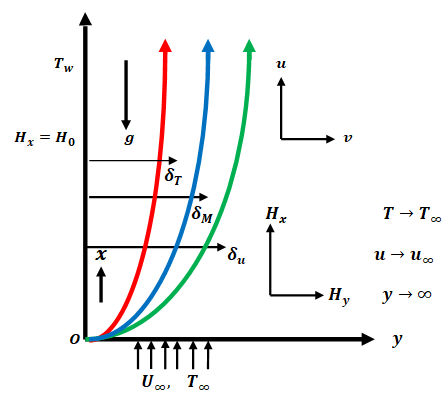
The magnetic fluid flow through vertical surface plays a significant impact in engineering and industrial processes of insulating materials and heat exchangers. The main theme of this mechanism is to obtain the heat and magnetic flux of viscous fluid motion along the symmetrical magnetized surface with variable viscosity, porous medium and magneto-hydrodynamic effects. The goal of present numerical research is to find the stability in thermal management of vertical magnetic plates in manufacturing processes. The mathematical analysis is performed by using stream functions and similarity variables for smooth coding in MATLAB program. The convenient form of present model is derived by using the combined relation of Keller box and Newton Raphson approach under defined boundary values along the magnetized plate. The fluid velocity, heat transfer and magnetic flux are the main findings of this wok. It is depicted that fluid velocity and temperature profile enhances for small viscosity and maximum reduced gravity. It is exhibited that temperature profile enhances as Prandtl number and porous medium enhances. It is found that heat transport and magnetic flux enhances as reduced gravity enhances. It is also noticed that skin friction and magnetic flux performs opposite behavior for maximum values of porous medium.
Graphical Abstract
Keywords
Data Availability Statement
Funding
Conflicts of Interest
Ethical Approval and Consent to Participate
References
- Kay, A., Kuiken, H. K., & Merkin, J. H. (1995). Boundary-layer analysis of the thermal bar. Journal of fluid mechanics, 303, 253-278.
[CrossRef] [Google Scholar] - Hazarika, G. C., & Ch, U. S. G. (2012). Effects of variable viscosity and thermal conductivity on MHD flow past a vertical plate. Matematicas: Ensenanza Universitaria, 20(2), 45-54.
[Google Scholar] - Srinivasacharya, D., Mallikarjuna, B., & Bhuvanavijaya, R. (2016). Effects of thermophoresis and variable properties on mixed convection along a vertical wavy surface in a fluid saturated porous medium. Alexandria Engineering Journal, 55(2), 1243-1253.
[CrossRef] [Google Scholar] - Gbadeyan, J. A., Titiloye, E. O., & Adeosun, A. T. (2020). Effect of variable thermal conductivity and viscosity on Casson nanofluid flow with convective heating and velocity slip. Heliyon, 6(1).
[CrossRef] [Google Scholar] - Chin, K. E., Nazar, R., Arifin, N. M., & Pop, I. (2007). Effect of variable viscosity on mixed convection boundary layer flow over a vertical surface embedded in a porous medium. International Communications in Heat and Mass Transfer, 34(4), 464-473.
[CrossRef] [Google Scholar] - Mahmoud, M. A. A. (2013). Effects of chemical reaction and heat generation on double-diffusive natural convection along a non-isothermal vertical cone in non-Newtonian fluid saturated porous medium with variable viscosity and thermal radiation. Latin American applied research, 43(2), 107-112.
[Google Scholar] - Malik, M. Y., Jamil, H., Salahuddin, T., Bilal, S., Rehman, K. U., & Mustafa, Z. (2016). Mixed convection dissipative viscous fluid flow over a rotating cone by way of variable viscosity and thermal conductivity. Results in physics, 6, 1126-1135.
[CrossRef] [Google Scholar] - Elaiw, A. M., Bakr, A. A., & Ibrahim, F. S. (2012). Effect of variable viscosity on vortex instability of non-Darcy free convection boundary layer flow adjacent to a non-isothermal horizontal surface in a porous medium. Boundary Value Problems, 2012(1), 26.
[CrossRef] [Google Scholar] - Hazarika, G. C., & Konch, J. (2014). Effects of Variable viscosity and thermal conductivity on MHD free convective flow along a vertical porous plate with viscous dissipation. International Journal of Mathematics Trends and Technology-IJMTT, 15.
[CrossRef] [Google Scholar] - Lin, C. R., & Chen, C. O. K. (1993). Free convection flow from a vertical isothermal cone with temperature-dependent viscosity. Polymer-Plastics Technology and Engineering, 32(4), 277-287.
[CrossRef] [Google Scholar] - Kishan, N., & Amrutha, P. (2015). Variable viscosity effects on mixed convection heat and mass transfer along a semi-infinite vertical plate in the presence of chemical reaction and viscous dissipation. International Journal of Engineering, Science and Technology, 7(2), 27-42.
[CrossRef] [Google Scholar] - Pullepu, B., Sambath, P., Selva Rani, M., Chamkha, A. J., & Viswanathan, K. K. (2015). Numerical solutions of free convective flow from a vertical cone with mass transfer under the influence of chemical reaction and heat generation/absorption in the presence of UWT/UWC. Journal of Applied Fluid Mechanics, 9(1), 343-356.
[CrossRef] [Google Scholar] - Abbas, A., & Ashraf, M. (2020). Combined effects of variable viscosity and thermophoretic transportation on mixed convection flow around the surface of a sphere. Thermal Science, 24(6 Part B), 4089-4101.
[CrossRef] [Google Scholar] - Umavathi, J. C., Chamkha, A. J., & Mohiuddin, S. (2016). Combined effect of variable viscosity and thermal conductivity on free convection flow of a viscous fluid in a vertical channel. International Journal of Numerical Methods for Heat & Fluid Flow, 26(1), 18-39.
[CrossRef] [Google Scholar] - Pullepu, B., Sambath, P., & Viswanathan, K. K. (2014). Effects of chemical reactions on unsteady free convective and mass transfer flow from a vertical cone with heat generation/absorption in the presence of VWT/VWC. Mathematical Problems in Engineering, 2014(1), 849570.
[CrossRef] [Google Scholar] - Palani, G., Lalith Kumar, E. J., & Kim, K. Y. (2016). Free convection effects on a vertical cone with variable viscosity and thermal conductivity. Journal of Applied Mechanics and Technical Physics, 57(3), 473-482.
[CrossRef] [Google Scholar] - Reddy, M. G., Dinesh, P. A., & Sandeep, N. (2017, November). Effects of variable viscosity and porosity of fluid, Soret and Dufour mixed double diffusive convective flow over an accelerating surface. In IOP conference series: materials science and engineering (Vol. 263, No. 6, p. 062012). IOP Publishing.
[CrossRef] [Google Scholar] - Awasthi, B. (2018). Effects of heat and mass flux on MHD free convection flow through a porous medium with radiation and first order chemical reaction. International Journal of Applied Mechanics and Engineering, 23(4).
[CrossRef] [Google Scholar] - Srinivasacharya, D., Mallikarjuna, B., & Bhuvanavijaya, R. (2015). Radiation effect on mixed convection over a vertical wavy surface in Darcy porous medium with variable properties. Journal of Applied Science and Engineering, 18(3), 265-274.
[CrossRef] [Google Scholar] - Sehra, Haq, S. U., Shah, S. I. A., Nisar, K. S., Jan, S. U., & Khan, I. (2021). Convection heat mass transfer and MHD flow over a vertical plate with chemical reaction, arbitrary shear stress and exponential heating. Scientific reports, 11(1), 4265.
[CrossRef] [Google Scholar] - Ganji, D. D., Mahboobtosi, M., Jalili, B., & Jalili, P. (2024). Heat transfer analysis of magnetized fluid flow through a vertical channel with thin porous surfaces: Python approach. Case Studies in Thermal Engineering, 60, 104643.
[CrossRef] [Google Scholar] - Niranjana, N., Vidhya, M., Govindarajan, A., Siva, E. P., & Priyadarshini, E. (2019, June). Mass transfer effects on flow over a vertical plate oscillating in porous plate in the presence of transverse magnetic field. In AIP Conference Proceedings (Vol. 2112, No. 1, p. 020106). AIP Publishing LLC.
[CrossRef] [Google Scholar] - Cheng, C. Y. (1999). Effect of a magnetic field on heat and mass transfer by natural convection from vertical surfaces in porous media-an integral approach. International communications in heat and mass transfer, 26(7), 935-943.
[CrossRef] [Google Scholar] - Onanuga, O. K., Chendo, M. A. C., & Erusiafe, N. E. (2018). Thermal Radiation of Hydromagnetic Stagnation Gravity-Driven Flow through a Porous Confined Cylinder with Non-Uniform Heat Source. Open Journal of Fluid Dynamics, 8(4), 361-377.
[CrossRef] [Google Scholar] - Srinivasulu, T., & Goud, B. S. (2021). Effect of inclined magnetic field on flow, heat and mass transfer of Williamson nanofluid over a stretching sheet. Case Studies in Thermal Engineering, 23, 100819.
[CrossRef] [Google Scholar] - Bayones, F. S., Abd-Alla, A. M., & Thabet, E. N. (2021). Effect of heat and mass transfer and magnetic field on peristaltic flow of a fractional Maxwell fluid in a tube. Complexity, 2021(1), 9911820.
[CrossRef] [Google Scholar] - Lotto, M. A., Johnson, K. M., Nie, C. W., & Klaus, D. M. (2017). The impact of reduced gravity on free convective heat transfer from a finite, flat, vertical plate. Microgravity Science and Technology, 29(5), 371-379.
[CrossRef] [Google Scholar] - Ostrach, S. (1982). Convection phenomena at reduced gravity of importance in space processing of materials. Bulletin of Materials Science, 4(2), 109-123.
[CrossRef] [Google Scholar] - Awwad, F. A., Ismail, E. A., & Gul, T. (2023). Heat and mass transfer gravity driven fluid flow over a symmetrically-vertical plane through neural networks. Symmetry, 15(6), 1288.
[CrossRef] [Google Scholar] - Maranna, T., Sneha, K. N., Mahabaleshwar, U. S., Sarris, I. E., & Karakasidis, T. E. (2022). An effect of radiation and MHD Newtonian fluid over a stretching/shrinking sheet with CNTs and mass transpiration. Applied Sciences, 12(11), 5466.
[CrossRef] [Google Scholar] - Mabood, F., Fatunmbi, E. O., Benos, L., & Sarris, I. E. (2022). Entropy generation in the magnetohydrodynamic Jeffrey nanofluid flow over a stretching sheet with wide range of engineering application parameters. International Journal of Applied and Computational Mathematics, 8(3), 98.
[CrossRef] [Google Scholar] - Hamad, M. A. A., & Ferdows, M. (2012). Similarity solution of boundary layer stagnation-point flow towards a heated porous stretching sheet saturated with a nanofluid with heat absorption/generation and suction/blowing: a Lie group analysis. Communications in Nonlinear Science and Numerical Simulation, 17(1), 132-140.
[CrossRef] [Google Scholar] - Alsaedi, A., Awais, M., & Hayat, T. (2012). Effects of heat generation/absorption on stagnation point flow of nanofluid over a surface with convective boundary conditions. Communications in Nonlinear Science and Numerical Simulation, 17(11), 4210-4223.
[CrossRef] [Google Scholar] - Awais, M., Hayat, T., Ali, A., & Irum, S. (2016). Velocity, thermal and concentration slip effects on a magneto-hydrodynamic nanofluid flow. Alexandria Engineering Journal, 55(3), 2107-2114.
[CrossRef] [Google Scholar] - Arshad, M., Alharbi, F. M., Hassan, A., Haider, Q., Alhushaybari, A., Eldin, S. M., ... & Galal, A. M. (2023). Effect of inclined magnetic field on radiative heat and mass transfer in chemically reactive hybrid nanofluid flow due to dual stretching. Scientific Reports, 13(1), 7828.
[CrossRef] [Google Scholar] - Wang, C., Rong, D., Zhang, W., Gong, B., & Wu, J. (2023). The flow and heat transfer performances of magnetic nanofluid in a duct in presence of magnetic fields with different direction. Journal of Mechanical Science and Technology, 37(9), 4899-4909.
[CrossRef] [Google Scholar] - Abdelhafez, M. A., Abd-Alla, A. M., Abo-Dahab, S. M., & Elmhedy, Y. (2023). Influence of an inclined magnetic field and heat and mass transfer on the peristaltic flow of blood in an asymmetric channel. Scientific Reports, 13(1), 5749.
[CrossRef] [Google Scholar]
Cited By (3)
-
Haimin Wang, Yifeng Xu, Zhiyuan Ji, Chunjing Lin. Experimental investigation of immersion cooling using insulating oil and forced convection heat transfer in high-energy-density battery modules.
Journal of Thermal Analysis and Calorimetry, 2026 , 151 (1).
[CrossRef] -
John O. Olabode, Mojeed T. Akolade. Prediction and computational analysis of gravity-driven multicomponent fluid flow along a convectively heated surface.
Thermal Advances, 2026 , 7 .
[CrossRef] -
G. P. Bhumika, K. J. Gowtham, B. J. Gireesha. Fibonacci wavelet method for temperature distribution of trihybrid nanofluid in FGM conical pin fin with internal heat generation.
International Journal of Mechanics and Materials in Design, 2026 , 22 (1).
[CrossRef]
Cite This Article
TY  - JOUR
AU  - Ullah, Zia
AU  - Abbas, Amir
AU  - Tariq, Uzma
AU  - Haq, Malik Izhar Ul
AU  - Kaynat, Alishba
AU  - Bibi, Anila
AU  - Soha, Tehreem
AU  - Iqbal, M Waheed
AU  - Ashraf, Muhammad
PY  - 2025
DA  - 2025/08/15
TI  - Gravity Modulation Analysis of Heat Transfer and Magnetic Boundary Layer of MHD Fluid Along Vertical Plate with Variable Viscosity and Porous Medium Effects
JO  - Computational Environmental Heat Transfer
T2  - Computational Environmental Heat Transfer
JF  - Computational Environmental Heat Transfer
VL  - 1
IS  - 2
SP  - 51
EP  - 64
DO  - 10.62762/CEHT.2025.812351
UR  - https://www.icck.org/article/abs/CEHT.2025.812351
KW  - magnetohydrodynamic
KW  - reduced gravity
KW  - variable viscosity
KW  - porous medium
KW  - magnetic flux
KW  - heat transport
AB  - The magnetic fluid flow through vertical surface plays a significant impact in engineering and industrial processes of insulating materials and heat exchangers. The main theme of this mechanism is to obtain the heat and magnetic flux of viscous fluid motion along the symmetrical magnetized surface with variable viscosity, porous medium and magneto-hydrodynamic effects. The goal of present numerical research is to find the stability in thermal management of vertical magnetic plates in manufacturing processes. The mathematical analysis is performed by using stream functions and similarity variables for smooth coding in MATLAB program. The convenient form of present model is derived by using the combined relation of Keller box and Newton Raphson approach under defined boundary values along the magnetized plate. The fluid velocity, heat transfer and magnetic flux are the main findings of this wok. It is depicted that fluid velocity and temperature profile enhances for small viscosity and maximum reduced gravity. It is exhibited that temperature profile enhances as Prandtl number and porous medium enhances. It is found that heat transport and magnetic flux enhances as reduced gravity enhances. It is also noticed that skin friction and magnetic flux performs opposite behavior for maximum values of porous medium.
SN  - 3068-5486
PB  - Institute of Central Computation and Knowledge
LA  - English
ER  -
@article{Ullah2025Gravity,
  author = {Zia Ullah and Amir Abbas and Uzma Tariq and Malik Izhar Ul Haq and Alishba Kaynat and Anila Bibi and Tehreem Soha and M Waheed Iqbal and Muhammad Ashraf},
  title = {Gravity Modulation Analysis of Heat Transfer and Magnetic Boundary Layer of MHD Fluid Along Vertical Plate with Variable Viscosity and Porous Medium Effects},
  journal = {Computational Environmental Heat Transfer},
  year = {2025},
  volume = {1},
  number = {2},
  pages = {51-64},
  doi = {10.62762/CEHT.2025.812351},
  url = {https://www.icck.org/article/abs/CEHT.2025.812351},
  abstract = {The magnetic fluid flow through vertical surface plays a significant impact in engineering and industrial processes of insulating materials and heat exchangers. The main theme of this mechanism is to obtain the heat and magnetic flux of viscous fluid motion along the symmetrical magnetized surface with variable viscosity, porous medium and magneto-hydrodynamic effects. The goal of present numerical research is to find the stability in thermal management of vertical magnetic plates in manufacturing processes. The mathematical analysis is performed by using stream functions and similarity variables for smooth coding in MATLAB program. The convenient form of present model is derived by using the combined relation of Keller box and Newton Raphson approach under defined boundary values along the magnetized plate. The fluid velocity, heat transfer and magnetic flux are the main findings of this wok. It is depicted that fluid velocity and temperature profile enhances for small viscosity and maximum reduced gravity. It is exhibited that temperature profile enhances as Prandtl number and porous medium enhances. It is found that heat transport and magnetic flux enhances as reduced gravity enhances. It is also noticed that skin friction and magnetic flux performs opposite behavior for maximum values of porous medium.},
  keywords = {magnetohydrodynamic, reduced gravity, variable viscosity, porous medium, magnetic flux, heat transport},
  issn = {3068-5486},
  publisher = {Institute of Central Computation and Knowledge}
}
Article Metrics
Publisher's Note
ICCK stays neutral with regard to jurisdictional claims in published maps and institutional affiliations.
Rights and Permissions
 Copyright © 2025 by the Author(s). Published by Institute of Central Computation and Knowledge. This article is an open access article distributed under the terms and conditions of the Creative Commons Attribution (CC BY) license (https://creativecommons.org/licenses/by/4.0/), which permits use, sharing, adaptation, distribution and reproduction in any medium or format, as long as you give appropriate credit to the original author(s) and the source, provide a link to the Creative Commons licence, and indicate if changes were made.


Portico
