

Calculation of Solar Position As Observed from Earth for Some Selected Cities in the Northern Hemisphere



Article Information
Abstract
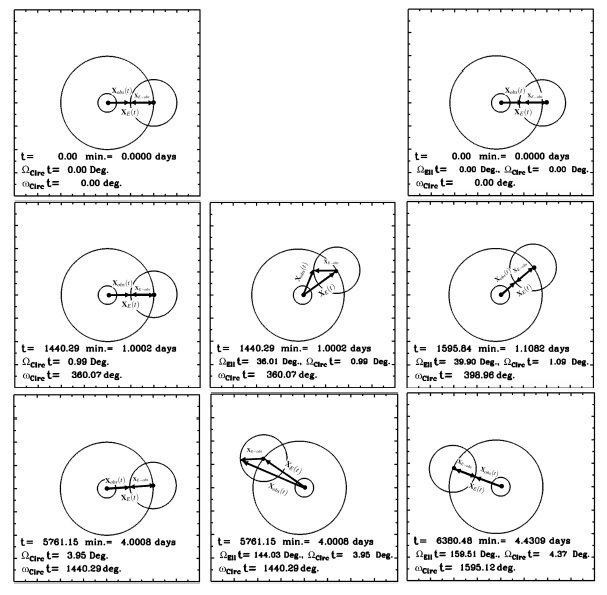
In our previous companion papers “On the elliptical orbit of the Earth and the position of the Sun in the sky: an engineering approach,” and “Calculation of solar trajectory in the sky and the solar analemma as observed from the earth,” published in The NUCLEUS, we presented the computational methodology for solar trajectory in the sky and solar analemmas (as observed from the earth surface) for New York city. In this paper, the methodology has been further elaborated and the results for solar position, as observed from earth, in the holy city of Mecca, Islamabad and Mexico city, have been presented. Orbital trajectory of the real earth, and that of an imaginary earth, as assumed in simple (clock time) calculations, are explained. This information is important for calculation of atmospheric temperatures and green energy applications. The position vector of an observer that rotates with the earth has been employed for observing the solar position at certain time of the day. A Cartesian coordinate system, whose origin is located at the center of the earth and subsequently transformed to a new system that rotates with the earth, has been used. The solar elevation angle and the solar azimuth angle are obtained by performing further transformations of the coordinate system. This later transformation was elaborated in the companion papers, mentioned above. The results obtained during this work depict several interesting features of the analemmas derived from solar position calculations for the whole year, and its dependence on the coordinates (latitude and longitude) of the observer on earth. It was evident from the results that the shapes of analemmas are quite similar for all locations. However, the abscissa and ordinates values vary significantly, corresponding to the latitude and longitude of the observer on earth.
Graphical Abstract
Keywords
Data Availability Statement
Funding
Conflicts of Interest
Ethical Approval and Consent to Participate
References
- Analemma. (2022). Wikipedia, the free encyclopedia. Retrieved from https://en.wikipedia.org/wiki/Analemma (accessed on May 31, 2025).
[Google Scholar] - BLATEYRON, F. (2020). The analemmatic sundial. Shadows Pro - Create your sundial. Retrieved from https://www.shadowspro.com/en/analemmatic-sundial.html (accessed on May 31, 2025).
[Google Scholar] - Bull, H. (2013). The Analemma Dilemma: Solving visualization issues in astronomy using 3D graphics. PRISM, 5(1).
[Google Scholar] - Ihtirozun, M., & Suraya, K. (2021). Correlation of analemma’s position towards the beginning of Maghrib prayer. Al-Hilal: Journal of Islamic Astronomy, 3(1).
[Google Scholar] - Avila, R., & Raza, S. (2024). On the elliptical orbit of the earth and the position of the sun in the sky: An engineering approach. The NUCLEUS, 61(1), 10–15.
[Google Scholar] - Avila, R., & Raza, S. (2024). Calculation of solar trajectory in the sky and the solar analemma as observed from the earth. The NUCLEUS, 61(1), 22–30.
[Google Scholar] - Junior, L. S. A. (2015). Paradoxical variation of the solar day related to Kepler/Newton system. Journal of Aeronautics & Aerospace Engineering, 4(2), 145–157.
[Google Scholar] - Gangui, A., Lastra, C., & Karaseur, F. (2018). On times and shadows: The observational analemma. The Physics Teacher, 56, 367–369.
[CrossRef] [Google Scholar] - Reda, I., & Andreas, A. (2008). Solar position algorithms (PSA) for solar radiation applications. Technical Report NREL/TP-560-34302. National Renewable Energy Laboratory, Golden, Colorado, USA.
[Google Scholar] - Jenkins, A. (2013). The Sun’s position in the sky. European Journal of Physics, 34(3), 633–652.
[CrossRef] [Google Scholar] - Blanco-Muriel, M., Alarcón-Padilla, D. C., López-Moratalla, T., & Lara-Coira, M. (2001). Computing the solar vector. Solar energy, 70(5), 431-441.
[CrossRef] [Google Scholar] - National Oceanic and Atmospheric Administration (NOAA), US Department of Commerce. NOAA Solar Calculator. Retrieved from http://www.esrl.noaa.gov/gmd/grad/solcalc/ (accessed on May 31, 2025).
[Google Scholar]
Cite This Article
TY  - JOUR
AU  - Avila, Ruben
AU  - Syed, Shoaib Raza
PY  - 2025
DA  - 2025/05/31
TI  - Calculation of Solar Position As Observed from Earth for Some Selected Cities in the Northern Hemisphere
JO  - Computational Environmental Heat Transfer
T2  - Computational Environmental Heat Transfer
JF  - Computational Environmental Heat Transfer
VL  - 1
IS  - 1
SP  - 19
EP  - 26
DO  - 10.62762/CEHT.2025.325632
UR  - https://www.icck.org/article/abs/CEHT.2025.325632
KW  - solar position
KW  - analemma
KW  - declination angle
KW  - azimuth angle
KW  - zenith angle
AB  - In our previous companion papers “On the elliptical orbit of the Earth and the position of the Sun in the sky: an engineering approach,” and “Calculation of solar trajectory in the sky and the solar analemma as observed from the earth,” published in The NUCLEUS, we presented the computational methodology for solar trajectory in the sky and solar analemmas (as observed from the earth surface) for New York city. In this paper, the methodology has been further elaborated and the results for solar position, as observed from earth, in the holy city of Mecca, Islamabad and Mexico city, have been presented. Orbital trajectory of the real earth, and that of an imaginary earth, as assumed in simple (clock time) calculations, are explained. This information is important for calculation of atmospheric temperatures and green energy applications. The position vector of an observer that rotates with the earth has been employed for observing the solar position at certain time of the day. A Cartesian coordinate system, whose origin is located at the center of the earth and subsequently transformed to a new system that rotates with the earth, has been used. The solar elevation angle and the solar azimuth angle are obtained by performing further transformations of the coordinate system. This later transformation was elaborated in the companion papers, mentioned above. The results obtained during this work depict several interesting features of the analemmas derived from solar position calculations for the whole year, and its dependence on the coordinates (latitude and longitude) of the observer on earth. It was evident from the results that the shapes of analemmas are quite similar for all locations. However, the abscissa and ordinates values vary significantly, corresponding to the latitude and longitude of the observer on earth.
SN  - 3068-5486
PB  - Institute of Central Computation and Knowledge
LA  - English
ER  -
@article{Avila2025Calculatio,
  author = {Ruben Avila and Shoaib Raza Syed},
  title = {Calculation of Solar Position As Observed from Earth for Some Selected Cities in the Northern Hemisphere},
  journal = {Computational Environmental Heat Transfer},
  year = {2025},
  volume = {1},
  number = {1},
  pages = {19-26},
  doi = {10.62762/CEHT.2025.325632},
  url = {https://www.icck.org/article/abs/CEHT.2025.325632},
  abstract = {In our previous companion papers “On the elliptical orbit of the Earth and the position of the Sun in the sky: an engineering approach,” and “Calculation of solar trajectory in the sky and the solar analemma as observed from the earth,” published in The NUCLEUS, we presented the computational methodology for solar trajectory in the sky and solar analemmas (as observed from the earth surface) for New York city. In this paper, the methodology has been further elaborated and the results for solar position, as observed from earth, in the holy city of Mecca, Islamabad and Mexico city, have been presented. Orbital trajectory of the real earth, and that of an imaginary earth, as assumed in simple (clock time) calculations, are explained. This information is important for calculation of atmospheric temperatures and green energy applications. The position vector of an observer that rotates with the earth has been employed for observing the solar position at certain time of the day. A Cartesian coordinate system, whose origin is located at the center of the earth and subsequently transformed to a new system that rotates with the earth, has been used. The solar elevation angle and the solar azimuth angle are obtained by performing further transformations of the coordinate system. This later transformation was elaborated in the companion papers, mentioned above. The results obtained during this work depict several interesting features of the analemmas derived from solar position calculations for the whole year, and its dependence on the coordinates (latitude and longitude) of the observer on earth. It was evident from the results that the shapes of analemmas are quite similar for all locations. However, the abscissa and ordinates values vary significantly, corresponding to the latitude and longitude of the observer on earth.},
  keywords = {solar position, analemma, declination angle, azimuth angle, zenith angle},
  issn = {3068-5486},
  publisher = {Institute of Central Computation and Knowledge}
}
Article Metrics
Publisher's Note
ICCK stays neutral with regard to jurisdictional claims in published maps and institutional affiliations.
Rights and Permissions
 Copyright © 2025 by the Author(s). Published by Institute of Central Computation and Knowledge. This article is an open access article distributed under the terms and conditions of the Creative Commons Attribution (CC BY) license (https://creativecommons.org/licenses/by/4.0/), which permits use, sharing, adaptation, distribution and reproduction in any medium or format, as long as you give appropriate credit to the original author(s) and the source, provide a link to the Creative Commons licence, and indicate if changes were made.


Portico
