

Hybrid Nanofluid Heat Transfer Adjacent to Vertical Permeable Surface in the Presence of Thermal Boundary Slip



Article Information
Abstract
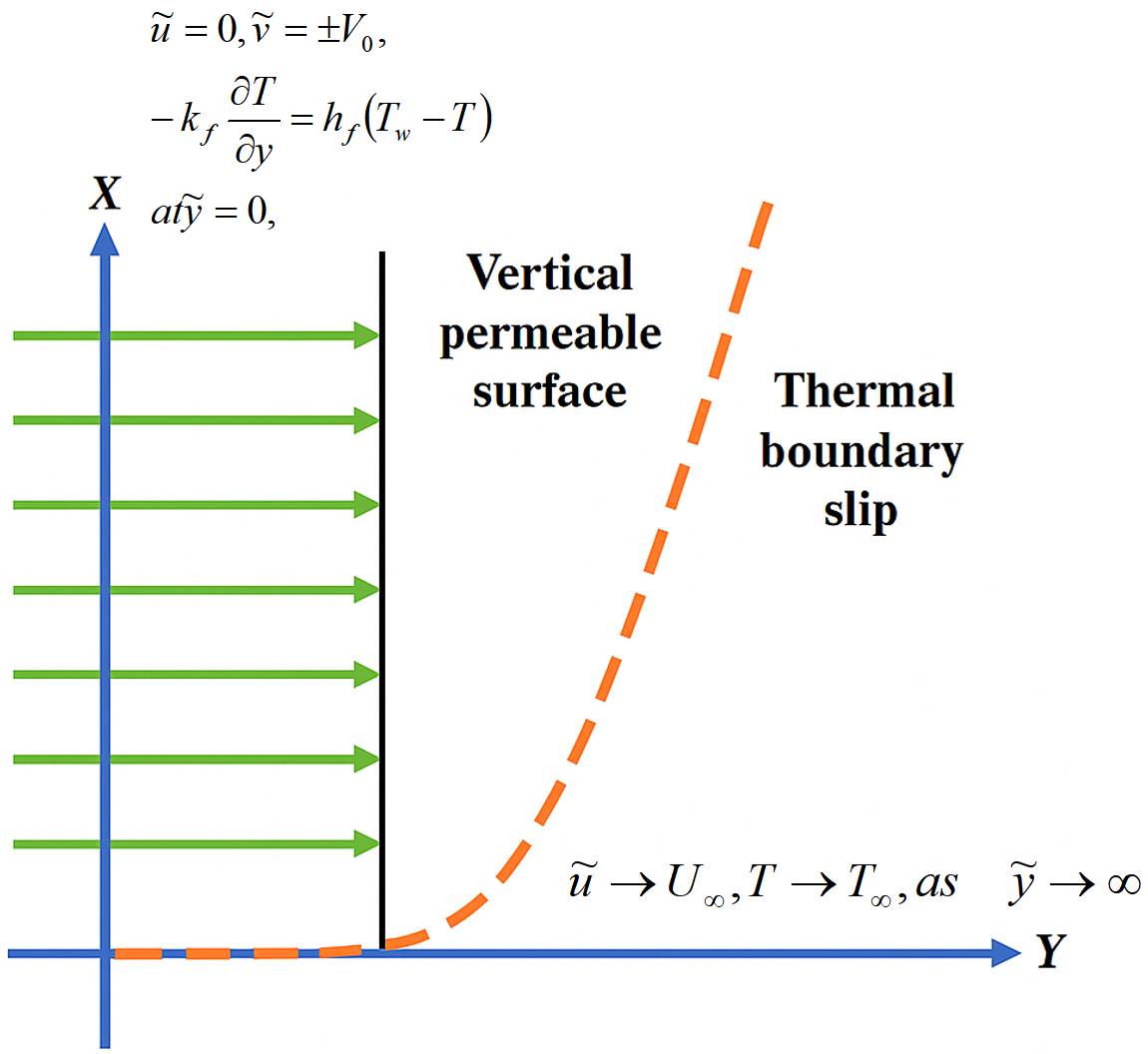
The class of fluid known as hybrid nanofluid has numerous engineering applications in the thermal industry. This study is focused on the heat transmission of the hybrid nanofluid adjacent to a vertical permeable surface by incorporating thermal boundary slip. To support this analysis, a mathematical framework has been established, presenting the problem in terms of coupled nonlinear partial differential equations. These equations have been transformed into a system of dimensionless partial differential equations using appropriate dimensionless variables. Furthermore, the finite difference technique has been employed to obtain the appropriate results. The effects of various dimensionless engineering physical parameters related to hybrid nanofluids have been examined in terms of heat transient rate, coefficient of skin friction, velocity, and temperature profiles. The findings are summarized in both graphical and tabular formats. It is keenly observed that, as the numeric values of transpiration parameter (xi_i) rise, the inclusion of thermal boundary slip leads to an augmentation of velocity and thermal profile at the surface under the effects of both suction and injection. However, an enhancement in the Prandtl number (P_r) results in a decline in velocity profile and an improvement in temperature distribution for both suction and injection.
Graphical Abstract
Keywords
Data Availability Statement
Funding
Conflicts of Interest
Ethical Approval and Consent to Participate
References
- Clarke, J. F. & Riley, N. (1975). Natural convection induced in a gas by the presence of a hot porous horizontal surface. The Quarterly Journal of Mechanics and Applied Mathematics, 28(4), 373-396.
[CrossRef] [Google Scholar] - Schlichting, H., Kestin, J. & Street, R. L. (1980). Boundary-layer theory (7th ed.). McGraw-Hill.
[Google Scholar] - Roganov, P. S., Zabolotsky, V. P., Shishov, E. V. & Leontiev, A. I. (1984). Some aspects of turbulent heat transfer in accelerated flows on permeable surfaces. International Journal of Heat and Mass Transfer, 27(8), 1251-1259.
[CrossRef] [Google Scholar] - Chaudhary, M. A., Merkin, J. H. & Pop, I. (1995). Similarity solutions in free convection boundary-layer flows adjacent to vertical permeable surfaces in porous media: II prescribed surface heat flux. Heat and Mass Transfer, 30(5), 341-347.
[CrossRef] [Google Scholar] - Eastman, J. A. (1999). Novel thermal properties of nanostructured materials (Technical Report ANL/MSD/CP-96711). Argonne National Lab.
[Google Scholar] - Hussain, S., Hossain, M. A. & Wilson, M. (2000). Natural convection flow from a vertical permeable flat plate with variable surface temperature and species concentration. Engineering Computations, 17(7), 789-812.
[CrossRef] [Google Scholar] - Yu, S. & Ameel, T. A. (2001). Slip-flow heat transfer in rectangular microchannels. International Journal of Heat and Mass Transfer, 44(22), 4225-4234.
[CrossRef] [Google Scholar] - Ali, M. & Al-Yousef, F. (2002). Laminar mixed convection boundary layers induced by a linearly stretching permeable surface. International Journal of Heat and Mass Transfer, 45(21), 4241-4250.
[CrossRef] [Google Scholar] - Andersson, H. I. (2002). Slip flow past a stretching surface. Acta Mechanica, 158(1-2), 121-125.
[CrossRef] [Google Scholar] - Khanafer, K., Vafai, K. & Lightstone, M. (2003). Buoyancy-driven heat transfer enhancement in a two-dimensional enclosure utilizing nanofluids. International Journal of Heat and Mass Transfer, 46(19), 3639-3653.
[CrossRef] [Google Scholar] - Maiga, S. E. B., Palm, S. J., Nguyen, C. T., Roy, G. & Galanis, N. (2005). Heat transfer enhancement by using nanofluids in forced convection flows. International Journal of Heat and Fluid Flow, 26(4), 530-546.
[CrossRef] [Google Scholar] - Martin, M. J. & Boyd, I. D. (2006). Momentum and heat transfer in a laminar boundary layer with slip flow. Journal of Thermophysics and Heat Transfer, 20(4), 710-719.
[CrossRef] [Google Scholar] - Ariel, P. D., Hayat, T. & Asghar, S. (2006). The flow of an elastico-viscous fluid past a stretching sheet with partial slip. Acta Mechanica, 187(1-4), 29-35.
[CrossRef] [Google Scholar] - Berg, S., Cense, A. W., Hofman, J. P. & Smits, R. M. M. (2008). Two-phase flow in porous media with slip boundary condition. Transport in Porous Media, 74, 275-292.
[CrossRef] [Google Scholar] - Abu-Nada, E., Masoud, Z. & Hijazi, A. (2008). Natural convection heat transfer enhancement in horizontal concentric annuli using nanofluids. International Communications in Heat and Mass Transfer, 35(5), 657-665.
[CrossRef] [Google Scholar] - Ishak, A., Nazar, R. & Pop, I. (2009). The effects of transpiration on the flow and heat transfer over a moving permeable surface in a parallel stream. Chemical Engineering Journal, 148(1), 63-67.
[CrossRef] [Google Scholar] - Martin, M. J. & Boyd, I. D. (2010). Falkner-Skan flow over a wedge with slip boundary conditions. Journal of Thermophysics and Heat Transfer, 24(2), 263-270.
[CrossRef] [Google Scholar] - Ishak, A. (2010). Similarity solutions for flow and heat transfer over a permeable surface with convective boundary condition. Applied Mathematics and Computation, 217(2), 837-842.
[CrossRef] [Google Scholar] - Abu-Nada, E., Masoud, Z., Oztop, H. F. & Campo, A. (2010). Effect of nanofluid variable properties on natural convection in enclosures. International Journal of Thermal Sciences, 49(3), 479-491.
[CrossRef] [Google Scholar] - Aziz, A. (2010). Hydrodynamic and thermal slip flow boundary layers over a flat plate with constant heat flux boundary condition. Communications in Nonlinear Science and Numerical Simulation, 15(3), 573-580.
[CrossRef] [Google Scholar] - Rahman, M. M., Aziz, A. & Al-Lawatia, M. A. (2010). Heat transfer in micropolar fluid along an inclined permeable plate with variable fluid properties. International Journal of Thermal Sciences, 49(6), 993-1002.
[CrossRef] [Google Scholar] - Ashraf, M., Asghar, S., & Hossain, M. A. (2010). Thermal radiation effects on hydromagnetic mixed convection flow along a magnetized vertical porous plate. Mathematical Problems in Engineering, 2010, 686594.
[CrossRef] [Google Scholar] - Sheikhzadeh, G. A., Arefmanesh, A., Kheirkhah, M. H. & Abdollahi, R. (2011). Natural convection of Cu-water nanofluid in a cavity with partially active side walls. European Journal of Mechanics-B/Fluids, 30(2), 166-176.
[CrossRef] [Google Scholar] - Khan, W. A. & Aziz, A. (2011). Natural convection flow of a nanofluid over a vertical plate with uniform surface heat flux. International Journal of Thermal Sciences, 50(7), 1207-1214.
[CrossRef] [Google Scholar] - Su, X. H. & Zheng, L. C. (2011). Approximate solutions to MHD Falkner-Skan flow over permeable wall. Applied Mathematics and Mechanics, 32(4), 401-408.
[CrossRef] [Google Scholar] - Suresh, S., Venkitaraj, K. P., Selvakumar, P., & Chandrasekar, M. (2012). Effect of Al2O3–Cu/water hybrid nanofluid in heat transfer. Experimental Thermal and Fluid Science, 38, 54-60.
[CrossRef] [Google Scholar] - Cortell, R. (2012). Heat transfer in a fluid through a porous medium over a permeable stretching surface with thermal radiation and variable thermal conductivity. The Canadian Journal of Chemical Engineering, 90(5), 1347-1355.
[CrossRef] [Google Scholar] - Alvarino, P. F., Jabardo, J. S., Arce, A. & Galdo, M. L. (2012). Heat transfer enhancement in nanofluids: A numerical approach. Journal of Physics: Conference Series, 395, 012116.
[CrossRef] [Google Scholar] - Ashraf, M., Asghar, S. & Hossain, M. A. (2012). Computational study of combined effects of conduction-radiation and hydromagnetics on natural convection flow past magnetized permeable plate. Applied Mathematics and Mechanics, 33(6), 731-748.
[CrossRef] [Google Scholar] - Huminic, G. & Huminic, A. (2012). Application of nanofluids in heat exchangers: A review. Renewable and Sustainable Energy Reviews, 16(8), 5625-5638.
[CrossRef] [Google Scholar] - Noghrehabadi, A., Pourrajab, R. & Ghalambaz, M. (2012). Effect of partial slip boundary condition on the flow and heat transfer of nanofluids past stretching sheet prescribed constant wall temperature. International Journal of Thermal Sciences, 54, 253-261.
[CrossRef] [Google Scholar] - Ibrahim, W. & Shankar, B. (2013). MHD boundary layer flow and heat transfer of a nanofluid past a permeable stretching sheet with velocity, thermal and solutal slip boundary conditions. Computers & Fluids, 75, 1-10.
[CrossRef] [Google Scholar] - Labib, M. N., Nine, M. J., Afrianto, H., Chung, H. & Jeong, H. (2013). Numerical investigation on effect of base fluids and hybrid nanofluid in forced convective heat transfer. International Journal of Thermal Sciences, 71, 163-171.
[CrossRef] [Google Scholar] - Abolbashari, M. H., Freidoonimehr, N., Nazari, F. & Rashidi, M. M. (2014). Entropy analysis for an unsteady MHD flow past a stretching permeable surface in nano-fluid. Powder Technology, 267, 256-267.
[CrossRef] [Google Scholar] - Mahdi, R. A., Mohammed, H. A., Munisamy, K. M. & Saeid, N. H. (2015). Review of convection heat transfer and fluid flow in porous media with nanofluid. Renewable and Sustainable Energy Reviews, 41, 715-734.
[CrossRef] [Google Scholar] - Sarkar, J., Ghosh, P. & Adil, A. (2015). A review on hybrid nanofluids: Recent research, development and applications. Renewable and Sustainable Energy Reviews, 43, 164-177.
[CrossRef] [Google Scholar] - Sidik, N. A. C., Adamu, I. M., Jamil, M. M., Kefayati, G. H. R., Mamat, R. & Najafi, G. (2016). Recent progress on hybrid nanofluids in heat transfer applications: A comprehensive review. International Communications in Heat and Mass Transfer, 78, 68-79.
[CrossRef] [Google Scholar] - Hussain, A. M. (2017). Thermal performance and thermal properties of hybrid nanofluid laminar flow in a double pipe heat exchanger. Experimental Thermal and Fluid Science, 88, 37-45.
[CrossRef] [Google Scholar] - Kasaeian, A., Daneshazarian, R., Mahian, O., Kolsi, L., Chamkha, A. J., Wongwises, S. & Pop, I. (2017). Nanofluid flow and heat transfer in porous media: A review of the latest developments. International Journal of Heat and Mass Transfer, 107, 778-791.
[CrossRef] [Google Scholar] - Fakour, M., Ganji, D. D., Khalili, A. & Bakhshi, A. (2017). Heat transfer in nanofluid MHD flow in a channel with permeable walls. Heat Transfer Research, 48(3), 209-222.
[CrossRef] [Google Scholar] - Sundar, L. S., Sharma, K. V., Singh, M. K. & Sousa, A. C. M. (2017). Hybrid nanofluids preparation, thermal properties, heat transfer and friction factor—A review. Renewable and Sustainable Energy Reviews, 68, 185-198.
[CrossRef] [Google Scholar] - Yarmand, H., Zulkifli, N. W. B. M., Gharehkhani, S., Shirazi, S. F. S., Alrashed, A. A., Ali, M. A. B. & Kazi, S. N. (2017). Convective heat transfer enhancement with graphene nano platelet/platinum hybrid nanofluid. International Communications in Heat and Mass Transfer, 88, 120-125.
[CrossRef] [Google Scholar] - Bhattad, A., Sarkar, J. & Ghosh, P. (2018). Discrete phase numerical model and experimental study of hybrid nanofluid heat transfer and pressure drop in plate heat exchanger. International Communications in Heat and Mass Transfer, 91, 262-273.
[CrossRef] [Google Scholar] - Minea, A. A. & Moldoveanu, M. G. (2018). Overview of hybrid nanofluids development and benefits. Journal of Engineering Thermophysics, 27, 507-514.
[CrossRef] [Google Scholar] - Aly, E. H. & Pop, I. (2019). MHD flow and heat transfer over a permeable stretching/shrinking sheet in a hybrid nanofluid with a convective boundary condition. International Journal of Numerical Methods for Heat & Fluid Flow, 29(9), 3012-3038.
[CrossRef] [Google Scholar] - Kumar, K. A., Sugunamma, V., Sandeep, N. & Mustafa, M. (2019). Simultaneous solutions for first order and second order slips on micropolar fluid flow across a convective surface in the presence of Lorentz force and variable heat source/sink. Scientific Reports, 9(1), 14706.
[CrossRef] [Google Scholar] - Sidik, N. A. C., Adamu, I. M. & Jamil, M. M. (2019). Preparation methods and thermal performance of hybrid nanofluids. Journal of Advanced Research in Materials Science, 56(1), 1-10.
[Google Scholar] - Babar, H. & Ali, H. M. (2019). Towards hybrid nanofluids: Preparation, thermophysical properties, applications, and challenges. Journal of Molecular Liquids, 281, 598-633.
[CrossRef] [Google Scholar] - Manjunatha, S., Kuttan, B. A., Jayanthi, S., Chamkha, A. & Gireesha, B. J. (2019). Heat transfer enhancement in the boundary layer flow of hybrid nanofluids due to variable viscosity and natural convection. Heliyon, 5(4), e01469.
[CrossRef] [Google Scholar] - Ashraf, M., Khan, A. & Gorla, R. S. R. (2019). Natural convection boundary layer flow of nanofluids around different stations of the sphere and into the plume above the sphere. Heat Transfer-Asian Research, 48(3), 1127-1148.
[CrossRef] [Google Scholar] - Shafiq, A., Rasool, G. & Khalique, C. M. (2020). Significance of thermal slip and convective boundary conditions in three dimensional rotating Darcy-Forchheimer nanofluid flow. Symmetry, 12(5), 741.
[CrossRef] [Google Scholar] - Roy, N. C. & Pop, I. (2020). Flow and heat transfer of a second-grade hybrid nanofluid over a permeable stretching/shrinking sheet. The European Physical Journal Plus, 135(9), 768.
[CrossRef] [Google Scholar] - Waini, I., Ishak, A.& Pop, I. (2020). MHD flow and heat transfer of a hybrid nanofluid past a permeable stretching/shrinking wedge. Applied Mathematics and Mechanics, 41(3), 507-520.
[CrossRef] [Google Scholar] - Jeelani, M. B. & Abbas, A. (2023). $Al_2O_3$-Cu ethylene glycol-based magnetohydrodynamic non-Newtonian Maxwell hybrid nano-fluid flow with suction effects in a porous space: Energy saving by solar radiation. Symmetry, 15(9), 1794.
[CrossRef] [Google Scholar] - Bhattad, A., Atgur, V., Rao, B. N., Banapurmath, N. R., Khan, T. M. Y., Vadlamudi, C. & Ayachit, N. H. (2023). Review on Mono and Hybrid Nanofluids: Preparation, Properties, Investigation, and Applications in IC Engines and Heat Transfer. Energies, 16(7), 3189.
[CrossRef] [Google Scholar]
Cited By (1)
-
Ghulam Rasool, Ali B.M. Ali, Azim Uddin, Ilkhom Khaydarov, Gaganjot Kaur, Geeta Durga, Mirjalol Ismoilov. Multi-objective heat transfer optimization of hybrid nanofluids in porous medium.
Results in Surfaces and Interfaces, 2026 , 24 .
[CrossRef]
Cite This Article
TY  - JOUR
AU  - Ahmad, Uzma
AU  - Jafri, Kainat
PY  - 2025
DA  - 2025/06/21
TI  - Hybrid Nanofluid Heat Transfer Adjacent to Vertical Permeable Surface in the Presence of Thermal Boundary Slip
JO  - Computational Environmental Heat Transfer
T2  - Computational Environmental Heat Transfer
JF  - Computational Environmental Heat Transfer
VL  - 1
IS  - 1
SP  - 39
EP  - 50
DO  - 10.62762/CEHT.2025.611372
UR  - https://www.icck.org/article/abs/CEHT.2025.611372
KW  - hybrid nanofluid
KW  - permeable surface
KW  - thermal boundary slip
KW  - finite difference technique
AB  - The class of fluid known as hybrid nanofluid has numerous engineering applications in the thermal industry. This study is focused on the heat transmission of the hybrid nanofluid adjacent to a vertical permeable surface by incorporating thermal boundary slip. To support this analysis, a mathematical framework has been established, presenting the problem in terms of coupled nonlinear partial differential equations. These equations have been transformed into a system of dimensionless partial differential equations using appropriate dimensionless variables. Furthermore, the finite difference technique has been employed to obtain the appropriate results. The effects of various dimensionless engineering physical parameters related to hybrid nanofluids have been examined in terms of heat transient rate, coefficient of skin friction, velocity, and temperature profiles. The findings are summarized in both graphical and tabular formats. It is keenly observed that, as the numeric values of transpiration parameter (xi_i) rise, the inclusion of thermal boundary slip leads to an augmentation of velocity and thermal profile at the surface under the effects of both suction and injection. However, an enhancement in the Prandtl number (P_r) results in a decline in velocity profile and an improvement in temperature distribution for both suction and injection.
SN  - 3068-5486
PB  - Institute of Central Computation and Knowledge
LA  - English
ER  -
@article{Ahmad2025Hybrid,
  author = {Uzma Ahmad and Kainat Jafri},
  title = {Hybrid Nanofluid Heat Transfer Adjacent to Vertical Permeable Surface in the Presence of Thermal Boundary Slip},
  journal = {Computational Environmental Heat Transfer},
  year = {2025},
  volume = {1},
  number = {1},
  pages = {39-50},
  doi = {10.62762/CEHT.2025.611372},
  url = {https://www.icck.org/article/abs/CEHT.2025.611372},
  abstract = {The class of fluid known as hybrid nanofluid has numerous engineering applications in the thermal industry. This study is focused on the heat transmission of the hybrid nanofluid adjacent to a vertical permeable surface by incorporating thermal boundary slip. To support this analysis, a mathematical framework has been established, presenting the problem in terms of coupled nonlinear partial differential equations. These equations have been transformed into a system of dimensionless partial differential equations using appropriate dimensionless variables. Furthermore, the finite difference technique has been employed to obtain the appropriate results. The effects of various dimensionless engineering physical parameters related to hybrid nanofluids have been examined in terms of heat transient rate, coefficient of skin friction, velocity, and temperature profiles. The findings are summarized in both graphical and tabular formats. It is keenly observed that, as the numeric values of transpiration parameter (xi\_i) rise, the inclusion of thermal boundary slip leads to an augmentation of velocity and thermal profile at the surface under the effects of both suction and injection. However, an enhancement in the Prandtl number (P\_r) results in a decline in velocity profile and an improvement in temperature distribution for both suction and injection.},
  keywords = {hybrid nanofluid, permeable surface, thermal boundary slip, finite difference technique},
  issn = {3068-5486},
  publisher = {Institute of Central Computation and Knowledge}
}
Article Metrics
Publisher's Note
ICCK stays neutral with regard to jurisdictional claims in published maps and institutional affiliations.
Rights and Permissions
 Copyright © 2025 by the Author(s). Published by Institute of Central Computation and Knowledge. This article is an open access article distributed under the terms and conditions of the Creative Commons Attribution (CC BY) license (https://creativecommons.org/licenses/by/4.0/), which permits use, sharing, adaptation, distribution and reproduction in any medium or format, as long as you give appropriate credit to the original author(s) and the source, provide a link to the Creative Commons licence, and indicate if changes were made.


Portico
