

Coulomb Counting Method based SOC Estimation of Lithium-Ion Batteries Considering Battery Temperature and Aging






Article Information
Abstract
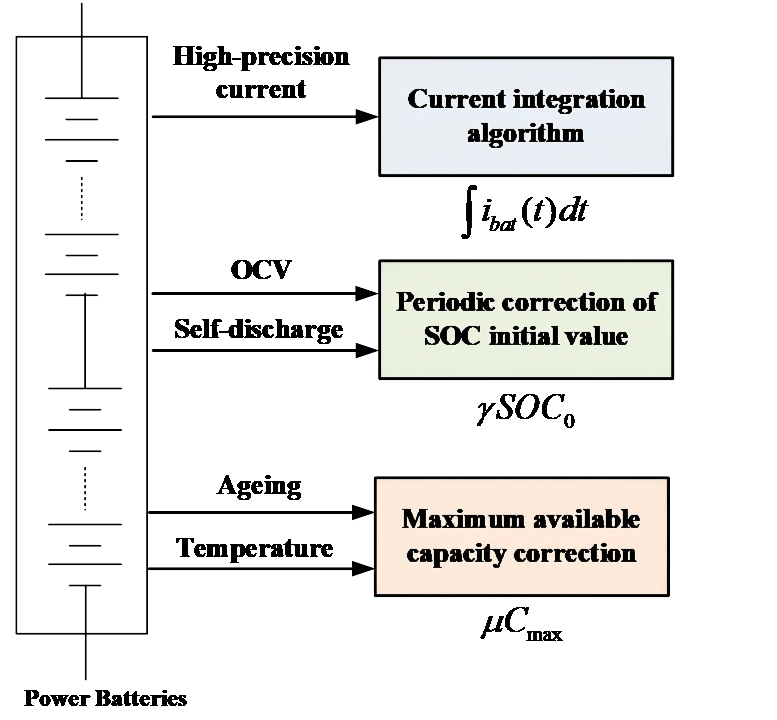
The Coulomb counting method is simple and effective in terms of state of charge (SOC) estimation of lithium-ion batteries. However, if the current measurement is not accurate, it will cause a cumulative calculation error, which will gradually increase with the time. And if the ambient temperature changes, the available capacity and initial SOC of the battery will also change. In order to solve the shortcomings of the traditional Coulomb counting method of SOC estimation, an improved method was proposed in this paper by taking into account the influence of battery temperature and aging on SOC. It can correct the initial value of SOC and the maximum available capacity of the battery more accurately, thus it solves the cumulative error problem, and improves the SOC estimation accuracy. A simple, accurate, and easy-to-implement method of battery SOC estimation is provided for the battery management system, which has practical application value.
Graphical Abstract
Keywords
Data Availability Statement
Funding
Conflicts of Interest
Ethical Approval and Consent to Participate
References
- Hannan, M. A., Hoque, M. M., Hussain, A., Yusof, Y., & Ker, P. J. (2018). State-of-the-art and energy management system of lithium-ion batteries in electric vehicle applications: Issues and recommendations. IEEE Access, 6, 19362-19378.
[CrossRef] [Google Scholar] - Khan, M., Yan, S., Ali, M., Mahmood, F., Zheng, Y., Li, G., ... & Wang, Y. (2024). Innovative solutions for high-performance silicon anodes in lithium-ion batteries: overcoming challenges and real-world applications. Nano-Micro Letters, 16(1), 179.
[CrossRef] [Google Scholar] - Zhang, Q., Shang, Y., Li, Y., Cui, N., Duan, B., & Zhang, C. (2020). A novel fractional variable-order equivalent circuit model and parameter identification of electric vehicle Li-ion batteries. ISA transactions, 97, 448-457.
[CrossRef] [Google Scholar] - Wang, C., Cui, N., Li, C., & Zhang, C. (2019). State of power prediction based on electro-thermal battery model and multi-parameter constraints for lithium-ion battery. Journal of Mechanical Engineering, 55(20), 28-35.
[Google Scholar] - Kumar, R. R., Bharatiraja, C., Udhayakumar, K., Devakirubakaran, S., Sekar, K. S., & Mihet-Popa, L. (2023). Advances in batteries, battery modeling, battery management system, battery thermal management, SOC, SOH, and charge/discharge characteristics in EV applications. IEEE Access, 11, 105761-105809.
[CrossRef] [Google Scholar] - Ci, S., Lin, N., & Wu, D. (2016). Reconfigurable battery techniques and systems: A survey. IEEE access, 4, 1175-1189.
[CrossRef] [Google Scholar] - Zhu, R., Duan, B., Zhang, J., Zhang, Q., & Zhang, C. (2020). Co-estimation of model parameters and state-of-charge for lithium-ion batteries with recursive restricted total least squares and unscented Kalman filter. Applied Energy, 277, 115494.
[CrossRef] [Google Scholar] - Shang, Y., Zhang, C., Cui, N., & Zhang, Q. (2016). State of charge estimation for lithium-ion batteries based on extended Kalman filter optimized by fuzzy neural network. Control Theory & Applications, 33(2), 212-220.
[CrossRef] [Google Scholar] - Plett, G. L. (2019). Review and some perspectives on different methods to estimate state of charge of lithium-ion batteries. Journal of Automotive Safety and Energy, 10(3), 249.
[Google Scholar] - Xiong, R., Cao, J., Yu, Q., He, H., & Sun, F. (2017). Critical review on the battery state of charge estimation methods for electric vehicles. IEEE Access, 6, 1832-1843.
[CrossRef] [Google Scholar] - Zhang, Q., Cui, N., Li, Y., Duan, B., & Zhang, C. (2020). Fractional calculus based modeling of open circuit voltage of lithium-ion batteries for electric vehicles. Journal of Energy Storage, 27, 100945.
[CrossRef] [Google Scholar] - Li, Z., Lu, L., & Ouyang, M. (2010). Comparison of methods for improving SOC estimation accuracy through an ampere-hour integration approach. Journal of Tsinghua University (Science and Technology), 50(8), 1293-1296.
[Google Scholar] - Chen, N., Zhang, P., Dai, J., & Gui, W. (2020). Estimating the state-of-charge of lithium-ion battery using an H-infinity observer based on electrochemical impedance model. IEEE Access, 8, 26872-26884.
[CrossRef] [Google Scholar] - Paizulamu, D., Cheng, L., Xu, H., Zhuang, Y., Qi, N., & Ci, S. (2025). LiFePO 4 Battery SOC Estimation under OCV-SOC Curve Error Based on Adaptive Multi-Model Kalman Filter. IEEE Transactions on Transportation Electrification, 11(4), 8833-8846.
[CrossRef] [Google Scholar] - Ma, B., & Xue, M. (2024, July). Artificial Intelligence Based SOC Technology for Electric Vehicle Batteries. In 2024 International Conference on Data Science and Network Security (ICDSNS) (pp. 1-4). IEEE.
[CrossRef] [Google Scholar] - Madani, S. S., Shabeer, Y., Allard, F., Fowler, M., Ziebert, C., Wang, Z., ... & Khalilpour, K. (2025). A comprehensive review on lithium-ion battery lifetime prediction and aging mechanism analysis. Batteries, 11(4), 127.
[CrossRef] [Google Scholar] - Yousefi, E., Ramasamy, D., Kadirgama, K., Talele, V., Najafi, H., Olyaei, M., ... & Panchal, S. (2025). Electrochemical-thermal modeling of phase change material battery thermal management systems: investigating mesh types for accurate simulations. International Journal of Heat and Mass Transfer, 247, 127107.
[CrossRef] [Google Scholar] - Shen, J. N., Shen, J. J., He, Y. J., & Ma, Z. F. (2018). Accurate state of charge estimation with model mismatch for li-ion batteries: A joint moving horizon estimation approach. IEEE Transactions on Power Electronics, 34(5), 4329-4342.
[CrossRef] [Google Scholar] - Liu, F., Yu, D., Su, W., Ma, S., & Bu, F. (2023). Adaptive multitimescale joint estimation method for SOC and capacity of series battery pack. IEEE Transactions on Transportation Electrification, 10(2), 4484-4502.
[CrossRef] [Google Scholar] - Lee, J., & Won, J. (2023). Enhanced coulomb counting method for SoC and SoH estimation based on coulombic efficiency. IEEE Access, 11, 15449-15459.
[CrossRef] [Google Scholar] - Zheng, Y., Qin, C., Lai, X., Han, X., & Xie, Y. (2019). A novel capacity estimation method for lithium-ion batteries using fusion estimation of charging curve sections and discrete Arrhenius aging model. Applied Energy, 251, 113327.
[CrossRef] [Google Scholar]
Cite This Article
TY  - JOUR
AU  - Zhang, Qi
AU  - Fu, Xiaoling
AU  - Pei, Wenhui
PY  - 2025
DA  - 2025/07/28
TI  - Coulomb Counting Method based SOC Estimation of Lithium-Ion Batteries Considering Battery Temperature and Aging
JO  - ICCK Transactions on Electric and Hybrid Vehicles
T2  - ICCK Transactions on Electric and Hybrid Vehicles
JF  - ICCK Transactions on Electric and Hybrid Vehicles
VL  - 1
IS  - 1
SP  - 4
EP  - 11
DO  - 10.62762/TEHV.2025.326438
UR  - https://www.icck.org/article/abs/TEHV.2025.326438
KW  - SOC estimation
KW  - coulomb counting method
KW  - electric vehicles
KW  - battery management system
AB  - The Coulomb counting method is simple and effective in terms of state of charge (SOC) estimation of lithium-ion batteries. However, if the current measurement is not accurate, it will cause a cumulative calculation error, which will gradually increase with the time. And if the ambient temperature changes, the available capacity and initial SOC of the battery will also change. In order to solve the shortcomings of the traditional Coulomb counting method of SOC estimation, an improved method was proposed in this paper by taking into account the influence of battery temperature and aging on SOC. It can correct the initial value of SOC and the maximum available capacity of the battery more accurately, thus it solves the cumulative error problem, and improves the SOC estimation accuracy. A simple, accurate, and easy-to-implement method of battery SOC estimation is provided for the battery management system, which has practical application value.
SN  - pending
PB  - Institute of Central Computation and Knowledge
LA  - English
ER  -
@article{Zhang2025Coulomb,
  author = {Qi Zhang and Xiaoling Fu and Wenhui Pei},
  title = {Coulomb Counting Method based SOC Estimation of Lithium-Ion Batteries Considering Battery Temperature and Aging},
  journal = {ICCK Transactions on Electric and Hybrid Vehicles},
  year = {2025},
  volume = {1},
  number = {1},
  pages = {4-11},
  doi = {10.62762/TEHV.2025.326438},
  url = {https://www.icck.org/article/abs/TEHV.2025.326438},
  abstract = {The Coulomb counting method is simple and effective in terms of state of charge (SOC) estimation of lithium-ion batteries. However, if the current measurement is not accurate, it will cause a cumulative calculation error, which will gradually increase with the time. And if the ambient temperature changes, the available capacity and initial SOC of the battery will also change. In order to solve the shortcomings of the traditional Coulomb counting method of SOC estimation, an improved method was proposed in this paper by taking into account the influence of battery temperature and aging on SOC. It can correct the initial value of SOC and the maximum available capacity of the battery more accurately, thus it solves the cumulative error problem, and improves the SOC estimation accuracy. A simple, accurate, and easy-to-implement method of battery SOC estimation is provided for the battery management system, which has practical application value.},
  keywords = {SOC estimation, coulomb counting method, electric vehicles, battery management system},
  issn = {pending},
  publisher = {Institute of Central Computation and Knowledge}
}
Article Metrics
Publisher's Note
ICCK stays neutral with regard to jurisdictional claims in published maps and institutional affiliations.
Rights and Permissions


Portico
