3D Convolutional Neural Network-Based Multi-Parameter Video Quality Assessment Model on Cloud Platforms




Article Information
Abstract
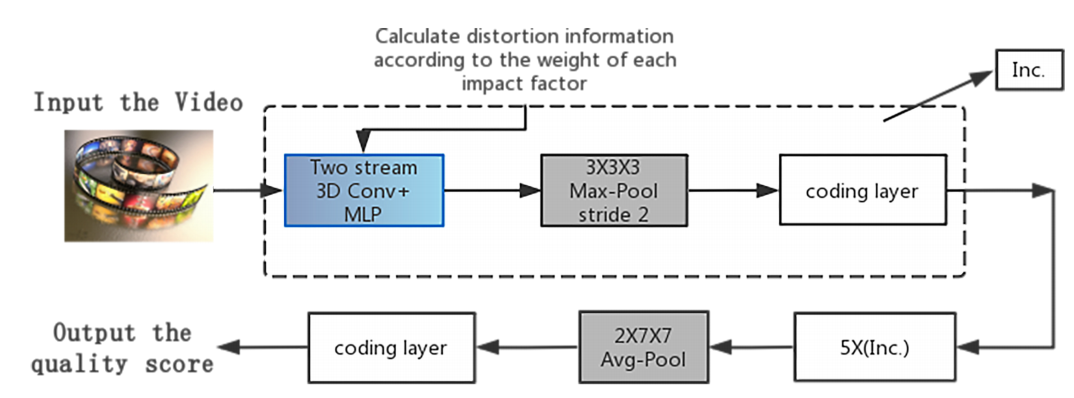
In light of the rapid advancements in big data and artificial intelligence technologies, the trend of uploading local files to cloud servers to mitigate local storage limitations is growing. However, the surge of duplicate files, especially images and videos, results in significant network bandwidth wastage and complicates server management. To tackle these issues, we have developed a multi-parameter video quality assessment model utilizing a 3D convolutional neural network within a video deduplication framework. Our method, inspired by the analytic hierarchy process, thoroughly evaluates the effects of packet loss rate, codec, frame rate, bit rate, and resolution on video quality. The model employs a two-stream 3D convolutional neural network to integrate spatial and temporal streams for capturing video distortion details, with a coding layer configured to remove redundant distortion information. We validated our approach using the LIVE and CSIQ datasets, comparing its performance against the V-BLIINDS and VIDEO schemes across different packet loss rates. Furthermore, we simulated the client-server interaction using a subset of the dataset and assessed the scheme's time efficiency. Our results indicate that the proposed scheme offers a highly efficient solution for video quality assessment.
Graphical Abstract
Keywords
Funding
References
- Yang, X., Lu, R., Choo, K. K. R., Yin, F., & Tang, X. (2017). Achieving efficient and privacy-preserving cross-domain big data deduplication in cloud. IEEE Transactions on Big Data, 8(1), 73-84.
[Google Scholar] - Wu, X., Hauptmann, A. G., & Ngo, C. W. (2007, September). Practical elimination of near-duplicates from web video search. In Proceedings of the 15th ACM international conference on Multimedia (pp. 218-227).
[Google Scholar] - Yao, J. Y., & Liu, G. (2018). Bitrate-based no-reference video quality assessment combining the visual perception of video contents. IEEE Transactions on Broadcasting, 65(3), 546-557.
[Google Scholar] - Botia Valderrama, D. J. L., & Gaviria Gómez, N. (2016). Nonintrusive method based on neural networks for video quality of experience assessment. Advances in Multimedia, 2016(1), 1730814.
[Google Scholar] - Søgaard, J., Forchhammer, S., & Korhonen, J. (2015, May). Video quality assessment and machine learning: Performance and interpretability. In 2015 Seventh International Workshop on Quality of Multimedia Experience (QoMEX) (pp. 1-6). IEEE.
[Google Scholar] - Seshadrinathan, K., Soundararajan, R., Bovik, A. C., & Cormack, L. K. (2010, February). A subjective study to evaluate video quality assessment algorithms. In Human Vision and Electronic Imaging XV (Vol. 7527, pp. 128-137). SPIE.
[Google Scholar] - Saad, M. A., Bovik, A. C., & Charrier, C. (2014). Blind prediction of natural video quality. IEEE Transactions on image Processing, 23(3), 1352-1365.
[Google Scholar] - Mittal, A., Soundararajan, R., & Bovik, A. C. (2012). Making a “completely blind” image quality analyzer. IEEE Signal processing letters, 20(3), 209-212.
[Google Scholar] - Loh, W. T., & Bong, D. B. L. (2018). A just noticeable difference-based video quality assessment method with low computational complexity. Sensing and Imaging, 19, 1-20.
[Google Scholar] - Cheng, Z., Ding, L., Huang, W., Yang, F., & Qian, L. (2017, June). A unified QoE prediction framework for HEVC encoded video streaming over wireless networks. In 2017 IEEE International Symposium on Broadband Multimedia Systems and Broadcasting (BMSB) (pp. 1-6). IEEE.
[Google Scholar] - Anegekuh, L., Sun, L., Jammeh, E., Mkwawa, I. H., & Ifeachor, E. (2015). Content-based video quality prediction for HEVC encoded videos streamed over packet networks. IEEE Transactions on Multimedia, 17(8), 1323-1334.
[Google Scholar] - Alreshoodi, M., Adeyemi-Ejeye, A. O., Woods, J., & Walker, S. D. (2015). Fuzzy logic inference system-based hybrid quality prediction model for wireless 4kUHD H. 265-coded video streaming. IET Networks, 4(6), 296-303.
[Google Scholar] - Zhang, Y., Gao, X., He, L., Lu, W., & He, R. (2018). Blind video quality assessment with weakly supervised learning and resampling strategy. IEEE Transactions on Circuits and Systems for Video Technology, 29(8), 2244-2255.
[Google Scholar] - Valderrama, J. F. B., & Valderrama, D. J. L. B. (2018). On LAMDA clustering method based on typicality degree and intuitionistic fuzzy sets. Expert Systems with Applications, 107, 196-221.
[Google Scholar] - Li, Y., Po, L. M., Cheung, C. H., Xu, X., Feng, L., Yuan, F., & Cheung, K. W. (2015). No-reference video quality assessment with 3D shearlet transform and convolutional neural networks. IEEE Transactions on Circuits and Systems for Video Technology, 26(6), 1044-1057.
[Google Scholar] - Agarla, M., Celona, L., & Schettini, R. (2020). No-reference quality assessment of in-capture distorted videos. Journal of Imaging, 6(8), 74.
[Google Scholar] - Nightingale, J., Salva-Garcia, P., Calero, J. M. A., & Wang, Q. (2018). 5G-QoE: QoE modelling for ultra-HD video streaming in 5G networks. IEEE Transactions on Broadcasting, 64(2), 621-634.
[Google Scholar] - Narwaria, M., & Lin, W. (2011, September). Machine learning based modeling of spatial and temporal factors for video quality assessment. In 2011 18th IEEE International Conference on Image Processing (pp. 2513-2516). IEEE.
[Google Scholar] - Pal, D., & Vanijja, V. (2017). A No-Reference Modular Video Quality Prediction Model for H. 265/HEVC and VP9 Codecs on a Mobile Device. Advances in Multimedia, 2017(1), 8317590.
[Google Scholar] - Qian, L., Pan, T., Zheng, Y., Zhang, J., Li, M., Yu, B., & Wang, B. (2020). No-Reference Nonuniform Distorted Video Quality Assessment Based on Deep Multiple Instance Learning. IEEE MultiMedia, 28(1), 28-37.
[Google Scholar] - Chen, P., Li, L., Ma, L., Wu, J., & Shi, G. (2020, October). RIRNet: Recurrent-in-recurrent network for video quality assessment. In Proceedings of the 28th ACM international conference on multimedia (pp. 834-842).
[Google Scholar] - Li, D., Jiang, T., & Jiang, M. (2021). Unified quality assessment of in-the-wild videos with mixed datasets training. International Journal of Computer Vision, 129(4), 1238-1257.
[Google Scholar] - Zhen, P., Chen, H. B., Cheng, Y., Ji, Z., Liu, B., & Yu, H. (2021). Fast video facial expression recognition by a deeply tensor-compressed LSTM neural network for mobile devices. ACM Transactions on Internet of Things, 2(4), 1-26.
[Google Scholar] - Wang, N., Fang, F., & Feng, M. (2014, May). Multi-objective optimal analysis of comfort and energy management for intelligent buildings. In The 26th Chinese control and decision conference (2014 CCDC) (pp. 2783-2788). IEEE.
[Google Scholar] - Fang, F. A. N. G., Tan, W., & Liu, J. Z. (2005). Tuning of coordinated controllers for boiler-turbine units. Acta Automatica Sinica, 31(2), 291-296.
[Google Scholar] - Fang, F., Jizhen, L., & Wen, T. (2004). Nonlinear internal model control for the boiler-turbine coordinate systems of power unit. PROCEEDINGS-CHINESE SOCIETY OF ELECTRICAL ENGINEERING, 24(4), 195-199.
[Google Scholar] - Lv, Y., Fang, F. A. N. G., Yang, T., & Romero, C. E. (2020). An early fault detection method for induced draft fans based on MSET with informative memory matrix selection. ISA transactions, 102, 325-334.
[Google Scholar]
Cite This Article
TY  - JOUR
AU  - Li, Xue
AU  - Qiu, Jiali
PY  - 2024
DA  - 2024/01/14
TI  - 3D Convolutional Neural Network-Based Multi-Parameter Video Quality Assessment Model on Cloud Platforms
JO  - ICCK Transactions on Internet of Things
T2  - ICCK Transactions on Internet of Things
JF  - ICCK Transactions on Internet of Things
VL  - 2
IS  - 1
SP  - 8
EP  - 19
DO  - 10.62762/TIOT.2024.369369
UR  - https://www.icck.org/article/abs/TIOT.2024.369369
KW  - Video quality assessment
KW  - 3D CNN
KW  - Packet loss rate
KW  - SRCC
KW  - PLCC
AB  - In light of the rapid advancements in big data and artificial intelligence technologies, the trend of uploading local files to cloud servers to mitigate local storage limitations is growing. However, the surge of duplicate files, especially images and videos, results in significant network bandwidth wastage and complicates server management. To tackle these issues, we have developed a multi-parameter video quality assessment model utilizing a 3D convolutional neural network within a video deduplication framework. Our method, inspired by the analytic hierarchy process, thoroughly evaluates the effects of packet loss rate, codec, frame rate, bit rate, and resolution on video quality. The model employs a two-stream 3D convolutional neural network to integrate spatial and temporal streams for capturing video distortion details, with a coding layer configured to remove redundant distortion information. We validated our approach using the LIVE and CSIQ datasets, comparing its performance against the V-BLIINDS and VIDEO schemes across different packet loss rates. Furthermore, we simulated the client-server interaction using a subset of the dataset and assessed the scheme's time efficiency. Our results indicate that the proposed scheme offers a highly efficient solution for video quality assessment.
SN  - pending
PB  - Institute of Central Computation and Knowledge
LA  - English
ER  -
@article{Li20243D,
  author = {Xue Li and Jiali Qiu},
  title = {3D Convolutional Neural Network-Based Multi-Parameter Video Quality Assessment Model on Cloud Platforms},
  journal = {ICCK Transactions on Internet of Things},
  year = {2024},
  volume = {2},
  number = {1},
  pages = {8-19},
  doi = {10.62762/TIOT.2024.369369},
  url = {https://www.icck.org/article/abs/TIOT.2024.369369},
  abstract = {In light of the rapid advancements in big data and artificial intelligence technologies, the trend of uploading local files to cloud servers to mitigate local storage limitations is growing. However, the surge of duplicate files, especially images and videos, results in significant network bandwidth wastage and complicates server management. To tackle these issues, we have developed a multi-parameter video quality assessment model utilizing a 3D convolutional neural network within a video deduplication framework. Our method, inspired by the analytic hierarchy process, thoroughly evaluates the effects of packet loss rate, codec, frame rate, bit rate, and resolution on video quality. The model employs a two-stream 3D convolutional neural network to integrate spatial and temporal streams for capturing video distortion details, with a coding layer configured to remove redundant distortion information. We validated our approach using the LIVE and CSIQ datasets, comparing its performance against the V-BLIINDS and VIDEO schemes across different packet loss rates. Furthermore, we simulated the client-server interaction using a subset of the dataset and assessed the scheme's time efficiency. Our results indicate that the proposed scheme offers a highly efficient solution for video quality assessment.},
  keywords = {Video quality assessment, 3D CNN, Packet loss rate, SRCC, PLCC},
  issn = {pending},
  publisher = {Institute of Central Computation and Knowledge}
}
Article Metrics
Publisher's Note
ICCK stays neutral with regard to jurisdictional claims in published maps and institutional affiliations.
Rights and Permissions


Portico