Uncovering COVID-19 Death Risk for Life on the Line with Machine Learning Precision



Article Information
Abstract
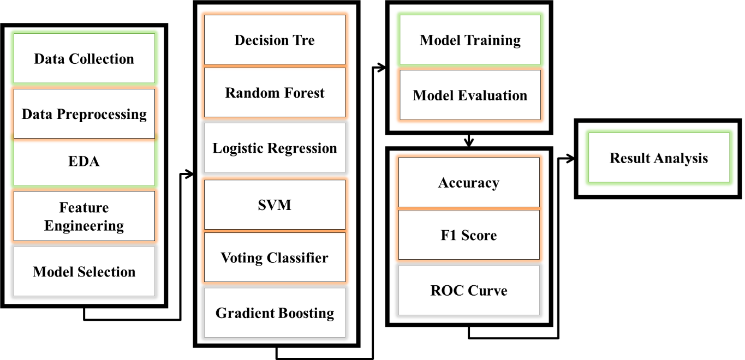
The global healthcare systems have faced unprecedented challenges due to the COVID-19 pandemic, necessitating innovative neural computing solutions to inform critical decision-making. In this study, we introduce a neural-inspired machine learning framework to predict COVID-19 mortality risk, utilizing a dataset comprising over one million records. We developed and evaluated a suite of advanced models—Decision Tree, Random Forest, Logistic Regression, Support Vector Machine, Gradient Boost Classifier, and a neural ensemble-based Voting Classifier—to analyze the influence of demographics, symptoms, and preexisting conditions on mortality predictions. Through meticulous feature engineering and data preprocessing, our approach yielded profound insights, with the Voting Classifier achieving an exceptional 93% accuracy on test data, outperforming Random Forest and Logistic Regression (both at 91%). Key risk factors identified include age and preexisting conditions, complemented by nuanced patterns linked to symptoms and socioeconomic-demographic factors. Model robustness was rigorously validated using F1-score and ROC curves, affirming its reliability and generalization capacity. The Voting Classifier’s neural ensemble design, integrating diverse model outputs, exemplifies the power of neural computing principles in processing complex health data. This framework not only enhances predictive accuracy but also provides actionable insights for public health, enabling optimized resource allocation, prioritized care for high-risk patients, and improved survival outcomes. Beyond elucidating COVID-19 mortality dynamics, this research underscores the transformative potential of neural computing in tackling global health crises, establishing a robust foundation for data-driven strategies in future challenges.
Graphical Abstract
Keywords
Data Availability Statement
Funding
Conflicts of Interest
Ethical Approval and Consent to Participate
References
- Oran, D. P., & Topol, E. J. (2020). Prevalence of asymptomatic SARS-CoV-2 infection: A narrative review. Annals of Internal Medicine, 173(5), 362-367.
[CrossRef] [Google Scholar] - Dabbah, M. A., Reed, A. B., Booth, A. T., Yassaee, A., Despotovic, A., Klasmer, B., ... & Mohan, D. (2021). Machine learning approach to dynamic risk modeling of mortality in COVID-19: a UK Biobank study. Scientific reports, 11(1), 16936.
[CrossRef] [Google Scholar] - Oran, D. P., & Topol, E. J. (2021). Prevalence of asymptomatic SARS-CoV-2 infection. Annals of internal medicine, 174(2), 286-287.
[CrossRef] [Google Scholar] - Byambasuren, O., Cardona, M., Bell, K., Clark, J., McLaws, M. L., & Glasziou, P. (2020). Estimating the extent of asymptomatic COVID-19 and its potential for community transmission: systematic review and meta-analysis. Official Journal of the Association of Medical Microbiology and Infectious Disease Canada, 5(4), 223-234.
[CrossRef] [Google Scholar] - Cao, Y., Hiyoshi, A., & Montgomery, S. (2020). COVID-19 case-fatality rate and demographic and socioeconomic influencers: Worldwide spatial regression analysis based on country-level data. BMJ Open, 10(11), e043560.
[CrossRef] [Google Scholar] - Atkins, J. L., Masoli, J. A., Delgado, J., Pilling, L. C., Kuo, C. L., Kuchel, G. A., & Melzer, D. (2020). Preexisting comorbidities predicting COVID-19 and mortality in the UK biobank community cohort. The Journals of Gerontology: Series A, 75(11), 2224-2230.
[CrossRef] [Google Scholar] - Li, B. (2020). The association between symptom onset and length of hospital stay in 2019 novel coronavirus pneumonia cases without epidemiological trace. Journal of the National Medical Association, 112(5), 516-517.
[CrossRef] [Google Scholar] - Rechtman, E., Curtin, P., Navarro, E., Nirenberg, S., & Horton, M. K. (2020). Vital signs assessed in initial clinical encounters predict COVID-19 mortality in an NYC hospital system. Scientific reports, 10(1), 21545.
[CrossRef] [Google Scholar] - Zhou, F., Yu, T., Du, R., Fan, G., Liu, Y., Liu, Z., ... & Cao, B. (2020). Clinical course and risk factors for mortality of adult inpatients with COVID-19 in Wuhan, China: a retrospective cohort study. The lancet, 395(10229), 1054-1062.
[CrossRef] [Google Scholar] - Foy, B. H., Carlson, J. C., Reinertsen, E., Valls, R. P. I., Lopez, R. P., Palanques-Tost, E., ... & Higgins, J. M. (2020). Association of red blood cell distribution width with mortality risk in hospitalized adults with SARS-CoV-2 infection. JAMA network open, 3(9), e2022058-e2022058.
[CrossRef] [Google Scholar] - Clift, A. K., Coupland, C. A., Keogh, R. H., Diaz-Ordaz, K., Williamson, E., Harrison, E. M., ... & Hippisley-Cox, J. (2020). Living risk prediction algorithm (QCOVID) for risk of hospital admission and mortality from coronavirus 19 in adults: national derivation and validation cohort study. bmj, 371.
[CrossRef] [Google Scholar] - Knight, S. R., Ho, A., Pius, R., Buchan, I., Carson, G., Drake, T. M., ... & Harrison, E. M. (2020). Risk stratification of patients admitted to hospital with covid-19 using the ISARIC WHO Clinical Characterisation Protocol: development and validation of the 4C Mortality Score. bmj, 370.
[CrossRef] [Google Scholar] - Williamson, E. J., Walker, A. J., Bhaskaran, K., Bacon, S., Bates, C., Morton, C. E., ... & Goldacre, B. (2020). Factors associated with COVID-19-related death using OpenSAFELY. Nature, 584(7821), 430-436.
[CrossRef] [Google Scholar] - Yan, L., Zhang, H. T., Goncalves, J., Xiao, Y., Wang, M., Guo, Y., ... & Yuan, Y. (2020). An interpretable mortality prediction model for COVID-19 patients. Nature machine intelligence, 2(5), 283-288.
[CrossRef] [Google Scholar] - Hamer, M., Kivimäki, M., Gale, C. R., & Batty, G. D. (2020). Lifestyle risk factors, inflammatory mechanisms, and COVID-19 hospitalization: A community-based cohort study of 387,109 adults in UK. Brain, behavior, and immunity, 87, 184-187.
[CrossRef] [Google Scholar] - Redondo, E., Rivero-Calle, I., Mascarós, E., Ocaña, D., Jimeno, I., Gil, Á., ... & Martinón-Torres, F. (2024). Respiratory syncytial virus vaccination recommendations for adults aged 60 years and older: the neumoexperts prevention group position paper. Archivos de Bronconeumología, 60(3), 161-170.
[CrossRef] [Google Scholar] - Estes, C., Razavi, H., Loomba, R., Younossi, Z., & Sanyal, A. J. (2018). Modeling the epidemic of nonalcoholic fatty liver disease demonstrates an exponential increase in burden of disease. Hepatology, 67(1), 123-133.
[CrossRef] [Google Scholar] - Adadi, A., Lahmer, M., & Nasiri, S. (2022). Artificial Intelligence and COVID-19: A Systematic umbrella review and roads ahead. Journal of King Saud University-Computer and Information Sciences, 34(8), 5898-5920.
[CrossRef] [Google Scholar] - Jose, R., Syed, F., Thomas, A., & Toma, M. (2024). Cardiovascular health management in diabetic patients with machine-learning-driven predictions and interventions. Applied Sciences, 14(5), 2132.
[CrossRef] [Google Scholar] - Rehman, A., Noor, F., Janjua, J. I., Ihsan, A., Saeed, A. Q., & Abbas, T. (2024). Classification of Lung Diseases Using Machine Learning Technique. 2024 International Conference on Decision Aid Sciences and Applications, 1-7.
[CrossRef] [Google Scholar] - Rainio, O., Teuho, J., & Klén, R. (2024). Evaluation metrics and statistical tests for machine learning. Scientific Reports, 14(1), 6086.
[CrossRef] [Google Scholar]
Cite This Article
TY  - JOUR
AU  - Hasnain, Muhammad Adnan
AU  - Abbas, Tahir
AU  - Janjua, Jamshaid Iqbal
AU  - Khan, Sunawar
PY  - 2025
DA  - 2025/03/30
TI  - Uncovering COVID-19 Death Risk for Life on the Line with Machine Learning Precision
JO  - ICCK Transactions on Neural Computing
T2  - ICCK Transactions on Neural Computing
JF  - ICCK Transactions on Neural Computing
VL  - 1
IS  - 1
SP  - 30
EP  - 43
DO  - 10.62762/TNC.2025.507897
UR  - https://www.icck.org/article/abs/TNC.2025.507897
KW  - COVID-19
KW  - health care analytics
KW  - predictive modeling mortality risk
AB  - The global healthcare systems have faced unprecedented challenges due to the COVID-19 pandemic, necessitating innovative neural computing solutions to inform critical decision-making. In this study, we introduce a neural-inspired machine learning framework to predict COVID-19 mortality risk, utilizing a dataset comprising over one million records. We developed and evaluated a suite of advanced models—Decision Tree, Random Forest, Logistic Regression, Support Vector Machine, Gradient Boost Classifier, and a neural ensemble-based Voting Classifier—to analyze the influence of demographics, symptoms, and preexisting conditions on mortality predictions. Through meticulous feature engineering and data preprocessing, our approach yielded profound insights, with the Voting Classifier achieving an exceptional 93% accuracy on test data, outperforming Random Forest and Logistic Regression (both at 91%). Key risk factors identified include age and preexisting conditions, complemented by nuanced patterns linked to symptoms and socioeconomic-demographic factors. Model robustness was rigorously validated using F1-score and ROC curves, affirming its reliability and generalization capacity. The Voting Classifier’s neural ensemble design, integrating diverse model outputs, exemplifies the power of neural computing principles in processing complex health data. This framework not only enhances predictive accuracy but also provides actionable insights for public health, enabling optimized resource allocation, prioritized care for high-risk patients, and improved survival outcomes. Beyond elucidating COVID-19 mortality dynamics, this research underscores the transformative potential of neural computing in tackling global health crises, establishing a robust foundation for data-driven strategies in future challenges.
SN  - 3068-7519
PB  - Institute of Central Computation and Knowledge
LA  - English
ER  -
@article{Hasnain2025Uncovering,
  author = {Muhammad Adnan Hasnain and Tahir Abbas and Jamshaid Iqbal Janjua and Sunawar Khan},
  title = {Uncovering COVID-19 Death Risk for Life on the Line with Machine Learning Precision},
  journal = {ICCK Transactions on Neural Computing},
  year = {2025},
  volume = {1},
  number = {1},
  pages = {30-43},
  doi = {10.62762/TNC.2025.507897},
  url = {https://www.icck.org/article/abs/TNC.2025.507897},
  abstract = {The global healthcare systems have faced unprecedented challenges due to the COVID-19 pandemic, necessitating innovative neural computing solutions to inform critical decision-making. In this study, we introduce a neural-inspired machine learning framework to predict COVID-19 mortality risk, utilizing a dataset comprising over one million records. We developed and evaluated a suite of advanced models—Decision Tree, Random Forest, Logistic Regression, Support Vector Machine, Gradient Boost Classifier, and a neural ensemble-based Voting Classifier—to analyze the influence of demographics, symptoms, and preexisting conditions on mortality predictions. Through meticulous feature engineering and data preprocessing, our approach yielded profound insights, with the Voting Classifier achieving an exceptional 93\% accuracy on test data, outperforming Random Forest and Logistic Regression (both at 91\%). Key risk factors identified include age and preexisting conditions, complemented by nuanced patterns linked to symptoms and socioeconomic-demographic factors. Model robustness was rigorously validated using F1-score and ROC curves, affirming its reliability and generalization capacity. The Voting Classifier’s neural ensemble design, integrating diverse model outputs, exemplifies the power of neural computing principles in processing complex health data. This framework not only enhances predictive accuracy but also provides actionable insights for public health, enabling optimized resource allocation, prioritized care for high-risk patients, and improved survival outcomes. Beyond elucidating COVID-19 mortality dynamics, this research underscores the transformative potential of neural computing in tackling global health crises, establishing a robust foundation for data-driven strategies in future challenges.},
  keywords = {COVID-19, health care analytics, predictive modeling mortality risk},
  issn = {3068-7519},
  publisher = {Institute of Central Computation and Knowledge}
}
Article Metrics
Publisher's Note
ICCK stays neutral with regard to jurisdictional claims in published maps and institutional affiliations.
Rights and Permissions
 Copyright © 2025 by the Author(s). Published by Institute of Central Computation and Knowledge. This article is an open access article distributed under the terms and conditions of the Creative Commons Attribution (CC BY) license (https://creativecommons.org/licenses/by/4.0/), which permits use, sharing, adaptation, distribution and reproduction in any medium or format, as long as you give appropriate credit to the original author(s) and the source, provide a link to the Creative Commons licence, and indicate if changes were made.


Portico