

Predictive Neural Computing Framework for Assessing Mental Health Conditions within Intelligent and Data-Driven Smart City Ecosystems



Article Information
Abstract
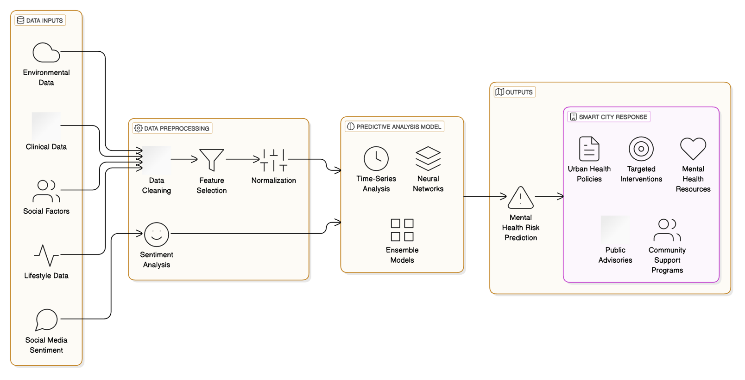
Mental health poses a growing concern in metropolitan areas where the speedy urbanization and societal demands are the chief causes of psychological discomfort. The context of intelligent cities, through their capabilities of advanced technologies and interconnecting networks, facilitates the approach of predictive analytic resolution of such issues. This paper is research regarding the implementation of machine learning in conjunction with Artificial Intelligence (AI) inter-operation for the prompt identification and management of mental health anomalies in smart cities. By using information from wearable gadgets, social networks, and the Internet of Things (IoT) based health monitoring systems, the proposed methodology tries to find trends and determinants of the mental health related applications. Federated learning models address data privacy and security requirements by enabling collaborative data analytics across organizations without exposing end-user identities. The results confirm that predictive analytics can boost mental wellness by means of individual approaches and precautionary measures. AI-supported initiatives are the possibility for acquiring mental health and sustaining the ability to get over the traumatic attacks of the smart city society.
Graphical Abstract
Keywords
Data Availability Statement
Funding
Conflicts of Interest
Ethical Approval and Consent to Participate
References
- Alwakeel, A., Alwakeel, M., Zahra, S. R., Saleem, T. J., Hijji, M., Alwakeel, S. S., ... & Alzorgi, S. (2023). Common mental disorders in smart city settings and use of multimodal medical sensor fusion to detect them. Diagnostics, 13(6), 1082.
[CrossRef] [Google Scholar] - Pinho, R. D. N. L., Costa, T. F., Silva, N. M., Barros-Areal, A. F., Salles, A. D. M., Oliveira, A. P., ... & Amado, V. M. (2021). Mental health and burnout syndrome among postgraduate students in medical and multidisciplinary residencies during the COVID-19 pandemic in Brazil: protocol for a prospective cohort study. JMIR Research Protocols, 10(1), e24298.
[CrossRef] [Google Scholar] - Mathews, F., Newlove‐Delgado, T., Finning, K., Boyle, C., Hayes, R., Johnston, P., & Ford, T. (2021). Teachers' concerns about pupils' mental health in a cross‐sectional survey of a population sample of British schoolchildren. Child and Adolescent Mental Health, 26(2), 99-105.
[CrossRef] [Google Scholar] - Corbo, I., Forte, G., Favieri, F., & Casagrande, M. (2023). Poor sleep quality in aging: The association with mental health. International Journal of Environmental Research and Public Health, 20(3).
[CrossRef] [Google Scholar] - Van Der Wal, S. J., Gorter, R., Reijnen, A., Geuze, E., & Vermetten, E. (2019). Cohort profile: The Prospective Research in Stress-Related Military Operations (PRISMO) study in the Dutch Armed Forces. BMJ Open, 9(3).
[CrossRef] [Google Scholar] - Lee, J. K., Lin, L., & Magee, C. (2020). Investigating the relationships between social capital, chronic health conditions and health status among Australian adults: Findings from an Australian national cohort survey. BMC Public Health, 20(1).
[CrossRef] [Google Scholar] - Mukherjee, S., Boamah, E. F., Ganguly, P., & Botchwey, N. (2021). A multilevel scenario based predictive analytics framework to model the community mental health and built environment nexus. Scientific Reports, 11(1).
[CrossRef] [Google Scholar] - Kutschke, J., Harris, J. R., & Bengtson, M. B. (2022). The relationships between IBS and perceptions of physical and mental health—a Norwegian twin study. BMC Gastroenterology, 22(1).
[CrossRef] [Google Scholar] - van de Wiel, W., Castillo-Laborde, C., Urzúa, I. F., Fish, M., & Scholte, W. F. (2021). Mental health consequences of long-term stays in refugee camps: preliminary evidence from Moria. BMC Public Health, 21(1).
[CrossRef] [Google Scholar] - Li, S., Wang, Y., Xue, J., Zhao, N., & Zhu, T. (2020). The impact of covid-19 epidemic declaration on psychological consequences: A study on active weibo users. International Journal of Environmental Research and Public Health, 17(6).
[CrossRef] [Google Scholar] - Ramirez-Cifuentes, D., Largeron, C., Tissier, J., Baeza-Yates, R., & Freire, A. (2021). Enhanced word embedding variations for the detection of substance abuse and mental health issues on social media writings. IEEE Access, 9.
[CrossRef] [Google Scholar] - Guerra, F., Di Giacomo, D., Ranieri, J., Tunno, M., Piscitani, L., & Ferri, C. (2021). Chronic kidney disease and its relationship with mental health: Allostatic load perspective for integrated care. Journal of Personalized Medicine, 11(12).
[CrossRef] [Google Scholar] - Andersson, S., Bathula, D. R., Iliadis, S. I., Walter, M., & Skalkidou, A. (2021). Predicting women with depressive symptoms postpartum with machine learning methods. Scientific Reports, 11(1).
[CrossRef] [Google Scholar] - Byshevets, N., Andrieieva, O., Goncharova, N., Hakman, A., Zakharina, I., Synihovets, I., & Zaitsev, V. (2023). Prediction of stress-related conditions in students and their prevention through health-enhancing recreational physical activity.
[CrossRef] [Google Scholar] - Cheng, C., Ebrahimi, O. V., & Luk, J. W. (2022). Heterogeneity of prevalence of social media addiction across multiple classification schemes: Latent profile analysis. Journal of Medical Internet Research, 24(1).
[CrossRef] [Google Scholar] - Panicheva, P., Mararitsa, L., Sorokin, S., Koltsova, O., & Rosso, P. (2022). Predicting subjective well-being in a high-risk sample of Russian mental health app users. EPJ Data Science, 11(1).
[CrossRef] [Google Scholar] - Barbui, C., Purgato, M., Abdulmalik, J., Acarturk, C., Eaton, J., Gastaldon, C., ... & Thornicroft, G. (2020). Efficacy of psychosocial interventions for mental health outcomes in low-income and middle-income countries: an umbrella review. The Lancet Psychiatry, 7(2), 162-172.
[CrossRef] [Google Scholar] - Ogunseye, E. O., Adenusi, C. A., Nwanakwaugwu, A. C., Ajagbe, S. A., & Akinola, S. O. (2022). Predictive analysis of mental health conditions using AdaBoost algorithm. ParadigmPlus, 3(2).
[CrossRef] [Google Scholar] - Rapisarda, F., Vallarino, M., Cavallini, E., Barbato, A., Brousseau-Paradis, C., De Benedictis, L., & Lesage, A. (2020). The early impact of the Covid-19 emergency on mental health workers: a survey in Lombardy, Italy. International journal of environmental research and public health, 17(22), 8615.
[CrossRef] [Google Scholar] - Kelley, S. W., Mhaonaigh, C. N., Burke, L., Whelan, R., & Gillan, C. M. (2022). Machine learning of language use on Twitter reveals weak and non-specific predictions. npj Digital Medicine, 5(1).
[CrossRef] [Google Scholar] - Bhatt, P., Liu, J., Gong, Y., Wang, J., & Guo, Y. (2022). Emerging artificial intelligence-empowered mHealth: Scoping review.
[CrossRef] [Google Scholar] - Katal, N. (2024). Ai-driven healthcare services and infrastructure in smart cities. In Smart Cities (pp. 150-170). CRC Press.
[Google Scholar]
Cite This Article
TY  - JOUR
AU  - Milon, Md Hasanujjaman
AU  - Raja, Mamunur R
AU  - Papel, Md Saidul Islam
AU  - Hossain, Zakir
PY  - 2025
DA  - 2025/06/28
TI  - Predictive Neural Computing Framework for Assessing Mental Health Conditions within Intelligent and Data-Driven Smart City Ecosystems
JO  - ICCK Transactions on Neural Computing
T2  - ICCK Transactions on Neural Computing
JF  - ICCK Transactions on Neural Computing
VL  - 1
IS  - 2
SP  - 98
EP  - 107
DO  - 10.62762/TNC.2025.421125
UR  - https://www.icck.org/article/abs/TNC.2025.421125
KW  - predictive analytics
KW  - mental health
KW  - smart city
KW  - IoT
KW  - federated learning
AB  - Mental health poses a growing concern in metropolitan areas where the speedy urbanization and societal demands are the chief causes of psychological discomfort. The context of intelligent cities, through their capabilities of advanced technologies and interconnecting networks, facilitates the approach of predictive analytic resolution of such issues. This paper is research regarding the implementation of machine learning in conjunction with Artificial Intelligence (AI) inter-operation for the prompt identification and management of mental health anomalies in smart cities. By using information from wearable gadgets, social networks, and the Internet of Things (IoT) based health monitoring systems, the proposed methodology tries to find trends and determinants of the mental health related applications. Federated learning models address data privacy and security requirements by enabling collaborative data analytics across organizations without exposing end-user identities. The results confirm that predictive analytics can boost mental wellness by means of individual approaches and precautionary measures. AI-supported initiatives are the possibility for acquiring mental health and sustaining the ability to get over the traumatic attacks of the smart city society.
SN  - 3068-7519
PB  - Institute of Central Computation and Knowledge
LA  - English
ER  -
@article{Milon2025Predictive,
  author = {Md Hasanujjaman Milon and Mamunur R Raja and Md Saidul Islam Papel and Zakir Hossain},
  title = {Predictive Neural Computing Framework for Assessing Mental Health Conditions within Intelligent and Data-Driven Smart City Ecosystems},
  journal = {ICCK Transactions on Neural Computing},
  year = {2025},
  volume = {1},
  number = {2},
  pages = {98-107},
  doi = {10.62762/TNC.2025.421125},
  url = {https://www.icck.org/article/abs/TNC.2025.421125},
  abstract = {Mental health poses a growing concern in metropolitan areas where the speedy urbanization and societal demands are the chief causes of psychological discomfort. The context of intelligent cities, through their capabilities of advanced technologies and interconnecting networks, facilitates the approach of predictive analytic resolution of such issues. This paper is research regarding the implementation of machine learning in conjunction with Artificial Intelligence (AI) inter-operation for the prompt identification and management of mental health anomalies in smart cities. By using information from wearable gadgets, social networks, and the Internet of Things (IoT) based health monitoring systems, the proposed methodology tries to find trends and determinants of the mental health related applications. Federated learning models address data privacy and security requirements by enabling collaborative data analytics across organizations without exposing end-user identities. The results confirm that predictive analytics can boost mental wellness by means of individual approaches and precautionary measures. AI-supported initiatives are the possibility for acquiring mental health and sustaining the ability to get over the traumatic attacks of the smart city society.},
  keywords = {predictive analytics, mental health, smart city, IoT, federated learning},
  issn = {3068-7519},
  publisher = {Institute of Central Computation and Knowledge}
}
Article Metrics
Publisher's Note
ICCK stays neutral with regard to jurisdictional claims in published maps and institutional affiliations.
Rights and Permissions
 Copyright © 2025 by the Author(s). Published by Institute of Central Computation and Knowledge. This article is an open access article distributed under the terms and conditions of the Creative Commons Attribution (CC BY) license (https://creativecommons.org/licenses/by/4.0/), which permits use, sharing, adaptation, distribution and reproduction in any medium or format, as long as you give appropriate credit to the original author(s) and the source, provide a link to the Creative Commons licence, and indicate if changes were made.


Portico
