


Academic Profile

Feng Ding was born in Guangshui, Hubei Province, China. He received his B. Sc. degree from the Hubei University of Technology (Wuhan, China) in 1984, and his M. Sc. and Ph. D. degrees both from the Tsinghua University (Beijing, China) in 1991 and 1994. From 1984 to 1988, he was an Electrical Technician at the Hubei Pharmaceutical Factory, Xiangfan, China. From 1994 to 2002, he was with the Department of Automation at the Tsinghua University, Beijing, China. From 2002 to 2005, he was a Post-Doctoral Fellow/Research Associate at the University of Alberta, Edmonton, Canada. He has been a professor in the School of Internet of Things Engineering at the Jiangnan University (Wuxi, China) since 2004. He has published over seven hundred papers and has authored or coauthored the books {\it Adaptive Control Systems} (Tsinghua University Press, Beijing, 2002) and {\it Modern Control Theory} (Tsinghua University Press, Beijing, 2018), and five books on {\it System Identification-New Theory and Methods} (2013), {\it System Identification-Performance Analysis for Identification Methods} (2014), {\it System Identification-Multi-Innovation Identification Theory and Methods} (2016), {\it System Identification-Auxiliary Model Identification Idea and Methods} (2017), {\it System Identification-Iterative Search Principle and Identification Methods} (2018) at Science Press, Beijing, China. His research interests include model identification and adaptive control.

ICCK Publications

Total Publications: 1
Free Access | Research Article | 14 April 2025 | Cited: 3 , Scopus 3
Iterative Estimation Algorithm for Bilinear Stochastic Systems by Using the Newton Search
ICCK Transactions on Intelligent Systematics | Volume 2, Issue 2: 76-84, 2025 | DOI: 10.62762/TIS.2024.155941
Abstract
This study addresses the challenge of estimating parameters iteratively in bilinear state-space systems affected by stochastic noise. A Newton iterative (NI) algorithm is introduced by utilizing the Newton search and iterative identification theory for identifying the system parameters. Following the estimation of the unknown parameters, we create a bilinear state observer (BSO) using the Kalman filtering principle for state estimation. Subsequently, we propose the BSO-NI algorithm for simultaneous parameter and state estimation. An iterative algorithm based on gradients is given for comparisons to illustrate the effectiveness of the proposed algorithms. More >

Graphical Abstract
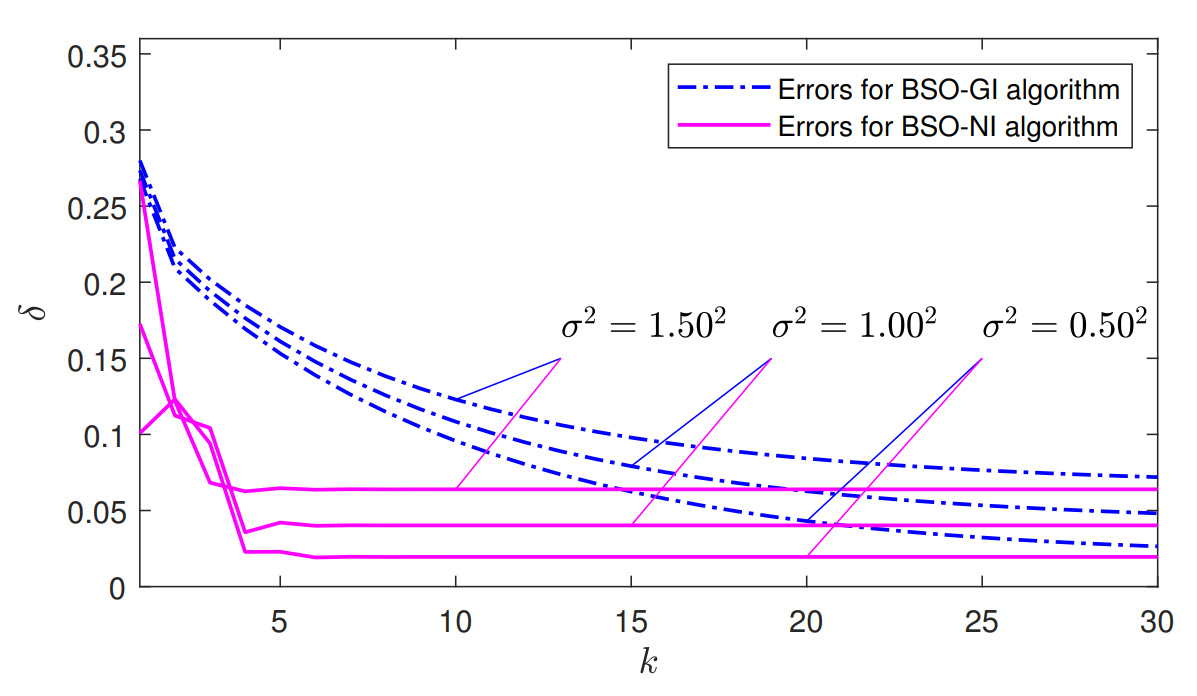
Iterative Estimation Algorithm for Bilinear Stochastic Systems by Using the Newton Search