Iterative Estimation Algorithm for Bilinear Stochastic Systems by Using the Newton Search




Article Information
Abstract
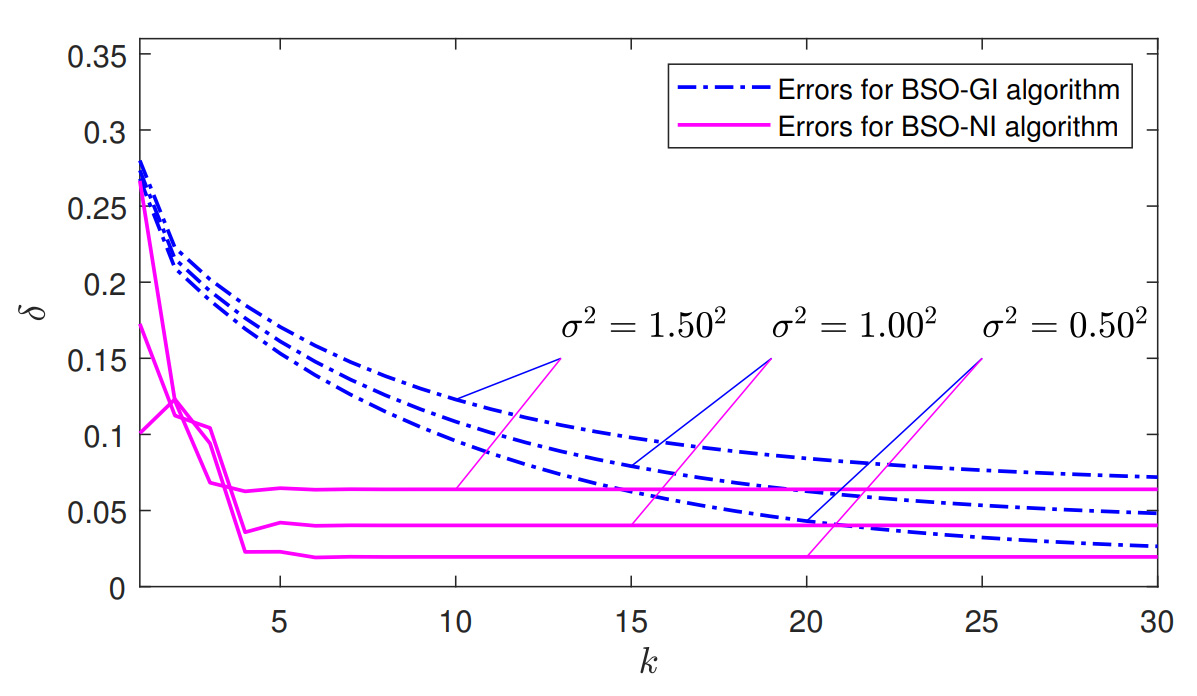
This study addresses the challenge of estimating parameters iteratively in bilinear state-space systems affected by stochastic noise. A Newton iterative (NI) algorithm is introduced by utilizing the Newton search and iterative identification theory for identifying the system parameters. Following the estimation of the unknown parameters, we create a bilinear state observer (BSO) using the Kalman filtering principle for state estimation. Subsequently, we propose the BSO-NI algorithm for simultaneous parameter and state estimation. An iterative algorithm based on gradients is given for comparisons to illustrate the effectiveness of the proposed algorithms.
Graphical Abstract
Keywords
Data Availability Statement
Funding
Conflicts of Interest
Ethical Approval and Consent to Participate
References
- Ljung, L. (1999). System identification: Theory for the user. (2nd ed.). Prentice Hall, Englewood Cliffs, New Jersey.
[CrossRef] [Google Scholar] - Miao, G., Ding, F., Liu, Q., & Yang, E. (2023). Iterative parameter identification algorithms for transformed dynamic rational fraction input–output systems. Journal of Computational and Applied Mathematics, 434, 115297.
[CrossRef] [Google Scholar] - Benesty, J., Paleologu, C., Dogariu, L. M., & Ciochină, S. (2021). Identification of linear and bilinear systems: A unified study. Electronics, 10(15), 1790.
[CrossRef] [Google Scholar] - Li, F., Zhang, M., Yu, Y., & Li, S. (2024). Deep belief network-based hammerstein nonlinear system for wind power prediction. IEEE Transactions on Instrumentation and Measurement, 73, 1-12. 2024. 73:6505912.
[CrossRef] [Google Scholar] - Chen, J., Mao, Y., Gan, M., Wang, D., & Zhu, Q. (2023). Greedy search method for separable nonlinear models using stage Aitken gradient descent and least squares algorithms. IEEE Transactions on Automatic Control, 68(8), 5044-5051.
[CrossRef] [Google Scholar] - Chen, J., Ma, J., Gan, M., & Zhu, Q. (2022). Multidirection gradient iterative algorithm: A unified framework for gradient iterative and least squares algorithms. IEEE Transactions on Automatic Control, 67(12), 6770-6777.
[CrossRef] [Google Scholar] - Khodarahmi, M., & Maihami, V. (2023). A review on Kalman filter models. Archives of Computational Methods in Engineering, 30(1), 727-747.
[CrossRef] [Google Scholar] - An, S., He, Y., & Wang, L. (2023). Maximum likelihood based multi‐innovation stochastic gradient identification algorithms for bilinear stochastic systems with ARMA noise. International Journal of Adaptive Control and Signal Processing, 37(10), 2690-2705.
[CrossRef] [Google Scholar] - Zhang, Q., Wang, H., & Liu, X. (2025). Auxiliary model maximum likelihood least squares-based iterative algorithm for multivariable autoregressive output-error autoregressive moving average systems. Proceedings of the Institution of Mechanical Engineers, Part I: Journal of Systems and Control Engineering, 09596518241280323.
[CrossRef] [Google Scholar] - An, S., Wang, L., & He, Y. (2023). Filtering-based maximum likelihood hierarchical recursive identification algorithms for bilinear stochastic systems. Nonlinear Dynamics, 111(13), 12405-12420.
[CrossRef] [Google Scholar] - Gu, Y., Dai, W., Zhu, Q., & Nouri, H. (2023). Hierarchical multi-innovation stochastic gradient identification algorithm for estimating a bilinear state-space model with moving average noise. Journal of Computational and Applied Mathematics, 420, 114794.
[CrossRef] [Google Scholar] - Xu, L. (2021). Separable multi-innovation Newton iterative modeling algorithm for multi-frequency signals based on the sliding measurement window. Circuits, Systems, and Signal Processing, 41(2), 805-830.
[CrossRef] [Google Scholar] - Xu, L. (2022). Separable Newton recursive estimation method through system responses based on dynamically discrete measurements with increasing data length. International Journal of Control, Automation and Systems, 20(2), 432-443.
[CrossRef] [Google Scholar] - Pan, Z., Luan, X., & Liu, F. (2022). Confidence set-membership state estimation for LPV systems with inexact scheduling variables. ISA Transactions, 122, 38-48.
[CrossRef] [Google Scholar] - Pan, Z., Luan, X., & Liu, F. (2022). Set-membership state and parameter estimation for discrete time-varying systems based on the constrained zonotope. International Journal of Control, 96(12), 3226-3238.
[CrossRef] [Google Scholar] - Chen, J., Zhu, Q., & Liu, Y. (2020). Modified Kalman filtering based multi-step-length gradient iterative algorithm for ARX models with random missing outputs. Automatica, 118, 109034.
[CrossRef] [Google Scholar] - Pan, Z., Zhao, S., Huang, B., & Liu, F. (2023). Confidence set-membership FIR filter for discrete time-variant systems. Automatica, 157, 111231.
[CrossRef] [Google Scholar] - Pan, Z., & Liu, F. (2022). Nonlinear set‐membership state estimation based on the Koopman operator. International Journal of Robust and Nonlinear Control, 33(4), 2703-2721.
[CrossRef] [Google Scholar] - Yang, D., Liu, Y., Ding, F., & Yang, E. (2023). Hierarchical gradient-based iterative parameter estimation algorithms for a nonlinear feedback system based on the hierarchical identification principle. Circuits, Systems, and Signal Processing, 43(1), 124-151.
[CrossRef] [Google Scholar] - Xu, F., Chen, J., Cheng, L., & Zhu, Q. (2025). Variable fractional order Nesterov accelerated gradient algorithm for rational models with missing inputs using interpolated model. Mechanical Systems and Signal Processing, 224, 111944.
[CrossRef] [Google Scholar] - Xu, F., Cheng, L., Chen, J., & Zhu, Q. (2024). The Nesterov accelerated gradient algorithm for auto-regressive exogenous models with random lost measurements: Interpolation method and auxiliary model method. Information Sciences, 659, 120055.
[CrossRef] [Google Scholar]
Cited By (20)
-
Lijuan Liu, Siyu Liu, Song Lu, Wei Liu, Huafeng Xia, Hao Fang. Data Filtering‐Based Maximum Likelihood Gradient Iterative Identification for Hammerstein Systems With Asymmetric Preload Nonlinearity.
International Journal of Robust and Nonlinear Control, 2026 , 36 (16).
[CrossRef] -
Jingsheng Chen, Xiao Zhang, Feng Ding. Joint Parameter and State Estimation of Errors‐in‐Variables Nonlinear Systems Based on the Adaptive Kalman Filter.
International Journal of Adaptive Control and Signal Processing, 2026 , 40 (7).
[CrossRef] -
Feng Ding, Hao Fang, Ling Xu. Auxiliary Model Hierarchical Iterative Parameter Estimation for Autoregressive Output‐Error Models.
International Journal of Adaptive Control and Signal Processing, 2026 , 40 (7).
[CrossRef] -
Andi Lin, Wen-An Zhang. The theory, method, and application of deep learning-based filtering: A review.
Information Fusion, 2026 .
[CrossRef] -
Yuan Liu, Lianpeng Zhang, Ruichen Wang, Litong Lyu, Jie Feng, Guangtao Ma. Adaptive integral sliding mode control for attitude tracking of 6-DOF electro-hydraulic shaking tables.
Journal of Measurements in Engineering, 2026 , 14 (2).
[CrossRef] -
Kaveesha Hewage, Boyu Li, Ting Guo, Alexis Stenfors, Peter Mere, Fang Chen. Learning unified market interdependencies via networked attention for stock price forecasting.
Engineering Applications of Artificial Intelligence, 2026 , 176 .
[CrossRef] -
Feng Ding, Hao Fang, Ling Xu, Yongsong Xiao. Auxiliary Model Hierarchical Generalized Extended Recursive Parameter Estimation for Autoregressive Output‐Error Autoregressive Moving Average Systems.
Optimal Control Applications and Methods, 2026 , 47 (2).
[CrossRef] -
Feng Ding, Hao Fang, Ling Xu, Zhiming Fang. Hierarchical Least Squares and Hierarchical Multi‐Innovation Least Squares Identification for Multivariable ARX Systems Based on the Coupled Identification Model.
Optimal Control Applications and Methods, 2026 , 47 (6).
[CrossRef] -
Kai Yao, Yan Ji, Hao Fang. Momentum Stochastic Gradient Algorithm With Data Filtering for Generalized Time‐Varying Systems.
Optimal Control Applications and Methods, 2026 , 47 (4).
[CrossRef] -
Feng Ding, Hao Fang, Chun Wei, Ling Xu. Hierarchical Iterative Parameter Estimation for Multivariable Systems Based on the Coupled Identification Model.
International Journal of Adaptive Control and Signal Processing, 2026 , 40 (10).
[CrossRef] -
Felix Buck, Christoph Imdahl Habel, Nikolas Dilger, Sabrina Zellmer, Christoph Herrmann. Iterative approach for scaling machine parameters to desired scale.
Results in Engineering, 2026 , 32 .
[CrossRef] -
Mariana Akemi Ikegawa Bernabé, Rafael González Perea, Juan Antonio Rodríguez Díaz, Jorge García Morillo. Transformer-based artificial intelligence for forecasting energy demand in irrigation districts.
Computers and Electronics in Agriculture, 2026 , 246 .
[CrossRef] -
Haoming Xing, Guangqin Miao, Feng Ding. Three‐Stage Filtered Gradient Identification Methods for Multivariable ARX Systems With Colored Noise.
Optimal Control Applications and Methods, 2026 , 47 (2).
[CrossRef] -
Rachid Bourday, Ali Zaaouat, Issam Aattouchi, Mounir Ait Kerroum. Explainable hybrid deep learning framework for cryptocurrency price forecasting using CNN-BiLSTM-TCN and SHAP analysis.
Results in Engineering, 2026 , 29 .
[CrossRef] -
Zi-Yun Wang, Li-Ping Liao, Qian-Yi Shen, Yan Wang, Zhen-Hua Wang. Design of a Novel Particle-Based Zonotopic Hybrid Filter and its Application.
IEEE Transactions on Industrial Informatics, 2026 , 22 (6).
[CrossRef] -
Chuanheng Wang, Yan Ji. A Novel Hierarchical Gradient Identification Method for Hammerstein State Space Systems Based on the Adaptive State Filter.
Optimal Control Applications and Methods, 2026 , 47 (1).
[CrossRef] -
Naishuo Yan, Yan Ji, Jin Ni. A Two‐Stage Auxiliary Model Gradient Algorithm With for Parameter Estimation of Nonlinear Fractional‐Order Model.
Optimal Control Applications and Methods, 2026 , 47 (3).
[CrossRef] -
Ang Li, Cheng Zhang. Physics-aware real-time estimation of multi-class travel time variability based on multi-source traffic data.
Knowledge-Based Systems, 2026 , 346 .
[CrossRef] -
Francesco A.B. Silva, Carlo Fiorina, Jean C. Ragusa. Optimal sensor placement and ensemble Kalman inversion for multiphysics reactor state estimation.
Results in Engineering, 2026 , 29 .
[CrossRef] -
Chenchen Tian, Yan Ji. Accelerated iterative identification of nonlinear systems based on the momentum approach.
ISA Transactions, 2025 , 167 .
[CrossRef]
Cite This Article
TY  - JOUR
AU  - Liu, Siyu
AU  - Ding, Feng
PY  - 2025
DA  - 2025/04/14
TI  - Iterative Estimation Algorithm for Bilinear Stochastic Systems by Using the Newton Search
JO  - ICCK Transactions on Intelligent Systematics
T2  - ICCK Transactions on Intelligent Systematics
JF  - ICCK Transactions on Intelligent Systematics
VL  - 2
IS  - 2
SP  - 76
EP  - 84
DO  - 10.62762/TIS.2024.155941
UR  - https://www.icck.org/article/abs/tis.2024.155941
KW  - newton search
KW  - bilinear system
KW  - parameter estimation
KW  - system identification
KW  - iterative method
AB  - This study addresses the challenge of estimating parameters iteratively in bilinear state-space systems affected by stochastic noise. A Newton iterative (NI) algorithm is introduced by utilizing the Newton search and iterative identification theory for identifying the system parameters. Following the estimation of the unknown parameters, we create a bilinear state observer (BSO) using the Kalman filtering principle for state estimation. Subsequently, we propose the BSO-NI algorithm for simultaneous parameter and state estimation. An iterative algorithm based on gradients is given for comparisons to illustrate the effectiveness of the proposed algorithms.
SN  - 3068-5079
PB  - Institute of Central Computation and Knowledge
LA  - English
ER  -
@article{Liu2025Iterative,
  author = {Siyu Liu and Feng Ding},
  title = {Iterative Estimation Algorithm for Bilinear Stochastic Systems by Using the Newton Search},
  journal = {ICCK Transactions on Intelligent Systematics},
  year = {2025},
  volume = {2},
  number = {2},
  pages = {76-84},
  doi = {10.62762/TIS.2024.155941},
  url = {https://www.icck.org/article/abs/tis.2024.155941},
  abstract = {This study addresses the challenge of estimating parameters iteratively in bilinear state-space systems affected by stochastic noise. A Newton iterative (NI) algorithm is introduced by utilizing the Newton search and iterative identification theory for identifying the system parameters. Following the estimation of the unknown parameters, we create a bilinear state observer (BSO) using the Kalman filtering principle for state estimation. Subsequently, we propose the BSO-NI algorithm for simultaneous parameter and state estimation. An iterative algorithm based on gradients is given for comparisons to illustrate the effectiveness of the proposed algorithms.},
  keywords = {newton search, bilinear system, parameter estimation, system identification, iterative method},
  issn = {3068-5079},
  publisher = {Institute of Central Computation and Knowledge}
}
Publisher's Note
ICCK stays neutral with regard to jurisdictional claims in published maps and institutional affiliations.
Rights and Permissions


Portico