

Short and Long-Term Renewable Electricity Demand Forecasting Based on CNN-Bi-GRU Model







Article Information
Abstract
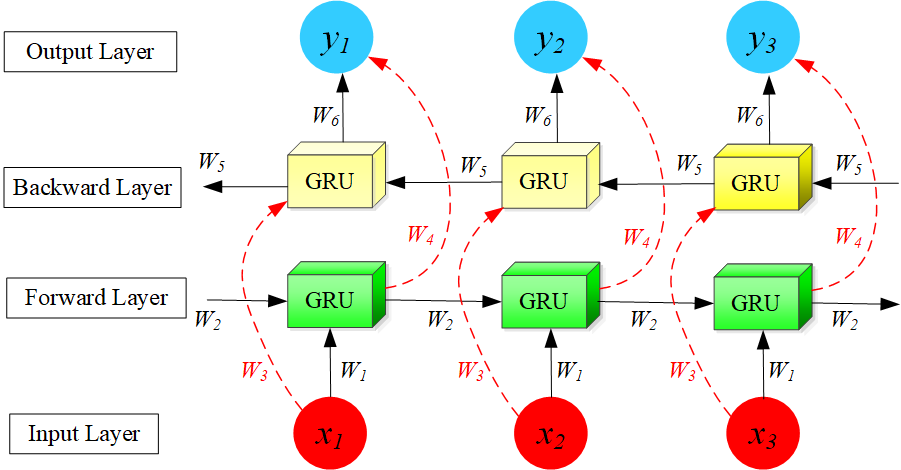
With the increasing global focus on renewable energy and the growing proportion of renewable power in the energy mix, accurate forecasting of renewable power demand has become crucial. This study addresses this challenge by proposing a multimodal information fusion approach that integrates time series data and textual data to leverage complementary information from heterogeneous sources. We develop a hybrid predictive model combining CNN and Bi-GRU architectures. First, time series data (e.g., historical power generation) and textual data (e.g., policy documents) are preprocessed through normalization and tokenization. Next, CNNs extract spatial features from both data modalities, which are fused via concatenation. The fused features are then fed into a Bi-GRU network to capture temporal dependencies, ultimately forming a robust CNN-Bi-GRU model. Comparative experiments with ARIMA, standalone GRU, and EEMD-ARIMA (a hybrid model combining ensemble empirical mode decomposition with ARIMA) demonstrate the superiority of our approach in both short- and long-term forecasting tasks on the same dataset. This research offers a potential framework to enhance renewable power demand prediction, supporting the industry’s sustainable growth and practical applications.
Graphical Abstract
Keywords
Data Availability Statement
Funding
Conflicts of Interest
Ethical Approval and Consent to Participate
References
- Singh, A. K., Ibraheem, S. K., Muazzam, M., & Chaturvedi, D. K. (2013). An overview of electricity demand forecasting techniques. Network and complex systems, 3(3), 38-48.
[Google Scholar] - Mir, A. A., Alghassab, M., Ullah, K., Khan, Z. A., Lu, Y., & Imran, M. (2020). A review of electricity demand forecasting in low and middle income countries: The demand determinants and horizons. Sustainability, 12(15), 5931.
[CrossRef] [Google Scholar] - Bianco, V., Manca, O., & Nardini, S. (2013). Linear regression models to forecast electricity consumption in Italy. Energy Sources, Part B: Economics, Planning, and Policy, 8(1), 86-93.
[CrossRef] [Google Scholar] - Arisoy, I., & Ozturk, I. (2014). Estimating industrial and residential electricity demand in Turkey: A time varying parameter approach. Energy, 66, 959-964.
[CrossRef] [Google Scholar] - Pappas, S. S., Ekonomou, L., Karamousantas, D. C., Chatzarakis, G. E., Katsikas, S. K., & Liatsis, P. (2008). Electricity demand loads modeling using AutoRegressive Moving Average (ARMA) models. Energy, 33(9), 1353-1360.
[CrossRef] [Google Scholar] - Erdogdu, E. (2007). Electricity demand analysis using cointegration and ARIMA modelling: A case study of Turkey. Energy policy, 35(2), 1129-1146.
[CrossRef] [Google Scholar] - Wang, Y., Wang, J., Zhao, G., & Dong, Y. (2012). Application of residual modification approach in seasonal ARIMA for electricity demand forecasting: A case study of China. Energy Policy, 48, 284-294.
[CrossRef] [Google Scholar] - Mitkov, A., Noorzad, N., Gabrovska-Evstatieva, K., & Mihailov, N. (2019, June). Forecasting the energy consumption in Afghanistan with the ARIMA model. In 2019 16th conference on electrical machines, drives and power systems (ELMA) (pp. 1-4). IEEE.
[CrossRef] [Google Scholar] - Hippert, H. S., Pedreira, C. E., & Souza, R. C. (2001). Neural networks for short-term load forecasting: A review and evaluation. IEEE Transactions on power systems, 16(1), 44-55.
[CrossRef] [Google Scholar] - Amjady, N. (2001). Short-term hourly load forecasting using time-series modeling with peak load estimation capability. IEEE Transactions on power systems, 16(3), 498-505.
[CrossRef] [Google Scholar] - Feinberg, E. A., & Genethliou, D. (2005). Load forecasting. Applied mathematics for restructured electric power systems: optimization, control, and computational intelligence, 269-285.
[CrossRef] [Google Scholar] - Kyriakides, E., & Polycarpou, M. (2007). Short term electric load forecasting: A tutorial. Trends in neural computation, 391-418.
[CrossRef] [Google Scholar] - Kuo, P. H., & Huang, C. J. (2018). A high precision artificial neural networks model for short-term energy load forecasting. Energies, 11(1), 213.
[CrossRef] [Google Scholar] - Perrusquía, A., & Yu, W. (2021). Identification and optimal control of nonlinear systems using recurrent neural networks and reinforcement learning: An overview. Neurocomputing, 438, 145-154.
[CrossRef] [Google Scholar] - AlShafeey, M., & Csáki, C. (2021). Evaluating neural network and linear regression photovoltaic power forecasting models based on different input methods. Energy Reports, 7, 7601-7614.
[CrossRef] [Google Scholar] - Wu, C., Wang, J., Chen, X., Du, P., & Yang, W. (2020). A novel hybrid system based on multi-objective optimization for wind speed forecasting. Renewable energy, 146, 149-165.
[CrossRef] [Google Scholar] - Bedi, J., & Toshniwal, D. (2019). Deep learning framework to forecast electricity demand. Applied energy, 238, 1312-1326.
[CrossRef] [Google Scholar] - Valenzuela, O., Rojas, I., Rojas, F., Pomares, H., Herrera, L. J., Guillén, A., ... & Pasadas, M. (2008). Hybridization of intelligent techniques and ARIMA models for time series prediction. Fuzzy sets and systems, 159(7), 821-845.
[CrossRef] [Google Scholar] - Liu, Y., Guan, L., Hou, C., Han, H., Liu, Z., Sun, Y., & Zheng, M. (2019). Wind power short-term prediction based on LSTM and discrete wavelet transform. Applied Sciences, 9(6), 1108.
[CrossRef] [Google Scholar] - Nie, Y., Jiang, P., & Zhang, H. (2020). A novel hybrid model based on combined preprocessing method and advanced optimization algorithm for power load forecasting. Applied Soft Computing, 97, 106809.
[CrossRef] [Google Scholar] - Saglam, M., Spataru, C., & Karaman, O. A. (2022). Electricity demand forecasting with use of artificial intelligence: the case of Gokceada Island. Energies, 15(16), 5950.
[CrossRef] [Google Scholar] - Zhang, W., Quan, H., & Srinivasan, D. (2018). An improved quantile regression neural network for probabilistic load forecasting. IEEE Transactions on Smart Grid, 10(4), 4425-4434.
[CrossRef] [Google Scholar] - Lee, S. J. (2023). Multimodal Data Fusion for Estimating Electricity Access and Demand (Doctoral dissertation, Massachusetts Institute of Technology).
[Google Scholar] - Xuan, Y., Si, W., Zhu, J., Sun, Z., Zhao, J., Xu, M., & Xu, S. (2021). Multi-model fusion short-term load forecasting based on random forest feature selection and hybrid neural network. IEEE Access, 9, 69002-69009.
[CrossRef] [Google Scholar] - Ji, Q., Zhang, S., Duan, Q., Gong, Y., Li, Y., Xie, X., ... & Zhao, X. (2022). Short-and medium-term power demand forecasting with multiple factors based on multi-model fusion. Mathematics, 10(12), 2148.
[CrossRef] [Google Scholar] - Kong, Z., Zhang, C., Lv, H., Xiong, F., & Fu, Z. (2020). Multimodal feature extraction and fusion deep neural networks for short-term load forecasting. IEEE Access, 8, 185373-185383.
[CrossRef] [Google Scholar] - Mikolov, T., Chen, K., Corrado, G., & Dean, J. (2013). Efficient estimation of word representations in vector space. arXiv preprint arXiv:1301.3781.
[CrossRef] [Google Scholar] - Szegedy, C., Vanhoucke, V., Ioffe, S., Shlens, J., & Wojna, Z. (2016). Rethinking the inception architecture for computer vision. In Proceedings of the IEEE conference on computer vision and pattern recognition (pp. 2818-2826).
[Google Scholar] - Er, M. J., Zhang, Y., Wang, N., & Pratama, M. (2016). Attention pooling-based convolutional neural network for sentence modelling. Information Sciences, 373, 388-403.
[CrossRef] [Google Scholar] - Yang, J., Yang, J. Y., Zhang, D., & Lu, J. F. (2003). Feature fusion: parallel strategy vs. serial strategy. Pattern recognition, 36(6), 1369-1381.
[CrossRef] [Google Scholar] - Huang, G., Liu, Z., Van Der Maaten, L., & Weinberger, K. Q. (2017). Densely connected convolutional networks. In Proceedings of the IEEE conference on computer vision and pattern recognition (pp. 4700-4708).
[Google Scholar]
Cited By (20)
-
Riaz K. Israni, Bhagyashree Rajeshkumar Shah, Poonam Nanjibhai Parmar, Yuvraj Kaushik Jani, Deepali Vishnu Bavlecha, Jatin Sureshchandra Agravat. .
Artificial Intelligence Based Smart and Secured Applications, 2026 , 2823 .
[CrossRef] -
Smita Singh, Snehlata, Sneha Jaiswal, Mohit Saxena. .
Next-Generation Networks and Deployable Artificial Intelligence, 2026 , 1792 .
[CrossRef] -
Remon Das, Tarek Kandil, Adam Harris, Bryson Herron, Ethan J. Magnante. A Hybrid Deep Learning Framework for National Level Power Generation Forecasting of Different Energy Sources Including Renewable Energy and Fossil Fuel.
Energies, 2026 , 19 (6).
[CrossRef] -
Parathraju P, Ram Kumar C, Alaudeen A, Sundar R, Silambarasan V, Amosedinakaran S. .
2026 International Conference on Emerging Trends in Mobile Computing and Sustainable Informatics (ICEMCSI), 2026 .
[CrossRef] -
Oluwagbenga Apata, Mukovhe Ratshitanga, Innocent Ewean Davidson. AI-Driven Load Forecasting for Dynamic Tariff Structuring: A Comprehensive Review.
Energies, 2026 , 19 (16).
[CrossRef] -
Syed Zarak Shah, Kaleem Ullah, Syed Mustafa Ali, Syed Ahmad Saleem Bokhari, Zafar Ullah Khan, Shehzad Ahmad, Pramita Mishra. Hybrid Bi‐LSTM–GRU Framework for Solar Energy Forecasting in Modern Power Systems.
International Transactions on Electrical Energy Systems, 2026 , 2026 (1).
[CrossRef] -
Zahraa Qasim Abed Al-Ezzi, Johnny Koh Siaw Paw, Jagadeesh Pasupuleti, Mustafa Musa Jaber. A hybrid deep temporal CNN For accurate real-time smart grid load forecasting.
Sustainable Computing: Informatics and Systems, 2026 , 50 .
[CrossRef] -
Hamdullah Karamollaoğlu. Histogram tabanlı gradyan artırma yöntemi ile Türkiye için kısa vadeli elektrik talep tahmini.
Ömer Halisdemir Üniversitesi Mühendislik Bilimleri Dergisi, 2026 , 17 .
[CrossRef] -
Avan Kumar, Sunghoon Kim, Bhavik R Bakshi. Role of artificial intelligence in the chemical industry transition to a sustainable, circular, and net-zero future.
Current Opinion in Chemical Engineering, 2026 , 51 .
[CrossRef] -
B. N. Bushra, K. Rajesh, Ah Heng You, Wai Kit Wong, Poh Kiat Ng. .
2026 8th International Conference on Inventive Material Science and Applications (ICIMA), 2026 .
[CrossRef] -
Chengjia Tang, Fangquan Wu, Junxin Wang, Junhan Hu, Weiqi Xiong. .
2025 2nd International Conference on Intelligent Algorithms for Computational Intelligence Systems (IACIS), 2025 .
[CrossRef] -
Anjan Gundaboina. .
2025 3rd International Conference on Sustainable Computing and Smart Systems (ICSCSS), 2025 .
[CrossRef] -
Yıldırım Özüpak, Shuhratjon Mansurov. A Hybrid Deep Learning Approach for Multi‐Output Short‐Term Electricity Demand Forecasting.
Concurrency and Computation: Practice and Experience, 2025 , 37 (25-26).
[CrossRef] -
Linying Tang, Junyi Gao, Yi Su. Chebyshev polynomial KAN-BiGRU model for hybrid renewable energy forecasting.
Physica Scripta, 2025 , 100 (11).
[CrossRef] -
Xiaoling Li, Kai Li. Dynamic load forecasting of thermal storage system based on multimodal transformer.
Thermal Science, 2025 , 29 (6 Part A).
[CrossRef] -
Dhinesh Kanna S, Thirunavukkarasan M. .
2025 IEEE International Conference on Communication Networks and Computing (CNC), 2025 .
[CrossRef] -
Lalit Sachdeva, Azimjanov Nazirbek, R. Gunasundari, Haeedir Mohameed, Saurabh, P Priyadharsini. .
2025 International Conference on Innovations and Emerging Technologies In AI & Communication Systems (IETACS), 2025 .
[CrossRef] -
Hiren Mewada, Lingala Syam Sundar. .
2025 International Symposium on Networks, Computers and Communications (ISNCC), 2025 .
[CrossRef] -
Adam Harris, Remon Das, Tarek Kandil. .
2025 57th North American Power Symposium (NAPS), 2025 .
[CrossRef] -
Fatima Aabadi, Yann Ben Maissa, Hamza Dahmouni, Ahmed Tamtaoui, Mohamed El Aroussi. .
2025 11th International Conference on Optimization and Applications (ICOA), 2025 .
[CrossRef]
Cite This Article
TY  - JOUR
AU  - Zhao, Shuchen
AU  - Xu, Zhongjin
AU  - Zhu, Zhefan
AU  - Liang, Xiaoxiang
AU  - Zhang, Zecheng
AU  - Jiang, Ruxue
PY  - 2025
DA  - 2025/02/16
TI  - Short and Long-Term Renewable Electricity Demand Forecasting Based on CNN-Bi-GRU Model
JO  - ICCK Transactions on Emerging Topics in Artificial Intelligence
T2  - ICCK Transactions on Emerging Topics in Artificial Intelligence
JF  - ICCK Transactions on Emerging Topics in Artificial Intelligence
VL  - 2
IS  - 1
SP  - 1
EP  - 15
DO  - 10.62762/TETAI.2024.532253
UR  - https://www.icck.org/article/abs/TETAI.2024.532253
KW  - multimodal information fusion
KW  - renewable electricity demand forecasting
KW  - CNN
KW  - Bi-GRU
KW  - predictive performance
AB  - With the increasing global focus on renewable energy and the growing proportion of renewable power in the energy mix, accurate forecasting of renewable power demand has become crucial. This study addresses this challenge by proposing a multimodal information fusion approach that integrates time series data and textual data to leverage complementary information from heterogeneous sources. We develop a hybrid predictive model combining CNN and Bi-GRU architectures. First, time series data (e.g., historical power generation) and textual data (e.g., policy documents) are preprocessed through normalization and tokenization. Next, CNNs extract spatial features from both data modalities, which are fused via concatenation. The fused features are then fed into a Bi-GRU network to capture temporal dependencies, ultimately forming a robust CNN-Bi-GRU model. Comparative experiments with ARIMA, standalone GRU, and EEMD-ARIMA (a hybrid model combining ensemble empirical mode decomposition with ARIMA) demonstrate the superiority of our approach in both short- and long-term forecasting tasks on the same dataset. This research offers a potential framework to enhance renewable power demand prediction, supporting the industry’s sustainable growth and practical applications.
SN  - 3068-6652
PB  - Institute of Central Computation and Knowledge
LA  - English
ER  -
@article{Zhao2025Short,
  author = {Shuchen Zhao and Zhongjin Xu and Zhefan Zhu and Xiaoxiang Liang and Zecheng Zhang and Ruxue Jiang},
  title = {Short and Long-Term Renewable Electricity Demand Forecasting Based on CNN-Bi-GRU Model},
  journal = {ICCK Transactions on Emerging Topics in Artificial Intelligence},
  year = {2025},
  volume = {2},
  number = {1},
  pages = {1-15},
  doi = {10.62762/TETAI.2024.532253},
  url = {https://www.icck.org/article/abs/TETAI.2024.532253},
  abstract = {With the increasing global focus on renewable energy and the growing proportion of renewable power in the energy mix, accurate forecasting of renewable power demand has become crucial. This study addresses this challenge by proposing a multimodal information fusion approach that integrates time series data and textual data to leverage complementary information from heterogeneous sources. We develop a hybrid predictive model combining CNN and Bi-GRU architectures. First, time series data (e.g., historical power generation) and textual data (e.g., policy documents) are preprocessed through normalization and tokenization. Next, CNNs extract spatial features from both data modalities, which are fused via concatenation. The fused features are then fed into a Bi-GRU network to capture temporal dependencies, ultimately forming a robust CNN-Bi-GRU model. Comparative experiments with ARIMA, standalone GRU, and EEMD-ARIMA (a hybrid model combining ensemble empirical mode decomposition with ARIMA) demonstrate the superiority of our approach in both short- and long-term forecasting tasks on the same dataset. This research offers a potential framework to enhance renewable power demand prediction, supporting the industry’s sustainable growth and practical applications.},
  keywords = {multimodal information fusion, renewable electricity demand forecasting, CNN, Bi-GRU, predictive performance},
  issn = {3068-6652},
  publisher = {Institute of Central Computation and Knowledge}
}
Publisher's Note
ICCK stays neutral with regard to jurisdictional claims in published maps and institutional affiliations.
Rights and Permissions
 Copyright © 2025 by the Author(s). Published by Institute of Central Computation and Knowledge. This article is an open access article distributed under the terms and conditions of the Creative Commons Attribution (CC BY) license (https://creativecommons.org/licenses/by/4.0/), which permits use, sharing, adaptation, distribution and reproduction in any medium or format, as long as you give appropriate credit to the original author(s) and the source, provide a link to the Creative Commons licence, and indicate if changes were made.


Portico
