

Federated Learning for Artificial Intelligence in Embedded Systems




Article Information
Abstract
Federated Learning (FL) has emerged as a principled paradigm for privacy-preserving decentralized machine learning, enabling model training across distributed embedded devices without centralizing sensitive data. This review examines FL as applied to resource-constrained embedded and edge AI systems, encompassing its architectural foundations, principal optimization algorithms, application domains, and security mechanisms. We analyze the interplay between FL's theoretical properties and the practical constraints imposed by heterogeneous embedded hardware, non-IID data distributions, bandwidth-limited IoT networks, and adversarial threat models. Application domains examined in depth include smart healthcare, autonomous vehicles, industrial IoT, precision agriculture, smart home automation, and urban infrastructure, with attention to how FL enables privacy-preserving AI deployment in each context. We further review the principal techniques that make embedded FL viable---including FedAvg, FedProx, model compression, gradient sparsification, differential privacy, secure multi-party computation, and blockchain-secured aggregation---and identify open research gaps in heterogeneous model aggregation and adaptive privacy protection. Future directions encompassing TinyML integration, federated reinforcement learning, and next-generation 5G/6G network infrastructure are discussed. The review aims to provide a technically grounded reference for researchers and practitioners seeking to deploy FL in real-world embedded environments where privacy, energy efficiency, and communication constraints are simultaneously binding.
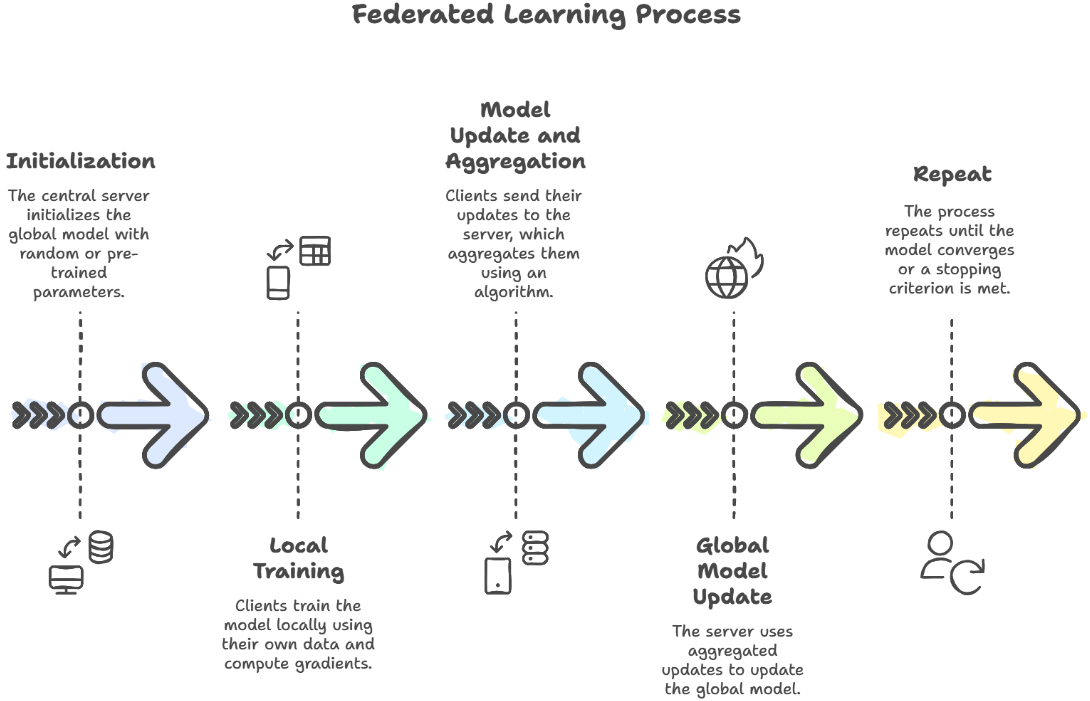
Graphical Abstract
Keywords
Data Availability Statement
Funding
Conflicts of Interest
Ethical Approval and Consent to Participate
References
- McMahan, B., Moore, E., Ramage, D., Hampson, S., & y Arcas, B. A. (2017, April). Communication-efficient learning of deep networks from decentralized data. In Artificial intelligence and statistics (pp. 1273-1282). PMLR. https://proceedings.mlr.press/v54/mcmahan17a?ref=https://githubhelp.com
[Google Scholar] - Imteaj, A., Thakker, U., Wang, S., Li, J., & Amini, M. H. (2021). A survey on federated learning for resource-constrained IoT devices. IEEE Internet of Things Journal, 9(1), 1-24.
[CrossRef] [Google Scholar] - Hazra, A., Adhikari, M., Nandy, S., Doulani, K., & Menon, V. G. (2022). Federated-learning-aided next-generation edge networks for intelligent services. IEEE Network, 36(3), 56-64.
[CrossRef] [Google Scholar] - Abdelmoniem, A. M., Ho, C. Y., Papageorgiou, P., & Canini, M. (2023). A comprehensive empirical study of heterogeneity in federated learning. IEEE Internet of Things Journal, 10(16), 14071-14083.
[CrossRef] [Google Scholar] - Li, T., Sahu, A. K., Zaheer, M., Sanjabi, M., Talwalkar, A., & Smith, V. (2020). Federated optimization in heterogeneous networks. Proceedings of Machine learning and systems, 2, 429-450.
[Google Scholar] - Konečný, J., McMahan, H. B., Yu, F. X., Richtárik, P., Suresh, A. T., & Bacon, D. (2016). Federated learning: Strategies for improving communication efficiency. arXiv preprint arXiv:1610.05492.
[CrossRef] [Google Scholar] - Kairouz, P., McMahan, H. B., Avent, B., Bellet, A., Bennis, M., Bhagoji, A. N., ... & Zhao, S. (2021). Advances and open problems in federated learning. Foundations and trends® in machine learning, 14(1-2), 1-210.
[CrossRef] [Google Scholar] - Li, T., Sahu, A. K., Talwalkar, A., & Smith, V. (2020). Federated learning: Challenges, methods, and future directions. IEEE signal processing magazine, 37(3), 50-60.
[CrossRef] [Google Scholar] - Aledhari, M., Razzak, R., Parizi, R. M., & Saeed, F. (2020). Federated learning: A survey on enabling technologies, protocols, and applications. IEEE Access, 8, 140699-140725.
[CrossRef] [Google Scholar] - Nguyen, D. C., Ding, M., Pathirana, P. N., Seneviratne, A., Li, J., & Poor, H. V. (2021). Federated learning for internet of things: A comprehensive survey. IEEE Communications Surveys & Tutorials, 23(3), 1622-1658.
[CrossRef] [Google Scholar] - Bagdasaryan, E., Veit, A., Hua, Y., Estrin, D., & Shmatikov, V. (2020, June). How to backdoor federated learning. In International conference on artificial intelligence and statistics (pp. 2938-2948). PMLR.
[Google Scholar] - Shejwalkar, V., & Houmansadr, A. (2021, January). Manipulating the byzantine: Optimizing model poisoning attacks and defenses for federated learning. In NDSS. https://par.nsf.gov/servlets/purl/10286354
[Google Scholar] - Mahlool, D. H., & Abed, M. H. (2022). A comprehensive survey on federated learning: Concept and applications. Mobile Computing and Sustainable Informatics: Proceedings of ICMCSI 2022, 539-553.
[CrossRef] [Google Scholar] - Rieke, N., Hancox, J., Li, W., Milletari, F., Roth, H. R., Albarqouni, S., ... & Cardoso, M. J. (2020). The future of digital health with federated learning. NPJ digital medicine, 3(1), 119.
[CrossRef] [Google Scholar] - Nguyen, V. D., Sharma, S. K., Vu, T. X., Chatzinotas, S., & Ottersten, B. (2020). Efficient federated learning algorithm for resource allocation in wireless IoT networks. IEEE Internet of Things Journal, 8(5), 3394-3409.
[CrossRef] [Google Scholar] - Bonawitz, K., Eichner, H., Grieskamp, W., Huba, D., Ingerman, A., Ivanov, V., ... & Roselander, J. (2019). Towards federated learning at scale: System design. Proceedings of machine learning and systems, 1, 374-388.
[Google Scholar] - Dutta, L., & Bharali, S. (2021). Tinyml meets iot: A comprehensive survey. Internet of Things, 16, 100461.
[CrossRef] [Google Scholar] - Zhang, W., Lu, Q., Yu, Q., Li, Z., Liu, Y., Lo, S. K., ... & Zhu, L. (2020). Blockchain-based federated learning for device failure detection in industrial IoT. IEEE Internet of Things Journal, 8(7), 5926-5937.
[CrossRef] [Google Scholar] - Qi, Q., & Chen, X. (2022). Robust design of federated learning for edge-intelligent networks. IEEE Transactions on Communications, 70(7), 4469-4481.
[CrossRef] [Google Scholar] - Yin, F., Lin, Z., Kong, Q., Xu, Y., Li, D., Theodoridis, S., & Cui, S. R. (2020). FedLoc: Federated learning framework for data-driven cooperative localization and location data processing. IEEE Open Journal of Signal Processing, 1, 187-215.
[CrossRef] [Google Scholar] - Liu, Z., Guo, J., Yang, W., Fan, J., Lam, K. Y., & Zhao, J. (2022). Privacy-preserving aggregation in federated learning: A survey. IEEE Transactions on Big Data.
[CrossRef] [Google Scholar] - El Ouadrhiri, A., & Abdelhadi, A. (2022). Differential privacy for deep and federated learning: A survey. IEEE access, 10, 22359-22380.
[CrossRef] [Google Scholar] - Kanagavelu, R., Li, Z., Samsudin, J., Yang, Y., Yang, F., Goh, R. S. M., ... & Wang, S. (2020, May). Two-phase multi-party computation enabled privacy-preserving federated learning. In 2020 20th IEEE/ACM international symposium on cluster, cloud and internet computing (CCGRID) (pp. 410-419). IEEE.
[CrossRef] [Google Scholar] - Mazzocca, C., Romandini, N., Mendula, M., Montanari, R., & Bellavista, P. (2023). TruFLaaS: Trustworthy federated learning as a service. IEEE Internet of Things Journal, 10(24), 21266-21281.
[CrossRef] [Google Scholar] - Zhang, J., Chen, J., Wu, D., Chen, B., & Yu, S. (2019, August). Poisoning attack in federated learning using generative adversarial nets. In 2019 18th IEEE international conference on trust, security and privacy in computing and communications/13th IEEE international conference on big data science and engineering (TrustCom/BigDataSE) (pp. 374-380). IEEE.
[CrossRef] [Google Scholar] - Truex, S., Baracaldo, N., Anwar, A., Steinke, T., Ludwig, H., Zhang, R., & Zhou, Y. (2019, November). A hybrid approach to privacy-preserving federated learning. In Proceedings of the 12th ACM workshop on artificial intelligence and security (pp. 1-11).
[CrossRef] [Google Scholar] - Liu, Y. N., Wang, Y. P., Wang, X. F., Xia, Z., & Xu, J. F. (2019). Privacy-preserving raw data collection without a trusted authority for IoT. Computer Networks, 148, 340-348.
[CrossRef] [Google Scholar] - Li, X., Huang, K., Yang, W., Wang, S., & Zhang, Z. (2019). On the convergence of fedavg on non-iid data. arXiv preprint arXiv:1907.02189.
[CrossRef] [Google Scholar] - Hard, A., Rao, K., Mathews, R., Ramaswamy, S., Beaufays, F., Augenstein, S., ... & Ramage, D. (2018). Federated learning for mobile keyboard prediction. arXiv preprint arXiv:1811.03604.
[CrossRef] [Google Scholar] - Fusco, P., Rimoli, G. P., & Ficco, M. (2025). TinyML and federated learning for resource-constrained medical devices. In Artificial Intelligence Techniques for Analysing Sensitive Data in Medical Cyber-Physical Systems: System Protection and Data Analysis (pp. 113-126). Cham: Springer Nature Switzerland.
[CrossRef] [Google Scholar] - Wang, H., Kaplan, Z., Niu, D., & Li, B. (2020, July). Optimizing federated learning on non-iid data with reinforcement learning. In IEEE INFOCOM 2020-IEEE Conference on computer communications (pp. 1698-1707). IEEE.
[CrossRef] [Google Scholar] - Jiang, Y., Wang, S., Valls, V., Ko, B. J., Lee, W. H., Leung, K. K., & Tassiulas, L. (2022). Model pruning enables efficient federated learning on edge devices. IEEE Transactions on Neural Networks and Learning Systems, 34(12), 10374-10386.
[CrossRef] [Google Scholar] - Abadi, M., Chu, A., Goodfellow, I., McMahan, H. B., Mironov, I., Talwar, K., & Zhang, L. (2016, October). Deep learning with differential privacy. In Proceedings of the 2016 ACM SIGSAC conference on computer and communications security (pp. 308-318).
[CrossRef] [Google Scholar] - Short, A. R., Leligou, H. C., & Theocharis, E. (2021, January). Execution of a Federated Learning process within a smart contract. In 2021 IEEE International Conference on Consumer Electronics (ICCE) (pp. 1-4). IEEE.
[CrossRef] [Google Scholar] - Klaine, P. V., Xu, H., Zhang, L., Imran, M., & Zhu, Z. (2023). A privacy-preserving blockchain platform for a data marketplace. Distributed Ledger Technologies: Research and Practice, 2(1), 1-16.
[CrossRef] [Google Scholar] - Blanchard, P., El Mhamdi, E. M., Guerraoui, R., & Stainer, J. (2017). Machine learning with adversaries: Byzantine tolerant gradient descent. Advances in neural information processing systems, 30.
[Google Scholar] - Fang, M., Cao, X., Jia, J., & Gong, N. (2020). Local model poisoning attacks to {Byzantine-Robust federated learning. In 29th USENIX security symposium (USENIX Security 20) (pp. 1605-1622). https://www.usenix.org/conference/usenixsecurity20/presentation/fang
[Google Scholar] - Chen, Y., Su, L., & Xu, J. (2017). Distributed statistical machine learning in adversarial settings: Byzantine gradient descent. Proceedings of the ACM on Measurement and Analysis of Computing Systems, 1(2), 1-25.
[CrossRef] [Google Scholar] - Niknam, S., Dhillon, H. S., & Reed, J. H. (2020). Federated learning for wireless communications: Motivation, opportunities, and challenges. IEEE Communications Magazine, 58(6), 46-51.
[CrossRef] [Google Scholar] - Konečný, J., McMahan, H. B., Ramage, D., & Richtárik, P. (2016). Federated optimization: Distributed machine learning for on-device intelligence. arXiv preprint arXiv:1610.02527.
[CrossRef] [Google Scholar] - Sattler, F., Wiedemann, S., Müller, K. R., & Samek, W. (2019). Robust and communication-efficient federated learning from non-iid data. IEEE transactions on neural networks and learning systems, 31(9), 3400-3413.
[CrossRef] [Google Scholar] - Kishor, K. (2022). Communication-efficient federated learning. In Federated Learning for IoT Applications (pp. 135-156). Cham: Springer International Publishing.
[CrossRef] [Google Scholar]
Cited By (6)
-
Bulus Bali, Favanza Iliya Kwaha. AI-Powered Wearable Devices for Real-Time Health Monitoring: Technologies, Challenges, and Emerging Trends.
Journal of Engineering Advancements, 2026 , 7 (02).
[CrossRef] -
Mazin Alshamrani, Shema Alhazmi, Tarik Alafif, Thamir M. Qadah, Malak Aljabri, Walla Al-Eidarous, Abdullah Alhawsawi, Majed Farrash. Machine Learning-Based Prediction Model of Pilgrims’ Tiredness During Hajj Using Smartwatch Physiological and Mobility Indicators.
Sensors, 2026 , 26 (17).
[CrossRef] -
Harjot Kaur Gill, Jagdeep Singh, Akshay Girdhar. .
2026 10th International Conference on Inventive Systems and Control (ICISC), 2026 .
[CrossRef] -
Chandan B Ram, Nirmala. M B, Swathi Papanna Gari. .
2025 2nd International Conference on Software, Systems and Information Technology (SSITCON), 2025 .
[CrossRef] -
Motlokwe Calvin Thobejane. .
Proceedings of the 2025 8th Artificial Intelligence and Cloud Computing Conference, 2025 .
[CrossRef] -
Sivashanmugam Thangavel, M.Revathi, Dr.R.Meenakshi, S Sujatha, Monisha R, Sathishkumar V E. .
2025 6th International Conference on Smart Electronics and Communication (ICOSEC), 2025 .
[CrossRef]
Cite This Article
TY  - JOUR
AU  - Radhakrishnan, Kanthavel
AU  - Ramakrishnan, Dhaya
AU  - Freeda, R. Adline
PY  - 2025
DA  - 2025/06/27
TI  - Federated Learning for Artificial Intelligence in Embedded Systems
JO  - ICCK Transactions on Emerging Topics in Artificial Intelligence
T2  - ICCK Transactions on Emerging Topics in Artificial Intelligence
JF  - ICCK Transactions on Emerging Topics in Artificial Intelligence
VL  - 2
IS  - 2
SP  - 91
EP  - 115
DO  - 10.62762/TETAI.2025.440076
UR  - https://www.icck.org/article/abs/TETAI.2025.440076
KW  - federated learning
KW  - embedded systems
KW  - artificial intelligence
KW  - edge computing
KW  - privacy-preserving internet of things
KW  - machine learning at the edge
KW  - data privacy
KW  - decentralized machine learning
AB  - Federated Learning (FL) has emerged as a principled paradigm for privacy-preserving decentralized machine learning, enabling model training across distributed embedded devices without centralizing sensitive data. This review examines FL as applied to resource-constrained embedded and edge AI systems, encompassing its architectural foundations, principal optimization algorithms, application domains, and security mechanisms. We analyze the interplay between FL's theoretical properties and the practical constraints imposed by heterogeneous embedded hardware, non-IID data distributions, bandwidth-limited IoT networks, and adversarial threat models. Application domains examined in depth include smart healthcare, autonomous vehicles, industrial IoT, precision agriculture, smart home automation, and urban infrastructure, with attention to how FL enables privacy-preserving AI deployment in each context. We further review the principal techniques that make embedded FL viable---including FedAvg, FedProx, model compression, gradient sparsification, differential privacy, secure multi-party computation, and blockchain-secured aggregation---and identify open research gaps in heterogeneous model aggregation and adaptive privacy protection. Future directions encompassing TinyML integration, federated reinforcement learning, and next-generation 5G/6G network infrastructure are discussed. The review aims to provide a technically grounded reference for researchers and practitioners seeking to deploy FL in real-world embedded environments where privacy, energy efficiency, and communication constraints are simultaneously binding.
SN  - 3068-6652
PB  - Institute of Central Computation and Knowledge
LA  - English
ER  -
@article{Radhakrishnan2025Federated,
  author = {Kanthavel Radhakrishnan and Dhaya Ramakrishnan and R. Adline Freeda},
  title = {Federated Learning for Artificial Intelligence in Embedded Systems},
  journal = {ICCK Transactions on Emerging Topics in Artificial Intelligence},
  year = {2025},
  volume = {2},
  number = {2},
  pages = {91-115},
  doi = {10.62762/TETAI.2025.440076},
  url = {https://www.icck.org/article/abs/TETAI.2025.440076},
  abstract = {Federated Learning (FL) has emerged as a principled paradigm for privacy-preserving decentralized machine learning, enabling model training across distributed embedded devices without centralizing sensitive data. This review examines FL as applied to resource-constrained embedded and edge AI systems, encompassing its architectural foundations, principal optimization algorithms, application domains, and security mechanisms. We analyze the interplay between FL's theoretical properties and the practical constraints imposed by heterogeneous embedded hardware, non-IID data distributions, bandwidth-limited IoT networks, and adversarial threat models. Application domains examined in depth include smart healthcare, autonomous vehicles, industrial IoT, precision agriculture, smart home automation, and urban infrastructure, with attention to how FL enables privacy-preserving AI deployment in each context. We further review the principal techniques that make embedded FL viable---including FedAvg, FedProx, model compression, gradient sparsification, differential privacy, secure multi-party computation, and blockchain-secured aggregation---and identify open research gaps in heterogeneous model aggregation and adaptive privacy protection. Future directions encompassing TinyML integration, federated reinforcement learning, and next-generation 5G/6G network infrastructure are discussed. The review aims to provide a technically grounded reference for researchers and practitioners seeking to deploy FL in real-world embedded environments where privacy, energy efficiency, and communication constraints are simultaneously binding.},
  keywords = {federated learning, embedded systems, artificial intelligence, edge computing, privacy-preserving internet of things, machine learning at the edge, data privacy, decentralized machine learning},
  issn = {3068-6652},
  publisher = {Institute of Central Computation and Knowledge}
}
Publisher's Note
ICCK stays neutral with regard to jurisdictional claims in published maps and institutional affiliations.
Rights and Permissions
 Copyright © 2025 by the Author(s). Published by Institute of Central Computation and Knowledge. This article is an open access article distributed under the terms and conditions of the Creative Commons Attribution (CC BY) license (https://creativecommons.org/licenses/by/4.0/), which permits use, sharing, adaptation, distribution and reproduction in any medium or format, as long as you give appropriate credit to the original author(s) and the source, provide a link to the Creative Commons licence, and indicate if changes were made.


Portico
