Deep Prediction Network Based on Covariance Intersection Fusion for Sensor Data






Article Information
Abstract
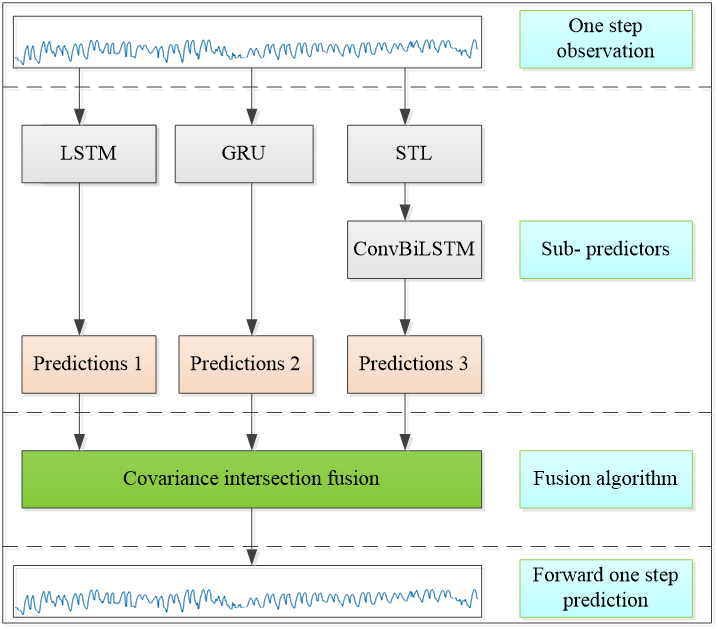
To predict future trends based on the data from sensors is an important technology for many applications, such as the Internet of Things, smart cities, etc. Based on the predicted results, further decisions and system controls can be made. Raw sensor data sets are often complex non-linear data with noise, which results in the difficulty of accurate prediction. This paper proposes a distributed deep prediction network based on a covariance intersection (CI) fusion algorithm in which the deep learning networks, such as long short-term memory networks (LSTM) and gated recurrent unit networks (GRU) are fused by CI fusion algorithm to effectively improve the performance of prediction. Moreover, the variance is obtained to evaluate the prediction results. The model is validated on the real weather dataset in Beijing. The experiments show that LSTM and GRU have their pros and cons for different data, CI fusion can improve the accuracy of the final predictions, and the entire framework has robust prediction results with a reasonable estimated variance.
Graphical Abstract
Keywords
Data Availability Statement
Funding
Conflicts of Interest
Ethical Approval and Consent to Participate
References
- Zhang, G. P. (2003). Time series forecasting using a hybrid ARIMA and neural network model. Neurocomputing, 50, 159-175.
[CrossRef] [Google Scholar] - Thissen, U. V. B. R., Van Brakel, R., De Weijer, A. P., Melssen, W. J., & Buydens, L. M. C. (2003). Using support vector machines for time series prediction. Chemometrics and intelligent laboratory systems, 69(1-2), 35-49.
[CrossRef] [Google Scholar] - Tay, F. E., & Cao, L. (2001). Application of support vector machines in financial time series forecasting. omega, 29(4), 309-317.
[CrossRef] [Google Scholar] - Mikolov, T., Karafiát, M., Burget, L., Cernocký, J., & Khudanpur, S. (2010, September). Recurrent neural network based language model. In Interspeech (Vol. 2, No. 3, pp. 1045-1048).
[CrossRef] [Google Scholar] - Mikolov, T., Kombrink, S., Burget, L., Černocký, J., & Khudanpur, S. (2011, May). Extensions of recurrent neural network language model. In 2011 IEEE international conference on acoustics, speech and signal processing (ICASSP) (pp. 5528-5531). IEEE.
[CrossRef] [Google Scholar] - Connor, J. T., Martin, R. D., & Atlas, L. E. (1994). Recurrent neural networks and robust time series prediction. IEEE transactions on neural networks, 5(2), 240-254.
[CrossRef] [Google Scholar] - Gers, F. A., Schmidhuber, J., & Cummins, F. (2000). Learning to forget: Continual prediction with LSTM. Neural computation, 12(10), 2451-2471.
[CrossRef] [Google Scholar] - Fu, R., Zhang, Z., & Li, L. (2016, November). Using LSTM and GRU neural network methods for traffic flow prediction. In 2016 31st Youth academic annual conference of Chinese association of automation (YAC) (pp. 324-328). IEEE.
[CrossRef] [Google Scholar] - Malhotra, P., Vig, L., Shroff, G., & Agarwal, P. (2015). Long short term memory networks for anomaly detection in time series. In ESANN 2015: Proceedings of the 23rd European Symposium on Artificial Neural Networks (pp. 89-94).
[Google Scholar] - Che, Z., Purushotham, S., Cho, K., Sontag, D., & Liu, Y. (2018). Recurrent neural networks for multivariate time series with missing values. Scientific reports, 8(1), 6085.
[CrossRef] [Google Scholar] - Yao, S., Hu, S., Zhao, Y., Zhang, A., & Abdelzaher, T. (2017, April). Deepsense: A unified deep learning framework for time-series mobile sensing data processing. In Proceedings of the 26th international conference on world wide web (pp. 351-360).
[CrossRef] [Google Scholar] - Osogami, T., Kajino, H., & Sekiyama, T. (2017, July). Bidirectional learning for time-series models with hidden units. In International Conference on Machine Learning (pp. 2711-2720). PMLR.
[CrossRef] [Google Scholar] - Siami-Namini, S., Tavakoli, N., & Namin, A. S. (2019, December). The performance of LSTM and BiLSTM in forecasting time series. In 2019 IEEE International conference on big data (Big Data) (pp. 3285-3292). IEEE.
[CrossRef] [Google Scholar] - Liu, Y., Zheng, H., Feng, X., & Chen, Z. (2017, October). Short-term traffic flow prediction with Conv-LSTM. In 2017 9th international conference on wireless communications and signal processing (WCSP) (pp. 1-6). IEEE.
[CrossRef] [Google Scholar] - Du, S., Li, T., Yang, Y., & Horng, S. J. (2019). Deep air quality forecasting using hybrid deep learning framework. IEEE Transactions on Knowledge and Data Engineering, 33(6), 2412-2424.
[CrossRef] [Google Scholar] - Kim, S., Hong, S., Joh, M., & Song, S. K. (2017). Deeprain: Convlstm network for precipitation prediction using multichannel radar data. arXiv preprint arXiv:1711.02316.
[Google Scholar] - Chen, Y., & Xie, Z. (2022). Multi-channel fusion graph neural network for multivariate time series forecasting. Journal of Computational Science, 64, 101862.
[CrossRef] [Google Scholar] - Li, M., & Zhu, Z. (2021, May). Spatial-temporal fusion graph neural networks for traffic flow forecasting. In Proceedings of the AAAI conference on artificial intelligence (Vol. 35, No. 5, pp. 4189-4196).
[Google Scholar] - Li, H., & Nashashibi, F. (2013). Cooperative multi-vehicle localization using split covariance intersection filter. IEEE Intelligent transportation systems magazine, 5(2), 33-44.
[CrossRef] [Google Scholar] - Qiu, X., Ren, Y., Suganthan, P. N., & Amaratunga, G. A. (2017). Empirical mode decomposition based ensemble deep learning for load demand time series forecasting. Applied soft computing, 54, 246-255.
[CrossRef] [Google Scholar] - Pu, L., Feng, X., & Hou, Z. (2019, May). Covariance intersection fusion for visual tracking with hierarchical features. In Tenth International Conference on Graphics and Image Processing (ICGIP 2018) (Vol. 11069, pp. 1158-1166). SPIE.
[CrossRef] [Google Scholar] - Niehsen, W. (2002, July). Information fusion based on fast covariance intersection filtering. In Proceedings of the Fifth International Conference on Information Fusion. FUSION 2002.(IEEE Cat. No. 02EX5997) (Vol. 2, pp. 901-904). IEEE.
[CrossRef] [Google Scholar] - Hurley, M. B. (2002, July). An information theoretic justification for covariance intersection and its generalization. In Proceedings of the fifth international conference on Information Fusion. FUSION 2002.(IEEE Cat. No. 02EX5997) (Vol. 1, pp. 505-511). IEEE.
[CrossRef] [Google Scholar] - Julier, S., & Uhlmann, J. K. (2017). General decentralized data fusion with covariance intersection. In Handbook of multisensor data fusion (pp. 339-364). CRC Press.
[Google Scholar] - Ma, Y., Zhang, N., & Li, J. (2022). Improved sequential least squares programming–driven feasible path algorithm for process optimisation. In Computer aided chemical engineering (Vol. 51, pp. 1279-1284). Elsevier.
[CrossRef] [Google Scholar]
Cited By (13)
-
Yu Wang, Junhao Qu, Ruifeng Liu, Zibo Wang, Qinying Wang, Kunpeng Shi, Qijie Zhou, Shiwen Xie. Near-field seismic wave attenuation and local magnitude calibration based on controlled blasting experiments.
Journal of Vibroengineering, 2026 , 28 (5).
[CrossRef] -
Yuting Bai, Haoran Tian, Xinyi Xue, Tingli Su, Xuebo Jin, Jianlei Kong. Echo state network and variational autoencoder integrated with online optimization for robust pose estimation in unmanned surface vehicles.
Measurement, 2026 , 276 .
[CrossRef] -
Qiang Li, Ruidong Liu, Yalei Liu, Zhenzhong Wei. Research on Registration Methods for Coupled Errors in Maneuvering Platforms.
Entropy, 2025 , 27 (6).
[CrossRef] -
Liangshi Sun, Xianzhen Huang, Zhiyuan Jiang, Jiatong Zhao, Xu Wang. Multi-source heterogeneous sensor information fusion framework for intelligent online chatter detection in different milling conditions.
Knowledge-Based Systems, 2025 , 330 .
[CrossRef] -
Anil Kumar V. V.S.S., Y.V. Srinivasa Murthy, Manoj Kumar M. V., Sravani V, Bethi Pardhasaradhi, Linga Reddy Cenkeramaddi. .
2025 IEEE Applied Sensing Conference (APSCON), 2025 .
[CrossRef] -
Yanfang Liu, Rui Zhou, Zheng Yao, Jiayu She, Naiming Qi. STDSD: A Spacecraft Target Detection Framework Considering Similarity and Diversity.
IEEE Transactions on Automation Science and Engineering, 2025 , 22 .
[CrossRef] -
Yuting Bai, Bin Yan, Wei Dong, Xuebo Jin, Tingli Su, Huijun Ma. A Novel Adaptive State Estimation Model: Kalman Filter Coupled With Neural Networks.
International Journal of Adaptive Control and Signal Processing, 2025 , 39 (5).
[CrossRef] -
Yan Li, Lei Feng, Chengpei Tang. A Vehicle Path Planning and Prediction Algorithm Based on Attention Mechanism for Complex Traffic Intersection Collaboration in Intelligent Transportation.
IEEE Transactions on Intelligent Transportation Systems, 2025 , 26 (10).
[CrossRef] -
Mengyu Liu, Zhe Cheng, Yu Yang, Niaoqing Hu, Guoji Shen, Yi Yang. A reliable degradation prediction method for proton exchange membrane fuel cells based on uncertainty Bayesian self-attention.
Engineering Applications of Artificial Intelligence, 2025 , 162 .
[CrossRef] -
Guangjia Song, Hui Wang, Jianhua Hu, Helena Rifà-Pous. Using MSPG to Suppress Flooding in the Data‐Link Layer for SDN.
Security and Communication Networks, 2024 , 2024 (1).
[CrossRef] -
Hui-Jun Ma, Xue-Bo Jin, Zi-Meng Li, Yu-Ting Bai. Fuzzy adaptive-normalized deep encoder-decoder network: Medium and long-term predictor of temperature and humidity in smart greenhouses.
Computers and Electronics in Agriculture, 2024 , 226 .
[CrossRef] -
Baohong Li, Hao Zhang, Ashraf Uz Zaman Robin, Qianqian Yu. Automatic identification of breech face impressions based on deep local features.
Displays, 2024 , 85 .
[CrossRef] -
Fei Zhu, Cuiping Shi, Liguo Wang, Kaijie Shi. A Greedy Strategy Guided Graph Self-Attention Network for Few-Shot Hyperspectral Image Classification.
IEEE Transactions on Geoscience and Remote Sensing, 2024 , 62 .
[CrossRef]
Cite This Article
TY  - JOUR
AU  - Ren, Hanchi
AU  - Wang, Yeqing
AU  - Ma, Huijun
PY  - 2024
DA  - 2024/05/25
TI  - Deep Prediction Network Based on Covariance Intersection Fusion for Sensor Data
JO  - ICCK Transactions on Intelligent Systematics
T2  - ICCK Transactions on Intelligent Systematics
JF  - ICCK Transactions on Intelligent Systematics
VL  - 1
IS  - 1
SP  - 10
EP  - 18
DO  - 10.62762/TIS.2024.136898
UR  - https://www.icck.org/article/abs/TIS.2024.136898
KW  - deep prediction network
KW  - covariance intersection (CI) fusion
KW  - sensor data analytics
AB  - To predict future trends based on the data from sensors is an important technology for many applications, such as the Internet of Things, smart cities, etc. Based on the predicted results, further decisions and system controls can be made. Raw sensor data sets are often complex non-linear data with noise, which results in the difficulty of accurate prediction. This paper proposes a distributed deep prediction network based on a covariance intersection (CI) fusion algorithm in which the deep learning networks, such as long short-term memory networks (LSTM) and gated recurrent unit networks (GRU) are fused by CI fusion algorithm to effectively improve the performance of prediction. Moreover, the variance is obtained to evaluate the prediction results. The model is validated on the real weather dataset in Beijing. The experiments show that LSTM and GRU have their pros and cons for different data, CI fusion can improve the accuracy of the final predictions, and the entire framework has robust prediction results with a reasonable estimated variance.
SN  - 3068-5079
PB  - Institute of Central Computation and Knowledge
LA  - English
ER  -
@article{Ren2024Deep,
  author = {Hanchi Ren and Yeqing Wang and Huijun Ma},
  title = {Deep Prediction Network Based on Covariance Intersection Fusion for Sensor Data},
  journal = {ICCK Transactions on Intelligent Systematics},
  year = {2024},
  volume = {1},
  number = {1},
  pages = {10-18},
  doi = {10.62762/TIS.2024.136898},
  url = {https://www.icck.org/article/abs/TIS.2024.136898},
  abstract = {To predict future trends based on the data from sensors is an important technology for many applications, such as the Internet of Things, smart cities, etc. Based on the predicted results, further decisions and system controls can be made. Raw sensor data sets are often complex non-linear data with noise, which results in the difficulty of accurate prediction. This paper proposes a distributed deep prediction network based on a covariance intersection (CI) fusion algorithm in which the deep learning networks, such as long short-term memory networks (LSTM) and gated recurrent unit networks (GRU) are fused by CI fusion algorithm to effectively improve the performance of prediction. Moreover, the variance is obtained to evaluate the prediction results. The model is validated on the real weather dataset in Beijing. The experiments show that LSTM and GRU have their pros and cons for different data, CI fusion can improve the accuracy of the final predictions, and the entire framework has robust prediction results with a reasonable estimated variance.},
  keywords = {deep prediction network, covariance intersection (CI) fusion, sensor data analytics},
  issn = {3068-5079},
  publisher = {Institute of Central Computation and Knowledge}
}
Publisher's Note
ICCK stays neutral with regard to jurisdictional claims in published maps and institutional affiliations.
Rights and Permissions


Portico