

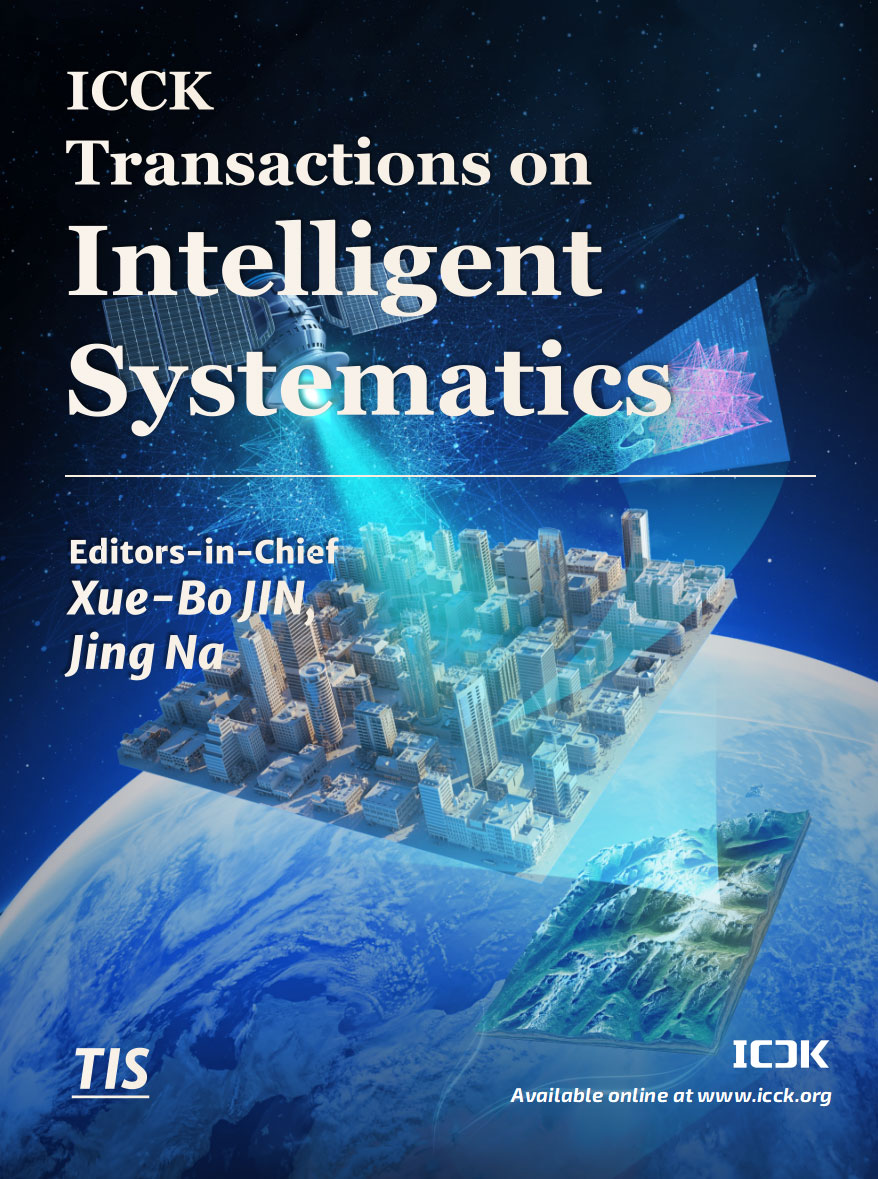
About the Journal
| Journal | ICCK Transactions on Intelligent Systematics |
|---|---|
| ISSN | eISSN: 3068-5079 pISSN: 3069-003X |
| Abbreviation | ICCK Trans. Intell. Syst. |
| CODEN | TIS |
| Publishing Model | Hybrid |
| DOI Prefix | 10.62762/TIS |
| Official Website | https://www.icck.org/tis |
| Former Publisher’s Prefix and Title | IECE Transactions on Intelligent Systematics (Before Volume 2, Issue 2) |
Aims & Scope
Aims
The ICCK Transactions on Intelligent Systematics (TIS) is a peer-reviewed academic journal dedicated to advancing the theory, methodology, and application of intelligent systems — computational frameworks that perceive, reason, learn, and act in complex, dynamic environments. TIS publishes original research that develops or rigorously evaluates intelligent systems methods, with emphasis on reproducibility, generalizability, and real-world applicability. By bridging foundational algorithmic research and domain-driven deployment, the journal serves researchers, engineers, and practitioners working at the intersection of artificial intelligence, machine learning, and systems engineering. There are no restrictions on the maximum length of papers or the use of color. Methods and approaches must be presented in sufficient detail to ensure the reproducibility of results.
Scope
The scope of the Journal includes, but is not limited to:
- Learning and Inference in Intelligent Systems — machine learning, deep learning, large language models, foundation model adaptation, probabilistic inference, system identification, and stochastic modeling for intelligent behavior
- Perception, Sensing, and Multimodal Intelligence — intelligent sensing and perception, multi-sensor fusion, computer vision, audio and speech processing, hyperspectral and remote sensing, and multimodal representation learning
- Decision-Making, Optimization, and Control — autonomous planning, real-time decision-making, multi-objective optimization, reinforcement learning, AI-driven control in cyber-physical systems, and distributed or multi-agent coordination
- Trustworthy and Efficient Intelligent Systems — explainable AI, robustness and uncertainty quantification, cybersecurity and digital media authentication, lightweight and edge-deployable models, and energy-efficient intelligent architectures
- Intelligent Systems for Health and Life Sciences — medical image analysis, clinical decision support, health monitoring, disease prediction, and AI-assisted diagnosis
- Intelligent Systems for Infrastructure and Environment — smart transportation, smart cities, industrial automation, robotics and UAVs, agricultural intelligence, and environmental monitoring
- Intelligent Systems for Information and Society — natural language processing, cross-lingual and multimodal understanding, information integrity and misinformation detection, and AI applications in finance, education, and sociotechnical systems
- Emerging Paradigms in Intelligent Systems — neural-symbolic integration, cognitive architectures, human-machine collaboration, Internet of Things intelligence, metaverse and extended reality systems, and other frontier topics at the boundaries of intelligent systems research
Publication Frequency
Quarterly
Ownership
The journal is owned by Institute of Central Computation and Knowledge Inc.
Author Fees
For information regarding publication fees and waiver policies, please refer to Article Processing Charge (APC).
Archiving
All journals published by ICCK are archived in Portico, which provides permanent digital archiving for scholarly journals.
Copyright & Licensing
Copyright: For subscription-based articles (closed access) published in TIS, the copyright is transferred to the publisher. Authors are required to sign a copyright transfer agreement upon acceptance. The publisher holds the rights to reproduce, distribute, and make the work available in print and electronic formats under the journal’s distribution system. Readers may access such articles through institutional or personal subscriptions.
For open access articles, authors retain copyright of their work. By choosing the open access option, authors agree to publish their article under a Creative Commons license, typically CC BY, which permits unrestricted use, distribution, and reproduction in any medium, provided the original work is properly cited.
Licensing: This journal adopts a hybrid model:
Subscription-based (default): Articles are accessible to subscribers and participating institutions. Copyright is held by the publisher, with all rights reserved.
Open Access: Available upon payment of an Article Processing Charge (APC). Articles are published under Creative Commons licenses (CC BY).
Access Policy
The journal operates under a hybrid access model. Articles published under the subscription model are accessible to subscribers and institutions with access. Authors may choose open access by paying the APC, in which case the article becomes freely accessible to all readers worldwide immediately upon publication.
Editorial Board
The Journal is guided by an Editorial Board consisting of recognized experts in the field. For the complete list of Editorial Board members, please refer to Editorial Board.
Peer Review
The journal adheres to rigorous peer review and undergoes single-blind peer review. For more details, please refer to Editorial Process and Peer Review Policy.
Editorial Process
All manuscripts submitted to TIS should adhere to the journal's Editorial Process.
Plagiarism
Plagiarism detection is performed at ICCK using the iThenticate- Crossref Similarity Checking tool. This web-based tool is employed in the editorial process to identify potential text plagiarism. It's important to note that while iThenticate can identify matching text, it cannot independently determine whether plagiarism has occurred. Manual examination of the matching text is still necessary, and judgment must be exercised to ascertain the presence or absence of plagiarism. The similarity report might be sent to the author for revision whenever needed.
Publication Ethics Statement
ICCK is responsible for implementing rigorous peer review and strict ethical policies and standards to ensure that high quality scientific work is added to the field of scholarly publishing. ICCK takes such publishing ethics issues very seriously, and our editors are trained to enforce COPE's Core Practices and Guidelines, with a zero-tolerance policy for plagiarism, data falsification, and other behaviours. To verify the originality of content submitted to our journals, we use iThenticate/Crossref Similarity Check to check submissions against previous publications.
Advertising
The journal does not accept any commercial product advertisements until policy changes otherwise.
Direct Marketing
Journal propagation has been done through the journal website and distribution of an introduction pamphlet. Invitations to submit a manuscript are usually targeted towards presenters at conferences, seminars, or workshops related to the journal's aims and scope.
Contact
Please visit Editorial Office for details about different queries.