Volume 3, Issue 3 (In Progress)


In Progress
Citations: Crossref logo 0,   0   |   Viewed: 1574, Download: 527

Table of Contents

Free Access | Research Article | 29 September 2026
A Multi-Scale Traffic-State Gated Attention Network for Bus Arrival Time Prediction
ICCK Transactions on Intelligent Systematics | Volume 3, Issue 3: 196-208, 2026 | DOI: 10.62762/TIS.2026.906270
Abstract
Accurate bus arrival time prediction supports passenger information services and transit dispatching, but irregular sampling and time-varying traffic conditions make the task strongly nonlinear. This paper proposes a Spatial Attention Multi-Scale Traffic-State Gated Long Short-Term Memory (SA-MS-TG-LSTM) network. Seven trajectory features are constructed from Global Positioning System (GPS) records, including acceleration, congestion index, and speed volatility. Scale-preserving Spatial Feature Attention (SFA) first reweights the feature dimensions, and three Traffic-State Gated Long Short-Term Memory (TG-LSTM) branches subsequently encode the latest 5, 10, and 15 time steps. Their outputs a... More >

Graphical Abstract
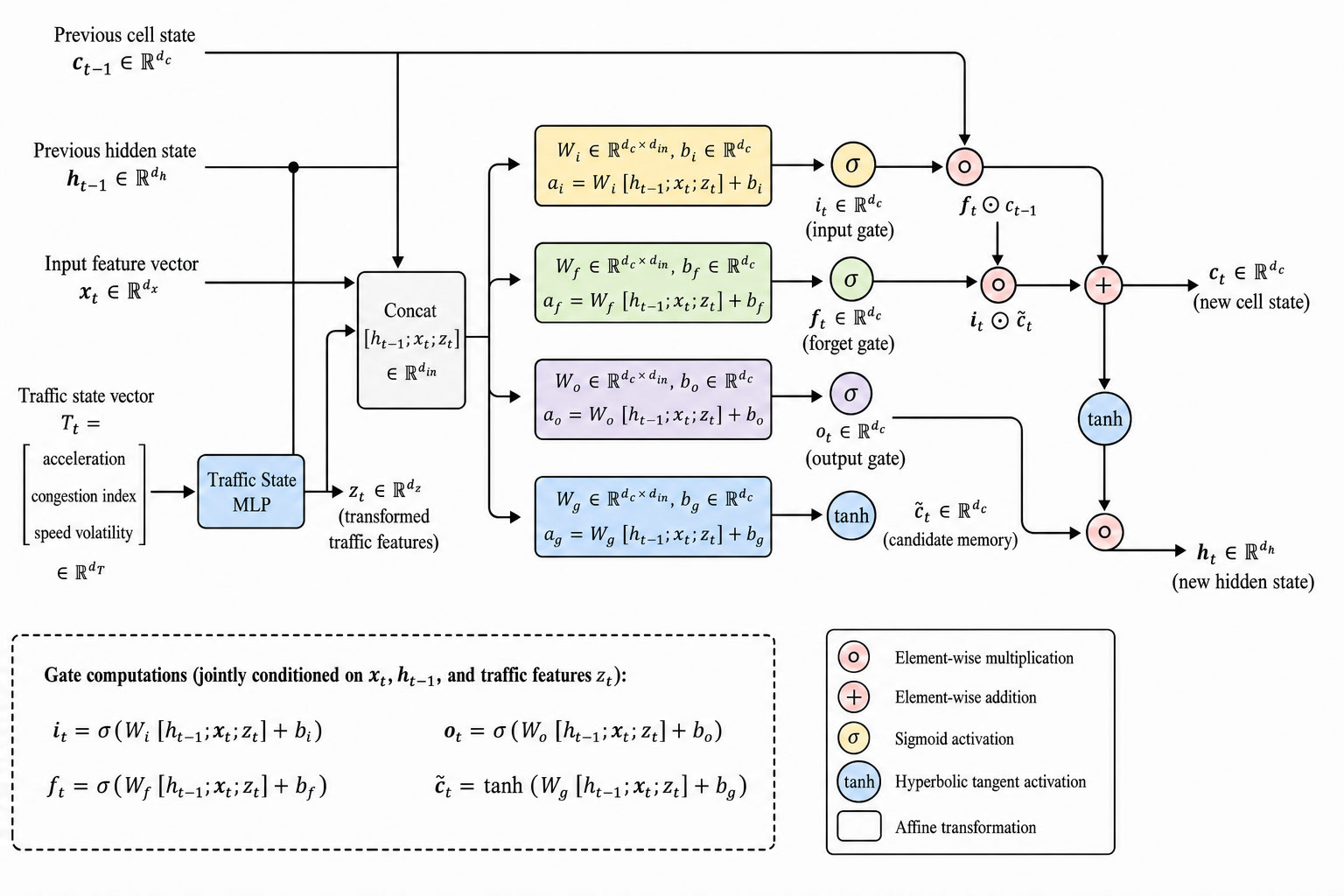
A Multi-Scale Traffic-State Gated Attention Network for Bus Arrival Time Prediction
Free Access | Research Article | 23 September 2026
Wind-Aware Angle-of-Arrival Consistency Validation for Spoofed Guidance Signal Rejection in Unmanned Aerial Vehicles
ICCK Transactions on Intelligent Systematics | Volume 3, Issue 3: 186-195, 2026 | DOI: 10.62762/TIS.2026.467986
Abstract
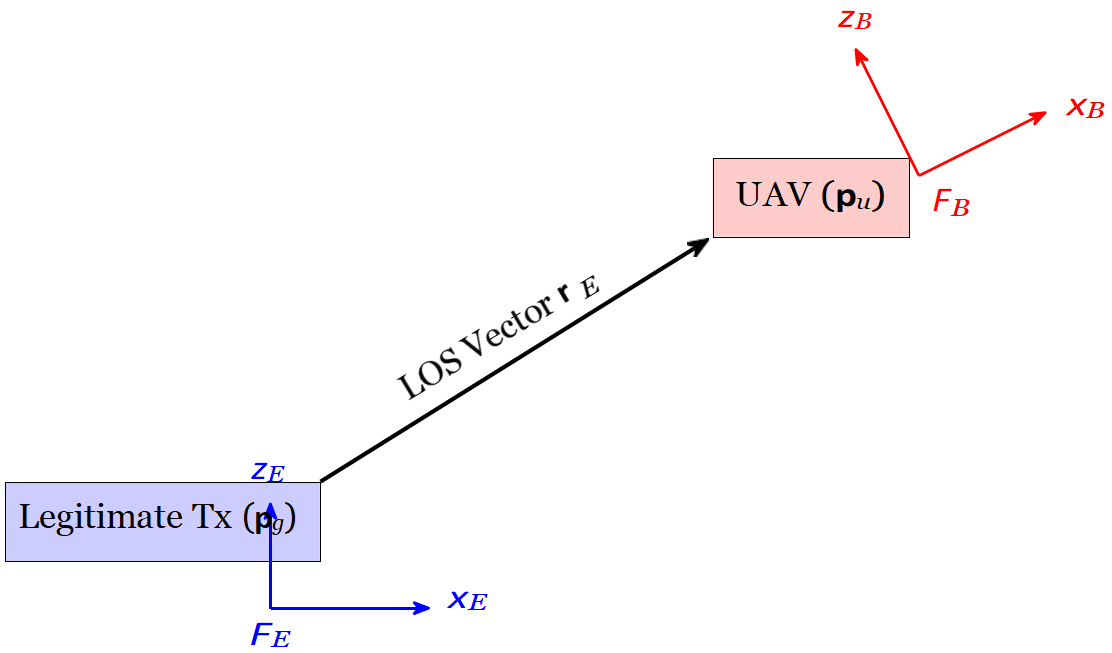
Unmanned Aerial Vehicles (UAVs) increasingly rely on wireless guidance and control links which are vulnerable to spoofing and false command injection attacks. Conventional protection mechanisms primarily rely on cryptographic authentication, which may not be sufficient under compromised or replay-based attack scenarios. This paper proposes a physics-informed, wind-aware angle-of-arrival (AoA) consistency validation framework for real-time rejection of spoofed guidance signals. The proposed method exploits geometric consistency between the expected line-of-sight (LOS) direction to a legitimate guidance transmitter and the measured signal bearing at the UAV. The expected bearing is computed fr... More >

Graphical Abstract
Wind-Aware Angle-of-Arrival Consistency Validation for Spoofed Guidance Signal Rejection in Unmanned Aerial Vehicles
Free Access | Research Article | 22 September 2026
Event-Triggered CNN-LSTM with Prediction-Error Closed-Loop Feedback for Rainfall Forecasting
ICCK Transactions on Intelligent Systematics | Volume 3, Issue 3: 172-185, 2026 | DOI: 10.62762/TIS.2026.531561
Abstract
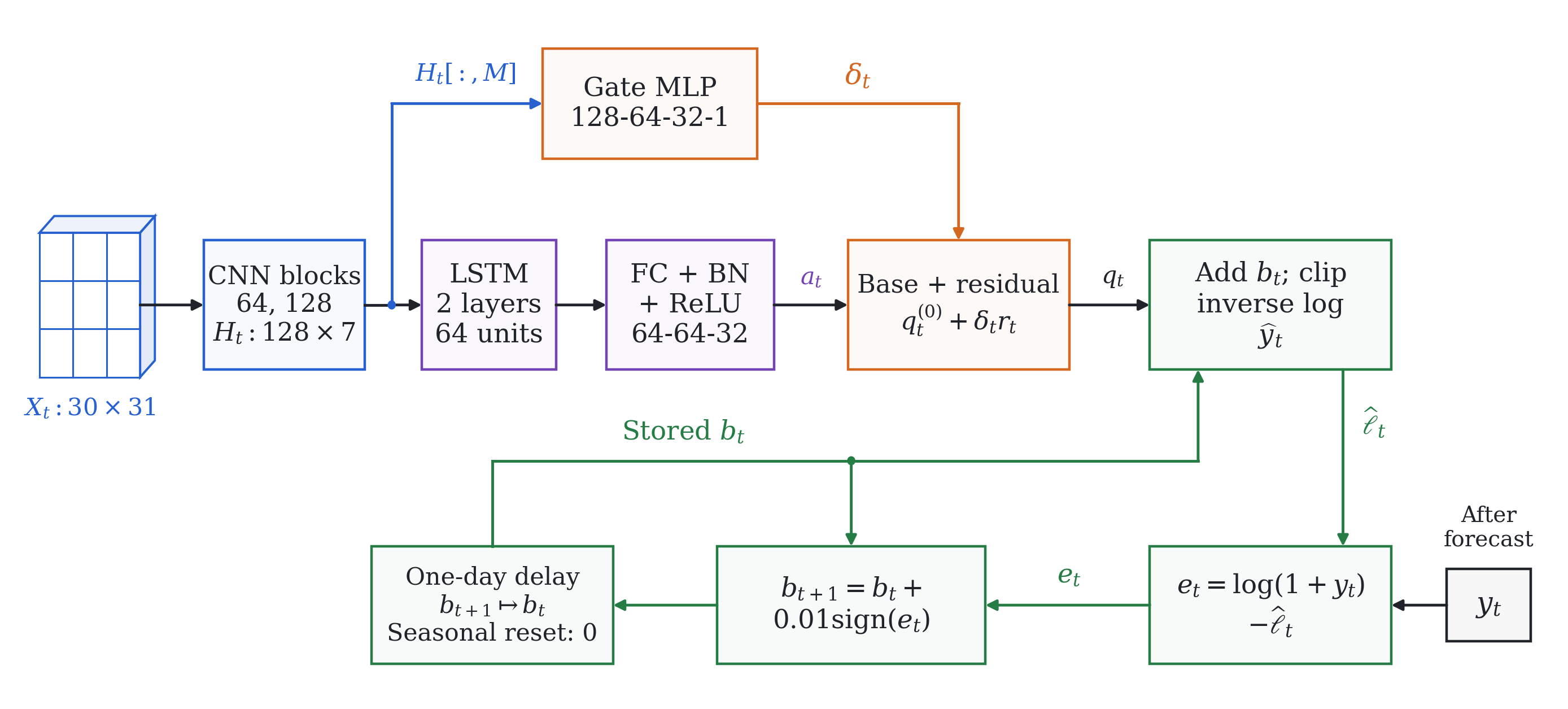
Intermittent daily rainfall requires temporal pattern extraction and correction of newly observed prediction errors. This paper presents an event-triggered convolutional neural network--long short-term memory model with prediction-error closed-loop feedback (ECF-CNN-LSTM) for seasonal one-day-ahead rainfall forecasting. A 30-day window supplies 31 causal rainfall-history and calendar features. A binary gate controls a zero-initialized, bounded residual and learns from the expected prediction errors of its inactive and active alternatives. A separate chronological controller uses each newly observed error to adjust subsequent forecasts. The single-series Tengzhou, Shandong dataset contains 97... More >

Graphical Abstract
Event-Triggered CNN-LSTM with Prediction-Error Closed-Loop Feedback for Rainfall Forecasting
Free Access | Research Article | 21 September 2026
DECIS: An LLM-Based Value Assessment Framework for Targets
ICCK Transactions on Intelligent Systematics | Volume 3, Issue 3: 162-171, 2026 | DOI: 10.62762/TIS.2026.310611
Abstract
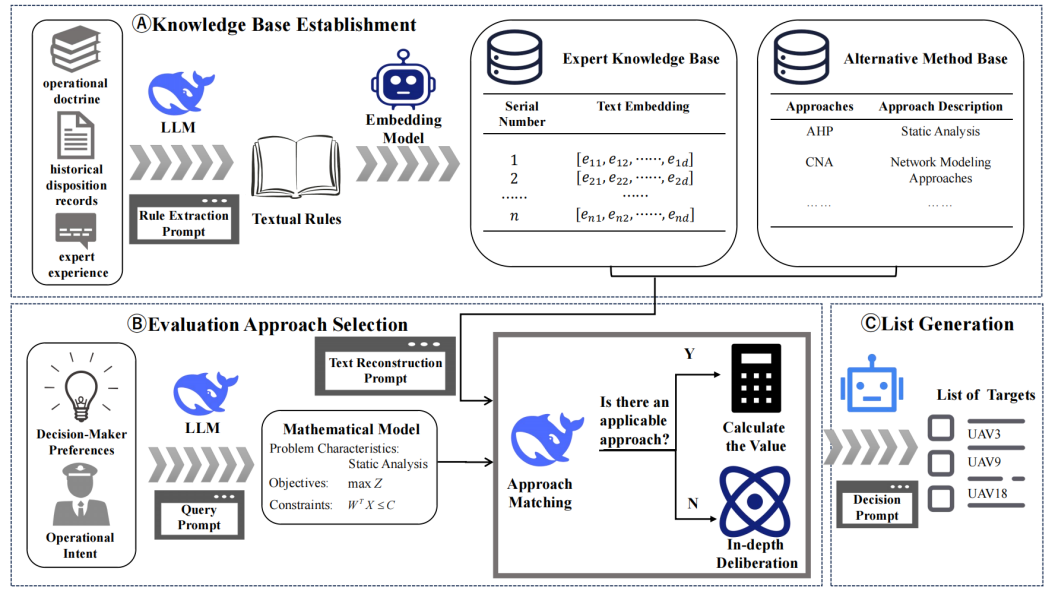
Target value assessment is a critical component of operational decision-making; however, existing methodologies suffer from the rigidity of static models in dynamic battlefield environments and the scarcity of specialized domain-specific data. To address these problems, we propose DECIS, a framework for adaptive decision support based on Retrieval-Augmented Generation (RAG). DECIS operates through a cohesive three-stage architecture centered on two core functions: first, RAG is employed to intelligently match optimal assessment strategies to dynamic contexts, thereby mitigating the challenge of limited military corpora; second, the Large Language Model (LLM) component autonomously generates... More >

Graphical Abstract
DECIS: An LLM-Based Value Assessment Framework for Targets
Free Access | Research Article | 01 September 2026
Low-Light Fire and Smoke Detection in Electric Vehicles via a Lightweight Dual-Branch Architecture with Adaptive Reflectance Enhancement
ICCK Transactions on Intelligent Systematics | Volume 3, Issue 3: 145-161, 2026 | DOI: 10.62762/TIS.2026.406065
Abstract
Fire and smoke detection in electric vehicle environments is essential for safety monitoring, yet existing methods often perform poorly under low-light conditions because of weak feature representation, flame overexposure, and limited nighttime data. In addition, many detection models cannot effectively balance accuracy and real-time efficiency, which restricts their deployment in practical applications. To address these issues, this study proposes a lightweight dual-branch detection framework for low-light fire and smoke recognition in electric vehicle environments. The proposed method integrates reflectance enhancement, adaptive feature weighting, and multi-scale feature learning within a... More >

Graphical Abstract
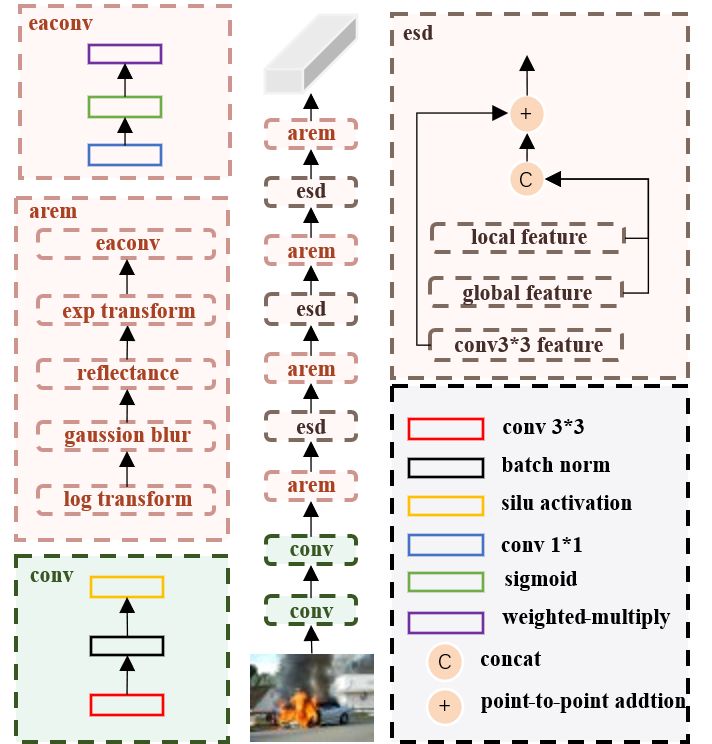
Low-Light Fire and Smoke Detection in Electric Vehicles via a Lightweight Dual-Branch Architecture with Adaptive Reflectance Enhancement