A Multi-Scale Traffic-State Gated Attention Network for Bus Arrival Time Prediction


Article Information
Abstract
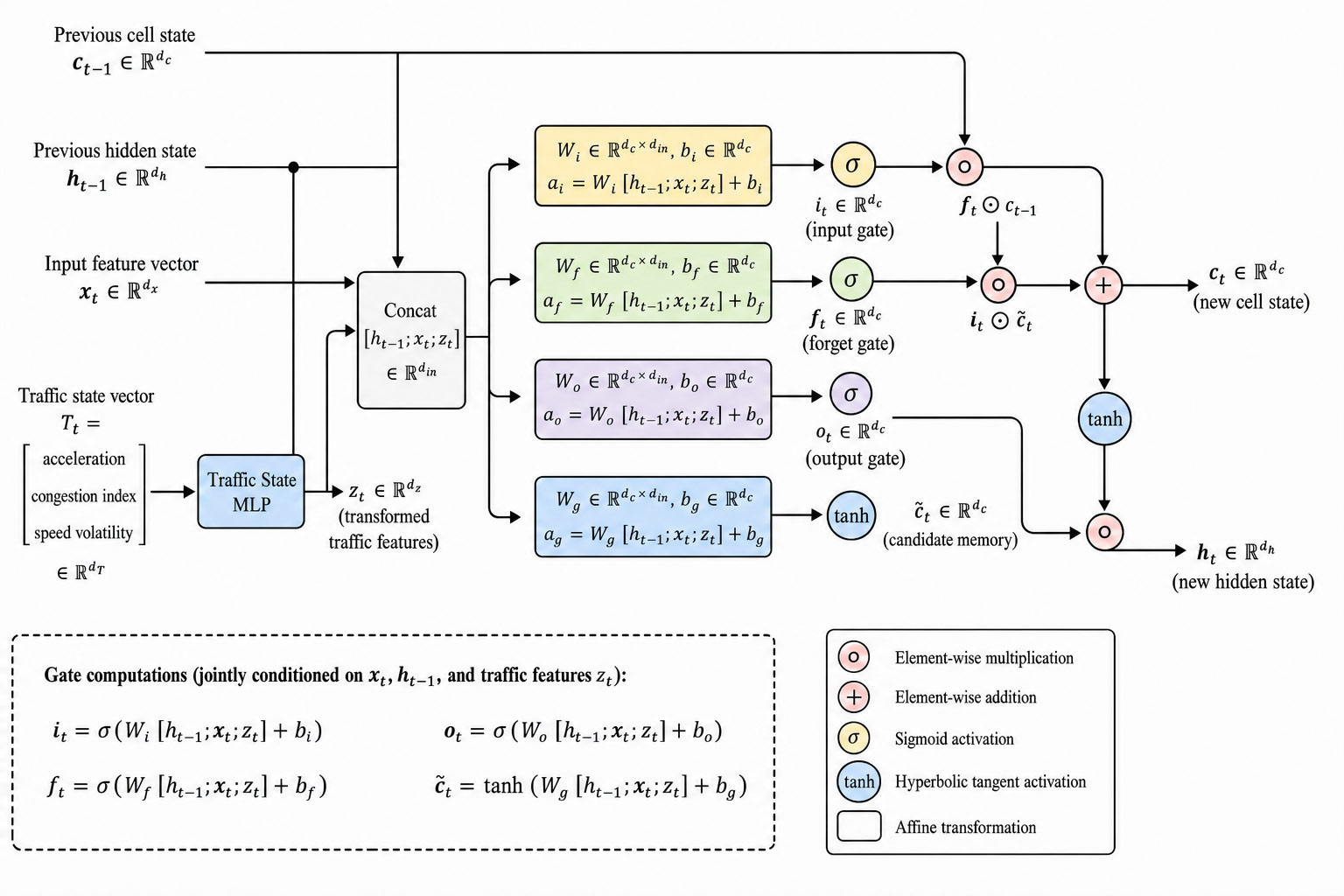
Accurate bus arrival time prediction supports passenger information services and transit dispatching, but irregular sampling and time-varying traffic conditions make the task strongly nonlinear. This paper proposes a Spatial Attention Multi-Scale Traffic-State Gated Long Short-Term Memory (SA-MS-TG-LSTM) network. Seven trajectory features are constructed from Global Positioning System (GPS) records, including acceleration, congestion index, and speed volatility. Scale-preserving Spatial Feature Attention (SFA) first reweights the feature dimensions, and three Traffic-State Gated Long Short-Term Memory (TG-LSTM) branches subsequently encode the latest 5, 10, and 15 time steps. Their outputs are concatenated and mapped to the remaining travel time. Experiments are conducted on 8,834 GPS records from 293 trips on a single bus route (Route 86). Under a controlled setting in which all recurrent models use a hidden size of 16, one recurrent layer, and at most 50 training epochs, SA-MS-TG-LSTM achieves the best aggregate performance, with a root mean square error (RMSE) of 1.056 min, mean absolute error (MAE) of 0.762 min, mean absolute percentage error (MAPE) of 12.06%, and coefficient of determination ($R^2$) of 0.9631. Compared with the Convolutional Neural Network--Gated Recurrent Unit (CNN-GRU), it reduces RMSE, MAE, and MAPE by 6.30%, 5.57%, and 11.26%, respectively. Trip-level analysis further confirms statistically significant MAE improvements over a standard Long Short-Term Memory (LSTM) model and TG-LSTM. These results demonstrate the effectiveness of the proposed method on the evaluated route, while broader multi-route validation remains an important direction for future work.
Graphical Abstract
Keywords
Data Availability Statement
Funding
Conflicts of Interest
AI Use Statement
Ethical Approval and Consent to Participate
References
- Cathey, F. W., & Dailey, D. J. (2003). A prescription for transit arrival/departure prediction using automatic vehicle location data. Transportation Research Part C: Emerging Technologies, 11(3-4), 241-264.
[CrossRef] [Google Scholar] - Patnaik, J., Chien, S., & Bladikas, A. (2004). Estimation of bus arrival times using APC data. Journal of public transportation, 7(1), 1-20.
[CrossRef] [Google Scholar] - Shalaby, A., & Farhan, A. (2004). Prediction model of bus arrival and departure times using AVL and APC data. Journal of Public Transportation, 7(1), 41-61.
[CrossRef] [Google Scholar] - Mete, S., Çelik, E., & Gül, M. (2022). Predicting the time of bus arrival for public transportation by time series models. Journal of Transportation and Logistics, 7(2), 541-555.
[CrossRef] [Google Scholar] - Chien, S. I. J., Ding, Y., & Wei, C. (2002). Dynamic bus arrival time prediction with artificial neural networks. Journal of transportation engineering, 128(5), 429-438.
[CrossRef] [Google Scholar] - Jeong, R., & Rilett, L. R. (2005). Prediction model of bus arrival time for real-time applications. Transportation Research Record, 1927(1), 195-204.
[CrossRef] [Google Scholar] - Yu, B., Lam, W. H. K., & Tam, M. L. (2011). Bus arrival time prediction at bus stop with multiple routes. Transportation Research Part C: Emerging Technologies, 19(6), 1157-1170.
[CrossRef] [Google Scholar] - Bengio, Y., Simard, P., & Frasconi, P. (1994). Learning long-term dependencies with gradient descent is difficult. IEEE transactions on neural networks, 5(2), 157-166.
[CrossRef] [Google Scholar] - Hochreiter, S., & Schmidhuber, J. (1997). Long short-term memory. Neural computation, 9(8), 1735-1780.
[CrossRef] [Google Scholar] - Kumar, B. A., Singh, R., Shaji, H. E., & Vanajakshi, L. (2025). Bus arrival time prediction: A comprehensive review. IEEE Transactions on Intelligent Transportation Systems, 26(6), 7362-7379.
[CrossRef] [Google Scholar] - Jalaney, J., & Ganesh, R. S. (2023). Multiple extreme learning machines based arrival time prediction for public bus transport. Intelligent Automation & Soft Computing, 36(3), 2819-2834.
[CrossRef] [Google Scholar] - Cho, K., Van Merriënboer, B., Gulçehre, Ç., Bahdanau, D., Bougares, F., Schwenk, H., & Bengio, Y. (2014, October). Learning phrase representations using RNN encoder–decoder for statistical machine translation. In Proceedings of the 2014 conference on empirical methods in natural language processing (EMNLP) (pp. 1724-1734).
[CrossRef] [Google Scholar] - Petersen, N. C., Rodrigues, F., & Pereira, F. C. (2019). Multi-output bus travel time prediction with convolutional LSTM neural network. Expert Systems with Applications, 120, 426-435.
[CrossRef] [Google Scholar] - Bahdanau, D., Cho, K., & Bengio, Y. (2014). Neural machine translation by jointly learning to align and translate. arXiv preprint arXiv:1409.0473.
[CrossRef] [Google Scholar] - Zhang, B., Tang, L., Zhou, D., Liu, K., & Xue, Y. (2024). Bus Arrival Time Prediction Based on the Optimized Long Short‐Term Memory Neural Network Model With the Improved Whale Algorithm. Journal of Advanced Transportation, 2024(1), 6997338.
[CrossRef] [Google Scholar] - Li, Z. (2024). DA-RNN-based bus arrival time prediction model. International Journal of Intelligent Transportation Systems Research, 22(3), 660-674.
[CrossRef] [Google Scholar] - Yu, C., Chong, Y. W., Budi, A. S., Setiawan, E., & Keoh, S. L. (2024, August). Bus Arrival Time Prediction Using Hybrid LightGBM-LSTM. In 2024 International Conference on Platform Technology and Service (PlatCon) (pp. 44-49). IEEE.
[CrossRef] [Google Scholar] - Lee, C., & Yoon, Y. (2022). A novel bus arrival time prediction method based on spatio-temporal flow centrality analysis and deep learning. Electronics, 11(12), 1875.
[CrossRef] [Google Scholar] - Sun, H., Li, F., & Liu, L. (2024, August). A spatial-temporal neural network model based on meta learning for bus arrival time prediction. In 2024 10th International Conference on Big Data Computing and Communications (BigCom) (pp. 57-64). IEEE.
[CrossRef] [Google Scholar] - Qiu, T., Lam, C. T., Liu, B., Ng, B. K., Yuan, X., & Im, S. K. (2025). FEN-MRMGCN: A frontend-enhanced network based on multi-relational modeling GCN for bus arrival time prediction. IEEE Access, 13, 5296-5307.
[CrossRef] [Google Scholar] - Vaswani, A., Shazeer, N., Parmar, N., Uszkoreit, J., Jones, L., Gomez, A. N., Kaiser, L., & Polosukhin, I. (2017). Attention is all you need. Advances in Neural Information Processing Systems, 30.
[Google Scholar] - Jeong, S., Oh, C., & Jeong, J. (2024). BAT-transformer: Prediction of bus arrival time with transformer encoder for smart public transportation system. Applied Sciences, 14(20), 9488.
[CrossRef] [Google Scholar] - Srivastava, N., Hinton, G., Krizhevsky, A., Sutskever, I., & Salakhutdinov, R. (2014). Dropout: A simple way to prevent neural networks from overfitting. Journal of Machine Learning Research, 15(56), 1929-1958. https://jmlr.org/papers/v15/srivastava14a.html
[Google Scholar] - Kingma, D. P., & Ba, J. (2014). Adam: A method for stochastic optimization. arXiv preprint arXiv:1412.6980.
[CrossRef] [Google Scholar] - Loshchilov, I., & Hutter, F. (2017). Decoupled weight decay regularization. arXiv preprint arXiv:1711.05101.
[CrossRef] [Google Scholar]
Cite This Article
TY  - JOUR
AU  - Liu, Ruping
AU  - Yin, Xiaoqi
AU  - Zhou, Jing
AU  - Ma, Chenxi
AU  - Li, Chen
PY  - 2026
DA  - 2026/09/29
TI  - A Multi-Scale Traffic-State Gated Attention Network for Bus Arrival Time Prediction
JO  - ICCK Transactions on Intelligent Systematics
T2  - ICCK Transactions on Intelligent Systematics
JF  - ICCK Transactions on Intelligent Systematics
VL  - 3
IS  - 3
SP  - 196
EP  - 208
DO  - 10.62762/TIS.2026.906270
UR  - https://www.icck.org/article/abs/TIS.2026.906270
KW  - bus arrival time prediction
KW  - intelligent transportation
KW  - LSTM
KW  - traffic-state gating
KW  - multi-scale temporal modeling
KW  - feature attention
AB  - Accurate bus arrival time prediction supports passenger information services and transit dispatching, but irregular sampling and time-varying traffic conditions make the task strongly nonlinear. This paper proposes a Spatial Attention Multi-Scale Traffic-State Gated Long Short-Term Memory (SA-MS-TG-LSTM) network. Seven trajectory features are constructed from Global Positioning System (GPS) records, including acceleration, congestion index, and speed volatility. Scale-preserving Spatial Feature Attention (SFA) first reweights the feature dimensions, and three Traffic-State Gated Long Short-Term Memory (TG-LSTM) branches subsequently encode the latest 5, 10, and 15 time steps. Their outputs are concatenated and mapped to the remaining travel time. Experiments are conducted on 8,834 GPS records from 293 trips on a single bus route (Route 86). Under a controlled setting in which all recurrent models use a hidden size of 16, one recurrent layer, and at most 50 training epochs, SA-MS-TG-LSTM achieves the best aggregate performance, with a root mean square error (RMSE) of 1.056 min, mean absolute error (MAE) of 0.762 min, mean absolute percentage error (MAPE) of 12.06%, and coefficient of determination ($R^2$) of 0.9631. Compared with the Convolutional Neural Network--Gated Recurrent Unit (CNN-GRU), it reduces RMSE, MAE, and MAPE by 6.30%, 5.57%, and 11.26%, respectively. Trip-level analysis further confirms statistically significant MAE improvements over a standard Long Short-Term Memory (LSTM) model and TG-LSTM. These results demonstrate the effectiveness of the proposed method on the evaluated route, while broader multi-route validation remains an important direction for future work.
SN  - 3068-5079
PB  - Institute of Central Computation and Knowledge
LA  - English
ER  -
@article{Liu2026A,
  author = {Ruping Liu and Xiaoqi Yin and Jing Zhou and Chenxi Ma and Chen Li},
  title = {A Multi-Scale Traffic-State Gated Attention Network for Bus Arrival Time Prediction},
  journal = {ICCK Transactions on Intelligent Systematics},
  year = {2026},
  volume = {3},
  number = {3},
  pages = {196-208},
  doi = {10.62762/TIS.2026.906270},
  url = {https://www.icck.org/article/abs/TIS.2026.906270},
  abstract = {Accurate bus arrival time prediction supports passenger information services and transit dispatching, but irregular sampling and time-varying traffic conditions make the task strongly nonlinear. This paper proposes a Spatial Attention Multi-Scale Traffic-State Gated Long Short-Term Memory (SA-MS-TG-LSTM) network. Seven trajectory features are constructed from Global Positioning System (GPS) records, including acceleration, congestion index, and speed volatility. Scale-preserving Spatial Feature Attention (SFA) first reweights the feature dimensions, and three Traffic-State Gated Long Short-Term Memory (TG-LSTM) branches subsequently encode the latest 5, 10, and 15 time steps. Their outputs are concatenated and mapped to the remaining travel time. Experiments are conducted on 8,834 GPS records from 293 trips on a single bus route (Route 86). Under a controlled setting in which all recurrent models use a hidden size of 16, one recurrent layer, and at most 50 training epochs, SA-MS-TG-LSTM achieves the best aggregate performance, with a root mean square error (RMSE) of 1.056 min, mean absolute error (MAE) of 0.762 min, mean absolute percentage error (MAPE) of 12.06\%, and coefficient of determination (\$R^2\$) of 0.9631. Compared with the Convolutional Neural Network--Gated Recurrent Unit (CNN-GRU), it reduces RMSE, MAE, and MAPE by 6.30\%, 5.57\%, and 11.26\%, respectively. Trip-level analysis further confirms statistically significant MAE improvements over a standard Long Short-Term Memory (LSTM) model and TG-LSTM. These results demonstrate the effectiveness of the proposed method on the evaluated route, while broader multi-route validation remains an important direction for future work.},
  keywords = {bus arrival time prediction, intelligent transportation, LSTM, traffic-state gating, multi-scale temporal modeling, feature attention},
  issn = {3068-5079},
  publisher = {Institute of Central Computation and Knowledge}
}
Article Metrics
Publisher's Note
ICCK stays neutral with regard to jurisdictional claims in published maps and institutional affiliations.
Rights and Permissions


Portico