A Machine Learning-Based Scientometric Evaluation for Fake News Detection





Article Information
Abstract
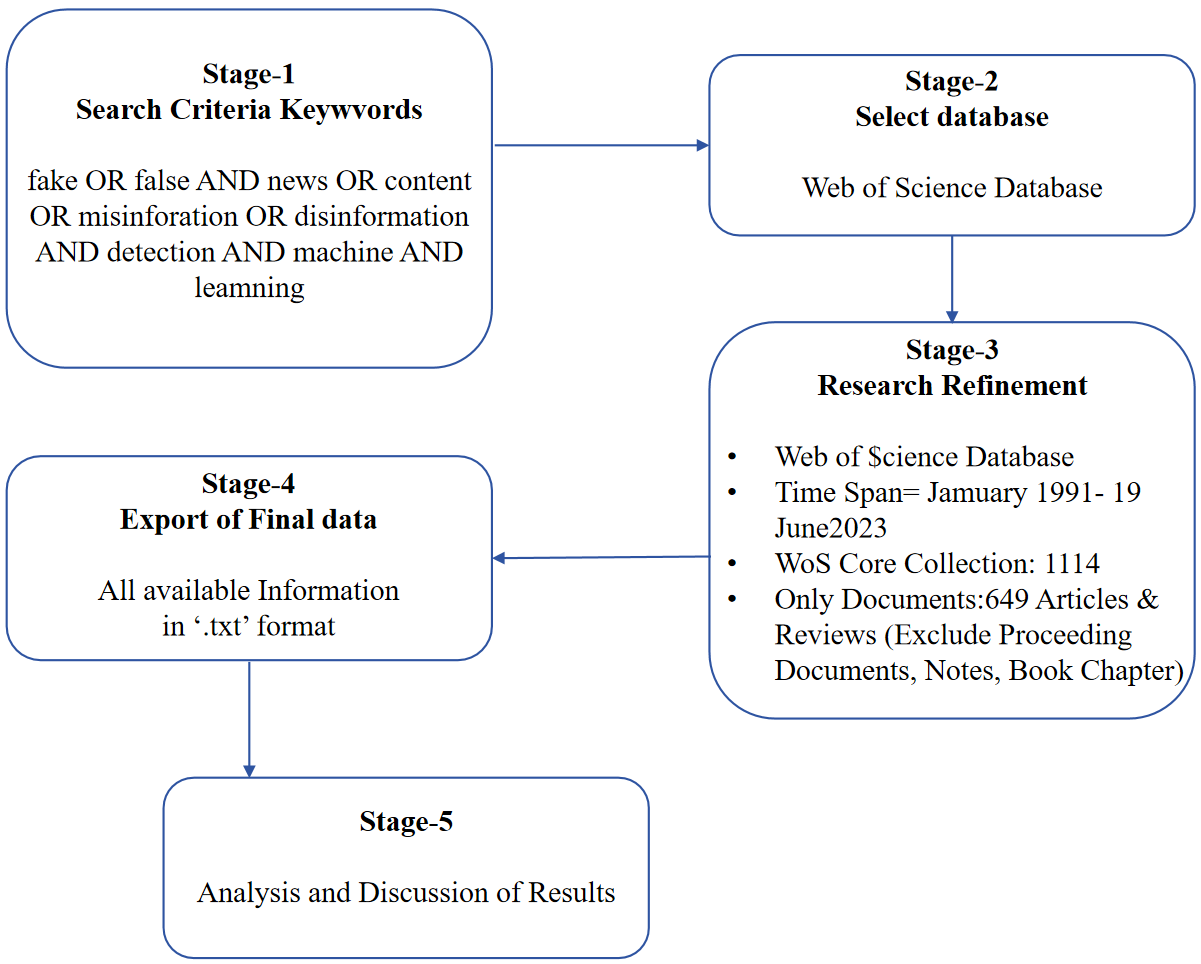
Fake news detection has emerged as a critical challenge in the modern information ecosystem, where the rapid proliferation of misinformation threatens democratic processes, public health, and societal stability. Machine learning (ML)-based approaches have demonstrated significant promise in automatically identifying and classifying misleading information across diverse platforms. This study presents a comprehensive scientometric and systematic review of ML-based fake news detection research, drawing on 649 peer-reviewed articles indexed in the Web of Science database (1991--2023). Using bibliometric tools including R-Bibliometrix and VOSviewer, we systematically evaluate publication trends, collaborative networks, thematic evolution, and the relative effectiveness of key ML paradigms---including classical classifiers (SVM, Naive Bayes), deep learning architectures (LSTM, CNN), and transformer-based models (BERT, RoBERTa)---as reflected in the literature. Our analysis reveals a significant surge in research activity post-2016, driven by electoral misinformation and the COVID-19 infodemic, with transformer-based models increasingly dominating the field due to their superior contextual understanding. The findings identify critical research gaps, including limited cross-lingual detection capabilities and insufficient attention to multimodal fake news involving deepfakes. This review provides actionable insights for researchers and practitioners seeking to advance intelligent systems for misinformation detection.
Graphical Abstract
Keywords
Data Availability Statement
Funding
Conflicts of Interest
Ethical Approval and Consent to Participate
References
- Lazer, D. M., Baum, M. A., Benkler, Y., Berinsky, A. J., Greenhill, K. M., Menczer, F., ... & Zittrain, J. L. (2018). The science of fake news. Science, 359(6380), 1094-1096.
[CrossRef] [Google Scholar] - Wardle, C., & Derakhshan, H. (2017). Information disorder: Toward an interdisciplinary framework for research and policymaking (Vol. 27, pp. 1-107). Strasbourg: Council of Europe.
[Google Scholar] - Rocha, Y. M., De Moura, G. A., Desidério, G. A., De Oliveira, C. H., Lourenço, F. D., & de Figueiredo Nicolete, L. D. (2023). The impact of fake news on social media and its influence on health during the COVID-19 pandemic: A systematic review. Journal of Public Health, 31(7), 1007-1016.
[CrossRef] [Google Scholar] - Shu, K., Sliva, A., Wang, S., Tang, J., & Liu, H. (2017). Fake news detection on social media: A data mining perspective. ACM SIGKDD explorations newsletter, 19(1), 22-36.
[CrossRef] [Google Scholar] - Shu, K., Mahudeswaran, D., Wang, S., Lee, D., & Liu, H. (2020). Fakenewsnet: A data repository with news content, social context, and spatiotemporal information for studying fake news on social media. Big data, 8(3), 171-188.
[CrossRef] [Google Scholar] - Pennycook, G., & Rand, D. G. (2021). The psychology of fake news. Trends in cognitive sciences, 25(5), 388-402.
[CrossRef] [Google Scholar] - Bawden, D., & Robinson, L. (2009). The dark side of information: overload, anxiety and other paradoxes and pathologies. Journal of information science, 35(2), 180-191.
[CrossRef] [Google Scholar] - Orso, D., Federici, N., Copetti, R., Vetrugno, L., & Bove, T. (2020). Infodemic and the spread of fake news in the COVID-19-era. European Journal of Emergency Medicine, 27(5), 327-328.
[CrossRef] [Google Scholar] - Sandu, A., Ioanăș, I., Delcea, C., Florescu, M. S., & Cotfas, L. A. (2024). Numbers do not lie: A bibliometric examination of machine learning techniques in fake news research. Algorithms, 17(2), 70.
[CrossRef] [Google Scholar] - Wang, H., & Ge, Y. (2024, August). Exploring worldwide research trends on fake news through a bibliometric and visual analysis. In 2024 international conference on asian language processing (IALP) (pp. 13-18). IEEE.
[CrossRef] [Google Scholar] - Zhou, X., & Zafarani, R. (2020). A survey of fake news: Fundamental theories, detection methods, and opportunities. ACM Computing Surveys (CSUR), 53(5), 1-40.
[CrossRef] [Google Scholar] - Yu, P., Xia, Z., Fei, J., & Lu, Y. (2021). A survey on deepfake video detection. Iet Biometrics, 10(6), 607-624.
[CrossRef] [Google Scholar] - Kaur, A., Noori Hoshyar, A., Saikrishna, V., Firmin, S., & Xia, F. (2024). Deepfake video detection: challenges and opportunities. Artificial Intelligence Review, 57(6), 159.
[CrossRef] [Google Scholar] - Gunawan, B., Ratmono, B. M., Abdullah, A. G., Sadida, N., & Kaprisma, H. (2022). Research mapping in the use of technology for fake news detection: Bibliometric analysis from 2011 to 2021. Indonesian Journal of Science and Technology, 7(3), 471-496.
[CrossRef] [Google Scholar] - Potthast, M., Kiesel, J., Reinartz, K., Bevendorff, J., & Stein, B. (2018, July). A stylometric inquiry into hyperpartisan and fake news. In Proceedings of the 56th annual meeting of the association for computational linguistics (volume 1: long papers) (pp. 231-240).
[CrossRef] [Google Scholar] - Patra, R. K., Pandey, N., & Sudarsan, D. (2023). Bibliometric analysis of fake news indexed in Web of Science and Scopus (2001-2020). Global Knowledge, Memory and Communication, 72(6-7), 628-647.
[CrossRef] [Google Scholar] - Bran, R., Tiru, L., Grosseck, G., Holotescu, C., & Malita, L. (2021). Learning from each other—A bibliometric review of research on information disorders. Sustainability, 13(18), 10094.
[CrossRef] [Google Scholar] - Ding, Y., Wang, Y., & Wang, Y. (2021, August). It's time to confront fake news and rumors on social media: a bibliometric study based on VOSviewer. In 2021 IEEE 4th International Conference on Computer and Communication Engineering Technology (CCET) (pp. 226-232). IEEE.
[CrossRef] [Google Scholar] - Jabeur, S. B., Ballouk, H., Arfi, W. B., & Sahut, J. M. (2023). Artificial intelligence applications in fake review detection: Bibliometric analysis and future avenues for research. Journal of Business Research, 158, 113631.
[CrossRef] [Google Scholar] - Ruchansky, N., Seo, S., & Liu, Y. (2017, November). Csi: A hybrid deep model for fake news detection. In Proceedings of the 2017 ACM on Conference on Information and Knowledge Management (pp. 797-806).
[CrossRef] [Google Scholar] - Zubiaga, A., Liakata, M., Procter, R., Wong Sak Hoi, G., & Tolmie, P. (2016). Analysing how people orient to and spread rumours in social media by looking at conversational threads. PloS one, 11(3), e0150989.
[CrossRef] [Google Scholar] - Bondielli, A., & Marcelloni, F. (2019). A survey on fake news and rumour detection techniques. Information sciences, 497, 38-55.
[CrossRef] [Google Scholar] - Meel, P., & Vishwakarma, D. K. (2020). Fake news, rumor, information pollution in social media and web: A contemporary survey of state-of-the-arts, challenges and opportunities. Expert Systems with Applications, 153, 112986.
[CrossRef] [Google Scholar] - Ahmed, H., Traore, I., & Saad, S. (2018). Detecting opinion spams and fake news using text classification. Security and Privacy, 1(1), e9.
[CrossRef] [Google Scholar] - Hakak, S., Alazab, M., Khan, S., Gadekallu, T. R., Maddikunta, P. K. R., & Khan, W. Z. (2021). An ensemble machine learning approach through effective feature extraction to classify fake news. Future Generation Computer Systems, 117, 47-58.
[CrossRef] [Google Scholar] - Molina, M. D., Sundar, S. S., Le, T., & Lee, D. (2021). “Fake news” is not simply false information: A concept explication and taxonomy of online content. American behavioral scientist, 65(2), 180-212.
[CrossRef] [Google Scholar] - Donthu, N., Kumar, S., Mukherjee, D., Pandey, N., & Lim, W. M. (2021). How to conduct a bibliometric analysis: An overview and guidelines. Journal of business research, 133, 285-296.
[CrossRef] [Google Scholar]
Cited By (3)
-
Muhammad Shoaib Khan, Hongsong Chen, XinJian Ma. Resource-efficient anomaly detection in social media accounts using lightweight LLM models: a review of methods, challenges, and future trends.
Cluster Computing, 2026 , 29 (5).
[CrossRef] -
Yang Zhang, Yating Zhao, Wenjuan Lian, Bin Jia. RAFN: A risk-aware feature network for identifying risk factors in supply chain finance.
Expert Systems with Applications, 2026 , 298 .
[CrossRef] -
N. Ilayaraja, S. Shankar. .
Intelligent Vision and Computing, 2026 , 1712 .
[CrossRef]
Cite This Article
TY  - JOUR
AU  - Zeeshan, Hafiz Muhammad
AU  - Ullah, Inam
AU  - Yousaf, Furkan
AU  - Sharafian, Amin
AU  - Heyat, Md Belal Bin
AU  - Saqib, Shazia
AU  - Rahman, Atta Ur
PY  - 2025
DA  - 2025/01/04
TI  - A Machine Learning-Based Scientometric Evaluation for Fake News Detection
JO  - ICCK Transactions on Intelligent Systematics
T2  - ICCK Transactions on Intelligent Systematics
JF  - ICCK Transactions on Intelligent Systematics
VL  - 2
IS  - 1
SP  - 38
EP  - 48
DO  - 10.62762/TIS.2024.564569
UR  - https://www.icck.org/article/abs/TIS.2024.564569
KW  - machine learning
KW  - fake news detection
KW  - bibliometric analysis
KW  - information ecosystem
KW  - intelligent systems
AB  - Fake news detection has emerged as a critical challenge in the modern information ecosystem, where the rapid proliferation of misinformation threatens democratic processes, public health, and societal stability. Machine learning (ML)-based approaches have demonstrated significant promise in automatically identifying and classifying misleading information across diverse platforms. This study presents a comprehensive scientometric and systematic review of ML-based fake news detection research, drawing on 649 peer-reviewed articles indexed in the Web of Science database (1991--2023). Using bibliometric tools including R-Bibliometrix and VOSviewer, we systematically evaluate publication trends, collaborative networks, thematic evolution, and the relative effectiveness of key ML paradigms---including classical classifiers (SVM, Naive Bayes), deep learning architectures (LSTM, CNN), and transformer-based models (BERT, RoBERTa)---as reflected in the literature. Our analysis reveals a significant surge in research activity post-2016, driven by electoral misinformation and the COVID-19 infodemic, with transformer-based models increasingly dominating the field due to their superior contextual understanding. The findings identify critical research gaps, including limited cross-lingual detection capabilities and insufficient attention to multimodal fake news involving deepfakes. This review provides actionable insights for researchers and practitioners seeking to advance intelligent systems for misinformation detection.
SN  - 3068-5079
PB  - Institute of Central Computation and Knowledge
LA  - English
ER  -
@article{Zeeshan2025A,
  author = {Hafiz Muhammad Zeeshan and Inam Ullah and Furkan Yousaf and Amin Sharafian and Md Belal Bin Heyat and Shazia Saqib and Atta Ur Rahman},
  title = {A Machine Learning-Based Scientometric Evaluation for Fake News Detection},
  journal = {ICCK Transactions on Intelligent Systematics},
  year = {2025},
  volume = {2},
  number = {1},
  pages = {38-48},
  doi = {10.62762/TIS.2024.564569},
  url = {https://www.icck.org/article/abs/TIS.2024.564569},
  abstract = {Fake news detection has emerged as a critical challenge in the modern information ecosystem, where the rapid proliferation of misinformation threatens democratic processes, public health, and societal stability. Machine learning (ML)-based approaches have demonstrated significant promise in automatically identifying and classifying misleading information across diverse platforms. This study presents a comprehensive scientometric and systematic review of ML-based fake news detection research, drawing on 649 peer-reviewed articles indexed in the Web of Science database (1991--2023). Using bibliometric tools including R-Bibliometrix and VOSviewer, we systematically evaluate publication trends, collaborative networks, thematic evolution, and the relative effectiveness of key ML paradigms---including classical classifiers (SVM, Naive Bayes), deep learning architectures (LSTM, CNN), and transformer-based models (BERT, RoBERTa)---as reflected in the literature. Our analysis reveals a significant surge in research activity post-2016, driven by electoral misinformation and the COVID-19 infodemic, with transformer-based models increasingly dominating the field due to their superior contextual understanding. The findings identify critical research gaps, including limited cross-lingual detection capabilities and insufficient attention to multimodal fake news involving deepfakes. This review provides actionable insights for researchers and practitioners seeking to advance intelligent systems for misinformation detection.},
  keywords = {machine learning, fake news detection, bibliometric analysis, information ecosystem, intelligent systems},
  issn = {3068-5079},
  publisher = {Institute of Central Computation and Knowledge}
}
Publisher's Note
ICCK stays neutral with regard to jurisdictional claims in published maps and institutional affiliations.
Rights and Permissions


Portico