Enhancing Fake News Detection with a Hybrid NLP-Machine Learning Framework








Article Information
Abstract
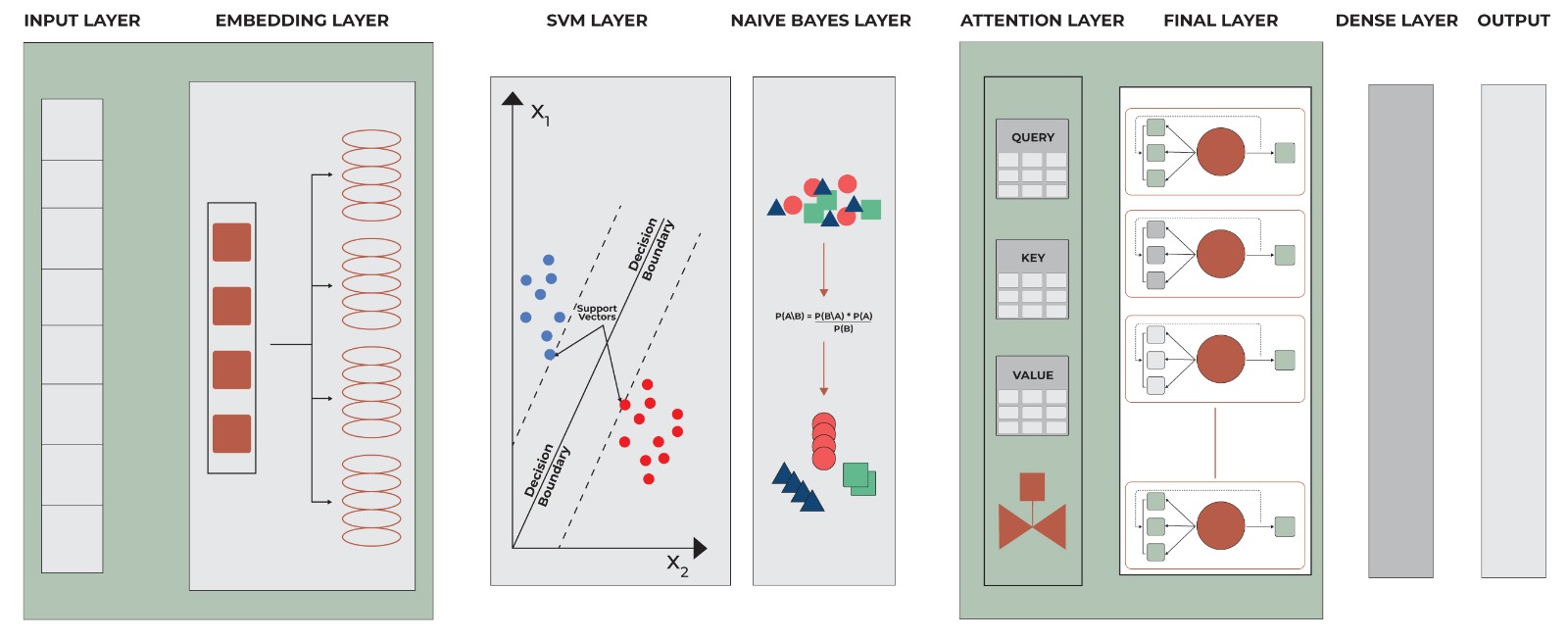
The increasing prevalence of fake news on social media has become a significant challenge in today’s digital landscape. This paper proposes a hybrid framework for fake news detection, combining Natural Language Processing (NLP) techniques and machine learning algorithms. Using Term Frequency-Inverse Document Frequency (TF-IDF) for feature extraction, and classifiers such as Logistic Regression (LR), Naïve Bayes (NB), and Support Vector Machines (SVM), the model integrates Maximum Likelihood Estimation (MLE) with Logistic Regression to achieve 95% accuracy and 92% precision on a Kaggle dataset. The results highlight the potential of combining statistical and NLP approaches to improve fake news detection accuracy.
Graphical Abstract
Keywords
Data Availability Statement
Funding
Conflicts of Interest
Ethical Approval and Consent to Participate
References
- De Oliveira, N. R., Pisa, P. S., Lopez, M. A., de Medeiros, D. S. V., & Mattos, D. M. (2021). Identifying fake news on social networks based on natural language processing: trends and challenges. Information, 12(1), 38.
[CrossRef] [Google Scholar] - Posetti, J., & Matthews, A. (2018). A short guide to the history of ‘fake news’ and disinformation. International Center for Journalists, 7(2018), 2018-07. https://www.icfj.org/sites/default/files/2018-07/A%20Short%20Guide%20to%20History%20of%20Fake%20News%20and%20Disinformation_ICFJ%20Final.pdf
[Google Scholar] - Tschiatschek, S., Singla, A., Gomez Rodriguez, M., Merchant, A., & Krause, A. (2018, April). Fake news detection in social networks via crowd signals. In Companion proceedings of the the web conference 2018 (pp. 517-524).
[CrossRef] [Google Scholar] - Su, Q., Wan, M., Liu, X., & Huang, C. R. (2020). Motivations, methods and metrics of misinformation detection: an NLP perspective. Natural Language Processing Research, 1(1), 1-13.
[CrossRef] [Google Scholar] - Ahmad, I., Yousaf, M., Yousaf, S., & Ahmad, M. O. (2020). Fake news detection using machine learning ensemble methods. Complexity, 2020(1), 8885861.
[CrossRef] [Google Scholar] - Mridha, M. F., Keya, A. J., Hamid, M. A., Monowar, M. M., & Rahman, M. S. (2021). A comprehensive review on fake news detection with deep learning. IEEE access, 9, 156151-156170.
[CrossRef] [Google Scholar] - Tardáguila, C., Benevenuto, F., & Ortellado, P. (2018). Fake News Is Poisoning Brazilian Politics. WhatsApp Can Stop It. International New York Times, NA-NA. https://link.gale.com/apps/doc/A558723738/AONE?u=anon~45882091&sid=googleScholar&xid=ce100143
[Google Scholar] - Collins, B., Hoang, D. T., Nguyen, N. T., & Hwang, D. (2021). Trends in combating fake news on social media–a survey. Journal of Information and Telecommunication, 5(2), 247-266.
[CrossRef] [Google Scholar] - Zhou, X., & Zafarani, R. (2020). A survey of fake news: Fundamental theories, detection methods, and opportunities. ACM Computing Surveys (CSUR), 53(5), 1-40.
[CrossRef] [Google Scholar] - Wang, W. Y. (2017, July). “liar, liar pants on fire”: A new benchmark dataset for fake news detection. In Proceedings of the 55th annual meeting of the association for computational linguistics (volume 2: short papers) (pp. 422-426).
[CrossRef] [Google Scholar] - Agarwal, A., & Dixit, A. (2020, May). Fake news detection: an ensemble learning approach. In 2020 4th international conference on intelligent computing and control systems (ICICCS) (pp. 1178-1183). IEEE.
[CrossRef] [Google Scholar] - Rubin, V. L., Conroy, N., Chen, Y., & Cornwell, S. (2016, June). Fake news or truth? using satirical cues to detect potentially misleading news. In Proceedings of the second workshop on computational approaches to deception detection (pp. 7-17).
[CrossRef] [Google Scholar] - Gottfried, J., & Shearer, E. (2016). News use across social media platforms 2016. Pew Research Center. https://apo.org.au/node/64483
[Google Scholar] - Campan, A., Cuzzocrea, A., & Truta, T. M. (2017, December). Fighting fake news spread in online social networks: Actual trends and future research directions. In 2017 IEEE International Conference on Big Data (Big Data) (pp. 4453-4457). IEEE.
[CrossRef] [Google Scholar] - Lazer, D. M., Baum, M. A., Benkler, Y., Berinsky, A. J., Greenhill, K. M., Menczer, F., ... & Zittrain, J. L. (2018). The science of fake news. Science, 359(6380), 1094-1096.
[CrossRef] [Google Scholar] - Chadwick, A., & Vaccari, C. (2019). News sharing on UK social media: Misinformation, disinformation, and correction (O3C Survey Report). Online Civic Culture Centre, Loughborough University. https://hdl.handle.net/2134/37720
[Google Scholar] - Reis, J. C., Correia, A., Murai, F., Veloso, A., & Benevenuto, F. (2019, June). Explainable machine learning for fake news detection. In Proceedings of the 10th ACM conference on web science (pp. 17-26).
[CrossRef] [Google Scholar] - Zafarani, R., Zhou, X., Shu, K., & Liu, H. (2019, July). Fake news research: Theories, detection strategies, and open problems. In Proceedings of the 25th ACM SIGKDD international conference on knowledge discovery & data mining (pp. 3207-3208).
[CrossRef] [Google Scholar] - Allcott, H., & Gentzkow, M. (2017). Social media and fake news in the 2016 election. Journal of economic perspectives, 31(2), 211-236.
[CrossRef] [Google Scholar] - Figueira, Á., & Oliveira, L. (2017). The current state of fake news: challenges and opportunities. Procedia computer science, 121, 817-825.
[CrossRef] [Google Scholar] - Aïmeur, E., Amri, S., & Brassard, G. (2023). Fake news, disinformation and misinformation in social media: a review. Social Network Analysis and Mining, 13(1), 30.
[CrossRef] [Google Scholar] - Graauwmans, V. V. (2016). Fake News in the Online World: An Experimental Study on Credibility Evaluations of Fake News depending on Information Processing Bachelor Thesis Tilburg University. http://arno.uvt.nl/show.cgi?fid=143285
[Google Scholar] - Guderlei, M., & Aßenmacher, M. (2020, December). Evaluating unsupervised representation learning for detecting stances of fake news. In Proceedings of the 28th international conference on computational linguistics (pp. 6339-6349).
[CrossRef] [Google Scholar] - Kumar, S., Asthana, R., Upadhyay, S., Upreti, N., & Akbar, M. (2020). Fake news detection using deep learning models: A novel approach. Transactions on Emerging Telecommunications Technologies, 31(2), e3767.
[CrossRef] [Google Scholar] - Shu, K., Sliva, A., Wang, S., Tang, J., & Liu, H. (2017). Fake news detection on social media: A data mining perspective. ACM SIGKDD explorations newsletter, 19(1), 22-36.
[CrossRef] [Google Scholar] - Al-Sarem, M., Saeed, F., Al-Mekhlafi, Z. G., Mohammed, B. A., Hadwan, M., Al-Hadhrami, T., ... & Alshammari, T. S. (2021). An improved multiple features and machine learning-based approach for detecting clickbait news on social networks. Applied Sciences, 11(20), 9487.
[CrossRef] [Google Scholar] - Petratos, P. N. (2021). Misinformation, disinformation, and fake news: Cyber risks to business. Business Horizons, 64(6), 763-774.
[CrossRef] [Google Scholar] - Paskin, D. (2018). Real or fake news: who knows?. The Journal of Social Media in Society, 7(2), 252-273. https://www.thejsms.org/index.php/JSMS/article/view/386
[Google Scholar] - Ahmed, H., Traore, I., & Saad, S. (2017). Detection of online fake news using n-gram analysis and machine learning techniques. In Intelligent, Secure, and Dependable Systems in Distributed and Cloud Environments: First International Conference, ISDDC 2017, Vancouver, BC, Canada, October 26-28, 2017, Proceedings 1 (pp. 127-138). Springer International Publishing.
[Google Scholar] - Gelfert, A. (2018). Fake news: A definition. Informal logic, 38(1), 84-117.
[CrossRef] [Google Scholar] - Srivastava, A. (2020). Real time fake news detection using machine learning and NLP. Int. Res. J. Eng. Technol.(IRJET), 7(06). https://www.irjet.net/archives/V7/i6/IRJET-V7I6688.pdf
[Google Scholar] - Madani, M., Motameni, H., & Mohamadi, H. (2022). Fake news detection using deep learning integrating feature extraction, natural language processing, and statistical descriptors. Security and Privacy, 5(6), e264.
[CrossRef] [Google Scholar] - George, J., Gerhart, N., & Torres, R. (2023). Uncovering the truth about fake news: A research model grounded in multi-disciplinary literature. Fake News on the Internet, 175-202.
[Google Scholar] - Hiramath, C. K., & Deshpande, G. C. (2019, July). Fake news detection using deep learning techniques. In 2019 1st International Conference on Advances in Information Technology (ICAIT) (pp. 411-415). IEEE.
[CrossRef] [Google Scholar] - Mahir, E. M., Akhter, S., & Huq, M. R. (2019, June). Detecting fake news using machine learning and deep learning algorithms. In 2019 7th international conference on smart computing & communications (ICSCC) (pp. 1-5). IEEE.
[CrossRef] [Google Scholar] - Granik, M., & Mesyura, V. (2017, May). Fake news detection using naive Bayes classifier. In 2017 IEEE first Ukraine conference on electrical and computer engineering (UKRCON) (pp. 900-903). IEEE.
[CrossRef] [Google Scholar] - Aldwairi, M., & Alwahedi, A. (2018). Detecting fake news in social media networks. Procedia Computer Science, 141, 215-222.
[CrossRef] [Google Scholar] - Hussain, M. G., Hasan, M. R., Rahman, M., Protim, J., & Al Hasan, S. (2020, August). Detection of bangla fake news using mnb and svm classifier. In 2020 International conference on computing, electronics & communications engineering (iCCECE) (pp. 81-85). IEEE.
[CrossRef] [Google Scholar] - Ivancová, K., Sarnovský, M., & Maslej-Krcšñáková, V. (2021, January). Fake news detection in Slovak language using deep learning techniques. In 2021 IEEE 19th World Symposium on Applied Machine Intelligence and Informatics (SAMI) (pp. 000255-000260). IEEE.
[CrossRef] [Google Scholar] - Meesad, P. (2021). Thai fake news detection based on information retrieval, natural language processing and machine learning. SN Computer Science, 2(6), 425.
[CrossRef] [Google Scholar] - Hirst, M. (2017). Towards a political economy of fake news. The political economy of communication, 5(2). https://polecom.org/index.php/polecom/article/view/86
[Google Scholar] - Bali, A. P. S., Fernandes, M., Choubey, S., & Goel, M. (2019). Comparative performance of machine learning algorithms for fake news detection. In Advances in Computing and Data Sciences: Third International Conference, ICACDS 2019, Ghaziabad, India, April 12–13, 2019, Revised Selected Papers, Part II 3 (pp. 420-430). Springer Singapore.
[CrossRef] [Google Scholar] - Faustini, P. H. A., & Covoes, T. F. (2020). Fake news detection in multiple platforms and languages. Expert Systems with Applications, 158, 113503.
[CrossRef] [Google Scholar] - Bangyal, W. H., Qasim, R., Rehman, N. U., Ahmad, Z., Dar, H., Rukhsar, L., ... & Ahmad, J. (2021). Detection of Fake News Text Classification on COVID‐19 Using Deep Learning Approaches. Computational and mathematical methods in medicine, 2021(1), 5514220.
[CrossRef] [Google Scholar] - Wu, J., Huang, C., & Chen, Y. (2020, October). Patent Text Classification Study Based on Bi-LSTM-A Model. In 2020 5th international conference on control, Robotics and Cybernetics (CRC) (pp. 1-5). IEEE.
[CrossRef] [Google Scholar] - Ganesh, P., Priya, L., & Nandakumar, R. (2021, June). Fake news detection-a comparative study of advanced ensemble approaches. In 2021 5th International Conference on Trends in Electronics and Informatics (ICOEI) (pp. 1003-1008). IEEE.
[CrossRef] [Google Scholar]
Cited By (12)
-
Anwesha Sahoo, Rounak Saha, Nabendu Chaki. .
Computer Information Systems and Industrial Management, 2027 , 16843 .
[CrossRef] -
Shafiqul Bashar, Lutfe Jahan. .
2026 IEEE 2nd International Conference on Quantum Photonics, Artificial Intelligence & Networking (QPAIN), 2026 .
[CrossRef] -
Yang Zhang, Yating Zhao, Wenjuan Lian, Bin Jia. RAFN: A risk-aware feature network for identifying risk factors in supply chain finance.
Expert Systems with Applications, 2026 , 298 .
[CrossRef] -
Abdullah, Muhammad Ateeb Ather, Kinza Sardar, Zulaikha Fatima, Grigori Sidorov, Carlos Guzmán Sánchez-Mejorada, Rolando Quintero Téllez, Miguel Jesús Torres Ruiz. H-FuseNet: A Hybrid Multi-Representation Fusion Framework for Robust Misinformation Detection.
Machine Learning and Knowledge Extraction, 2026 , 8 (7).
[CrossRef] -
M. Tanveer, Mohammad Tabish, Anuradha Kumari, Ashwani Kumar Malik, Weiping Ding. Support Vector Clustering Uncovered: Insights, Challenges, and Future Outlook.
IEEE/CAA Journal of Automatica Sinica, 2026 , 13 (4).
[CrossRef] -
Muhammad Abdullah, Hongying Zan, Arifa Javed, Muhammad Sohail, Orken Mamyrbayev, Zhanibek Turysbek, Hassan Eshkiki, Fabio Caraffini. A Multimodal Ensemble-Based Framework for Detecting Fake News Using Visual and Textual Features.
Mathematics, 2026 , 14 (2).
[CrossRef] -
Dong Peng, Jian Song. Fake news detection based on machine learning hybrid model.
Procedia Computer Science, 2026 , 285 .
[CrossRef] -
Lavanya Jonnalagadda, G. Nagendra, Rajendra Prasad Madepogu, Venu Kumar Panga, K. Swamy. .
INTERNATIONAL CONFERENCE ON INNOVATIONS IN COMMUNICATION AND INFORMATICS: ICICI2024, 2026 , 3469 .
[CrossRef] -
Gaurav Singh, Yunuskhujaev Khabibulla, Hamidbek Yusupov, Elyorbek Yuldashov, Etibor Sariyeva, Harshit Pandey. .
2025 Modern Electronics Devices and Intelligent Communication Systems (MEDCOM), 2025 .
[CrossRef] -
Davon Perry Nugroho, Bryan Anthony, Henry Lucky, Derwin Suhartono. .
2025 7th International Conference on Cybernetics and Intelligent System (ICORIS), 2025 .
[CrossRef] -
Sampa Biswas, Preethi Vennam, G.N.V. Bhavana, Katyayani Kaligathi, Samiran Biswas. .
2025 2nd International Conference on Recent Trends in Electrical, Electronics and Computing Technologies (ICRTEECT), 2025 .
[CrossRef] -
Ashima Kukkar, Gagandeep Kaur. AEC: A novel adaptive ensemble classifier with LIME and SHAP-Based interpretability for fake news detection.
Expert Systems with Applications, 2025 , 281 .
[CrossRef]
Cite This Article
TY  - JOUR
AU  - Nadeem, Muhammad
AU  - Abbas, Parchamdar
AU  - Zhang, Wei
AU  - Rafique, Sumaira
AU  - Iqbal, Sundas
PY  - 2024
DA  - 2024/12/12
TI  - Enhancing Fake News Detection with a Hybrid NLP-Machine Learning Framework
JO  - ICCK Transactions on Intelligent Systematics
T2  - ICCK Transactions on Intelligent Systematics
JF  - ICCK Transactions on Intelligent Systematics
VL  - 1
IS  - 3
SP  - 203
EP  - 214
DO  - 10.62762/TIS.2024.461943
UR  - https://www.icck.org/article/abs/TIS.2024.461943
KW  - fake news
KW  - natural language processing
KW  - statistical technique
KW  - machine learning
KW  - maximum likelihood estimation
KW  - social media
AB  - The increasing prevalence of fake news on social media has become a significant challenge in today’s digital landscape. This paper proposes a hybrid framework for fake news detection, combining Natural Language Processing (NLP) techniques and machine learning algorithms. Using Term Frequency-Inverse Document Frequency (TF-IDF) for feature extraction, and classifiers such as Logistic Regression (LR), Naïve Bayes (NB), and Support Vector Machines (SVM), the model integrates Maximum Likelihood Estimation (MLE) with Logistic Regression to achieve 95% accuracy and 92% precision on a Kaggle dataset. The results highlight the potential of combining statistical and NLP approaches to improve fake news detection accuracy.
SN  - 3068-5079
PB  - Institute of Central Computation and Knowledge
LA  - English
ER  -
@article{Nadeem2024Enhancing,
  author = {Muhammad Nadeem and Parchamdar Abbas and Wei Zhang and Sumaira Rafique and Sundas Iqbal},
  title = {Enhancing Fake News Detection with a Hybrid NLP-Machine Learning Framework},
  journal = {ICCK Transactions on Intelligent Systematics},
  year = {2024},
  volume = {1},
  number = {3},
  pages = {203-214},
  doi = {10.62762/TIS.2024.461943},
  url = {https://www.icck.org/article/abs/TIS.2024.461943},
  abstract = {The increasing prevalence of fake news on social media has become a significant challenge in today’s digital landscape. This paper proposes a hybrid framework for fake news detection, combining Natural Language Processing (NLP) techniques and machine learning algorithms. Using Term Frequency-Inverse Document Frequency (TF-IDF) for feature extraction, and classifiers such as Logistic Regression (LR), Naïve Bayes (NB), and Support Vector Machines (SVM), the model integrates Maximum Likelihood Estimation (MLE) with Logistic Regression to achieve 95\% accuracy and 92\% precision on a Kaggle dataset. The results highlight the potential of combining statistical and NLP approaches to improve fake news detection accuracy.},
  keywords = {fake news, natural language processing, statistical technique, machine learning, maximum likelihood estimation, social media},
  issn = {3068-5079},
  publisher = {Institute of Central Computation and Knowledge}
}
Publisher's Note
ICCK stays neutral with regard to jurisdictional claims in published maps and institutional affiliations.
Rights and Permissions


Portico