Comprehensive Evaluation of Artificial Intelligence Applications in Forensic Odontology: A Systematic Review and Meta-Analysis



Article Information
Abstract
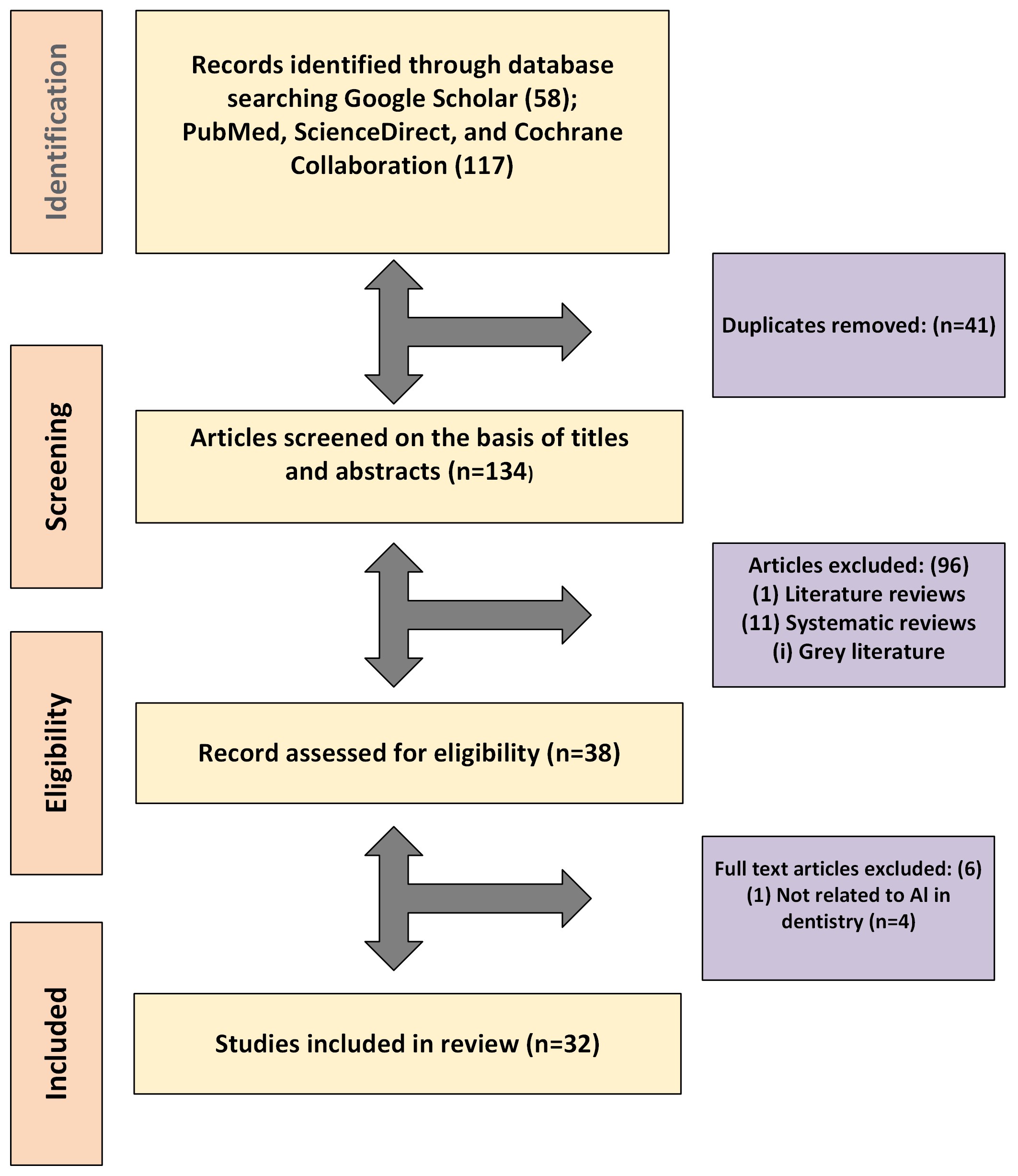
This systematic review and meta-analysis explores the integration of artificial intelligence (AI) technologies into forensic odontology from an intelligent systems perspective, with particular emphasis on enhancing identification accuracy, pattern recognition capabilities, and workflow efficiency. Traditional dental identification methods rely heavily on manual comparison of charts and radiographs, which are time-consuming and susceptible to human bias. Recent advancements in machine learning algorithms, deep learning-based image recognition networks, and intelligent decision-support systems have demonstrated significant potential in automating critical tasks such as bite-mark analysis, dental age estimation, and ante-mortem/post-mortem record reconciliation. Adhering to the PRISMA guidelines, a comprehensive literature search was conducted across PubMed, ScienceDirect, Google Scholar, and Cochrane Library. After removing duplicates and applying pre-established inclusion and exclusion criteria, selected studies were included for qualitative and quantitative synthesis. The analytical performance of these intelligent systems was primarily evaluated using the Kvaal and Cameriere frameworks. The synthesized findings reveal that AI-driven intelligent approaches consistently outperform conventional manual methods in terms of accuracy, speed, and consistency across diverse cohorts. These results underscore the value of intelligent systems as reliable decision-support tools in forensic odontology, paving the way for more robust, efficient, and objective forensic intelligence applications in legal and disaster victim identification contexts.
Graphical Abstract
Keywords
Data Availability Statement
Funding
Conflicts of Interest
Ethical Approval and Consent to Participate
References
- Sims, C. A., Berketa, J., & Higgins, D. (2020). Is human identification by dental comparison a scientifically valid process?. Science & Justice, 60(5), 403-405.
[CrossRef] [Google Scholar] - Kirchhoff, S., Fischer, F., Lindemaier, G., Herzog, P., Kirchhoff, C., Becker, C., ... & Eisenmenger, W. (2008). Is post-mortem CT of the dentition adequate for correct forensic identification?: comparison of dental computed tomograpy and visual dental record. International journal of legal medicine, 122, 471-479.
[CrossRef] [Google Scholar] - Galante, N., Cotroneo, R., Furci, D., Lodetti, G., & Casali, M. B. (2023). Applications of artificial intelligence in forensic sciences: Current potential benefits, limitations and perspectives. International journal of legal medicine, 137(2), 445-458.
[CrossRef] [Google Scholar] - Smitha, T. (2021). Artificial intelligence in forensic odontology. Journal of Forensic Dental Sciences, 13(1), 1-2.
[CrossRef] [Google Scholar] - Khanagar, S. B., Vishwanathaiah, S., Naik, S., Al-Kheraif, A. A., Divakar, D. D., Sarode, S. C., ... & Patil, S. (2021). Application and performance of artificial intelligence technology in forensic odontology–A systematic review. Legal Medicine, 48, 101826.
[CrossRef] [Google Scholar] - Thurzo, A., Kosnáčová, H. S., Kurilová, V., Kosmeľ, S., Beňuš, R., Moravanský, N., ... & Varga, I. (2021, November). Use of advanced artificial intelligence in forensic medicine, forensic anthropology and clinical anatomy. In Healthcare (Vol. 9, No. 11, p. 1545). MDPI.
[CrossRef] [Google Scholar] - Liang, Y., Han, W., Qiu, L., Wu, C., Shao, Y., Wang, K., & He, L. (2021). Exploring forensic dental identification with deep learning. Advances in Neural Information Processing Systems, 34, 3244-3258.
[Google Scholar] - Bui, R., Iozzino, R., Richert, R., Roy, P., Boussel, L., Tafrount, C., & Ducret, M. (2023). Artificial intelligence as a decision-making tool in forensic dentistry: a pilot study with I3M. International journal of environmental research and public health, 20(5), 4620.
[CrossRef] [Google Scholar] - Jaffino, G., Banumathi, A., Vijayakumari, B., & Prabin Jose, J. (2017). A new mathematical modelling based shape extraction technique for Forensic Odontology. Journal of forensic and legal medicine, 47, 39-45.
[CrossRef] [Google Scholar] - Ahmed, N., Abbasi, M. S., Zuberi, F., Qamar, W., Halim, M. S. B., Maqsood, A., & Alam, M. K. (2021). Artificial intelligence techniques: analysis, application, and outcome in dentistry—a systematic review. BioMed research international, 2021(1), 9751564.
[CrossRef] [Google Scholar] - Sathya, B., & Neelaveni, R. (2020). Transfer learning based automatic human identification using dental traits-an aid to forensic odontology. Journal of Forensic and Legal Medicine, 76, 102066.
[CrossRef] [Google Scholar] - Ahmed Alaa El-Din, E. (2022). Artificial intelligence in forensic science: Invasion or revolution?. Egyptian Society of Clinical Toxicology Journal, 10(2), 20-32.
[Google Scholar] - Heo, M. S., Kim, J. E., Hwang, J. J., Han, S. S., Kim, J. S., Yi, W. J., & Park, I. W. (2021). Artificial intelligence in oral and maxillofacial radiology: what is currently possible?. Dentomaxillofacial Radiology, 50(3), 20200375.
[CrossRef] [Google Scholar] - Kishimoto, T., Goto, T., Matsuda, T., Iwawaki, Y., & Ichikawa, T. (2022). Application of artificial intelligence in the dental field: A literature review. Journal of Prosthodontic Research, 66(1), 19-28.
[CrossRef] [Google Scholar] - Ahmed, O., Saleem, S. A., Khan, A. A., Daruwala, S., & Pettiwala, A. (2023). Artificial intelligence in forensic odontology – A review. International Dental Journal of Students' Research, 11(2).
[CrossRef] [Google Scholar] - Wright, F. D., & Golden, G. S. (2010). The use of full spectrum digital photography for evidence collection and preservation in cases involving forensic odontology. Forensic science international, 201(1-3), 59-67.
[CrossRef] [Google Scholar] - Vodanović, M., Subašić, M., Milošević, D., Galić, I., & Brkić, H. (2023). Artificial intelligence in forensic medicine and forensic dentistry. The journal of forensic odonto-stomatology, 41(2), 30-41.
[Google Scholar] - De Micco, F., Martino, F., Velandia Palacio, L. A., Cingolani, M., & Campobasso, C. P. (2021). Third molar maturity index and legal age in different ethnic populations: Accuracy of Cameriere’s method. Medicine, Science and the Law, 61(1\_suppl), 105-112.
[CrossRef] [Google Scholar] - Iruvuri, A. G., Miryala, G., Khan, Y., Ramalingam, N. T., Sevugaperumal, B., Soman, M., & Padmanabhan, A. (2023). Revolutionizing Dental Imaging: A Comprehensive Study on the Integration of Artificial Intelligence in Dental and Maxillofacial Radiology. Cureus, 15(12), e50292.
[CrossRef] [Google Scholar] - Enomoto, A., Lee, A. D., Sukedai, M., Shimoide, T., Katada, R., Sugimoto, K., & Matsumoto, H. (2023). Automatic identification of individuals using deep learning method on panoramic radiographs. Journal of Dental Sciences, 18(2), 696-701.
[CrossRef] [Google Scholar] - Verma, D., Puri, S., Prabhu, S., & Smriti, K. (2020, November). Anomaly detection in panoramic dental x-rays using a hybrid Deep Learning and Machine Learning approach. In 2020 IEEE region 10 conference (TENCON) (pp. 263-268). IEEE.
[CrossRef] [Google Scholar] - Baydoğan, M. P., Baybars, S. C., & Tuncer, S. A. (2022). Age detection by deep learning from dental panoramic radiographs. Artificial Intelligence Theory and Applications, 2(2), 51-58. https://izlik.org/JA27GD97JT
[Google Scholar] - Lee, Y. H., Won, J. H., Auh, Q. S., & Noh, Y. K. (2022). Age group prediction with panoramic radiomorphometric parameters using machine learning algorithms. Scientific reports, 12(1), 11703.
[CrossRef] [Google Scholar] - Yazdanian, M., Karami, S., Tahmasebi, E., Alam, M., Abbasi, K., Rahbar, M., ... & Yazdanian, A. (2022). Dental radiographic/digital radiography technology along with biological agents in human identification. Scanning, 2022(1), 5265912.
[CrossRef] [Google Scholar] - Lemoine, A. (2019). Odontology & Artificial Intelligence (Master's thesis). Faculdade de Ciências de Saúde, Universidade Fernando Pessoa, Porto, Portugal.
[Google Scholar] - Pauwels, R. (2021). A brief introduction to concepts and applications of artificial intelligence in dental imaging. Oral radiology, 37(1), 153-160.
[CrossRef] [Google Scholar] - Jaffino, G., & Prabin Jose, J. (2022). Contour-and Texture-based analysis for victim identification in forensic odontology. Data Technologies and Applications, 56(1), 146-160.
[CrossRef] [Google Scholar] - Alqutaibi, A. Y., Algabri, R. S., Elawady, D., & Ibrahim, W. I. (2023). Advancements in artificial intelligence algorithms for dental implant identification: A systematic review with meta-analysis. The Journal of prosthetic dentistry.
[CrossRef] [Google Scholar] - Shafi, I., Fatima, A., Afzal, H., Díez, I. D. L. T., Lipari, V., Breñosa, J., & Ashraf, I. (2023). A comprehensive review of recent advances in artificial intelligence for dentistry e-health. Diagnostics, 13(13), 2196.
[CrossRef] [Google Scholar] - Thurzo, A., Jančovičová, V., Hain, M., Thurzo, M., Novák, B., Kosnáčová, H., ... & Moravanský, N. (2022). Human remains identification using Micro-CT, Chemometric and AI methods in Forensic Experimental Reconstruction of Dental patterns after concentrated sulphuric acid significant impact. Molecules, 27(13), 4035.
[CrossRef] [Google Scholar] - Ataş, İ., Özdemir, C., Ataş, M., & Doğan, Y. (2023). Forensic dental age estimation using modified deep learning neural network. Balkan Journal of Electrical and Computer Engineering, 11(4), 298-305.
[CrossRef] [Google Scholar] - Chen, Y. F., & Tseng, P. K. C. (2023). The boundary of artificial intelligence in forensic science. Dialogo, 1, 83-90. https://www.ceeol.com/search/article-detail?id=1213450
[Google Scholar] - Patcas, R., Bornstein, M. M., Schätzle, M. A., & Timofte, R. (2022). Artificial intelligence in medico-dental diagnostics of the face: a narrative review of opportunities and challenges. Clinical oral investigations, 26(12), 6871-6879.
[CrossRef] [Google Scholar] - Mohammad, N., Ahmad, R., Kurniawan, A., & Mohd Yusof, M. Y. P. (2022). Applications of contemporary artificial intelligence technology in forensic odontology as primary forensic identifier: A scoping review. Frontiers in artificial intelligence, 5, 1049584.
[CrossRef] [Google Scholar] - Thurzo, A., Urbanová, W., Novák, B., Czako, L., Siebert, T., Stano, P., ... & Varga, I. (2022, July). Where is the artificial intelligence applied in dentistry? Systematic review and literature analysis. In Healthcare (Vol. 10, No. 7, p. 1269). MDPI.
[CrossRef] [Google Scholar] - Pinchi, V., Norelli, G. A., Caputi, F., Fassina, G., Pradella, F., & Vincenti, C. (2012). Dental identification by comparison of antemortem and postmortem dental radiographs: influence of operator qualifications and cognitive bias. Forensic science international, 222(1-3), 252-255.
[CrossRef] [Google Scholar]
Cited By (8)
-
Nasreen Hamarash Hamonari, Hannah Wesley. Exploring Senior Dental Students’ Readiness and Perceptions of Artificial Intelligence in Dentistry: Insights From a Cross‐Sectional Study.
International Journal of Dentistry, 2026 , 2026 (1).
[CrossRef] -
Xu Wang, Zhaoshui He, Hao Liang, Jing Guo, Zhijie Lin, Liqiang Zhang, Xingfang Pan. APCA-Net: Adaptive Patch-Correlation Attention Network for Vision-Based Human Hand Acupoint Detection in Acupuncture.
IEEE Transactions on Human-Machine Systems, 2026 , 56 (3).
[CrossRef] -
Alapati Naga Supriya, Vishnu Priya Veeraraghavan, Supraja S., Rama Laxmi Koruprolu, Ravikanth Manyam, Swetha P., Smita Shrishail Birajdar, Rameswarapu Mounika, Mohan Kumar P.. Age Estimation in Forensic Dentistry Using Artificial Intelligence: An Umbrella Review.
Journal of Advanced Oral Research, 2026 .
[CrossRef] -
Aya Mohammed Gaber, Al-Hassan Soliman Wadan, Nour Ammar, Varun Surya, Samah S. Mehanny, Mostafa Abuelhamed, Akhilanand Chaurasia. Artificial intelligence fosters forensic odontology-a narrative review.
Egyptian Journal of Forensic Sciences, 2026 , 16 (1).
[CrossRef] -
Esi Sharon, Ilana Engel, Tzipi Kahana, Nurit Beyth. Atlas-based radiographic classification of mandibular molar root morphology for forensic dental identification.
Forensic Science International, 2026 , 388 .
[CrossRef] -
Marwa Elchaghaby, Reem Wahby. Knowledge, attitudes, and perceptions of a group of Egyptian dental students toward artificial intelligence: a cross-sectional study.
BMC Oral Health, 2025 , 25 (1).
[CrossRef] -
Esra Nur Bal, Aylin Yalcin Saribey. .
2025 International Conference on Artificial Intelligence, Computer, Data Sciences and Applications (ACDSA), 2025 .
[CrossRef] -
Biswaroop Mohanty, Sri Lekha Dasari, Sasankoti Mohan Ravi Prakash, V.S. Deepasri, Karthik Kommuri, Harisha Dewan, Heena Dixit Tiwari. Comparison of Different Artificial Intelligence Tools in Regard to Forensic Dentistry: A Comparative Study.
Journal of Pharmacy and Bioallied Sciences, 2025 , 17 (Suppl 5).
[CrossRef]
Cite This Article
TY  - JOUR
AU  - Khan, Muhammad Salman
AU  - Afridi, Urooj
AU  - Ahmed, Muhammad Jamal
AU  - Zeb, Babar
AU  - Ullah, Irfan
AU  - Hassan, Muhammad Zain
PY  - 2024
DA  - 2024/11/09
TI  - Comprehensive Evaluation of Artificial Intelligence Applications in Forensic Odontology: A Systematic Review and Meta-Analysis
JO  - ICCK Transactions on Intelligent Systematics
T2  - ICCK Transactions on Intelligent Systematics
JF  - ICCK Transactions on Intelligent Systematics
VL  - 1
IS  - 3
SP  - 176
EP  - 189
DO  - 10.62762/TIS.2024.818917
UR  - https://www.icck.org/article/abs/TIS.2024.818917
KW  - artificial intelligence
KW  - forensic odontology
KW  - dental identification
KW  - pattern recognition
KW  - dental identification
AB  - This systematic review and meta-analysis explores the integration of artificial intelligence (AI) technologies into forensic odontology from an intelligent systems perspective, with particular emphasis on enhancing identification accuracy, pattern recognition capabilities, and workflow efficiency. Traditional dental identification methods rely heavily on manual comparison of charts and radiographs, which are time-consuming and susceptible to human bias. Recent advancements in machine learning algorithms, deep learning-based image recognition networks, and intelligent decision-support systems have demonstrated significant potential in automating critical tasks such as bite-mark analysis, dental age estimation, and ante-mortem/post-mortem record reconciliation. Adhering to the PRISMA guidelines, a comprehensive literature search was conducted across PubMed, ScienceDirect, Google Scholar, and Cochrane Library. After removing duplicates and applying pre-established inclusion and exclusion criteria, selected studies were included for qualitative and quantitative synthesis. The analytical performance of these intelligent systems was primarily evaluated using the Kvaal and Cameriere frameworks. The synthesized findings reveal that AI-driven intelligent approaches consistently outperform conventional manual methods in terms of accuracy, speed, and consistency across diverse cohorts. These results underscore the value of intelligent systems as reliable decision-support tools in forensic odontology, paving the way for more robust, efficient, and objective forensic intelligence applications in legal and disaster victim identification contexts.
SN  - 3068-5079
PB  - Institute of Central Computation and Knowledge
LA  - English
ER  -
@article{Khan2024Comprehens,
  author = {Muhammad Salman Khan and Urooj Afridi and Muhammad Jamal Ahmed and Babar Zeb and Irfan Ullah and Muhammad Zain Hassan},
  title = {Comprehensive Evaluation of Artificial Intelligence Applications in Forensic Odontology: A Systematic Review and Meta-Analysis},
  journal = {ICCK Transactions on Intelligent Systematics},
  year = {2024},
  volume = {1},
  number = {3},
  pages = {176-189},
  doi = {10.62762/TIS.2024.818917},
  url = {https://www.icck.org/article/abs/TIS.2024.818917},
  abstract = {This systematic review and meta-analysis explores the integration of artificial intelligence (AI) technologies into forensic odontology from an intelligent systems perspective, with particular emphasis on enhancing identification accuracy, pattern recognition capabilities, and workflow efficiency. Traditional dental identification methods rely heavily on manual comparison of charts and radiographs, which are time-consuming and susceptible to human bias. Recent advancements in machine learning algorithms, deep learning-based image recognition networks, and intelligent decision-support systems have demonstrated significant potential in automating critical tasks such as bite-mark analysis, dental age estimation, and ante-mortem/post-mortem record reconciliation. Adhering to the PRISMA guidelines, a comprehensive literature search was conducted across PubMed, ScienceDirect, Google Scholar, and Cochrane Library. After removing duplicates and applying pre-established inclusion and exclusion criteria, selected studies were included for qualitative and quantitative synthesis. The analytical performance of these intelligent systems was primarily evaluated using the Kvaal and Cameriere frameworks. The synthesized findings reveal that AI-driven intelligent approaches consistently outperform conventional manual methods in terms of accuracy, speed, and consistency across diverse cohorts. These results underscore the value of intelligent systems as reliable decision-support tools in forensic odontology, paving the way for more robust, efficient, and objective forensic intelligence applications in legal and disaster victim identification contexts.},
  keywords = {artificial intelligence, forensic odontology, dental identification, pattern recognition, dental identification},
  issn = {3068-5079},
  publisher = {Institute of Central Computation and Knowledge}
}
Publisher's Note
ICCK stays neutral with regard to jurisdictional claims in published maps and institutional affiliations.
Rights and Permissions


Portico