Event-Triggered CNN-LSTM with Prediction-Error Closed-Loop Feedback for Rainfall Forecasting


Article Information
Abstract
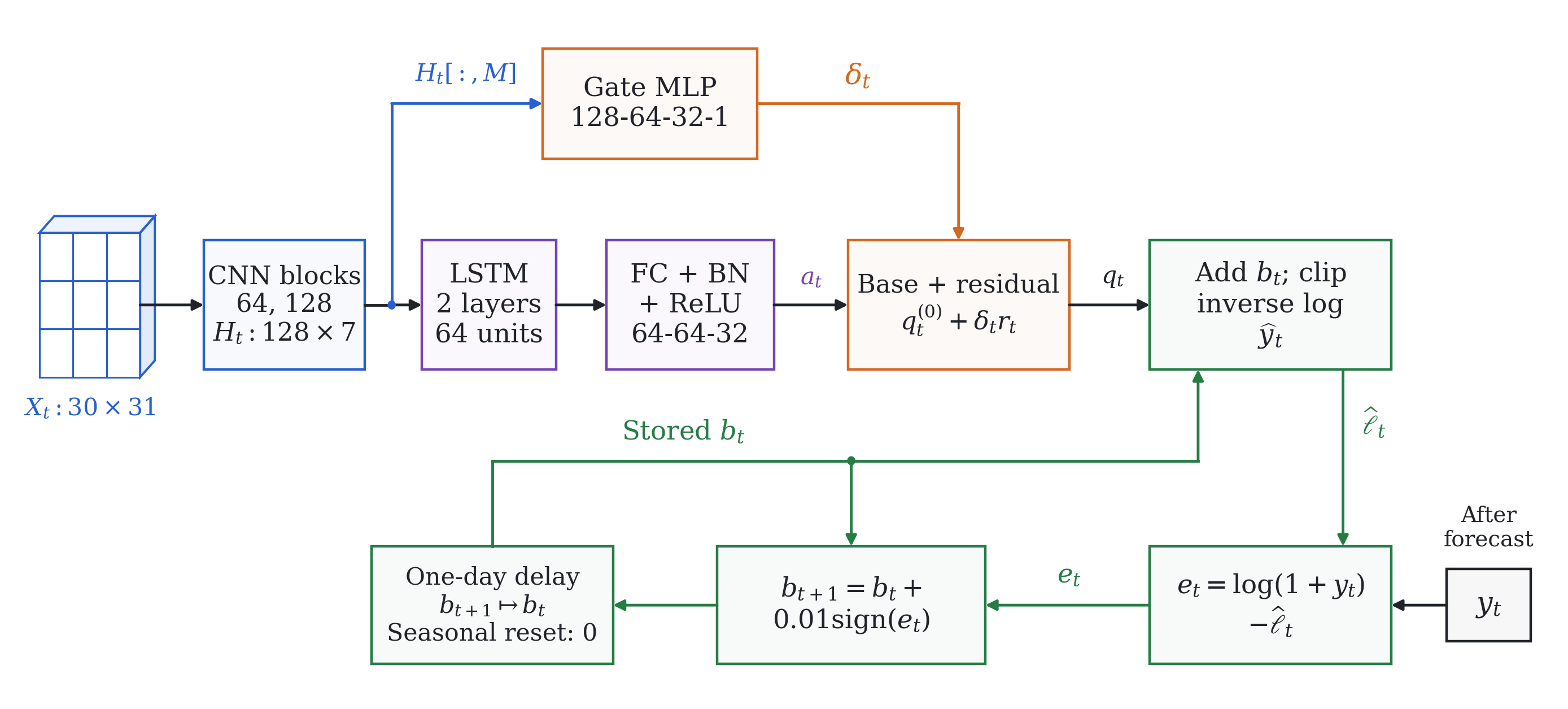
Intermittent daily rainfall requires temporal pattern extraction and correction of newly observed prediction errors. This paper presents an event-triggered convolutional neural network--long short-term memory model with prediction-error closed-loop feedback (ECF-CNN-LSTM) for seasonal one-day-ahead rainfall forecasting. A 30-day window supplies 31 causal rainfall-history and calendar features. A binary gate controls a zero-initialized, bounded residual and learns from the expected prediction errors of its inactive and active alternatives. A separate chronological controller uses each newly observed error to adjust subsequent forecasts. The single-series Tengzhou, Shandong dataset contains 976 unique June--September dates over 2013--2020. The proposed model and its ablations use 312 training targets from 2013--2016 and 156 validation targets from 2017--2018, with five random seeds. In the fixed-network feedback comparison, the complete model obtains mean absolute error (MAE) of 1.948576 mm and root mean squared error (RMSE) of 7.370497 mm, reducing the backbone errors by 1.15% and 2.43%, respectively. Feedback reduces MAE in all five paired runs for both predictor variants. The complete model's wet-day and dry/trace-day MAEs are 11.049914 and 0.043645 mm; the MAE standard deviation across seeds is 0.104537 mm. The results quantify complementary learned and sequential forecast corrections within the evaluated seasonal setting. The rainfall-intensity analysis covers 27 wet targets, including one above 50 mm.
Graphical Abstract
Keywords
Data Availability Statement
Funding
Conflicts of Interest
AI Use Statement
Ethical Approval and Consent to Participate
References
- Necesito, I. V., Kim, D., Bae, Y. H., Kim, K., Kim, S., & Kim, H. S. (2023). Deep learning-based univariate prediction of daily rainfall: application to a flood-prone, data-deficient country. Atmosphere, 14(4), 632.
[CrossRef] [Google Scholar] - Patro, B. S., & Bartakke, P. P. (2024). Daily rainfall prediction using long short-term memory (LSTM) algorithm. Journal of Agrometeorology, 26(4), 509-511.
[CrossRef] [Google Scholar] - Samson, T. K., & Aweda, F. O. (2025). Comparative study of single and hybrid deep learning models for daily rainfall prediction in selected African cities. Scientific Reports, 15(1), 42718.
[CrossRef] [Google Scholar] - Küllahcı, K., & Altunkaynak, A. (2024). Maximizing daily rainfall prediction accuracy with maximum overlap discrete wavelet transform-based machine learning models. International Journal of Climatology, 44(10), 3405-3426.
[CrossRef] [Google Scholar] - Wu, H., Du, P., & Heng, J. (2024). Gated convolution with attention mechanism under variational mode decomposition for daily rainfall forecasting. Measurement, 237, 115222.
[CrossRef] [Google Scholar] - Hochreiter, S., & Schmidhuber, J. (1997). Long short-term memory. Neural computation, 9(8), 1735-1780.
[CrossRef] [Google Scholar] - Gers, F. A., Schmidhuber, J., & Cummins, F. (2000). Learning to forget: Continual prediction with LSTM. Neural computation, 12(10), 2451-2471.
[CrossRef] [Google Scholar] - Seidu, J., Ampomah, E. K., Asante, E., & Frimpong, K. A. (2026). Forecasting daily rainfall in Coastal Ghana with machine learning: an evaluation analysis of gated residual learning framework. Frontiers in Climate, 8, 1845902.
[CrossRef] [Google Scholar] - Farman, H., Hussain, M. A., Shaikh, S., Hassan, S., & Hassan, S. R. (2026). Dual framework for rainfall prediction: A multi-seed machine and deep learning evaluation across Pakistan's climatic regimes. Scientific Reports, 16, 20031.
[CrossRef] [Google Scholar] - Rojas-Campos, A., Wittenbrink, M., Nieters, P., Schaffernicht, E. J., Keller, J. D., & Pipa, G. (2023). Postprocessing of NWP precipitation forecasts using deep learning. Weather and Forecasting, 38(3), 487-497.
[CrossRef] [Google Scholar] - Miri, S. M., Kavianpour, M. R., & Alizadeh, M. J. (2026). Delta feature and random forest-enhanced LSTM-attention forecasts with probabilistic postprocessing for rainfall forecasting. Scientific Reports, 16, 24208.
[CrossRef] [Google Scholar] - Khan, M. I., & Maity, R. (2020). Hybrid deep learning approach for multi-step-ahead daily rainfall prediction using GCM simulations. IEEE Access, 8, 52774-52784.
[CrossRef] [Google Scholar] - Lim, B., & Zohren, S. (2021). Time-series forecasting with deep learning: a survey. Philosophical Transactions of the Royal Society A, 379(2194), 20200209.
[CrossRef] [Google Scholar] - Aderyani, F. R., Mousavi, S. J., & Jafari, F. (2022). Short-term rainfall forecasting using machine learning-based approaches of PSO-SVR, LSTM and CNN. Journal of Hydrology, 614, 128463.
[CrossRef] [Google Scholar] - Waqas, M., Humphries, U. W., Hlaing, P. T., Wangwongchai, A., & Dechpichai, P. (2024). Advancements in daily precipitation forecasting: a deep dive into daily precipitation forecasting hybrid methods in the tropical climate of Thailand. MethodsX, 12, 102757.
[CrossRef] [Google Scholar] - Chen, Y., Huang, G., Wang, Y., Tao, W., Tian, Q., Yang, K., ... & He, H. (2023). Improving the heavy rainfall forecasting using a weighted deep learning model. Frontiers in Environmental Science, 11, 1116672.
[CrossRef] [Google Scholar] - Narejo, S., Jawaid, M. M., Talpur, S., Baloch, R., & Pasero, E. G. A. (2021). Multi-step rainfall forecasting using deep learning approach. PeerJ Computer Science, 7, e514. http://doi.org/10.7717/peerj-cs.514
[Google Scholar] - Wang, F., Tian, D., & Carroll, M. (2023). Customized deep learning for precipitation bias correction and downscaling. Geoscientific Model Development, 16(2), 535-556.
[CrossRef] [Google Scholar] - You, X. X., Liang, Z. M., Wang, Y. Q., & Zhang, H. (2023). A study on loss function against data imbalance in deep learning correction of precipitation forecasts. Atmospheric Research, 281, 106500.
[CrossRef] [Google Scholar] - Ioffe, S., & Szegedy, C. (2015). Batch normalization: Accelerating deep network training by reducing internal covariate shift. Proceedings of the 32nd International Conference on Machine Learning, PMLR 37, 448-456. https://proceedings.mlr.press/v37/ioffe15.html
[Google Scholar] - Srivastava, N., Hinton, G., Krizhevsky, A., Sutskever, I., & Salakhutdinov, R. (2014). Dropout: a simple way to prevent neural networks from overfitting. The journal of machine learning research, 15(1), 1929-1958. https://jmlr.org/papers/v15/srivastava14a.html
[Google Scholar] - Loshchilov, I., & Hutter, F. (2017). Decoupled weight decay regularization. arXiv preprint arXiv:1711.05101.
[CrossRef] [Google Scholar] - Pedregosa, F., Varoquaux, G., Gramfort, A., Michel, V., Thirion, B., Grisel, O., ... & Duchesnay, É. (2011). Scikit-learn: Machine learning in Python. Journal of machine Learning research, 12, 2825-2830. https://jmlr.org/papers/v12/pedregosa11a.html
[Google Scholar] - Hyndman, R. J., & Koehler, A. B. (2006). Another look at measures of forecast accuracy. International Journal of Forecasting, 22(4), 679-688.
[CrossRef] [Google Scholar] - Willmott, C. J., & Matsuura, K. (2005). Advantages of the mean absolute error (MAE) over the root mean square error (RMSE) in assessing average model performance. Climate Research, 30, 79-82.
[CrossRef] [Google Scholar]
Cite This Article
TY  - JOUR
AU  - Yin, Xiaoqi
AU  - Zhou, Jing
AU  - Liu, Ruping
AU  - Ma, Chenxi
AU  - Li, Chen
PY  - 2026
DA  - 2026/09/22
TI  - Event-Triggered CNN-LSTM with Prediction-Error Closed-Loop Feedback for Rainfall Forecasting
JO  - ICCK Transactions on Intelligent Systematics
T2  - ICCK Transactions on Intelligent Systematics
JF  - ICCK Transactions on Intelligent Systematics
VL  - 3
IS  - 3
SP  - 172
EP  - 185
DO  - 10.62762/TIS.2026.531561
UR  - https://www.icck.org/article/abs/TIS.2026.531561
KW  - rainfall forecasting
KW  - CNN-LSTM
KW  - event trigger
KW  - prediction-error feedback
KW  - closed-loop correction
AB  - Intermittent daily rainfall requires temporal pattern extraction and correction of newly observed prediction errors. This paper presents an event-triggered convolutional neural network--long short-term memory model with prediction-error closed-loop feedback (ECF-CNN-LSTM) for seasonal one-day-ahead rainfall forecasting. A 30-day window supplies 31 causal rainfall-history and calendar features. A binary gate controls a zero-initialized, bounded residual and learns from the expected prediction errors of its inactive and active alternatives. A separate chronological controller uses each newly observed error to adjust subsequent forecasts. The single-series Tengzhou, Shandong dataset contains 976 unique June--September dates over 2013--2020. The proposed model and its ablations use 312 training targets from 2013--2016 and 156 validation targets from 2017--2018, with five random seeds. In the fixed-network feedback comparison, the complete model obtains mean absolute error (MAE) of 1.948576 mm and root mean squared error (RMSE) of 7.370497 mm, reducing the backbone errors by 1.15% and 2.43%, respectively. Feedback reduces MAE in all five paired runs for both predictor variants. The complete model's wet-day and dry/trace-day MAEs are 11.049914 and 0.043645 mm; the MAE standard deviation across seeds is 0.104537 mm. The results quantify complementary learned and sequential forecast corrections within the evaluated seasonal setting. The rainfall-intensity analysis covers 27 wet targets, including one above 50 mm.
SN  - 3068-5079
PB  - Institute of Central Computation and Knowledge
LA  - English
ER  -
@article{Yin2026EventTrigg,
  author = {Xiaoqi Yin and Jing Zhou and Ruping Liu and Chenxi Ma and Chen Li},
  title = {Event-Triggered CNN-LSTM with Prediction-Error Closed-Loop Feedback for Rainfall Forecasting},
  journal = {ICCK Transactions on Intelligent Systematics},
  year = {2026},
  volume = {3},
  number = {3},
  pages = {172-185},
  doi = {10.62762/TIS.2026.531561},
  url = {https://www.icck.org/article/abs/TIS.2026.531561},
  abstract = {Intermittent daily rainfall requires temporal pattern extraction and correction of newly observed prediction errors. This paper presents an event-triggered convolutional neural network--long short-term memory model with prediction-error closed-loop feedback (ECF-CNN-LSTM) for seasonal one-day-ahead rainfall forecasting. A 30-day window supplies 31 causal rainfall-history and calendar features. A binary gate controls a zero-initialized, bounded residual and learns from the expected prediction errors of its inactive and active alternatives. A separate chronological controller uses each newly observed error to adjust subsequent forecasts. The single-series Tengzhou, Shandong dataset contains 976 unique June--September dates over 2013--2020. The proposed model and its ablations use 312 training targets from 2013--2016 and 156 validation targets from 2017--2018, with five random seeds. In the fixed-network feedback comparison, the complete model obtains mean absolute error (MAE) of 1.948576 mm and root mean squared error (RMSE) of 7.370497 mm, reducing the backbone errors by 1.15\% and 2.43\%, respectively. Feedback reduces MAE in all five paired runs for both predictor variants. The complete model's wet-day and dry/trace-day MAEs are 11.049914 and 0.043645 mm; the MAE standard deviation across seeds is 0.104537 mm. The results quantify complementary learned and sequential forecast corrections within the evaluated seasonal setting. The rainfall-intensity analysis covers 27 wet targets, including one above 50 mm.},
  keywords = {rainfall forecasting, CNN-LSTM, event trigger, prediction-error feedback, closed-loop correction},
  issn = {3068-5079},
  publisher = {Institute of Central Computation and Knowledge}
}
Article Metrics
Publisher's Note
ICCK stays neutral with regard to jurisdictional claims in published maps and institutional affiliations.
Rights and Permissions


Portico