Wind-Aware Angle-of-Arrival Consistency Validation for Spoofed Guidance Signal Rejection in Unmanned Aerial Vehicles



Article Information
Abstract
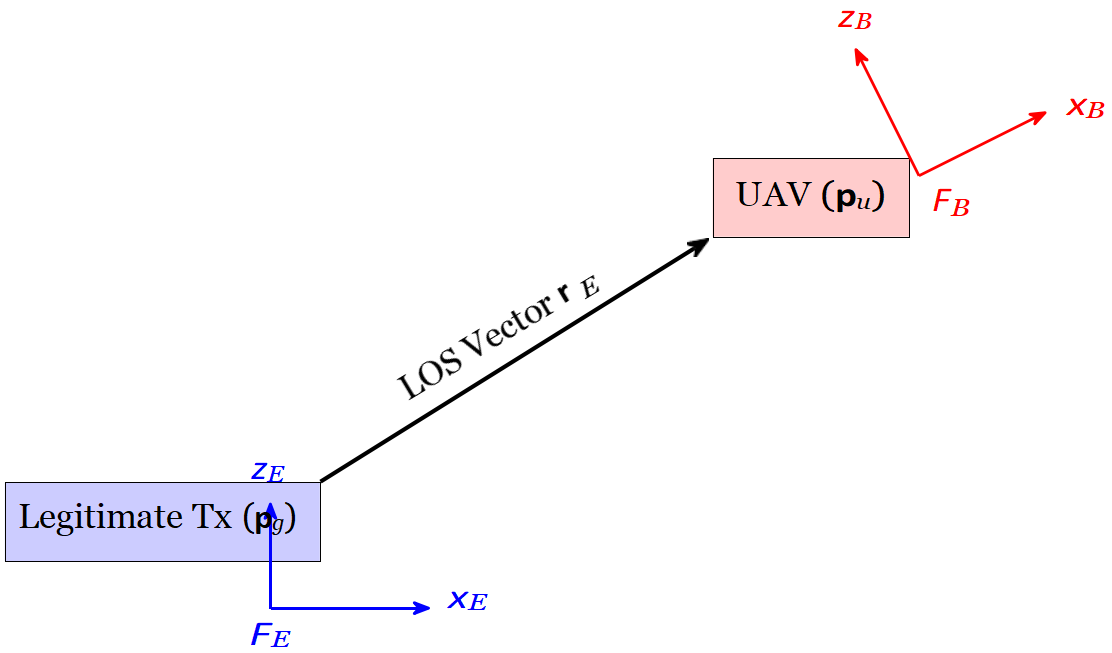
Unmanned Aerial Vehicles (UAVs) increasingly rely on wireless guidance and control links which are vulnerable to spoofing and false command injection attacks. Conventional protection mechanisms primarily rely on cryptographic authentication, which may not be sufficient under compromised or replay-based attack scenarios. This paper proposes a physics-informed, wind-aware angle-of-arrival (AoA) consistency validation framework for real-time rejection of spoofed guidance signals. The proposed method exploits geometric consistency between the expected line-of-sight (LOS) direction to a legitimate guidance transmitter and the measured signal bearing at the UAV. The expected bearing is computed from relative positioning and transformed into the UAV body frame using inertial attitude estimates. To mitigate false alarms caused by wind-induced attitude fluctuations, an adaptive stochastic consistency test is introduced, incorporating wind-dependent uncertainty modeling into a Mahalanobis-distance-based hypothesis test. Extensive simulations and trajectory-driven evaluations under varying wind intensities (0–10 m/s), transmitter distances, and adversarial angular offsets demonstrate robust spoofing detection performance. The proposed framework achieves a detection probability numerically evaluated as 1.0000 for angular deviations of 20$^\circ$, while maintaining a false rejection rate of 1.0% under 10 m/s strong gust conditions. The method operates in real time with negligible computational overhead, requiring less than 1 ms per validation cycle, as estimated for typical embedded hardware. The results indicate that wind-aware geometric bearing validation provides an effective secondary integrity layer for UAV guidance systems, enhancing resilience against spoofed control signals without requiring modifications to communication protocols.
Graphical Abstract
Keywords
Data Availability Statement
Funding
Conflicts of Interest
AI Use Statement
Ethical Approval and Consent to Participate
References
- Humphreys, T. (2012). Statement on the vulnerability of civil unmanned aerial vehicles and other systems to civil GPS spoofing. University of Texas at Austin (July 18, 2012), 1-16. \url{https://rnl.ae.utexas.edu/images/stories/files/papers/Testimony-Humphreys.pdf
[Google Scholar] - Tippenhauer, N. O., Pöpper, C., Rasmussen, K. B., & Capkun, S. (2011, October). On the requirements for successful GPS spoofing attacks. In Proceedings of the 18th ACM conference on Computer and communications security (pp. 75-86).
[CrossRef] [Google Scholar] - Psiaki, M. L., & Humphreys, T. E. (2016). GNSS spoofing and detection. Proceedings of the IEEE, 104(6), 1258-1270.
[CrossRef] [Google Scholar] - Chen, Z., Li, H., Wei, Y., Zhou, Z., & Lu, M. (2023). GNSS antispoofing method using the intersection angle between two directions of arrival (IA-DOA) for multiantenna receivers. GPS Solutions, 27(1), 11.
[CrossRef] [Google Scholar] - Xiao, L., Greenstein, L. J., Mandayam, N. B., & Trappe, W. (2008). A physical-layer technique to enhance authentication for mobile terminals. In 2008 IEEE International Conference on Communications (pp. 1520-1524). IEEE.
[CrossRef] [Google Scholar] - Srinivasan, M., Senigagliesi, L., Chen, H., Chorti, A., Baldi, M., & Wymeersch, H. (2024, September). AoA-based physical layer authentication in analog arrays under impersonation attacks. In 2024 IEEE 25th International Workshop on Signal Processing Advances in Wireless Communications (SPAWC) (pp. 496-500). IEEE.
[CrossRef] [Google Scholar] - Magiera, J., & Katulski, R. (2015). Detection and mitigation of GPS spoofing based on antenna array processing. Journal of applied research and technology, 13(1), 45-57.
[CrossRef] [Google Scholar] - Yang, Y., Liu, X., Liu, X., Guo, Y., & Zhang, W. (2022). Model-free integrated navigation of small fixed-wing UAVs full state estimation in wind disturbance. IEEE Sensors Journal, 22(3), 2771-2781.
[CrossRef] [Google Scholar] - Chen, Y., Trappe, W., & Martin, R. P. (2007, June). Detecting and localizing wireless spoofing attacks. In 2007 4th Annual IEEE Communications Society Conference on sensor, mesh and ad hoc communications and networks (pp. 193-202). IEEE.
[CrossRef] [Google Scholar] - Pham, T. M., Senigagliesi, L., Baldi, M., Schaefer, R. F., Fettweis, G. P., & Chorti, A. (2026). Leveraging angle of arrival estimation against impersonation attacks in physical layer authentication. IEEE Transactions on Information Forensics and Security, 21, 3226-3239.
[CrossRef] [Google Scholar] - Yılmaz, M. H., & Arslan, H. (2015, October). A survey: Spoofing attacks in physical layer security. In 2015 IEEE 40th local computer networks conference workshops (LCN workshops) (pp. 812-817). IEEE.
[CrossRef] [Google Scholar] - Huang, K. W., & Wang, H. M. (2018). Combating the control signal spoofing attack in UAV systems. IEEE transactions on vehicular technology, 67(8), 7769-7773.
[CrossRef] [Google Scholar] - Zhi, Y., Fu, Z., Sun, X., & Yu, J. (2020). Security and privacy issues of UAV: A survey. Mobile Networks and Applications, 25(1), 95-101.
[CrossRef] [Google Scholar] - Van Trees, H. L. (2002). Optimum array processing: Part IV of detection, estimation, and modulation theory. John Wiley & Sons.
[CrossRef] [Google Scholar] - Kay, S. M. (1998). Fundamentals of statistical signal processing: Detection theory. Prentice Hall. \url{https://www.dsprelated.com/books/140.php
[Google Scholar] - Zhou, Y., Yeoh, P. L., Kim, K. J., Ma, Z., Li, Y., & Vucetic, B. (2022). Game theoretic physical layer authentication for spoofing detection in UAV communications. IEEE Transactions on Vehicular Technology, 71(6), 6750-6755.
[CrossRef] [Google Scholar] - van der Merwe, J. R., Rügamer, A., & Lipka, M. (2023). Enhanced spatial spoofing detection with and without direction of arrival estimation. IEEE Transactions on Aerospace and Electronic Systems, 59(5), 5530-5540.
[CrossRef] [Google Scholar] - Alhoraibi, L., Alghazzawi, D., & Alhebshi, R. (2024). Detection of GPS spoofing attacks in UAVs based on adversarial machine learning model. Sensors, 24(18), 6156.
[CrossRef] [Google Scholar] - Li, J., Zhu, X., Ouyang, M., Li, W., Chen, Z., & Fu, Q. (2021). GNSS spoofing jamming detection based on generative adversarial network. IEEE Sensors Journal, 21(20), 22823-22832.
[CrossRef] [Google Scholar] - Zhong, L., Tang, T., Li, R., Xia, Z., & Tang, M. (2025). Enhancing the resilience of UAV networks against GPS spoofing attacks via byzantine distributed detection algorithm. Reliability Engineering & System Safety, 112101.
[CrossRef] [Google Scholar] - Zhang, P., Li, X., & Han, K. (2025, October). Lightweight GNSS Spoofing Detection via Joint AoA--IMU Fusion and Group Testing in UAV Swarms. In 2025 International Conference on Satellite Internet (SAT-NET) (pp. 73-78). IEEE.
[CrossRef] [Google Scholar] - Zhao, Y., Shen, F., Xu, G., & Wang, G. (2021). A spatial-temporal approach based on antenna array for GNSS anti-spoofing. Sensors, 21(3), 929.
[CrossRef] [Google Scholar] - Zhou, Y., Ma, Z., Liu, H., Yeoh, P. L., Li, Y., Vucetic, B., & Fan, P. (2023). A UAV-aided physical layer authentication based on channel characteristics and geographical locations. IEEE Transactions on Vehicular Technology, 73(1), 1053-1064.
[CrossRef] [Google Scholar] - Rothmaier, F., Chen, Y. H., Lo, S., & Walter, T. (2021). GNSS spoofing detection through spatial processing. Navigation, 68(2), 243-258.
[CrossRef] [Google Scholar] - Aladi, A., & Alsusa, E. (2023). Uav attack detection and mitigation using a localization verification-based autoencoder. IEEE Access, 11, 117752-117764.
[CrossRef] [Google Scholar] - De Maesschalck, R., Jouan-Rimbaud, D., & Massart, D. L. (2000). The Mahalanobis distance. Chemometrics and Intelligent Laboratory Systems, 50(1), 1-18.
[CrossRef] [Google Scholar]
Cite This Article
TY  - JOUR
AU  - Tsiakalos, Anastasios
AU  - Tsiakalos, Apostolos
PY  - 2026
DA  - 2026/09/23
TI  - Wind-Aware Angle-of-Arrival Consistency Validation for Spoofed Guidance Signal Rejection in Unmanned Aerial Vehicles
JO  - ICCK Transactions on Intelligent Systematics
T2  - ICCK Transactions on Intelligent Systematics
JF  - ICCK Transactions on Intelligent Systematics
VL  - 3
IS  - 3
SP  - 186
EP  - 195
DO  - 10.62762/TIS.2026.467986
UR  - https://www.icck.org/article/abs/TIS.2026.467986
KW  - Angle-of-Arrival
KW  - Unmanned Aerial Vehicle
KW  - spoofing detection
KW  - physical-layer security
AB  - Unmanned Aerial Vehicles (UAVs) increasingly rely on wireless guidance and control links which are vulnerable to spoofing and false command injection attacks. Conventional protection mechanisms primarily rely on cryptographic authentication, which may not be sufficient under compromised or replay-based attack scenarios. This paper proposes a physics-informed, wind-aware angle-of-arrival (AoA) consistency validation framework for real-time rejection of spoofed guidance signals. The proposed method exploits geometric consistency between the expected line-of-sight (LOS) direction to a legitimate guidance transmitter and the measured signal bearing at the UAV. The expected bearing is computed from relative positioning and transformed into the UAV body frame using inertial attitude estimates. To mitigate false alarms caused by wind-induced attitude fluctuations, an adaptive stochastic consistency test is introduced, incorporating wind-dependent uncertainty modeling into a Mahalanobis-distance-based hypothesis test. Extensive simulations and trajectory-driven evaluations under varying wind intensities (0–10 m/s), transmitter distances, and adversarial angular offsets demonstrate robust spoofing detection performance. The proposed framework achieves a detection probability numerically evaluated as 1.0000 for angular deviations of 20$^\circ$, while maintaining a false rejection rate of 1.0% under 10 m/s strong gust conditions. The method operates in real time with negligible computational overhead, requiring less than 1 ms per validation cycle, as estimated for typical embedded hardware. The results indicate that wind-aware geometric bearing validation provides an effective secondary integrity layer for UAV guidance systems, enhancing resilience against spoofed control signals without requiring modifications to communication protocols.
SN  - 3068-5079
PB  - Institute of Central Computation and Knowledge
LA  - English
ER  -
@article{Tsiakalos2026WindAware,
  author = {Anastasios Tsiakalos and Apostolos Tsiakalos},
  title = {Wind-Aware Angle-of-Arrival Consistency Validation for Spoofed Guidance Signal Rejection in Unmanned Aerial Vehicles},
  journal = {ICCK Transactions on Intelligent Systematics},
  year = {2026},
  volume = {3},
  number = {3},
  pages = {186-195},
  doi = {10.62762/TIS.2026.467986},
  url = {https://www.icck.org/article/abs/TIS.2026.467986},
  abstract = {Unmanned Aerial Vehicles (UAVs) increasingly rely on wireless guidance and control links which are vulnerable to spoofing and false command injection attacks. Conventional protection mechanisms primarily rely on cryptographic authentication, which may not be sufficient under compromised or replay-based attack scenarios. This paper proposes a physics-informed, wind-aware angle-of-arrival (AoA) consistency validation framework for real-time rejection of spoofed guidance signals. The proposed method exploits geometric consistency between the expected line-of-sight (LOS) direction to a legitimate guidance transmitter and the measured signal bearing at the UAV. The expected bearing is computed from relative positioning and transformed into the UAV body frame using inertial attitude estimates. To mitigate false alarms caused by wind-induced attitude fluctuations, an adaptive stochastic consistency test is introduced, incorporating wind-dependent uncertainty modeling into a Mahalanobis-distance-based hypothesis test. Extensive simulations and trajectory-driven evaluations under varying wind intensities (0–10 m/s), transmitter distances, and adversarial angular offsets demonstrate robust spoofing detection performance. The proposed framework achieves a detection probability numerically evaluated as 1.0000 for angular deviations of 20\$^\circ\$, while maintaining a false rejection rate of 1.0\% under 10 m/s strong gust conditions. The method operates in real time with negligible computational overhead, requiring less than 1 ms per validation cycle, as estimated for typical embedded hardware. The results indicate that wind-aware geometric bearing validation provides an effective secondary integrity layer for UAV guidance systems, enhancing resilience against spoofed control signals without requiring modifications to communication protocols.},
  keywords = {Angle-of-Arrival, Unmanned Aerial Vehicle, spoofing detection, physical-layer security},
  issn = {3068-5079},
  publisher = {Institute of Central Computation and Knowledge}
}
Article Metrics
Publisher's Note
ICCK stays neutral with regard to jurisdictional claims in published maps and institutional affiliations.
Rights and Permissions


Portico