Low-Light Fire and Smoke Detection in Electric Vehicles via a Lightweight Dual-Branch Architecture with Adaptive Reflectance Enhancement







Article Information
Abstract
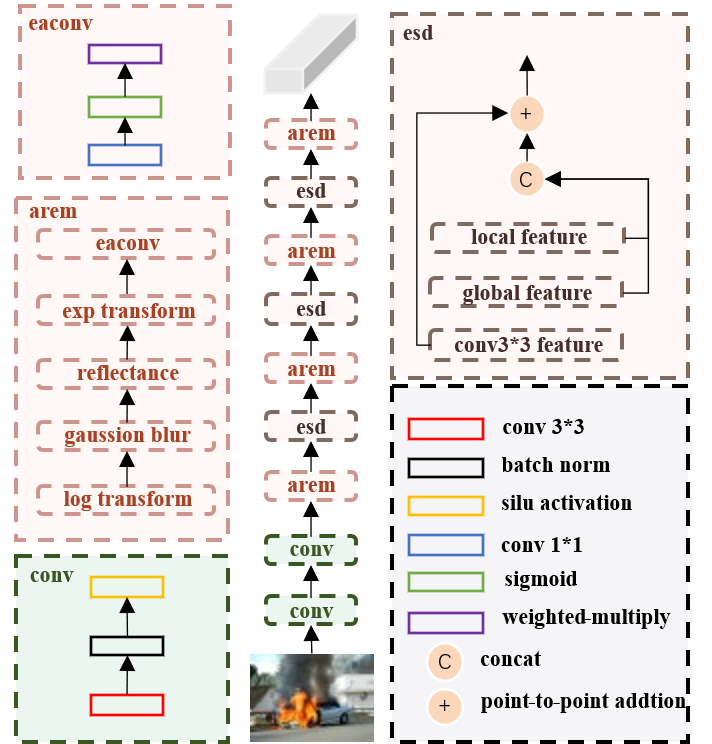
Fire and smoke detection in electric vehicle environments is essential for safety monitoring, yet existing methods often perform poorly under low-light conditions because of weak feature representation, flame overexposure, and limited nighttime data. In addition, many detection models cannot effectively balance accuracy and real-time efficiency, which restricts their deployment in practical applications. To address these issues, this study proposes a lightweight dual-branch detection framework for low-light fire and smoke recognition in electric vehicle environments. The proposed method integrates reflectance enhancement, adaptive feature weighting, and multi-scale feature learning within a unified architecture. Specifically, the auxiliary branch enhances weak fire-related features under low illumination through the Adaptive Reflectance Enhancement Module (AREM) and the Element-wise Adaptive Weight Convolution (EAConv), while the main branch employs a Self-Adaptive Feature Convolution (SAConv) module to strengthen multi-scale representation with limited computational overhead. Moreover, a self-constructed and publicly released dataset containing 3,512 images is introduced, including 1,910 daytime and 1,602 nighttime samples, to provide a more realistic benchmark for fire detection in electric vehicle environments under diverse lighting conditions. Experimental results show that the proposed method achieves 85.3% AP50 and 52.2% AP on the full dataset, and 52.9% AP50 and 26.5% AP on the nighttime subset. Compared with YOLOv11-n, the proposed model improves AP50 by 1.2% and AP by 1.7%, while demonstrating more stable performance in challenging low-light environments. These results indicate that the proposed framework provides a practical and reliable solution for real-time fire detection in electric vehicle environments.
Graphical Abstract
Keywords
Data Availability Statement
Funding
Conflicts of Interest
AI Use Statement
Ethical Approval and Consent to Participate
References
- Foggia, P., Saggese, A., & Vento, M. (2015). Real-time fire detection for video-surveillance applications using a combination of experts based on color, shape, and motion. IEEE TRANSACTIONS on circuits and systems for video technology, 25(9), 1545-1556.
[CrossRef] [Google Scholar] - Reis, H. C., & Turk, V. (2023). Detection of forest fire using deep convolutional neural networks with transfer learning approach. Applied Soft Computing, 143, 110362.
[CrossRef] [Google Scholar] - Jiang, M., Zhao, Y., Yu, F., Zhou, C., & Peng, T. (2022). A self-attention network for smoke detection. Fire safety journal, 129, 103547.
[CrossRef] [Google Scholar] - Zhao, L., Zhi, L., Zhao, C., & Zheng, W. (2022). Fire-YOLO: A small target object detection method for fire inspection. Sustainability, 14(9), 4930.
[CrossRef] [Google Scholar] - Li, Y., Zhang, W., Liu, Y., Jing, R., & Liu, C. (2022). An efficient fire and smoke detection algorithm based on an end-to-end structured network. Engineering Applications of Artificial Intelligence, 116, 105492.
[CrossRef] [Google Scholar] - Wang, G., Li, H., Xiao, Q., Yu, P., Ding, Z., Wang, Z., & Xie, S. (2025). Fighting against forest fire: A lightweight real-time detection approach for forest fire based on synthetic images. Expert Systems with Applications, 262, 125620.
[CrossRef] [Google Scholar] - Xue, Z., Lin, H., & Wang, F. (2022). A small target forest fire detection model based on YOLOv5 improvement. Forests, 13(8), 1332.
[CrossRef] [Google Scholar] - Gao, D., Zhang, S., Ju, Y., & Yang, Q. (2023). A real-time fire and flame detection method for electric vehicle charging station based on machine vision. Journal of Real-Time Image Processing, 20(2), 38.
[CrossRef] [Google Scholar] - Yar, H., Ullah, W., Khan, Z. A., & Baik, S. W. (2023). An effective attention-based CNN model for fire detection in adverse weather conditions. ISPRS Journal of Photogrammetry and Remote Sensing, 206, 335-346.
[CrossRef] [Google Scholar] - Huang, L., Liu, G., Wang, Y., Yuan, H., & Chen, T. (2022). Fire detection in video surveillances using convolutional neural networks and wavelet transform. Engineering Applications of Artificial Intelligence, 110, 104737.
[CrossRef] [Google Scholar] - Rehman, A., Kim, D., & Paul, A. (2023). Convolutional neural network model for fire detection in real-time environment. Computers, Materials and Continua, 77(2), 2289-2307.
[CrossRef] [Google Scholar] - Zhao, S., Liu, B., Chi, Z., Li, T., & Li, S. (2022). Characteristics based fire detection system under the effect of electric fields with improved Yolo-v4 and ViBe. IEEE Access, 10, 81899-81909.
[CrossRef] [Google Scholar] - Zhao, H., Jin, J., Liu, Y., Guo, Y., & Shen, Y. (2024). FSDF: A high-performance fire detection framework. Expert Systems with Applications, 238, 121665.
[CrossRef] [Google Scholar] - Xu, H., Li, B., & Zhong, F. (2022). Light-YOLOv5: A lightweight algorithm for improved YOLOv5 in complex fire scenarios. Applied Sciences, 12(23), 12312.
[CrossRef] [Google Scholar] - Jadon, A., Varshney, A., & Ansari, M. S. (2020). Low-complexity high-performance deep learning model for real-time low-cost embedded fire detection systems. Procedia Computer Science, 171, 418-426.
[CrossRef] [Google Scholar] - Chino, D. Y., Avalhais, L. P., Rodrigues, J. F., & Traina, A. J. (2015, August). Bowfire: detection of fire in still images by integrating pixel color and texture analysis. In 2015 28th SIBGRAPI conference on graphics, patterns and images (pp. 95-102). IEEE.
[CrossRef] [Google Scholar] - Gragnaniello, D., Greco, A., Sansone, C., & Vento, B. (2024). Fire and smoke detection from videos: A literature review under a novel taxonomy. Expert Systems with Applications, 255, 124783.
[CrossRef] [Google Scholar] - Huo, Y., Zhang, Q., Zhang, Y., Zhu, J., & Wang, J. (2022). 3DVSD: An end-to-end 3D convolutional object detection network for video smoke detection. Fire safety journal, 134, 103690.
[CrossRef] [Google Scholar] - Wang, S., Wu, M., Wei, X., Song, X., Wang, Q., Jiang, Y., ... & Lv, J. (2025). An advanced multi-source data fusion method utilizing deep learning techniques for fire detection. Engineering Applications of Artificial Intelligence, 142, 109902.
[CrossRef] [Google Scholar] - de Venancio, P. V. A., Lisboa, A. C., & Barbosa, A. V. (2022). An automatic fire detection system based on deep convolutional neural networks for low-power, resource-constrained devices. Neural Computing and Applications, 34(18), 15349-15368.
[CrossRef] [Google Scholar] - Ko, B., Cheong, K. H., & Nam, J. Y. (2010). Early fire detection algorithm based on irregular patterns of flames and hierarchical Bayesian Networks. Fire safety journal, 45(4), 262-270.
[CrossRef] [Google Scholar] - T5 Capstone. (2024). Fire Detection Dataset [DS/OL]. Roboflow Universe. Retrieved from https://universe.roboflow.com/t5-capstone/fire-detection-9aome
[Google Scholar] - Chaoxia, C., Shang, W., & Zhang, F. (2020). Information-guided flame detection based on faster R-CNN. IEEE Access, 8, 58923-58932.
[CrossRef] [Google Scholar] - Barmpoutis, P., Dimitropoulos, K., Kaza, K., & Grammalidis, N. (2019, May). Fire detection from images using faster R-CNN and multidimensional texture analysis. In ICASSP 2019-2019 IEEE International Conference on Acoustics, Speech and Signal Processing (ICASSP) (pp. 8301-8305). IEEE.
[CrossRef] [Google Scholar] - Pan, W., Wang, X., & Huan, W. (2024). EFA-YOLO: An efficient feature attention model for fire and flame detection. arXiv preprint arXiv:2409.12635.
[CrossRef] [Google Scholar] - Park, M., & Ko, B. C. (2020). Two-step real-time night-time fire detection in an urban environment using static ELASTIC-YOLOv3 and temporal fire-tube. Sensors, 20(8), 2202.
[CrossRef] [Google Scholar] - Zheng, H., Wang, G., Xiao, D., Liu, H., & Hu, X. (2024). FTA-DETR: An efficient and precise fire detection framework based on an end-to-end architecture applicable to embedded platforms. Expert Systems with Applications, 248, 123394.
[CrossRef] [Google Scholar] - Li, H. (2024, September). Rethinking features-fused-pyramid-neck for object detection. In European conference on computer vision (pp. 74-90). Cham: Springer Nature Switzerland.
[CrossRef] [Google Scholar] - Wei, C., Wang, W., Yang, W., & Liu, J. (2018). Deep Retinex decomposition for low-light enhancement. arXiv preprint arXiv:1808.04560.
[CrossRef] [Google Scholar] - Jocher, G., Chaurasia, A., Stoken, A., Borovec, J., Kwon, Y., Fang, J., ... & Thanh Minh, M. (2022). ultralytics/yolov5: v6. 1-tensorrt, tensorflow edge tpu and openvino export and inference. Zenodo.
[CrossRef] [Google Scholar] - Khanam, R., & Hussain, M. (2024). Yolov11: An overview of the key architectural enhancements. arXiv preprint arXiv:2410.17725.
[CrossRef] [Google Scholar] - Li, C., Li, L., Jiang, H., Weng, K., Geng, Y., Li, L., ... & Wei, X. (2022). YOLOv6: A single-stage object detection framework for industrial applications. arXiv preprint arXiv:2209.02976.
[CrossRef] [Google Scholar] - Wang, C. Y., Bochkovskiy, A., & Liao, H. Y. M. (2023, June). YOLOv7: Trainable bag-of-freebies sets new state-of-the-art for real-time object detectors. In 2023 IEEE/CVF conference on computer vision and pattern recognition (CVPR) (pp. 7464-7475). IEEE.
[CrossRef] [Google Scholar] - Varghese, R., & Sambath, M. (2024, April). Yolov8: A novel object detection algorithm with enhanced performance and robustness. In 2024 International conference on advances in data engineering and intelligent computing systems (ADICS) (pp. 1-6). IEEE.
[CrossRef] [Google Scholar] - Wang, A., Chen, H., Liu, L., Chen, K., Lin, Z., Han, J., & Ding, G. (2024). Yolov10: Real-time end-to-end object detection. Advances in neural information processing systems, 37, 107984-108011.
[CrossRef] [Google Scholar] - Wang, T., Wang, J., Wang, C., Lei, Y., Cao, R., & Wang, L. (2024). Improving YOLOX network for multi-scale fire detection. The Visual Computer, 40(9), 6493-6505.
[CrossRef] [Google Scholar] - Carion, N., Massa, F., Synnaert, G., Usunier, N., Kirillov, A., & Zagoruyko, S. (2020). End-to-end object detection with transformers. In European conference on computer vision (ECCV) (pp. 213-229). Springer, Cham.
[CrossRef] [Google Scholar] - Ren, S., He, K., Girshick, R., & Sun, J. (2016). Faster R-CNN: Towards real-time object detection with region proposal networks. IEEE transactions on pattern analysis and machine intelligence, 39(6), 1137-1149.
[CrossRef] [Google Scholar] - Liu, W., Anguelov, D., Erhan, D., Szegedy, C., Reed, S., Fu, C. Y., & Berg, A. C. (2016). SSD: Single shot multibox detector. In European conference on computer vision (ECCV) (pp. 21-37). Springer, Cham.
[CrossRef] [Google Scholar]
Cite This Article
TY  - JOUR
AU  - Tang, Xiu
AU  - Man, Yaxin
AU  - Wang, Xiaoyan
AU  - Ji, Rendong
AU  - Zhang, Xiaojun
AU  - Xu, Yunlong
PY  - 2026
DA  - 2026/09/01
TI  - Low-Light Fire and Smoke Detection in Electric Vehicles via a Lightweight Dual-Branch Architecture with Adaptive Reflectance Enhancement
JO  - ICCK Transactions on Intelligent Systematics
T2  - ICCK Transactions on Intelligent Systematics
JF  - ICCK Transactions on Intelligent Systematics
VL  - 3
IS  - 3
SP  - 145
EP  - 161
DO  - 10.62762/TIS.2026.406065
UR  - https://www.icck.org/article/abs/TIS.2026.406065
KW  - electric vehicle safety
KW  - electric vehicles
KW  - fire detection
KW  - low-light optimization
AB  - Fire and smoke detection in electric vehicle environments is essential for safety monitoring, yet existing methods often perform poorly under low-light conditions because of weak feature representation, flame overexposure, and limited nighttime data. In addition, many detection models cannot effectively balance accuracy and real-time efficiency, which restricts their deployment in practical applications. To address these issues, this study proposes a lightweight dual-branch detection framework for low-light fire and smoke recognition in electric vehicle environments. The proposed method integrates reflectance enhancement, adaptive feature weighting, and multi-scale feature learning within a unified architecture. Specifically, the auxiliary branch enhances weak fire-related features under low illumination through the Adaptive Reflectance Enhancement Module (AREM) and the Element-wise Adaptive Weight Convolution (EAConv), while the main branch employs a Self-Adaptive Feature Convolution (SAConv) module to strengthen multi-scale representation with limited computational overhead. Moreover, a self-constructed and publicly released dataset containing 3,512 images is introduced, including 1,910 daytime and 1,602 nighttime samples, to provide a more realistic benchmark for fire detection in electric vehicle environments under diverse lighting conditions. Experimental results show that the proposed method achieves 85.3% AP50 and 52.2% AP on the full dataset, and 52.9% AP50 and 26.5% AP on the nighttime subset. Compared with YOLOv11-n, the proposed model improves AP50 by 1.2% and AP by 1.7%, while demonstrating more stable performance in challenging low-light environments. These results indicate that the proposed framework provides a practical and reliable solution for real-time fire detection in electric vehicle environments.
SN  - 3068-5079
PB  - Institute of Central Computation and Knowledge
LA  - English
ER  -
@article{Tang2026LowLight,
  author = {Xiu Tang and Yaxin Man and Xiaoyan Wang and Rendong Ji and Xiaojun Zhang and Yunlong Xu},
  title = {Low-Light Fire and Smoke Detection in Electric Vehicles via a Lightweight Dual-Branch Architecture with Adaptive Reflectance Enhancement},
  journal = {ICCK Transactions on Intelligent Systematics},
  year = {2026},
  volume = {3},
  number = {3},
  pages = {145-161},
  doi = {10.62762/TIS.2026.406065},
  url = {https://www.icck.org/article/abs/TIS.2026.406065},
  abstract = {Fire and smoke detection in electric vehicle environments is essential for safety monitoring, yet existing methods often perform poorly under low-light conditions because of weak feature representation, flame overexposure, and limited nighttime data. In addition, many detection models cannot effectively balance accuracy and real-time efficiency, which restricts their deployment in practical applications. To address these issues, this study proposes a lightweight dual-branch detection framework for low-light fire and smoke recognition in electric vehicle environments. The proposed method integrates reflectance enhancement, adaptive feature weighting, and multi-scale feature learning within a unified architecture. Specifically, the auxiliary branch enhances weak fire-related features under low illumination through the Adaptive Reflectance Enhancement Module (AREM) and the Element-wise Adaptive Weight Convolution (EAConv), while the main branch employs a Self-Adaptive Feature Convolution (SAConv) module to strengthen multi-scale representation with limited computational overhead. Moreover, a self-constructed and publicly released dataset containing 3,512 images is introduced, including 1,910 daytime and 1,602 nighttime samples, to provide a more realistic benchmark for fire detection in electric vehicle environments under diverse lighting conditions. Experimental results show that the proposed method achieves 85.3\% AP50 and 52.2\% AP on the full dataset, and 52.9\% AP50 and 26.5\% AP on the nighttime subset. Compared with YOLOv11-n, the proposed model improves AP50 by 1.2\% and AP by 1.7\%, while demonstrating more stable performance in challenging low-light environments. These results indicate that the proposed framework provides a practical and reliable solution for real-time fire detection in electric vehicle environments.},
  keywords = {electric vehicle safety, electric vehicles, fire detection, low-light optimization},
  issn = {3068-5079},
  publisher = {Institute of Central Computation and Knowledge}
}
Article Metrics
Publisher's Note
ICCK stays neutral with regard to jurisdictional claims in published maps and institutional affiliations.
Rights and Permissions


Portico