DECIS: An LLM-Based Value Assessment Framework for Targets


Article Information
Abstract
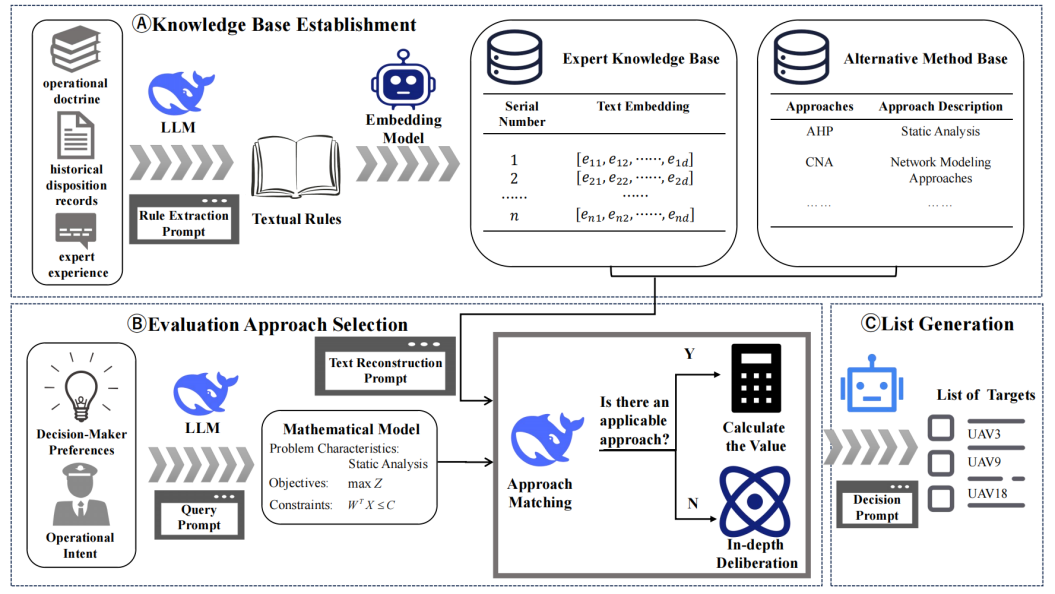
Target value assessment is a critical component of operational decision-making; however, existing methodologies suffer from the rigidity of static models in dynamic battlefield environments and the scarcity of specialized domain-specific data. To address these problems, we propose DECIS, a framework for adaptive decision support based on Retrieval-Augmented Generation (RAG). DECIS operates through a cohesive three-stage architecture centered on two core functions: first, RAG is employed to intelligently match optimal assessment strategies to dynamic contexts, thereby mitigating the challenge of limited military corpora; second, the Large Language Model (LLM) component autonomously generates and refines target lists, ensuring decision recommendations are characterized by high temporal validity and situational awareness. Experimental validation confirms that DECIS reduces the Largest Connected Component to 0.6, compared to 0.75 for PageRank and 0.8 for Betweenness Centrality, providing robust decision support and demonstrating competitive performance against established baselines in dynamic target value assessment.
Graphical Abstract
Keywords
Data Availability Statement
Funding
Conflicts of Interest
AI Use Statement
Ethical Approval and Consent to Participate
References
- Manolache, I. C. (2023). The role of multi-domain operations in modern warfare. Land Forces Academy Review, 28(3), 163-170.
[CrossRef] [Google Scholar] - Luo, R., Huang, S., Zhao, Y., & Song, Y. (2021). Threat assessment method of low altitude slow small (LSS) targets based on information entropy and AHP. Entropy, 23(10), 1292.
[CrossRef] [Google Scholar] - Qi, Z. F., & Wang, G. S. (2014). Grey synthetic relational analysis method-based effectiveness evaluation of ewcc system with incomplete information. Applied Mechanics and Materials, 638, 2409-2412.
[CrossRef] [Google Scholar] - Li, J., Wu, G., & Wang, L. (2024). A comprehensive survey of weapon target assignment problem: Model, algorithm, and application. Engineering Applications of Artificial Intelligence, 137, 109212.
[CrossRef] [Google Scholar] - Yin, Y., Zhang, R., & Su, Q. (2023). Threat assessment of aerial targets based on improved GRA-TOPSIS method and three-way decisions. Math. Biosci. Eng, 20(7), 13250-13266. http://doi.org/10.3934/mbe.2023591
[Google Scholar] - Lu, X., Ma, H., & Wang, Z. (2022). Analysis of OODA loop based on adversarial for complex game environments. arXiv preprint arXiv:2203.15502.
[CrossRef] [Google Scholar] - Wang, Y., Liang, J., & Wang, S. (2022). A New Approach for Target Capability Assessment and Selection in Complex Situations. Computational Intelligence and Neuroscience, 2022(1), 3146683.
[CrossRef] [Google Scholar] - Wu, W., Jie, W., Luo, A., Liu, X., & Luo, W. (2025). Data-fusion-based algorithm for assessing threat levels of low-altitude and slow-speed small targets. Sensors, 25(17), 5510.
[CrossRef] [Google Scholar] - Wei, J., Wang, X., Schuurmans, D., Bosma, M., Xia, F., Chi, E., ... & Zhou, D. (2022). Chain-of-thought prompting elicits reasoning in large language models. Advances in neural information processing systems, 35, 24824-24837.
[Google Scholar] - Yao, S., Yu, D., Zhao, J., Shafran, I., Griffiths, T., Cao, Y., & Narasimhan, K. (2023). Tree of thoughts: Deliberate problem solving with large language models. Advances in neural information processing systems, 36, 11809-11822.
[Google Scholar] - Besta, M., Blach, N., Kubicek, A., Gerstenberger, R., Podstawski, M., Gianinazzi, L., ... & Hoefler, T. (2024, March). Graph of thoughts: Solving elaborate problems with large language models. In Proceedings of the AAAI conference on artificial intelligence (Vol. 38, No. 16, pp. 17682-17690).
[CrossRef] [Google Scholar] - Lewis, P., Perez, E., Piktus, A., Petroni, F., Karpukhin, V., Goyal, N., ... & Kiela, D. (2020). Retrieval-augmented generation for knowledge-intensive nlp tasks. Advances in neural information processing systems, 33, 9459-9474.
[Google Scholar] - Gao, Y., Xiong, Y., Gao, X., Jia, K., Pan, J., Bi, Y., ... & Wang, H. (2023). Retrieval-augmented generation for large language models: A survey. arXiv preprint arXiv:2312.10997.
[CrossRef] [Google Scholar] - Shuster, K., Poff, S., Chen, M., Kiela, D., & Weston, J. (2021, November). Retrieval augmentation reduces hallucination in conversation. In Findings of the Association for Computational Linguistics: EMNLP 2021 (pp. 3784-3803).
[CrossRef] [Google Scholar] - Şakar, T., & Emekci, H. (2025). Maximizing RAG efficiency: A comparative analysis of RAG methods. Natural Language Processing, 31(1), 1-25.
[CrossRef] [Google Scholar] - Hao, J. X., Chen, L., & Meng, L. (2025). Advancing large language models with enhanced retrieval-augmented generation: Evidence from biological UAV swarm control. Drones, 9(5), 361.
[CrossRef] [Google Scholar] - Siriwardhana, S., Weerasekera, R., Wen, E., Kaluarachchi, T., Rana, R., & Nanayakkara, S. (2023). Improving the domain adaptation of retrieval augmented generation (RAG) models for open domain question answering. Transactions of the Association for Computational Linguistics, 11, 1-17.
[CrossRef] [Google Scholar] - Zhang, R., Du, H., Liu, Y., Niyato, D., Kang, J., Sun, S., ... & Poor, H. V. (2024). Interactive AI with retrieval-augmented generation for next generation networking. IEEE network, 38(6), 414-424.
[CrossRef] [Google Scholar] - Fan, W., Ding, Y., Ning, L., Wang, S., Li, H., Yin, D., ... & Li, Q. (2024, August). A survey on rag meeting llms: Towards retrieval-augmented large language models. In Proceedings of the 30th ACM SIGKDD conference on knowledge discovery and data mining (pp. 6491-6501).
[CrossRef] [Google Scholar] - Xiao, S., Liu, Z., Zhang, P., Muennighoff, N., Lian, D., & Nie, J. Y. (2024, July). C-pack: Packed resources for general chinese embeddings. In Proceedings of the 47th international ACM SIGIR conference on research and development in information retrieval (pp. 641-649).
[CrossRef] [Google Scholar] - DeepSeek-AI. (2025). DeepSeek-R1: Incentivizing reasoning capability in LLMs via reinforcement learning. arXiv preprint arXiv:2501.12948.
[CrossRef] [Google Scholar]
Cite This Article
TY  - JOUR
AU  - Zhuang, Zixuan
AU  - Cheng, Haoxiang
AU  - Fan, Changjun
AU  - Chen, Chao
PY  - 2026
DA  - 2026/09/21
TI  - DECIS: An LLM-Based Value Assessment Framework for Targets
JO  - ICCK Transactions on Intelligent Systematics
T2  - ICCK Transactions on Intelligent Systematics
JF  - ICCK Transactions on Intelligent Systematics
VL  - 3
IS  - 3
SP  - 162
EP  - 171
DO  - 10.62762/TIS.2026.310611
UR  - https://www.icck.org/article/abs/TIS.2026.310611
KW  - target value assessment
KW  - retrieval-augmented generation
KW  - large language models
AB  - Target value assessment is a critical component of operational decision-making; however, existing methodologies suffer from the rigidity of static models in dynamic battlefield environments and the scarcity of specialized domain-specific data. To address these problems, we propose DECIS, a framework for adaptive decision support based on Retrieval-Augmented Generation (RAG). DECIS operates through a cohesive three-stage architecture centered on two core functions: first, RAG is employed to intelligently match optimal assessment strategies to dynamic contexts, thereby mitigating the challenge of limited military corpora; second, the Large Language Model (LLM) component autonomously generates and refines target lists, ensuring decision recommendations are characterized by high temporal validity and situational awareness. Experimental validation confirms that DECIS reduces the Largest Connected Component to 0.6, compared to 0.75 for PageRank and 0.8 for Betweenness Centrality, providing robust decision support and demonstrating competitive performance against established baselines in dynamic target value assessment.
SN  - 3068-5079
PB  - Institute of Central Computation and Knowledge
LA  - English
ER  -
@article{Zhuang2026DECIS,
  author = {Zixuan Zhuang and Haoxiang Cheng and Changjun Fan and Chao Chen},
  title = {DECIS: An LLM-Based Value Assessment Framework for Targets},
  journal = {ICCK Transactions on Intelligent Systematics},
  year = {2026},
  volume = {3},
  number = {3},
  pages = {162-171},
  doi = {10.62762/TIS.2026.310611},
  url = {https://www.icck.org/article/abs/TIS.2026.310611},
  abstract = {Target value assessment is a critical component of operational decision-making; however, existing methodologies suffer from the rigidity of static models in dynamic battlefield environments and the scarcity of specialized domain-specific data. To address these problems, we propose DECIS, a framework for adaptive decision support based on Retrieval-Augmented Generation (RAG). DECIS operates through a cohesive three-stage architecture centered on two core functions: first, RAG is employed to intelligently match optimal assessment strategies to dynamic contexts, thereby mitigating the challenge of limited military corpora; second, the Large Language Model (LLM) component autonomously generates and refines target lists, ensuring decision recommendations are characterized by high temporal validity and situational awareness. Experimental validation confirms that DECIS reduces the Largest Connected Component to 0.6, compared to 0.75 for PageRank and 0.8 for Betweenness Centrality, providing robust decision support and demonstrating competitive performance against established baselines in dynamic target value assessment.},
  keywords = {target value assessment, retrieval-augmented generation, large language models},
  issn = {3068-5079},
  publisher = {Institute of Central Computation and Knowledge}
}
Article Metrics
Publisher's Note
ICCK stays neutral with regard to jurisdictional claims in published maps and institutional affiliations.
Rights and Permissions


Portico