Academic Profile

Dr. Shubhani Aggarwal is an Assistant Professor-III at UPES, Dehradun, with research expertise in Information Security, Blockchain, UAVs, and Cyber-Physical Systems. He completed his postdoctoral research at ÉTS, University of Quebec, Canada, and has published extensively in reputed journals and conferences.

Editorial Roles

No Editorial Roles

This user currently does not serve as an editor for any ICCK journals.

ICCK Publications

Total Publications: 4
Free Access | Research Article | 16 November 2025
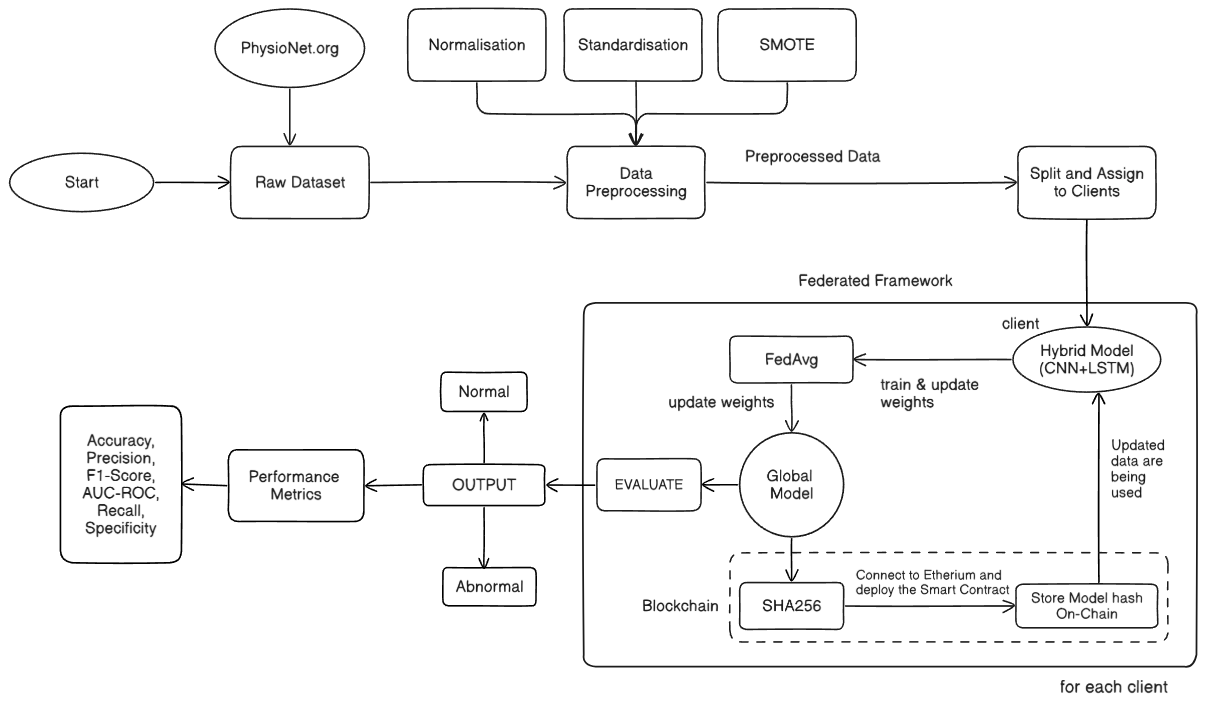
Secure and Decentralized Heart Sound Analysis using Federated Learning and Blockchain Technology
ICCK Transactions on Machine Intelligence | Volume 2, Issue 1: 1-11, 2025 | DOI: 10.62762/TMI.2025.567350
Abstract
Early diagnosis of cardiac abnormalities depends on accurate classification of heart sounds, but centralized training methods run the danger of violating patient privacy. We thus propose a privacy-preserving and reliable heart sound abnormality detection system combining Blockchain Technology with Federated Learning (FL). Training is spread among seven clients, each simulating an independent data source, using a preprocessed dataset from the PhysioNet Challenge 2016 to enable distributed learning without sharing raw data. CNN-LSTM model using FedAvg achieved the best performance: 94\% accuracy, 0.90 precision, 0.96 recall, and an AUC of 0.98 among five deep learning architectures evaluated w... More >

Graphical Abstract
Secure and Decentralized Heart Sound Analysis using Federated Learning and Blockchain Technology
Free Access | Review Article | 06 November 2025
Quantum Computing Essentials: Bridging Theory and Practice for New Learners
ICCK Transactions on Machine Intelligence | Volume 1, Issue 3: 117-126, 2025 | DOI: 10.62762/TMI.2025.173543
Abstract
This paper investigates the core principles of quantum computation, providing an in-depth understanding of quantum phenomena and illustrating how these principles form the scientific foundation of the field. The pivotal physical concepts, such as properties of subatomic particles, including electrons and photons, as well as their mathematical description through linear algebra are examined. It focuses on the qubit, the quantum analogue of a classical bit, featuring properties like superposition, entanglement, and wave function collapse, which redefine the traditional concept of information processing. The mathematical structures that underlie quantum system modelling—vector spaces, tensor... More >

Graphical Abstract
Quantum Computing Essentials: Bridging Theory and Practice for New Learners
Free Access | Research Article | 21 September 2025 | Cited: 1 , Scopus 1
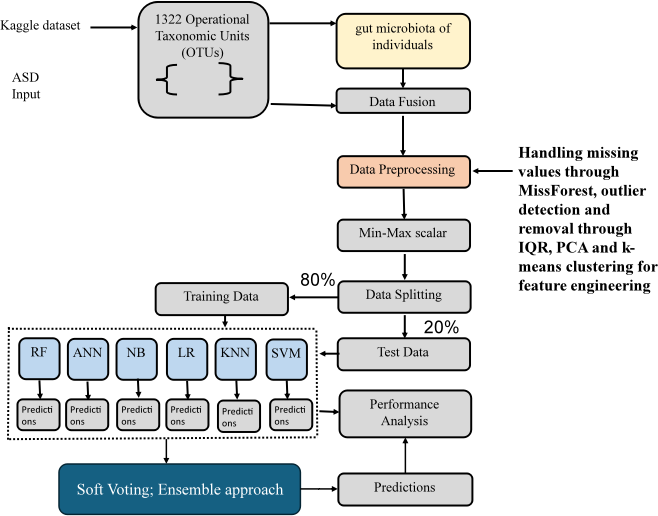
Integrating Artificial Intelligence and Machine Learning in Autism Detection via Gut Microbiome Analysis
ICCK Transactions on Machine Intelligence | Volume 1, Issue 2: 90-102, 2025 | DOI: 10.62762/TMI.2025.682666
Abstract
The Autism Spectrum Disorder (ASD) diagnosis and detection in its initial stages is a more complex issue in the face of the wide-ranging, diverse nature and causes. Subsequent literature inclined towards a possible correlation of gut microbiome with ASD, and its disclosure presents a more promising attribute for imminent discovery conduits. The dataset on gut microbiome associated with ASD focuses specifically on the microbial compositions obtained through 16S rRNA sequencing. This study presents a novel method that integrates Artificial Intelligence employing various Machine Learning (ML) robust classifiers such that Support Vector Machines (SVM), Random Forest, k-Nearest Neighbors (KNN), L... More >

Graphical Abstract
Integrating Artificial Intelligence and Machine Learning in Autism Detection via Gut Microbiome Analysis
Free Access | Research Article | 12 September 2025 | Cited: 1 , Scopus 1
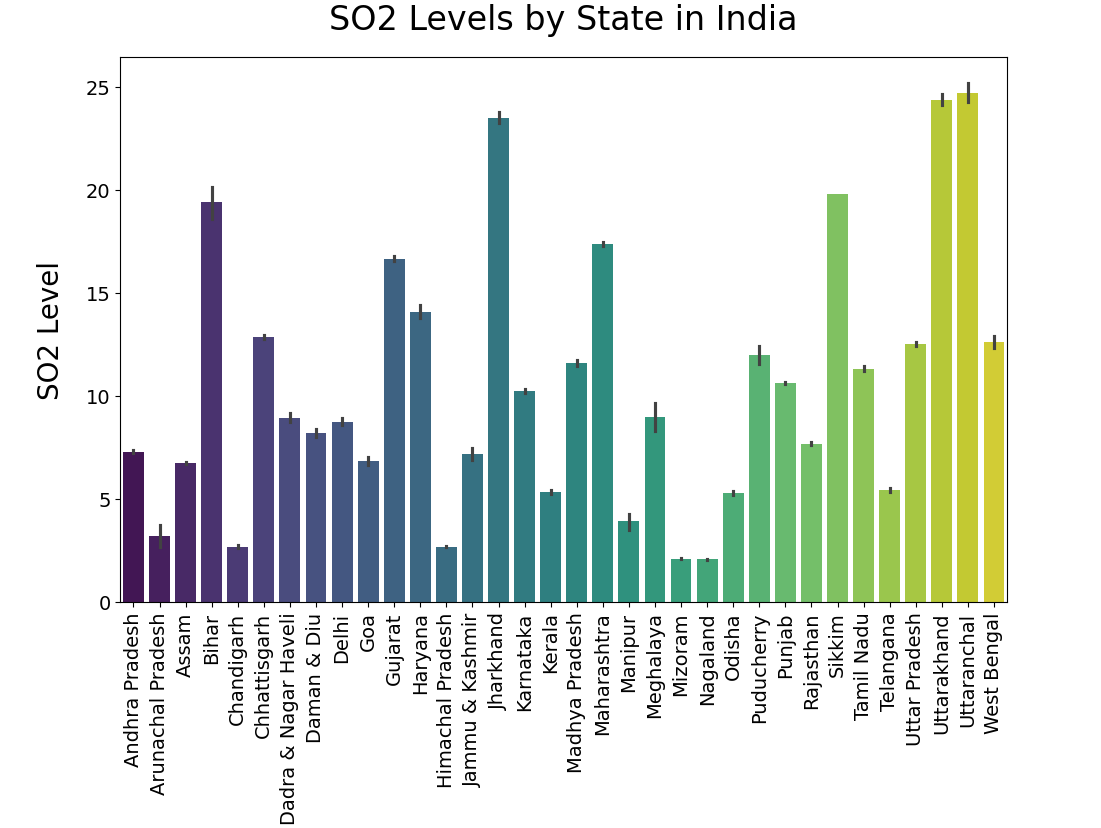
Neuro-Inspired Alert System for Air Quality Prediction Using Ensemble Preprocessing and SNN Classification
ICCK Transactions on Machine Intelligence | Volume 1, Issue 2: 69-79, 2025 | DOI: 10.62762/TMI.2025.403059
Abstract
Air pollution has emerged as a critical challenge, directly affecting human health, urban sustainability, and climate systems. Traditional air-quality index (AQI) prediction models often struggle to provide timely alerts because they are not very sensitive to changes over time and are hard to understand. This paper proposes a Neuro-Inspired Alert System for Air Quality Prediction (NAS--AQP) that incorporates an ensemble learning approach using voting regression to enhance input quality, followed by classification through a Spiking Neural Network (SNN). The system is designed such that it captures the temporal and nonlinear relationships between air pollutants such as Nitrogen Dioxide ($NO_2$... More >

Graphical Abstract
Neuro-Inspired Alert System for Air Quality Prediction Using Ensemble Preprocessing and SNN Classification